

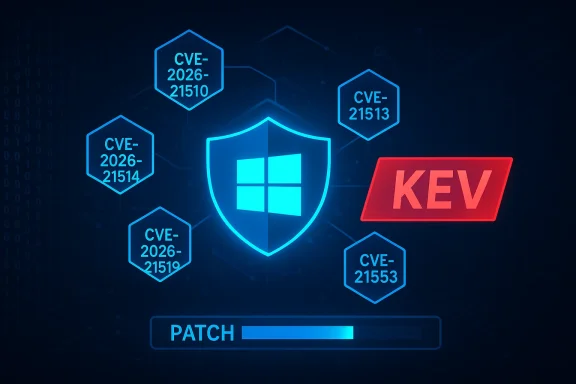
CISA’s catalog has just expanded again, and this time the additions hit the Windows stack: six Microsoft vulnerabilities — spanning Windows Shell, MSHTML, Office Word, Desktop Window Manager, Remote Access Connection Manager, and Remote Desktop Services — were added to the Known Exploited Vulnerabilities (KEV) list after evidence of active exploitation was observed. The additions coincide with Microsoft’s February security roll-up and underline a continuing trend: adversaries are targeting core Windows components and Office surfaces to gain footholds, escalate privileges, and move laterally inside networks. Independent reporting and vendor advisories confirm the scope and urgency of the action, offering a clear signal to federal agencies, critical infrastructure operators, and enterprise defenders to treat these flaws as emergency priorities.
CISA’s Known Exploited Vulnerabilities Catalog (KEV) exists to translate evidence of real-world exploitation into operational mandate under Binding Operational Directive (BOD) 22‑01. When CISA places a CVE on the KEV list, Federal Civilian Executive Branch (FCEB) agencies must remediate by the due dates specified in the entry or implement compensating controls and report accordingly. The KEV process intentionally prioritizes evidence-backed risks — that is, vulnerabilities that are already being used in attacks — which is why additions prompt a sprint in many security teams’ patch and detection workflows.
This February addition covers six Microsoft-tracked CVEs: CVE‑2026‑21510, CVE‑2026‑21513, CVE‑2026‑21514, CVE‑2026‑21519, CVE‑2026‑21525, and CVE‑2026‑21533. Vendor and security-industry advisories published alongside Microsoft’s February update list these as among the actively exploited zero‑days addressed this month, making them immediate priorities for patching and hunting.
Why this matters now: the KEV designation converts a vulnerability from “important” to “mission-critical.” For federal systems the directive creates enforceable timelines; for commercial organizations the operational signal is identical — treat KEV entries as emergency triage items and assume adversaries will widen exploitation rapidly once proof-of-concept tooling appears.
Practical, resilient defense requires a two-track approach: patch rapidly and harden the attack surface while simultaneously improving detection and containment capabilities. Organizations that can map their exposures, apply patches in a controlled yet accelerated fashion, and hunt for early signs of compromise will materially reduce risk and shorten attacker dwell time. This KEV addition is the kind of operational priority that separates disciplined security programs from reactive ones — treat it accordingly.
Conclusion: act now — patch, isolate, detect, and verify — because KEV additions mean attackers are already testing these weaknesses in the wild, and the clock to prevent serious incidents is short.
Source: CISA CISA Adds Six Known Exploited Vulnerabilities to Catalog | CISA
 Background / Overview
CISA’s Known Exploited Vulnerabilities Catalog (KEV) exists to translate evidence of real-world exploitation into operational mandate under Binding Operational Directive (BOD) 22‑01. When CISA places a CVE on the KEV list, Federal Civilian Executive Branch (FCEB) agencies must remediate by the due dates specified in the entry or implement compensating controls and report accordingly. The KEV process intentionally prioritizes evidence-backed risks — that is, vulnerabilities that are already being used in attacks — which is why additions prompt a sprint in many security teams’ patch and detection workflows.This February addition covers six Microsoft-tracked CVEs: CVE‑2026‑21510, CVE‑2026‑21513, CVE‑2026‑21514, CVE‑2026‑21519, CVE‑2026‑21525, and CVE‑2026‑21533. Vendor and security-industry advisories published alongside Microsoft’s February update list these as among the actively exploited zero‑days addressed this month, making them immediate priorities for patching and hunting.
Why this matters now: the KEV designation converts a vulnerability from “important” to “mission-critical.” For federal systems the directive creates enforceable timelines; for commercial organizations the operational signal is identical — treat KEV entries as emergency triage items and assume adversaries will widen exploitation rapidly once proof-of-concept tooling appears.
The Six CVEs — Quick Technical Summaries
Below are concise, practical descriptions of each CVE added to KEV. The intent is to summarize the class of flaw, typical attacker impact, and immediate detection/mitigation priorities. Where public vendor detail is limited, the descriptions rely on Microsoft’s patch summaries and independent vendor advisories that tracked the February updates.CVE‑2026‑21510 — Microsoft Windows Shell: Protection Mechanism Failure
- What it is: A failure in a Windows Shell protection mechanism that can allow bypass of designed platform mitigations. These failures often let crafted content or application interactions circumvent exploit mitigations intended to reduce privilege escalation or code-path exploitation.
- Impact: Depending on exploitability, an attacker could leverage this to run code with higher privileges or bypass sandboxing, increasing the risk of persistence and lateral movement.
- Immediate priorities: Patch Windows Shell components, audit Group Policy and local mitigations (AppLocker, SmartScreen, controlled folder access), and hunt for unusual child processes spawned from shell components.
CVE‑2026‑21513 — Microsoft MSHTML Framework: Security Feature Bypass
- What it is: A security feature bypass in MSHTML (the Internet Explorer/legacy HTML rendering engine used across Windows and some Office surfaces). These flaws let specially crafted web content or files evade security checks.
- Impact: Often used as a delivery or initial access vector (malicious HTML content embedded into documents or web pages that then reach legacy rendering code paths).
- Immediate priorities: Ensure Edge/Chromium components are current, limit host exposure to legacy MSHTML rendering when possible, and block suspicious document types at email gateways.
CVE‑2026‑21514 — Microsoft Office Word: Reliance on Untrusted Inputs in a Security Decision
- What it is: A logic/security decision flaw where Office Word made a security determination based on untrusted input. This class of vulnerability is frequently exploited using crafted documents to bypass protections or cause unintended code/logic flow.
- Impact: Targeted Word documents can be weaponized to bypass mitigations and execute subsequent stages, potentially leading to code execution or privilege escalation when combined with other flaws.
- Immediate priorities: Apply Office updates, disable or restrict macro execution and external content by policy, and use mail gateway sanitization for Office attachments.
CVE‑2026‑21519 — Microsoft Windows: Type Confusion
- What it is: A type confusion vulnerability within a Windows graphical or display subsystem (reports reference Desktop Window Manager/related components), where the code misinterprets the type of an object leading to memory corruption.
- Impact: Memory corruption vulnerabilities like type confusion can be escalated to arbitrary code execution or privilege escalation, especially in kernels or desktop composition components.
- Immediate priorities: Patch immediately, monitor for anomalous crashes in dwm.exe and related services, and use host-based EDR to detect post-exploitation behaviors (token manipulation, privilege escalations).
CVE‑2026‑21525 — Microsoft Windows: NULL Pointer Dereference (Remote Access Connection Manager)
- What it is: A NULL pointer dereference in Windows Remote Access Connection Manager or related networking component can cause denial-of-service (service crash) and in some chaining scenarios be used for privilege escalation or information leakage.
- Impact: At minimum a DoS affecting remote access capabilities; potentially exploitable in chaining attacks to destabilize services and facilitate other behaviors.
- Immediate priorities: Patch, reduce public exposure of Remote Access services, and review network segmentation to prevent external actors from easily reaching exposed targets.
CVE‑2026‑21533 — Windows Remote Desktop Services: Elevation of Privilege
- What it is: An elevation-of-privilege vulnerability in Remote Desktop Services (RDS) that allows an authenticated or in‑some-cases unauthenticated attacker to escalate privileges on a host.
- Impact: Because RDS is commonly exposed for remote management, successful exploitation can lead directly to administrative control or lateral movement into sensitive systems.
- Immediate priorities: Patch RDS, enforce multi-factor authentication, restrict RDS exposure with network-level access controls (VPNs, jump hosts), and hunt for signs of anomalous interactive logins or new admin accounts.
Why These Additions Fit a Pattern — Threat Context and Trends
- Windows and Office remain top targets. Attackers continue to favor high-value primitives — document-based initial access, browser/renderer flaws, and remote administration services — because they provide the shortest path to privileged access in enterprise environments. Microsoft-facing zero-days are therefore high-value to both criminal and nation-state operators.
- KEV entries often follow observed exploitation, not just theoretical impact. That operational evidence distinguishes KEV from broader vulnerability feeds: it means defenders must assume the bugs are being weaponized and that exploit code or observed compromises likely exist. The KEV designation therefore shortens acceptable patch windows for organizations that mirror federal priorities.
- Chaining is the practical risk. Many modern attacks chain a delivery vulnerability (MSHTML, Office document parsing) with a local privilege escalation or type-confusion bug to convert a remote foothold into full system control. The February additions include both delivery-surface and elevation primitives, creating powerful chaining opportunities for attackers.
What Federal Agencies (and Enterprises) Must Do Now — A Practical Playbook
CISA’s KEV designation means federal agencies must remediate within mandated deadlines, but the operational playbook below applies to any organization that wants to reduce exposure quickly and reliably.Immediate triage (first 24–72 hours)
- Inventory: Map which assets in your environment are affected (Windows versions, Office builds, RDS exposure). Use CMDBs, vulnerability scanners, and network scans.
- Prioritize: Place KEV-listed CVEs at the top of your patch queue. If you can’t patch immediately, implement compensating controls (isolation, access restriction).
- Test and deploy patches: Validate vendor updates in a staging environment and push with an accelerated rollout plan to production groups.
- Control exposure: Block RDP/RDS and Remote Access services at the perimeter unless absolutely necessary; require jump hosts or VPNs for remote access.
- Hardening: Enforce macro restrictions, disable legacy rendering engines where feasible, and tighten Group Policy for Office/Edge/MSHTML behaviors.
Detection and hunting guidance
- Hunt for suspicious document behavior: monitor Office processes spawning child processes, unusual file writes following document openings, and unexplained network connections from Office apps.
- Monitor for exploitation artifacts: anomalous service crashes in dwm.exe or remote access services, unexpected reboots, and new administrative user creation.
- EDR rules: create behavioral detections for process injection, token theft, credential dumping, and suspicious usage of Remote Desktop Protocol.
- Network telemetry: identify connections to known malicious infrastructure and unusual RDP session patterns (odd geolocation, time-of-day).
Compensating controls when patches are delayed
- Network segmentation: isolate high-risk hosts (management servers, RDS hosts) behind jump boxes and strict ACLs.
- Application allow‑listing and attack surface reduction: where feasible, implement allow‑listing and remove unneeded legacy components (e.g., MSHTML/IE components from application stacks).
- Enhanced monitoring: increase logging and retention for authentication and process events on high-value hosts.
- Temporary mitigations: disable features (macros, external content) that provide attack surfaces until patches are applied.
Detection Playbook — Example IOC and Hunt Queries
Below are actionable patterns defenders can adapt for Splunk/Elastic/EDR searches. Tailor to your telemetry schema.- Office document spawn detection:
- Query: look for Win32 process create events where ParentImage endswith "winword.exe" or "excel.exe" and ChildImage is not normally launched (e.g., cmd.exe, powershell.exe).
- RDS suspicious sessions:
- Query: find RDP sessions from unusual source IPs or with failed authentication followed by successful authentication within a short window.
- Desktop compositor crashes:
- Query: Windows application crash events referencing dwm.exe or desktop composition components correlated with new service creation or privilege escalations.
- Network telemetry:
- Query: identify endpoints that initiated outbound connections to domains/IPs not seen historically or flagged by threat feeds in the 24–72 hour window after public disclosure.
Risk Assessment — What’s Different This Time?
- Concentration of Windows core bugs: The six CVEs cover both delivery (MSHTML, Word) and escalation (type confusion, elevation-of-privilege) primitives, which makes them more likely to be effective when chained. That concentration elevates the systemic risk because patching one class (e.g., Office) without addressing elevation primitives leaves a residual pathway for attackers.
- Broad install base and legacy components: MSHTML and Office document surfaces are ubiquitous and frequently allowed through mail and web gateways, so attackers retain a low-friction vector to numerous targets. Legacy components or un-updated Office instances in user populations or vendor-managed endpoints significantly increase attack success probability.
- Operational friction: Many organizations cannot redeploy patches instantly without risk of disruption; that gap is where compensating controls and rapid, high-fidelity detection matter most. KEV additions deliberately shorten timelines and increase friction because they reflect already used exploits.
Vendor Patch Notes and Verification (practical advice)
- Always verify patch applicability against your exact OS and product versions. Microsoft’s monthly rollup can include variant KB numbers per Windows/Office SKU; map each KB to your device builds before mass deployment. Independent vendor advisories (network security vendors, IPS/AV vendors) often publish signatures and policy updates timed to Microsoft’s release.
- Test before mass rollout: Use a staged rollout and monitoring to detect regressions prior to enterprise-wide deployment; keep rollback plans and maintain communication with change control. This is especially important for service-critical hosts (domain controllers, RDS farms).
- Confirm fixes removed vulnerable behavior: After patching, validate by checking for the specific patched function or confirmed mitigation behavior (vendor guidance often includes testable indicators or updated process behaviors). If vendor guidance includes temporary registry or policy mitigations, document and automate their application where necessary.
Strengths and Weaknesses of the KEV Approach — Critical Analysis
Strengths
- Operational clarity: KEV’s evidence‑based selection reduces noise compared with bulk vulnerability feeds. Organizations get a short, prioritized list of issues that are being actively weaponized.
- Policy teeth for federal agencies: BOD 22‑01 enforces remediation timelines, driving organizational accountability and resource allocation. That policy lever improves baseline security posture across agencies when followed.
- Signal to defenders: Public KEV entries bring industry attention — vendors, managed service providers, and security vendors tend to accelerate protections and telemetry signatures in response.
Weaknesses and risks
- Operational strain: Rapid remediation demands can overwhelm patch teams and cause rushed changes that produce outages or incomplete testing. For complex environments, this creates a tough trade-off between security and availability.
- Incomplete coverage outside federal scope: BOD 22‑01 obliges federal agencies, but many private organizations lack similar mandates; the KEV signal helps but cannot force action across commercial ecosystems. That means widespread risk can persist in third-party or vendor environments.
- Detection gap: For many organizations, the biggest gap is not patching but detecting exploitation attempts before compromise. KEV helps prioritize patching, but adversaries can succeed in environments where detection and forensics capabilities are weak.
Recommended Roadmap — A Prioritized Checklist
- Immediate inventory and exposure mapping for the six CVEs.
- Deploy vendor-published patches for Microsoft Windows and Office in staged waves with accelerated rollouts for exposed hosts.
- If unable to patch immediately, enact compensating network controls, disable the affected services where unnecessary, and enforce strict access controls for RDS and remote access services.
- Implement or tune detection rules for Office document exploitation and escalation primitives (process creation, token operations, anomalous RDP sessions).
- Engage third parties and managed vendors: confirm that hosting providers, SaaS vendors, and managed services have applied the necessary updates.
- After remediation, conduct targeted hunts focused on the period when exploits were first publicly reported and keep forensic evidence for possible incident response.
Final Assessment and Call to Action
The addition of these six Microsoft vulnerabilities to the KEV Catalog is not just another bulletin — it’s a prioritized, evidence-based alarm bell. The combination of document/renderer exploitation surfaces (MSHTML and Office) with memory-safety and privilege‑escalation flaws (type confusion, elevation-of-privilege in RDS) creates an environment where attackers can weaponize simple delivery vectors into full domain compromise. Federal agencies must follow BOD 22‑01 timelines; private-sector defenders should mirror that urgency and assume that exploit code and targeting will accelerate in the coming days and weeks.Practical, resilient defense requires a two-track approach: patch rapidly and harden the attack surface while simultaneously improving detection and containment capabilities. Organizations that can map their exposures, apply patches in a controlled yet accelerated fashion, and hunt for early signs of compromise will materially reduce risk and shorten attacker dwell time. This KEV addition is the kind of operational priority that separates disciplined security programs from reactive ones — treat it accordingly.
Conclusion: act now — patch, isolate, detect, and verify — because KEV additions mean attackers are already testing these weaknesses in the wild, and the clock to prevent serious incidents is short.
Source: CISA CISA Adds Six Known Exploited Vulnerabilities to Catalog | CISA
