

 Background
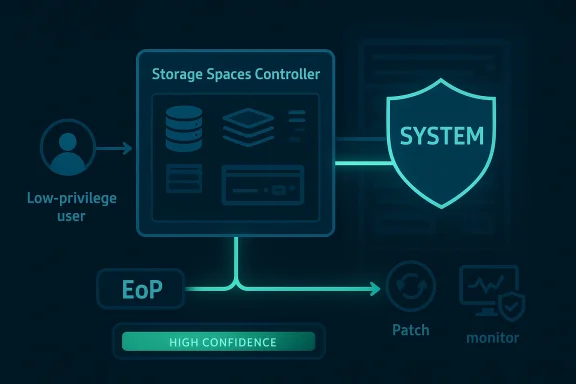
Microsoft’s CVE-2026-27907 is labeled a Windows Storage Spaces Controller elevation of privilege issue, a category that usually signals local abuse rather than remote compromise. In plain English, that means the attacker is typically expected to already have some foothold on the machine before the vulnerability becomes useful. That matters because local privilege escalation bugs are often the bridge between a low-value intrusion and full system control.The phrase that MSRC uses to describe the confidence metric is important because it tells defenders how much certainty exists around the bug itself and the technical picture behind it. A high-confidence rating generally means Microsoft has validated the issue, understands the affected code path, and believes the vulnerability exists in a concrete, reproducible way. Lower confidence would imply more ambiguity, such as a suspected weakness, a partially understood root cause, or a scenario still being corroborated.
For Windows administrators, this kind of finding lands in a familiar but still dangerous part of the threat landscape. Storage-related components sit close to the operating system’s trust boundary, and bugs in those layers can have outsized consequences if abused. Even when the exploit path is local, a successful attacker can often pivot from a standard user to SYSTEM, sabotage defenses, or prepare the ground for persistence.
Microsoft’s vulnerability disclosure framework has also become more transparent in recent years, with the Security Update Guide, machine-readable CSAF files, and related advisory infrastructure designed to speed response across the enterprise stack. That is useful, but it also means defenders sometimes see a CVE identifier and a short impact label before the full story is obvious. For a vulnerability like CVE-2026-27907, the limited initial framing is itself a clue: the issue is important enough to publish, but not necessarily accompanied by a full public technical teardown.
At a broader level, Storage Spaces has long been positioned as a flexible storage virtualization feature for Windows clients and servers. Features like that are attractive targets because they sit where file systems, management stacks, device abstractions, and privileged operations intersect. Those are exactly the places where attackers hope to find confusion about ownership, permissions, or object lifetimes.
Overview
The most important detail in the public description is the vulnerability class: Elevation of Privilege. That means the security failure is not primarily about breaking into a machine over the network, but about taking a limited foothold and converting it into higher rights. In practice, that often means an ordinary local user, a compromised service account, or a sandboxed process can trigger privileged behavior through a flaw in the controller logic.The second critical detail is the component name: Windows Storage Spaces Controller. That points away from generic app-layer issues and toward a subsystem that likely participates in storage orchestration or controller-level operations. When the vulnerable surface sits inside a controller or management path, the attacker’s advantage is often leverage: a bug there may expose privileged IO paths, object handling mistakes, or authorization bypasses that ordinary user-mode code should never reach.
Microsoft’s own confidence language, as reflected in the MSRC metric description supplied by the user, implies this is not merely a hypothetical weakness. It is a measure of how sure the vendor is that the vulnerability exists and how much technical detail is available to would-be attackers. The more certain the existence, the more defenders should treat the CVE as actionable, even if exploitation details remain sparse.
That distinction matters because local EoP issues are frequently underestimated. People tend to prioritize remote code execution and ignore local privilege escalation until post-compromise operations begin. But many modern intrusions rely on exactly this sequence: initial access via phishing, token theft, malicious script execution, or abused credentials, followed by a local privilege escalation to harden persistence and disable recovery.
Storage-related Windows components also have a history of rewarding attackers who understand the edge cases. Bugs in device management, metadata parsing, and privileged control paths can have consequences that are more severe than the feature name suggests. A system service that is intended to safely coordinate storage can become, in the wrong conditions, an avenue for arbitrary kernel or service-level execution.
Why the confidence metric matters
The MSRC confidence metric is not just a label for security engineers. It helps defenders infer how much of the vulnerability story is confirmed versus speculative. A higher-confidence finding usually means patch planning should be treated as urgent, because the existence of the bug is no longer a question mark.It also hints at attacker readiness. If Microsoft has enough certainty to publish a CVE with a specific affected component and impact class, then a capable adversary may already be able to reverse the issue from the public guidance or from the patch itself. In other words, certainty on the defender’s side often becomes opportunity on the attacker’s side.
- High confidence usually means the flaw is real and understood.
- Lower confidence can indicate incomplete technical corroboration.
- Public CVE visibility increases the odds of reverse engineering.
- Local EoP often becomes a post-exploitation multiplier.
What Storage Spaces Controller Implies
The name Storage Spaces Controller suggests a privileged orchestration layer rather than a simple user-facing feature. That distinction is vital because controller code usually coordinates multiple lower-level operations, and privilege mistakes there can have a wide blast radius. A bug in a controller path is often more interesting than a bug in a cosmetic UI because the former may expose security-sensitive actions by design.Privileged storage paths are sensitive
Storage systems frequently mediate access to disks, virtual volumes, metadata, and controller state. If any of those paths can be influenced by untrusted input, the consequences can range from information disclosure to complete system takeover. In Windows, a component that controls storage behavior may also interact with services running as SYSTEM, making a logic flaw especially dangerous.There is also a broader architectural lesson here: storage stacks are rarely isolated from the rest of the OS. They touch configuration, device enumeration, registry state, service management, and in some cases kernel-adjacent interfaces. That means attackers do not need a “storage attack” in the narrow sense; they only need a way to abuse a privileged code path that trusts something it should not.
The likely attacker model
Because the vulnerability is categorized as elevation of privilege, the attacker usually needs local access first. That access could come from malware, a malicious insider, a compromised remote-management foothold, or any execution primitive that does not initially have administrator rights. Once that foothold exists, the Storage Spaces Controller bug may provide the jump to a much stronger security context.This pattern is common across Windows local privilege escalations. The initial compromise is not the endgame; it is the setup. The actual prize is often SYSTEM, kernel-adjacent influence, or a privileged service account that can tamper with security tooling, dump credentials, or install persistence mechanisms.
- Initial foothold is often standard user or similarly limited.
- The escalation target is often SYSTEM or service-level control.
- Attackers can then disable EDR, tamper with logs, or stage persistence.
- In enterprise environments, the bug can become a domain-impacting stepping stone.
Why Local Elevation Still Matters
Some organizations still think of local privilege escalation as a “second-stage” issue, and technically that is true. Operationally, though, it is often the most valuable stage because it turns a noisy compromise into a durable one. A malware sample running as a user is easier to contain than one that has crossed the boundary into privileged control.A successful local EoP can also change the defender’s timeline. Without escalation, responders may be able to reimage one account and move on. With escalation, they must assume the attacker may have altered system state, tampered with security products, exfiltrated secrets, or planted mechanisms that survive cleanup.
Enterprise and consumer impact differ
For consumers, the practical result of a local EoP is often full machine compromise. That can mean ransomware, password theft, browser credential harvesting, or unauthorized remote access. The user may never see the escalation itself; they only notice that the malware suddenly behaves like it owns the system.For enterprises, the impact is often broader because local privilege is a gateway to lateral movement and stealth. If the compromised machine is joined to a domain, holds cached credentials, or runs management tooling, the attacker may leverage the elevated position to spread. That is why “local” vulnerabilities can still become enterprise-wide incidents.
Why defenders should care early
The timing of patching matters because exploit development usually accelerates once a CVE is public. Even without detailed proof-of-concept code, attackers can often infer a great deal from the vulnerability class, component name, and patched binaries. That is especially true for Windows subsystem bugs, where the patch can reveal which code paths changed.- Local EoP often enables credential theft.
- It can be used to disable defenses.
- It can help attackers achieve persistence.
- It can act as a bridge to lateral movement.
- It can make incident response significantly more expensive.
Confidence, Disclosure, and Threat Knowledge
The user-supplied description of the metric is the real story behind this CVE’s public posture. Microsoft is not just saying that a vulnerability exists; it is signaling how much confidence it has in the technical claim. That metric helps practitioners decide whether a CVE is a watch item, a patch-now item, or a “hold for more details” item.What high confidence usually means
A high-confidence rating generally implies that the flaw has been validated internally or through reliable reporting. It suggests Microsoft knows enough to publish a meaningful advisory and expects defenders to act on it. For attackers, it also means the underlying issue is less likely to be a dead end.That has two implications. First, the patch is probably addressing a concrete weakness, not just hardening around a vague concern. Second, the vulnerability may be easier to understand through binary diffing once updates are available. The patch itself can become a roadmap.
What lower confidence would have suggested
If the confidence were lower, defenders might interpret the CVE more cautiously. It could point to a vulnerability that is suspected but not fully reproduced, or to a technical claim that remains partly inferential. In those cases, organizations often prioritize exposure management and monitoring while awaiting more evidence.But that is not the posture here. The way Microsoft frames these metrics is intended to help organizations understand urgency, and a published CVE attached to a named Windows component is already a strong signal. In practice, teams should treat it as an actionable item unless subsequent guidance meaningfully downgrades the concern.
- Confidence affects patch urgency.
- It influences threat hunting priorities.
- It changes how much weight to give proof-of-concept speculation.
- It hints at how much reverse engineering effort attackers may need.
Patch Management Implications
Even when the public details are thin, patch management still has to move. The Windows ecosystem is too large to wait for perfect information, and Microsoft’s publication of a CVE generally means the vulnerability is real enough to matter. For enterprise administrators, the right approach is to treat the affected system family as potentially exposed until proven otherwise.How to operationalize response
The first step is to inventory systems that use Storage Spaces or related storage virtualization features. The second is to determine whether those systems are exposed to untrusted local code execution paths, because any local foothold increases risk. The third is to prioritize servers, admin workstations, and high-value endpoints where privilege escalation would be especially damaging.A disciplined patch workflow should include validation, but not delay. Storage and disk-management bugs can be tricky to test in a lab because reproducing the exact state may require specific controller configurations or workload conditions. That is precisely why defenders should combine patching with monitoring rather than wait for a perfect reproduction recipe.
Practical response checklist
- Identify whether Storage Spaces is used on the affected fleet.
- Patch servers and admin endpoints first.
- Verify that endpoint protection and telemetry remain active after update.
- Review accounts with local login rights on sensitive systems.
- Hunt for unusual privilege changes, service creation, and tampering.
- Reassess any machine that shows signs of prior compromise.
- Keep an eye on Microsoft’s advisory for update revisions or clarifications.
Enterprise versus home users
Enterprise users benefit most from staged rollout and change control, but they also face the highest blast radius if they delay. Home users have simpler patch logistics, yet they are more likely to ignore the issue until after an infection has already turned a user-level compromise into a full takeover. In both cases, the goal is the same: close the escalation path before it is chained into something worse.- Prioritize high-value systems.
- Use telemetry to spot suspicious privilege changes.
- Assume the patch may need validation in storage-heavy environments.
- Do not wait for an exploit to become public.
Competitive and Market Implications
Windows storage and security subsystems exist in a competitive market where reliability and trust matter almost as much as features. When Microsoft publishes a vulnerability like CVE-2026-27907, it reinforces a broader reality: platform security is not a static claim but a moving target. Enterprises that run Windows infrastructure expect patch cadence, transparency, and hardening guidance to keep pace with risk.Why this matters for Microsoft
For Microsoft, a local EoP in a core Windows component is a reputation issue even if the bug is not remotely exploitable. Customers judge operating-system security by the quality of the mitigations and the speed of response. The company has spent years expanding disclosure transparency, and that effort pays off only if defenders can act quickly on the information.It also underscores Microsoft’s strategy of publishing richer advisory data, including machine-readable formats and update-guide entries. That is important because modern enterprises do not consume security news as a blog-reading exercise; they ingest it into ticketing systems, asset inventories, and automated response pipelines. Better metadata means faster operational response.
Why rivals watch these cases closely
Other platform vendors, cloud providers, and endpoint-security firms watch Microsoft vulnerability handling because Windows remains a dominant enterprise endpoint environment. A well-handled EoP issue can raise the bar for disclosure and remediation across the industry. A poorly handled one can become a cautionary tale about ambiguity, lag, or incomplete guidance.This also influences how security vendors tune detections. If the issue becomes commonly exploited, EDR and SIEM vendors will look for behavioral markers around privilege escalation, suspicious storage interactions, or service abuse. The more specific the CVE response, the easier it is for the defensive ecosystem to build around it.
- Strong disclosure improves customer trust.
- Fast patching reduces competitive criticism.
- Clear guidance helps security vendors tune detections.
- Ambiguous advisories leave room for attacker interpretation.
What Defenders Should Look For
Even without public exploit specifics, there are common signals that often accompany local privilege escalation abuse. Security teams should focus on endpoint behavior around privilege transitions, new service creation, and changes that look inconsistent with the user’s normal activity. The key is not to overfit on the CVE name itself, but to watch for the kinds of activity an attacker would need after exploiting it.Behavioral indicators
Look for suspicious access to storage-management interfaces, especially on systems where ordinary users should not be touching controller-level operations. Monitor for unusual parent-child process chains involving administrative tools, script hosts, or service-control utilities. Pay attention to escalation attempts that happen shortly after a low-privilege user session begins, because those are often the fingerprints of post-exploitation activity.It is also wise to review logs for unexpected local account changes, new scheduled tasks, or service tampering. Those are not unique to this CVE, but they are common end states of successful privilege escalation. If an attacker escalates through a storage component, their next moves will usually be the same as any other intruder: persistence, defense evasion, and lateral movement.
Hunting priorities
- Watch for new SYSTEM-context processes spawned from unusual parents.
- Inspect service control manager activity for irregular changes.
- Review PowerShell and scripting logs for post-escalation automation.
- Check for disabled security tools or altered logging settings.
- Correlate with sign-ins from the same endpoint around the same time.
- Reimage or isolate systems where privilege escalation is suspected.
Strengths and Opportunities
Microsoft’s disclosure model gives defenders a path to act quickly even when the technical details are limited, and that is a real advantage. The publication of a clearly categorized EoP CVE lets organizations route the issue into patch, monitoring, and risk-management workflows without waiting for a full postmortem.- Clear severity class makes prioritization easier.
- Named affected component helps asset owners identify exposure.
- Security Update Guide structure supports enterprise automation.
- Confidence metrics help teams judge certainty.
- Patch-first response reduces attacker dwell time.
- Telemetry-driven hunting can catch follow-on abuse.
- Vendor transparency strengthens long-term trust.
Risks and Concerns
The biggest concern is that local EoP bugs are often weaponized after an initial intrusion, which means they can sit quietly until the attacker is already inside. That makes them especially dangerous in environments where basic infection prevention has already failed, because they can transform a manageable incident into a serious breach.- Attackers may chain it with phishing or malware.
- Public CVE data can speed reverse engineering.
- Storage subsystems can be difficult to test exhaustively.
- Enterprises may delay updates due to change-control friction.
- Legacy systems may remain exposed longer than intended.
- Detection can be hard if the exploit is low-noise.
- Misunderstanding “local” can cause under-prioritization.
Looking Ahead
The immediate next question is whether Microsoft will add more clarity to CVE-2026-27907 through an advisory revision, update-guide change, or further documentation. In many cases, the first public entry is intentionally sparse, and later updates provide the operational specifics that defenders need. If that happens here, the additional detail may sharpen exposure assessments without changing the core recommendation to patch.Another question is whether security researchers will begin mapping the patch to infer the vulnerable code path. That is a normal and expected part of the ecosystem. Once the patch is available, researchers can often determine whether the issue stems from access control confusion, object lifetime mishandling, validation gaps, or a logic error in privileged storage orchestration.
What to watch next
- Microsoft advisory revisions or expanded guidance.
- Signs of exploit development or public proof-of-concept code.
- Security vendor detections tied to storage-controller abuse.
- Enterprise reports of update compatibility issues.
- Any mention of affected Windows editions or feature configurations.
- Related CVEs that suggest a broader pattern in storage subsystems.
CVE-2026-27907 is therefore best understood not as an isolated storage bug, but as another reminder that modern Windows security still hinges on controlling the paths between ordinary users and privileged system functions. If Microsoft’s confidence in the issue is high, defenders should respond with equal confidence in the need to patch, monitor, and harden before the bug becomes someone else’s foothold.
Source: MSRC Security Update Guide - Microsoft Security Response Center
Last edited:
