

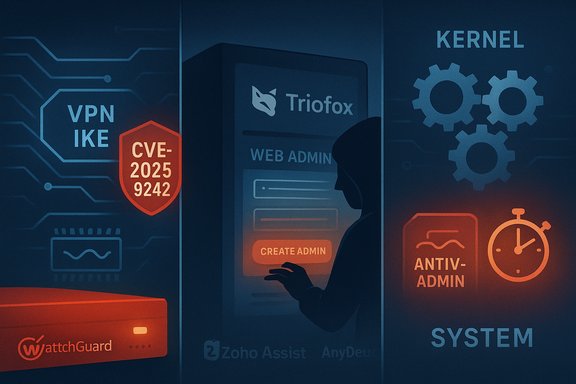
CISA’s decision to add three fresh entries to its Known Exploited Vulnerabilities (KEV) Catalog marks another urgent reminder that attackers are continuing to weaponize both edge devices and enterprise software against unpatched targets — and that federal agencies and private organizations alike must prioritize rapid remediation. The three CVEs in question target three different layers of the stack: a critical out‑of‑bounds write in WatchGuard Firebox appliances (CVE‑2025‑9242), an improper access control affecting Gladinet Triofox (CVE‑2025‑12480) that has already been abused to achieve remote admin access, and a Windows Kernel race‑condition privilege escalation (CVE‑2025‑62215) that was patched in Microsoft’s November security updates after evidence of active exploitation. Together they illustrate how internet‑exposed network appliances, collaboration/file‑sharing products, and privileged OS components remain prime targets for intrusion and post‑compromise escalation — and why the KEV/BOD 22‑01 process exists to force timely fixes across the federal enterprise.
CISA’s Known Exploited Vulnerabilities Catalog (KEV) is a policy mechanism that turns operational threat intelligence into mandatory action for Federal Civilian Executive Branch (FCEB) agencies under Binding Operational Directive BOD 22‑01. The catalog is a living list: when CISA determines there is credible evidence a CVE is being actively exploited in the wild, it adds the CVE to KEV and assigns a remediation due date. In practice the agency’s default timeline has been to require remediation within three weeks (21 days) unless CISA specifies an accelerated window for particularly dangerous flaws — though individual KEV entries can carry different due dates or tighter orders depending on severity and context. For private sector organizations, KEV additions are not legally binding, but they are operationally significant: the vulnerabilities listed reflect active campaigns and therefore deserve top priority in any vulnerability management program.
The three vulnerabilities highlighted here reflect different attacker tradecraft phases:
The vulnerability’s technical profile — an out‑of‑bounds write triggered via IKEv2 handling — makes it particularly dangerous for internet‑facing devices. Firewalls, VPN gateways, and other perimeter appliances are high‑value targets because successful exploitation often yields immediate, persistent, network‑wide access.
Why this is critical: many organizations expose VPN services for remote workers and branch connectivity. A vulnerability in the IKEv2 stack can be exploited without authentication, meaning simple internet reachability is sufficient for initial compromise.
In targeted campaigns, threat actors leveraged this weakness to create a native administrator account, then abused Triofox’s built‑in antivirus/scan features to execute arbitrary payloads, thereby gaining persistent, high‑privileged access on affected servers.
Gladinet has released patched Triofox builds — organizations must upgrade to the fixed version (a specific build number was issued by the vendor) and validate configuration hardening. Several independent researchers and incident responders published exploitation details and IOCs tied to the campaigns that abused this flaw.
The flaw’s exploitation requires local access and precise timing (winning the race), which increases attack complexity — however, threat actors frequently chain local escalation bugs with remote foothold exploits to achieve full compromise.
Supply‑chain exposure is another factor. File‑sharing platforms and management appliances are used by multiple organizations and often integrated with third‑party tools. An encounter with one compromised vendor instance can cascade if the downstream trust model allows remote code execution or lateral deployments.
However, the model has limitations:
Source: CISA CISA Adds Three Known Exploited Vulnerabilities to Catalog | CISA
 Background / Overview
CISA’s Known Exploited Vulnerabilities Catalog (KEV) is a policy mechanism that turns operational threat intelligence into mandatory action for Federal Civilian Executive Branch (FCEB) agencies under Binding Operational Directive BOD 22‑01. The catalog is a living list: when CISA determines there is credible evidence a CVE is being actively exploited in the wild, it adds the CVE to KEV and assigns a remediation due date. In practice the agency’s default timeline has been to require remediation within three weeks (21 days) unless CISA specifies an accelerated window for particularly dangerous flaws — though individual KEV entries can carry different due dates or tighter orders depending on severity and context. For private sector organizations, KEV additions are not legally binding, but they are operationally significant: the vulnerabilities listed reflect active campaigns and therefore deserve top priority in any vulnerability management program.The three vulnerabilities highlighted here reflect different attacker tradecraft phases:
- A perimeter appliance with remote code execution potential (WatchGuard Firebox).
- A file‑sharing/administration product abused for initial remote takeover and lateral movement (Gladinet Triofox).
- A local privilege escalation in the Windows Kernel used to convert initial access into SYSTEM control (Microsoft Windows race condition).
CISA’s KEV addition: what changed and why it matters
CISA’s addition of these CVEs to the KEV catalog is not merely informational — it is an operational directive that changes patching priority and compliance posture across federal networks. When a CVE lands on KEV:- FCEB agencies must document and remediate the vulnerability by the due date or remove the vulnerable product from use.
- Security operations teams should elevate detection and containment efforts for the affected systems.
- Supply‑chain and third‑party risk managers must validate whether any upstream or downstream dependencies include the vulnerable components.
CVE‑2025‑9242 — WatchGuard Firebox: Out‑of‑Bounds Write in iked
What it is
CVE‑2025‑9242 is an out‑of‑bounds write in the IKEv2 keying process (iked) of WatchGuard Firebox appliances running Fireware OS. The flaw can allow a remote, unauthenticated attacker to trigger memory corruption that leads to arbitrary code execution on affected devices.The vulnerability’s technical profile — an out‑of‑bounds write triggered via IKEv2 handling — makes it particularly dangerous for internet‑facing devices. Firewalls, VPN gateways, and other perimeter appliances are high‑value targets because successful exploitation often yields immediate, persistent, network‑wide access.
Affected software and exposure
Affected Fireware OS versions include multiple 11.x and 12.x releases and 2025.1 builds (specific version ranges vary by advisory). The vendor has published firmware updates that address the issue for supported branches; WatchGuard’s advisories name patched builds and provide recommended mitigations where immediate patching isn’t possible.Why this is critical: many organizations expose VPN services for remote workers and branch connectivity. A vulnerability in the IKEv2 stack can be exploited without authentication, meaning simple internet reachability is sufficient for initial compromise.
Exploitation and vendor response
Evidence of active exploitation — combined with the CVSS severity and the appliance’s exposure profile — is why CISA added the CVE to KEV. WatchGuard released updates and recommended immediate patching, and also supplied workaround guidance for environments where immediate upgrading is impractical (for example, disabling dynamic peer features or tightening access controls).Detection and containment guidance
- Immediately identify all externally reachable Firebox devices, and prioritize those exposing IKEv2 or VPN endpoints.
- Apply vendor firmware updates to all supported devices as a first step.
- Where patching cannot be completed in hours, block or restrict IKEv2 connectivity at perimeter filters or use IP allowlists for management and VPN termination.
- Hunt for anomalous VPN session creation and unknown configuration changes in Firebox logs; look for unexpected dynamic peer traffic and for spikes in IKE negotiation failures that could indicate probing.
- Review device backups and system integrity (including suspicious new users or changed VPN policies) — appliances have been used as persistence footholds in previous campaigns.
CVE‑2025‑12480 — Gladinet Triofox: Improper Access Control exploited for remote admin
What it is
CVE‑2025‑12480 is a critical improper access control vulnerability in Gladinet’s Triofox secure file‑sharing and remote access product. The flaw allows unauthenticated access to initial setup/administration pages long after installation, enabling an attacker to perform the setup flow remotely and create high‑privilege administrative accounts.In targeted campaigns, threat actors leveraged this weakness to create a native administrator account, then abused Triofox’s built‑in antivirus/scan features to execute arbitrary payloads, thereby gaining persistent, high‑privileged access on affected servers.
Real‑world exploitation profile
Threat intelligence reports indicate a tracked cluster exploited the vulnerability in August 2025, using Host header manipulation and unauthenticated access to complete setup steps and drop administrative accounts. Attackers then used the product’s legitimate features to execute installers and deploy remote access tools such as Zoho Assist and AnyDesk — a textbook example of abuse of trusted functionality to evade detection.Gladinet has released patched Triofox builds — organizations must upgrade to the fixed version (a specific build number was issued by the vendor) and validate configuration hardening. Several independent researchers and incident responders published exploitation details and IOCs tied to the campaigns that abused this flaw.
Why this is dangerous
- The attack path requires no authentication; public access to Triofox web interfaces is sufficient.
- The ability to create an admin account and execute payloads via a trusted anti‑virus/scan engine bypasses many file execution protections and reduces the need for privilege escalation exploits.
- The campaign demonstrates lateral movement and persistence tools (remote management utilities, SSH tunnels) deployed post‑compromise.
Detection and remediation
- Upgrade Triofox to the vendor‑released patched version immediately.
- Audit all Triofox instances for unexpected administrator accounts, changed admin passwords, and unknown scheduled tasks.
- Verify that Triofox’s anti‑virus engine is not being used to execute arbitrary scripts or binaries; neutralize any suspicious “antivirus path” configurations.
- Hunt for signs of persistence and lateral movement: newly installed remote assistance agents, unusual SSH tunneling, and communication to remote management endpoints.
- If compromise is suspected, isolate the host, collect forensic artifacts from web server logs and Triofox audit trails, and rotate credentials for any accounts created or modified.
CVE‑2025‑62215 — Windows Kernel race condition: local privilege escalation
The vulnerability
CVE‑2025‑62215 is a Windows Kernel vulnerability that manifests as a race condition (concurrent execution with improper synchronization) and is associated with a double‑free memory corruption pattern. When successfully exploited, it allows a locally authenticated attacker with limited privileges to elevate to SYSTEM. Microsoft classified it as a privilege escalation bug and released a patch as part of the November 2025 update cycle.The flaw’s exploitation requires local access and precise timing (winning the race), which increases attack complexity — however, threat actors frequently chain local escalation bugs with remote foothold exploits to achieve full compromise.
Scope and impact
The vulnerability affects currently supported Windows versions and Windows 10 systems under Extended Security Updates (where applicable). Because it targets the kernel, successful exploitation enables persistent system‑level control and evasion of many user‑space defenses. Microsoft labeled the issue as “exploitation detected” when issuing the fix.Response and mitigations
- Apply Microsoft’s November security updates across all impacted Windows builds, including servers and client systems covered by Extended Security Updates if applicable.
- For environments that cannot immediately patch, restrict local code execution vectors: enforce application control policies, harden user privilege assignment, and limit the ability of low‑privileged users to run arbitrary binaries.
- Use EDR telemetry to hunt for behaviors associated with kernel privilege escalation attempts: unusual calls to system APIs, kernel memory corruption indicators, and process injection patterns.
- Review segmentation and lateral movement defenses: ensure attackers who achieve initial access cannot easily reach additional critical systems where they could run local exploit code.
Practical remediation priorities for security teams
When KEV entries affect your environment, triage must be fast and decisive. Use the following prioritized checklist to manage risk after a KEV addition:- Inventory:
- Identify whether affected products/versions exist in your estate (appliances, web apps, endpoints).
- Patch:
- If vendor patches are available, schedule immediate deployment to all impacted systems; prioritize internet‑facing assets and externally reachable services.
- Compensating controls:
- Where patching is not feasible within hours, apply network rules, access lists, or temporary configuration changes to block exploit vectors.
- Detection:
- Push detection rules to SIEM/EDR that target known exploitation patterns and IOCs tied to the CVE.
- Hunt and verify:
- Run targeted hunts for post‑exploit artifacts: unexpected admin accounts, remote tools, suspicious kernel anomalies, or device configuration changes.
- Remediation validation:
- Confirm that patches were applied successfully and that the vulnerable service is no longer exposed.
- Reporting & documentation:
- For FCEB agencies, document remediation actions in accordance with BOD 22‑01 timetables; for private organizations, retain change logs and incident analysis.
- Post‑remediation audit:
- Conduct an after‑action review to identify process gaps that delayed patching or detection.
Detection playbook — realistic hunting suggestions
- For perimeter appliances (WatchGuard): search VPN and IKE logs for unusual negotiation traffic patterns, spikes in IKE connections from unknown IPs, and configuration changes. Look for shell or command execution linked to device system logs and unexpected reboots.
- For Triofox: check web server logs for Host header anomalies, localhost Host values from external sources, and POST requests to setup/configuration endpoints. Search for creation of “Cluster Admin”‑type accounts and the presence of Zoho or AnyDesk installers executed shortly after.
- For Windows Kernel EoP: hunt for local processes spawning privileged actions or evidence of kernel memory corruption and instability following execution of non‑privileged binaries. EDR event sequences involving pool grooming, repeated thread creation, or abnormal driver loads merit deep analysis.
Broader implications and risk analysis
These KEV additions expose several persistent risk themes:- Edge devices and management interfaces remain attractive targets. Network appliances are high‑value and often under‑monitored.
- Trusted features inside legitimate products (antivirus integration, remote management) can be weaponized, underlining that feature abuse is a primary adversary strategy.
- Privilege escalation in widely used OS kernels remains a critical last step for full compromise; defenders must assume local escalation vulnerabilities will be combined with remote foothold exploits.
Supply‑chain exposure is another factor. File‑sharing platforms and management appliances are used by multiple organizations and often integrated with third‑party tools. An encounter with one compromised vendor instance can cascade if the downstream trust model allows remote code execution or lateral deployments.
Recommended policy and governance actions
- Treat KEV additions as a trigger for emergency patch windows in enterprise patch policy: reduce approval friction for fixes tied to active exploitation.
- Maintain an authoritative asset inventory that includes firmware and build numbers for appliances, not just software versions.
- Require vendors to support secure update mechanisms and timely advisories; consider contractual patch SLAs for critical infrastructure vendors.
- Run periodic table‑top exercises that simulate KEV additions to validate operational readiness, communications, and escalations across IT, security, and procurement teams.
Strengths and risks of the current response model
CISA’s KEV catalog is effective at focusing attention on actively exploited vulnerabilities and forcing remedial action in federal networks. It provides a clear operational signal: if it’s on KEV, it’s being used — and should be fixed fast.However, the model has limitations:
- It depends on observable exploitation signals; many zero‑day abuses remain stealthy and may not be detected until later, so KEV is reactive by nature.
- The default remediation window (typically three weeks) is practical for many enterprise updates but may be too slow for certain high‑risk appliance flaws. CISA does sometimes accelerate deadlines, but that step depends on judgment calls and available telemetry.
- Private sector organizations may lack the visibility or resources to remediate within CISA timelines, especially for appliances that require scheduled maintenance windows.
Final verdict — what organizations should do now
- Prioritize and patch. Apply vendor fixes for WatchGuard Firebox and Triofox immediately, and deploy Microsoft’s November updates for Windows hosts. Confirm successful deployment.
- Hunt for compromise. Treat Triofox cases and internet‑facing Firebox instances as high‑priority hunt targets for persistence and lateral movement artifacts.
- Harden operations. Tighten access to management interfaces, restrict VPN endpoints by IP/address, and enforce strict configuration management and change control.
- Update policies. Ensure vulnerability management workflows escalate KEV hits to emergency status, and that business continuity plans accommodate urgent appliance upgrades.
- Retain evidence. If a host shows signs of exploitation, isolate, preserve logs, and engage incident response — attackers using these vulnerabilities have demonstrated the ability to create legitimate‑looking artifacts (e.g., remote‑management tools, installed agents) that can be mistaken for normal maintenance.
Source: CISA CISA Adds Three Known Exploited Vulnerabilities to Catalog | CISA
