

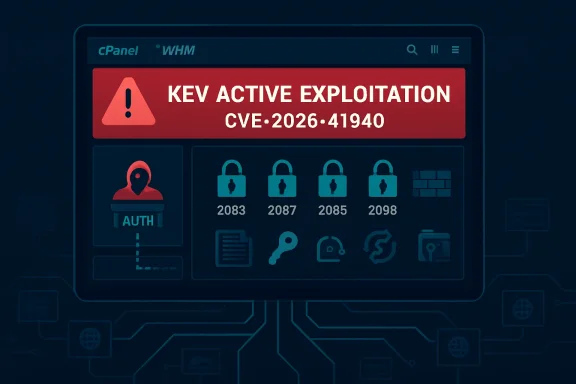
CISA’s Catalog Is No Longer Just a Federal To-Do List
The Known Exploited Vulnerabilities Catalog began life as a federal risk-management mechanism, but in practice it has become one of the security industry’s most useful triage signals. When CISA adds a CVE to KEV, it is not saying the bug is theoretically interesting. It is saying attackers are already using it.
That distinction matters. Vulnerability management programs are drowning in CVEs, scanner noise, severity scores, and vendor bulletins. A CVSS 9.8 rating is attention-grabbing, but exploitation status is the more operational fact. CISA’s addition of CVE-2026-41940 tells defenders that this vulnerability has crossed the line from “dangerous if weaponized” to “dangerous because it is being weaponized.”
Binding Operational Directive 22-01 formally applies to Federal Civilian Executive Branch agencies, which must remediate cataloged flaws by CISA’s due dates. But the catalog’s influence is much broader than Washington. Insurers, auditors, enterprise security teams, incident responders, and managed service providers increasingly treat KEV entries as a practical shortlist of vulnerabilities that cannot be deferred without accepting visible risk.
That is why this particular addition lands with force. cPanel & WHM sits inside the operational layer of web hosting, especially across small business sites, agencies, resellers, VPS fleets, and shared hosting providers. A flaw in that layer does not merely endanger a single application. It can expose the administrative machinery behind many applications at once.
The Bug Is an Authentication Failure in the Worst Possible Place
CVE-2026-41940 is categorized as a missing authentication for a critical function vulnerability. In plain English, attackers can reach something they should never be able to reach without first proving who they are. In a low-value subsystem, that would be bad. In a hosting control panel, it is potentially catastrophic.
cPanel & WHM is not just another web app. WHM provides server-level administration, while cPanel gives users access to site, email, database, DNS, file, and account-management functions. Compromise of that stack can give an attacker a path to hosted websites, mailboxes, databases, configuration files, SSL settings, cron jobs, and potentially credentials or persistence mechanisms sitting on the server.
The vendor’s advisory says the issue affects cPanel software, including DNSOnly, across versions after 11.40, with patches issued for multiple supported release branches. The fixed cPanel & WHM builds include 11.86.0.41, 11.110.0.97, 11.118.0.63, 11.126.0.54, 11.130.0.19, 11.132.0.29, 11.134.0.20, and 11.136.0.5. WP Squared is fixed in version 136.1.7.
The most troubling part is not simply that a login-adjacent vulnerability exists. Bugs happen. The deeper concern is that the affected component is pre-authentication infrastructure, the code path that is supposed to stand between the public internet and administrative authority. When the gatehouse is vulnerable, the strength of the castle wall becomes a secondary question.
The Hosting Control Panel Became the Blast Radius
For years, security teams have warned about exposed management interfaces: VPN portals, firewalls, hypervisors, remote monitoring tools, backup consoles, and cloud dashboards. cPanel belongs in that same family. It is a convenience layer that centralizes power, and centralization is exactly what attackers prefer.
The hosting market amplifies the risk because one panel often manages many sites. A single compromised WHM instance at a reseller or shared host can become a staging point for website defacement, malware injection, spam infrastructure, credential theft, phishing pages, or lateral movement into customer environments. The technical vulnerability is in cPanel; the business impact can spill into every organization whose web presence depends on that server.
That is why the usual website-owner mental model is inadequate. Many affected customers will not patch cPanel themselves because they do not administer the underlying server. They will rely on a hosting provider, agency, MSP, or reseller to do it. The gap between “the patch exists” and “the infrastructure I depend on is actually patched” is where attackers live.
This is also the awkward reality for small businesses. They may think of a website as a marketing asset, not an IT system. But the panel behind that site may hold mailboxes, DNS records, database passwords, file managers, backups, and administrative users. A control-panel compromise can rapidly become an identity, fraud, and reputation problem.
Patch Availability Does Not Mean Exposure Has Ended
cPanel has issued fixed versions and provided update instructions, including forcing an update with the standard cPanel update script, verifying the installed build, and restarting the cPanel service. That is the cleanest path: update immediately to a patched branch and confirm the version. For supported installations, this should be treated as emergency maintenance.
But hosting environments are rarely clean. Some servers have pinned update preferences, disabled automatic updates, legacy operating systems, brittle customer workloads, or old cPanel branches kept alive because migration looked more expensive than postponement. The vendor specifically warns that pinned or disabled updates may prevent automatic remediation and that older environments may require manual action.
This is where defenders should resist the comforting language of “patched.” A vendor can publish a patch in hours; the ecosystem may take days or weeks to absorb it. Every unsupported host, unmanaged VPS, abandoned reseller node, or forgotten DNSOnly instance becomes part of the remaining attack surface.
The temporary mitigations are blunt because the risk is blunt. cPanel’s guidance includes blocking inbound access to cPanel and WHM web-service ports such as 2083, 2087, 2095, and 2096, or stopping relevant services where an immediate update is not possible. Those steps can disrupt operations, but that is the nature of management-plane security. If the admin interface is vulnerable and exposed, availability has to compete with containment.
Detection Is Now as Important as Remediation
The KEV listing confirms active exploitation, which means patching is necessary but not sufficient. A patched system may already have been touched. That changes the job from vulnerability management to incident scoping.
cPanel’s advisory includes a detection script intended to look for indicators of compromise in session files, including suspicious combinations of session attributes, pre-authenticated sessions with authenticated markers, two-factor-authentication flags in questionable contexts, and malformed password-field artifacts. The script’s existence is important because it hints at the practical shape of the exploit path: session state, authentication flow, and improper trust in data written before a user is truly authenticated.
Administrators should treat a positive indicator as the beginning of an investigation, not as a self-contained finding. If exploitation is suspected, the next moves should include purging affected sessions, rotating root and WHM-user passwords, reviewing WHM and access logs, checking for unauthorized account creation, auditing SSH keys, inspecting cron jobs, looking for web shells, and validating backups. A control-panel compromise is rarely limited to the control panel.
Even a negative detection result should not become a blanket assurance. Detection scripts are useful, but they are bounded by known artifacts. Attackers may clean up, modify behavior, or use access quickly and leave little obvious trace. The safer assumption is that internet-exposed vulnerable systems require heightened log review around the disclosure and exploitation window.
Two-Factor Authentication Was Never a Magic Shield
One of the predictable reactions to an authentication-bypass vulnerability is to ask whether two-factor authentication saves the day. The uncomfortable answer is that 2FA is only as strong as the path that enforces it. If the vulnerability allows an attacker to manipulate or bypass the authentication state before the normal login process completes, 2FA may not provide the protection admins expect.
That does not make 2FA useless. It remains essential against password theft, credential stuffing, phishing reuse, and many forms of account takeover. But this incident shows the limits of treating identity controls as a universal backstop. If an attacker can convince the system that the authentication ceremony already happened, the ceremony’s strength is beside the point.
This is a broader lesson for management software. Security controls need to be layered below the application’s own sense of session state. Network allowlists, VPN-only access, private administrative endpoints, privileged-access workstations, and strict monitoring all matter because they reduce the number of people who can even reach the fragile parts of the login stack.
For cPanel environments, the best long-term posture is not “publicly expose WHM and hope the login form holds.” It is to make administrative interfaces boringly inaccessible from the general internet. That is operationally less convenient, especially for resellers and distributed support teams, but convenience is precisely what turned web control panels into high-value targets.
The Federal Deadline Is a Floor, Not a Strategy
BOD 22-01 gives federal agencies a compliance mechanism. It does not give private organizations a complete response plan. For everyone outside the federal enterprise, the KEV catalog should be treated less like a legal mandate and more like a priority siren.
The practical deadline for internet-facing cPanel systems is now. Not next patch cycle. Not after the weekend. Not when the next vulnerability scan runs. Active exploitation compresses the timeline because attackers do not need to wait for procurement windows or CAB meetings.
This is especially true for managed hosting providers. A provider that delays remediation is not merely risking its own infrastructure. It is assuming risk on behalf of customers who may have no visibility into the panel version, no way to validate patch status, and no direct control over mitigation. In that context, transparency becomes part of security response.
Customers should expect direct communication from providers: whether cPanel & WHM or WP Squared is in use, whether affected versions were present, when patches were applied, whether temporary port restrictions were used, and whether logs were reviewed for compromise. Silence is not reassurance. It is often just the absence of process.
The Vulnerability Economy Rewards the Fastest Exploiters
The industry’s response to CVE-2026-41940 also illustrates how quickly the window between disclosure and mass exploitation has collapsed. Security researchers, vendors, hosting providers, and attackers all move in parallel now. Once technical details and proof-of-concept material circulate, the question becomes not whether commodity exploitation will follow, but how quickly.
That does not mean research should be blamed. Public technical analysis can help defenders understand exploitability, build detections, validate exposure, and pressure lagging operators to act. But it does mean that “we have a few weeks” is an obsolete assumption for high-impact, internet-facing bugs in widely deployed software.
Control-panel vulnerabilities are especially attractive because the post-exploitation payoff is immediate. Attackers do not need to chain a dozen subtle primitives to find value. Administrative access to hosting infrastructure can yield data, persistence, monetizable traffic, phishing capacity, and leverage over downstream victims.
The economics are brutal. A single reliable pre-authentication exploit against a popular management interface can be worth more than a portfolio of ordinary application bugs. CISA’s KEV catalog exists because attackers make exactly that calculation every day.
Legacy Systems Turn Emergency Patches Into Migration Tests
One under-discussed part of the advisory is the pressure it puts on older systems. cPanel’s patch list covers supported release branches, while unsupported or constrained environments may need to move to a supported server platform. That is easy to write in a bulletin and hard to execute at scale.
Many hosting servers are old for ordinary reasons. Customers run outdated PHP applications. Migration risks downtime. Billing systems are entangled with provisioning scripts. OS upgrades threaten compatibility. The result is a long tail of infrastructure that remains in production because each individual exception seems rational.
CVE-2026-41940 turns that technical debt into an immediate security liability. If a server cannot receive a critical management-plane patch without major surgery, the organization has learned something important about its resilience. The emergency is not just the vulnerability; it is the fact that remediation depends on systems no one wanted to touch.
This is where leadership has to resist blaming administrators alone. Sysadmins often know which servers are fragile. They also know when budget, staffing, customer pressure, or business incentives keep those servers alive. A critical KEV entry should become evidence in the case for modernization, not just another overnight scramble.
Windows Shops Should Still Care
At first glance, a cPanel vulnerability may look like a Linux-hosting problem with little relevance to WindowsForum readers. That would be a mistake. Many Windows-centric organizations still depend on cPanel-backed hosting for public websites, WordPress properties, marketing microsites, customer portals, DNS zones, and email routing.
The compromise path may begin on a Linux host and end in a Microsoft environment. Stolen mailbox credentials can lead to Microsoft 365 abuse. A defaced or backdoored website can be used for credential harvesting against employees. DNS manipulation can undermine mail security records or redirect users. Malicious scripts planted in a trusted company site can become a foothold for broader campaigns.
For MSPs, the overlap is even more direct. The same provider may manage Microsoft 365 tenants, endpoint security, Windows servers, and web hosting for a small business. If the web-hosting panel is compromised, the incident response conversation will not respect product boundaries. Customers will call the IT provider they know.
That is why cPanel exposure belongs in asset inventories, even for organizations that think of themselves as Windows shops. The modern attack surface is not defined by operating-system preference. It is defined by every control plane that can change what users trust.
The Right Response Is Boring, Fast, and Documented
There is no glamorous fix here. The response should be immediate patching, exposure reduction, session and credential hygiene, log review, and customer communication. These are ordinary controls made urgent by the fact that the vulnerable software sits at an extraordinary point of leverage.
Administrators should first establish whether they run cPanel & WHM, DNSOnly, or WP Squared in any environment, including reseller nodes, lab systems, inherited VPS instances, and dormant hosting accounts. Then they should verify the installed version rather than assuming automatic updates succeeded. Any system that cannot be patched immediately should have administrative ports restricted to trusted sources or temporarily disabled where feasible.
After that comes compromise assessment. Review the vendor’s indicators, run the detection tooling where appropriate, inspect logs for anomalous access, and treat unexpected administrative activity as serious. Password rotation should include root and WHM users, but defenders should also look for persistence that survives password changes.
Documentation matters because this incident will become an audit question. If a KEV-listed, actively exploited flaw touched the environment, security teams need to know when the vulnerable asset was identified, when it was patched or mitigated, what evidence was reviewed, and what follow-up actions were taken. The absence of records will look a lot like the absence of action.
The cPanel KEV Entry Leaves Little Room for Half Measures
The concrete lesson from CISA’s April 30 action is that management-plane exposure has to be treated as a first-class risk, not an administrative convenience. The following points are the operational core of the story:
- CVE-2026-41940 is in CISA’s Known Exploited Vulnerabilities Catalog because there is evidence of active exploitation, not merely because the bug is severe.
- Affected cPanel & WHM environments should be updated immediately to a fixed supported build, and administrators should verify the installed version after the update.
- Systems that cannot be patched right away should have cPanel, WHM, and webmail administrative access restricted or disabled until remediation is possible.
- Detection and log review are necessary because already-compromised systems may remain dangerous after the patch is applied.
- Hosting providers, MSPs, and resellers should communicate patch and investigation status clearly because many downstream customers cannot validate exposure themselves.
- Organizations should use this incident to reduce public exposure of administrative interfaces before the next pre-authentication control-panel bug appears.
The larger story is not that cPanel had a bad week, though it did. It is that the internet continues to concentrate enormous authority in web-accessible management software and then acts surprised when attackers aim there first. CISA’s KEV listing should push every operator to patch CVE-2026-41940 today, but the more durable fix is architectural: fewer exposed control panels, faster migration off unsupported platforms, better visibility into delegated hosting, and a security culture that treats administrative convenience as a risk to be justified rather than a default to be inherited.