

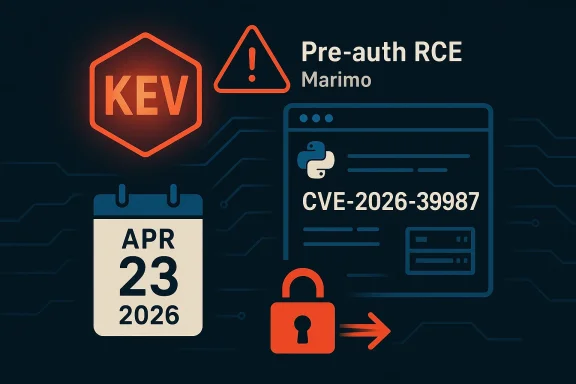
CISA’s April 23, 2026 update to its Known Exploited Vulnerabilities Catalog is a reminder that the most dangerous security problems are often the ones attackers have already operationalized. This time, the agency added a single entry: CVE-2026-39987, a Marimo remote code execution vulnerability, and it did so because CISA has evidence the flaw is being actively exploited. That puts Marimo, a modern Python notebook environment used in data science and AI-adjacent workflows, into the same urgent category as the enterprise software and edge devices that regularly populate the KEV list. For defenders, the message is straightforward: this is not a theoretical issue, and it should be treated as a live remediation priority, not a routine vulnerability-ticket item.
CISA’s Known Exploited Vulnerabilities Catalog exists to solve a basic but stubborn problem in security operations: not every high-severity vulnerability is equally urgent, but some low-visibility issues are being used in the wild right now. Under Binding Operational Directive 22-01, the catalog functions as a living list of CVEs that pose significant risk to the federal enterprise, and Federal Civilian Executive Branch agencies must remediate listed items by set deadlines. CISA also encourages all organizations to use KEV as a practical prioritization signal, even though the legal requirement applies only to federal civilian agencies.
That distinction matters because vulnerability management is no longer just a scoring exercise. A CVSS score tells you what a flaw could do in the abstract, but KEV tells you what attackers are actually doing in the present tense. The April 23 addition of CVE-2026-39987 fits that operational model perfectly: a pre-authentication remote code execution flaw in Marimo is exactly the sort of issue that can move quickly from disclosure to intrusion if exposed systems remain unpatched.
Marimo itself is part of a broader shift in how developers, analysts, and machine-learning teams build interactive notebooks. It is often positioned as a reactive Python notebook environment and a modern alternative to older notebook workflows. That makes it especially relevant in organizations where data science, experimentation, and automation are increasingly intertwined with production-adjacent systems. When a vulnerability hits a tool like this, the blast radius can extend beyond a single developer machine and into shared servers, cloud-hosted workspaces, and internal analytics platforms.
The timing also matters. Public reporting and vendor-adjacent analysis suggest the flaw was being exploited quickly after disclosure, and CISA’s decision to add it to KEV confirms that the issue crossed from advisory territory into active threat territory. That is the moment when every delay becomes more expensive. If a notebook environment is reachable by users, contractors, CI systems, or remote collaborators, it can become an attractive initial foothold for attackers looking for code execution, credential access, or a pivot point into broader infrastructure.
The key technical phrase is remote code execution. That means an attacker may be able to run arbitrary code on a vulnerable system, which is among the most serious outcomes in vulnerability management because it can convert a software service into an attacker-controlled execution environment. In the case of a notebook platform, that can be especially dangerous because notebooks often sit close to datasets, secrets, tokens, and internal workflows.
That matters because notebook software often has privileged access to data, credentials, and shared environments. A notebook server may be reachable by multiple users, mounted into cloud storage, integrated with APIs, or exposed through orchestration layers that developers assume are internal and therefore safe. Assumed trust is exactly the sort of condition attackers exploit, especially when code execution is available before authentication.
The technical profile is also important. A pre-authentication bug means an attacker does not need to log in first, and a remote code execution flaw means the attack can be carried out over the network. Put those together, and defenders are looking at a scenario where scanning, exploitation, and automation become easy to scale.
Security teams should also think beyond simple version upgrades. If the affected notebook server is internet-facing, temporary network restrictions or isolation may be needed while patching is arranged. If the environment is internal but broadly reachable, segmentation and access control should be tightened immediately. The core idea is to remove easy paths before the exploit window widens.
For consumers, the exposure is narrower but not nonexistent. Individuals using hosted notebook services, demo environments, or shared collaborative platforms could still be affected if those services run vulnerable Marimo instances. The real difference is scale: enterprises often have more instances, more network paths, and more hidden dependencies, which increases the odds of an overlooked deployment.
Another pattern is that KEV additions are not always about the newest software ecosystems. Older, well-understood attack primitives keep reappearing because defenders are slow to inventory, patch, or retire exposed systems. In that sense, the specific application matters less than the role it plays inside an organization. An overlooked notebook server can be just as dangerous as a more famous enterprise platform if it sits on a reachable network and handles valuable data.
A second concern is exposure creep. Tools that begin life as internal-only services often get wider access over time through VPNs, tunnels, reverse proxies, cloud security groups, or collaboration shortcuts. Every additional access path is another chance to miss the vulnerability during triage.
The second question is whether this becomes another example of the gap between developer tooling and enterprise governance. If Marimo is running in teams that do not report to central IT, patching could be delayed even when the security team is aware of the issue. That is where modern exposure management either works or fails: at the handoff between technical discovery and actual ownership.
CISA’s latest KEV addition is small in number but large in implication. A single pre-auth RCE in a specialized notebook platform is exactly the kind of issue that can slip past normal enterprise attention and still cause outsized damage. The catalog entry is a warning, but it is also a test: can organizations identify the tools they forgot they were running, and can they patch them before exploitation becomes an incident report? The teams that answer yes will keep moving; the rest will learn, once again, that niche software can produce very non-niche consequences.
Source: CISA CISA Adds One Known Exploited Vulnerability to Catalog | CISA
 Overview
CISA’s Known Exploited Vulnerabilities Catalog exists to solve a basic but stubborn problem in security operations: not every high-severity vulnerability is equally urgent, but some low-visibility issues are being used in the wild right now. Under Binding Operational Directive 22-01, the catalog functions as a living list of CVEs that pose significant risk to the federal enterprise, and Federal Civilian Executive Branch agencies must remediate listed items by set deadlines. CISA also encourages all organizations to use KEV as a practical prioritization signal, even though the legal requirement applies only to federal civilian agencies.That distinction matters because vulnerability management is no longer just a scoring exercise. A CVSS score tells you what a flaw could do in the abstract, but KEV tells you what attackers are actually doing in the present tense. The April 23 addition of CVE-2026-39987 fits that operational model perfectly: a pre-authentication remote code execution flaw in Marimo is exactly the sort of issue that can move quickly from disclosure to intrusion if exposed systems remain unpatched.
Marimo itself is part of a broader shift in how developers, analysts, and machine-learning teams build interactive notebooks. It is often positioned as a reactive Python notebook environment and a modern alternative to older notebook workflows. That makes it especially relevant in organizations where data science, experimentation, and automation are increasingly intertwined with production-adjacent systems. When a vulnerability hits a tool like this, the blast radius can extend beyond a single developer machine and into shared servers, cloud-hosted workspaces, and internal analytics platforms.
The timing also matters. Public reporting and vendor-adjacent analysis suggest the flaw was being exploited quickly after disclosure, and CISA’s decision to add it to KEV confirms that the issue crossed from advisory territory into active threat territory. That is the moment when every delay becomes more expensive. If a notebook environment is reachable by users, contractors, CI systems, or remote collaborators, it can become an attractive initial foothold for attackers looking for code execution, credential access, or a pivot point into broader infrastructure.
What CISA Added
CISA added one vulnerability to the KEV Catalog on April 23: CVE-2026-39987, identified as a Marimo Remote Code Execution Vulnerability. CISA says the addition is based on evidence of active exploitation, which is the catalog’s threshold for inclusion. In other words, this is not simply a bug with a high CVSS score; it is a flaw that has already entered the real-world attack ecosystem.The key technical phrase is remote code execution. That means an attacker may be able to run arbitrary code on a vulnerable system, which is among the most serious outcomes in vulnerability management because it can convert a software service into an attacker-controlled execution environment. In the case of a notebook platform, that can be especially dangerous because notebooks often sit close to datasets, secrets, tokens, and internal workflows.
Why “known exploited” changes the calculus
A vulnerability being exploited in the wild changes nearly every decision a security team has to make. The question is no longer whether the bug is serious; it is whether the organization can find all exposed instances before someone else does. That shift affects patch scheduling, exception handling, asset discovery, and even incident-response planning.- Patch priority becomes immediate
- Exposure mapping becomes urgent
- Compensating controls matter more
- Internet-facing instances become top risk
- Exception requests should narrow sharply
- Monitoring should be heightened until remediation is complete
Why Marimo Matters
Marimo is not a household name in the way browsers, operating systems, or major enterprise suites are, but that can make it more dangerous in practice. Security teams are often very good at tracking the obvious targets and much weaker at inventorying the niche tools that quietly accumulate in developer workflows, research environments, and data platforms. Vulnerabilities in those tools can be missed precisely because they sit outside the traditional enterprise application catalog.That matters because notebook software often has privileged access to data, credentials, and shared environments. A notebook server may be reachable by multiple users, mounted into cloud storage, integrated with APIs, or exposed through orchestration layers that developers assume are internal and therefore safe. Assumed trust is exactly the sort of condition attackers exploit, especially when code execution is available before authentication.
Notebook platforms as high-value targets
Notebook environments are particularly attractive because they blur the line between development, analysis, and execution. Users paste code, connect secrets, load datasets, and run commands in interactive sessions that can be difficult to fully isolate. If an attacker gains control of that environment, they may inherit access to far more than a notebook file.- They often handle sensitive data
- They are frequently shared across users
- They may connect to cloud resources
- They can expose API keys and tokens
- They are attractive stepping stones into larger systems
Exploitation and Threat Behavior
CISA’s decision to add CVE-2026-39987 confirms what the broader security community had already started to suspect: the flaw was not just serious, but actively useful to attackers. Several sources reported rapid exploitation after disclosure, and the exploitability profile is exactly the kind that tends to move fast once details are public. That speed matters, because the window between disclosure and mass probing is often brutally short for internet-facing or semi-exposed services.The technical profile is also important. A pre-authentication bug means an attacker does not need to log in first, and a remote code execution flaw means the attack can be carried out over the network. Put those together, and defenders are looking at a scenario where scanning, exploitation, and automation become easy to scale.
How attackers benefit from speed
Once a vulnerability is known and workable, it becomes a race between defenders and opportunistic actors. That race is often won by whichever side can automate first. For many organizations, the risk is not a sophisticated targeted campaign; it is a broad internet sweep that finds an unpatched notebook instance before patch teams have even finished triage.- Mass scanning can find exposed services quickly
- Automation lowers attacker cost
- Pre-auth flaws reduce friction
- RCE enables fast post-exploitation actions
- Notebook environments may lack mature monitoring
- Internal trust assumptions can delay detection
Patch and Remediation Implications
The practical response to a KEV-listed issue is to move from passive awareness to active mitigation. For CVE-2026-39987, that means identifying all Marimo deployments, confirming version status, and prioritizing remediation before attackers find the service first. If an instance is not yet patched, it should be assumed exposed until proven otherwise.Security teams should also think beyond simple version upgrades. If the affected notebook server is internet-facing, temporary network restrictions or isolation may be needed while patching is arranged. If the environment is internal but broadly reachable, segmentation and access control should be tightened immediately. The core idea is to remove easy paths before the exploit window widens.
A practical triage sequence
A defensible response plan does not have to be complicated, but it should be disciplined. The fastest teams will usually do the same things in the same order: find the asset, verify exposure, patch or contain, then validate. That sequence is especially important when a flaw is already in KEV because delay itself becomes a risk factor.- Inventory all Marimo instances and owners.
- Identify the version and deployment model.
- Check whether the service is reachable from untrusted networks.
- Apply the vendor fix or isolate the system.
- Validate that remediation actually removed exposure.
- Review logs for signs of suspicious access or command execution.
Enterprise vs. Consumer Impact
The direct impact of this KEV entry falls more heavily on enterprises, research institutions, and developers than on ordinary home users. Marimo is a specialized tool, and that means the most likely victims are organizations that rely on Python notebooks for analytics, experimentation, or internal automation. These are precisely the environments where confidential data and high-trust workflows tend to coexist.For consumers, the exposure is narrower but not nonexistent. Individuals using hosted notebook services, demo environments, or shared collaborative platforms could still be affected if those services run vulnerable Marimo instances. The real difference is scale: enterprises often have more instances, more network paths, and more hidden dependencies, which increases the odds of an overlooked deployment.
Why enterprise exposure is more serious
In enterprise environments, a notebook server can become a gateway into broader systems. It may connect to internal APIs, cloud storage, container platforms, or data warehouses, and a compromise there can cascade quickly. That is why “just a notebook” is the wrong mental model.- Shared environments increase blast radius
- Service accounts may have elevated privileges
- Secrets may be cached or mounted locally
- Internal network access can reveal more targets
- Audit logging is often uneven across research stacks
The Broader KEV Pattern
Although this update contains only one vulnerability, it fits a familiar pattern in the KEV Catalog. CISA regularly prioritizes flaws that offer remote reachability, low friction, and high operational payoff. Those are often bugs in collaboration tools, management interfaces, browser-adjacent software, or internet-facing services. Marimo belongs in that family because it can sit close to sensitive workflows and can offer meaningful control once compromised.Another pattern is that KEV additions are not always about the newest software ecosystems. Older, well-understood attack primitives keep reappearing because defenders are slow to inventory, patch, or retire exposed systems. In that sense, the specific application matters less than the role it plays inside an organization. An overlooked notebook server can be just as dangerous as a more famous enterprise platform if it sits on a reachable network and handles valuable data.
What this says about attacker priorities
Attackers tend to focus on systems that offer the best ratio of access to effort. That means they like software with network exposure, privileged integration, and a user base that is large enough to produce unpatched targets. Marimo’s presence in KEV suggests it has crossed into that practical category.- Reachability beats obscurity
- Code execution beats nuisance bugs
- Shared tooling can become a pivot point
- Specialized software is not low risk
- Fast patching reduces attacker ROI
Strengths and Opportunities
The good news is that KEV gives defenders a clear, actionable priority list, and this update is no exception. Because the flaw is already in CISA’s catalog, security teams do not have to debate whether it matters. The main opportunity now is to move quickly, use the signal to improve asset visibility, and harden adjacent systems before the same path is reused elsewhere.- CISA’s signal removes ambiguity
- Patch prioritization becomes easier
- Asset discovery can be improved immediately
- Notebook security can be folded into broader governance
- Logging and monitoring can be tuned for higher scrutiny
- Exposure reduction may uncover other forgotten services
- The event can drive stronger developer-platform controls
Risks and Concerns
The biggest concern is simple: many organizations still do not have a reliable inventory of internal developer tools, and that makes remediation slower than it should be. A vulnerable Marimo instance can sit quietly inside a lab, a shared workspace, or a cloud project while teams assume it is low importance because it is not a mainstream enterprise app. That assumption is exactly what exploitation feeds on.A second concern is exposure creep. Tools that begin life as internal-only services often get wider access over time through VPNs, tunnels, reverse proxies, cloud security groups, or collaboration shortcuts. Every additional access path is another chance to miss the vulnerability during triage.
- Incomplete inventories can delay response
- Internal trust may be overstated
- Shared notebook environments can amplify impact
- Credential exposure may follow code execution
- Patching may lag in research-heavy teams
- Detection may be weak in niche platforms
- Overconfidence in “non-production” systems is dangerous
Looking Ahead
The most important near-term question is how widely Marimo is deployed in real organizations and how quickly owners can verify their exposure. CISA’s KEV update tells us the flaw is active, but it does not tell us which environments are most at risk. That means defenders need to do the mapping themselves, and they need to do it fast.The second question is whether this becomes another example of the gap between developer tooling and enterprise governance. If Marimo is running in teams that do not report to central IT, patching could be delayed even when the security team is aware of the issue. That is where modern exposure management either works or fails: at the handoff between technical discovery and actual ownership.
What defenders should watch
- Whether additional exploitation details emerge
- Whether patched Marimo releases are rapidly adopted
- Whether cloud-hosted notebook platforms are affected downstream
- Whether security teams can inventory hidden deployments
- Whether other notebook ecosystems show similar risk
CISA’s latest KEV addition is small in number but large in implication. A single pre-auth RCE in a specialized notebook platform is exactly the kind of issue that can slip past normal enterprise attention and still cause outsized damage. The catalog entry is a warning, but it is also a test: can organizations identify the tools they forgot they were running, and can they patch them before exploitation becomes an incident report? The teams that answer yes will keep moving; the rest will learn, once again, that niche software can produce very non-niche consequences.
Source: CISA CISA Adds One Known Exploited Vulnerability to Catalog | CISA
