

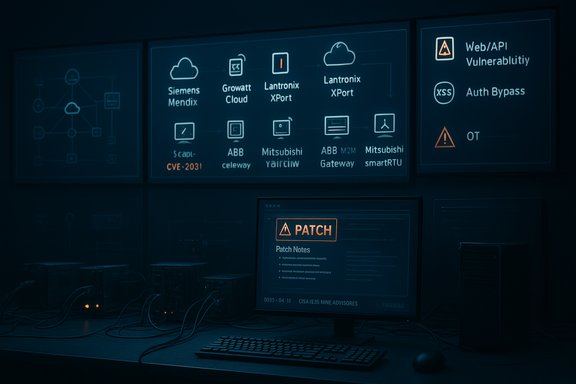
CISA’s consolidated bulletin announcing nine new Industrial Control Systems (ICS) advisories is a blunt reminder that the operational-technology (OT) landscape — and the Windows systems that often bridge to it — remain under persistent attack and demand coordinated, prioritized remediation. The April 15, 2025 release bundles advisories for products from Siemens, Growatt, Lantronix, National Instruments (LabVIEW), Delta Electronics, ABB, Mitsubishi Electric Europe, and others, and it highlights multiple high-severity flaws that are remotely exploitable and, in some cases, permit command execution or complete takeover of devices.
Industrial control systems run decades-long lifecycles and frequently combine legacy protocols, embedded devices, and modern cloud services. CISA’s advisories are intended to centralize vendor disclosures, scoring, and mitigation guidance so operators can act quickly across diverse estates. The April 15 package groups nine advisories (ICSA-25-105-01 through ICSA-25-105-09) and offers CVSS v3/v4 scores, attack vectors, and vendor recommendations for each issue. Windows administrators and OT engineers should treat these advisories as enterprise-level incidents: vulnerable field devices, gateways, or engineering tools often connect to Windows servers, HMIs, or engineering workstations, and an attacker can pivot from a compromised ICS asset into IT environments if segmentation and hardening are incomplete. Community discussion mirrors that concern, urging cross-domain triage and prioritized patching.
Conclusion
The nine ICS advisories consolidated by CISA present a mix of high-severity, remotely exploitable flaws across cloud portals, embedded device servers, engineering tools, and M2M gateways. Operators should act now: inventory, isolate, patch, and harden Windows-hosted engineering tools. The combination of vendor-supplied patches and network-based compensating controls will reduce the short-term risk, but longer-term resilience requires lifecycle planning, reducing internet exposure of OT assets, and continual integration of vulnerability intelligence into operational workflows. Community resources and incident-response playbooks should be updated to reflect these advisories and to prepare incident-response teams for the types of exploitation these CVEs enable.
Source: CISA CISA Releases Nine Industrial Control Systems Advisories | CISA
 Background
Industrial control systems run decades-long lifecycles and frequently combine legacy protocols, embedded devices, and modern cloud services. CISA’s advisories are intended to centralize vendor disclosures, scoring, and mitigation guidance so operators can act quickly across diverse estates. The April 15 package groups nine advisories (ICSA-25-105-01 through ICSA-25-105-09) and offers CVSS v3/v4 scores, attack vectors, and vendor recommendations for each issue. Windows administrators and OT engineers should treat these advisories as enterprise-level incidents: vulnerable field devices, gateways, or engineering tools often connect to Windows servers, HMIs, or engineering workstations, and an attacker can pivot from a compromised ICS asset into IT environments if segmentation and hardening are incomplete. Community discussion mirrors that concern, urging cross-domain triage and prioritized patching.Overview of the nine advisories (what’s included)
CISA’s April 15 advisory bundle lists the following items:- ICSA-25-105-01 — Siemens Mendix Runtime (observable response discrepancies; entity enumeration).
- ICSA-25-105-02 — Siemens Industrial Edge Device Kit (weak authentication; identity-federation endpoints affected).
- ICSA-25-105-03 — Siemens suites (SIMOCODE, SIMATIC, SIPLUS, SIDOOR, SIWAREX — grouped advisory).
- ICSA-25-105-04 — Growatt Cloud Applications (multiple web and API issues including stored XSS and authorization bypass; several CVEs assigned).
- ICSA-25-105-05 — Lantronix XPort (missing authentication for critical function; high CVSS).
- ICSA-25-105-06 — National Instruments LabVIEW (out-of-bounds writes; remote code execution when opening crafted VIs).
- ICSA-25-105-07 — Delta Electronics COMMGR (cryptographic weakness / weak PRNG and other issues).
- ICSA-25-105-08 — ABB M2M Gateway (dozens of weaknesses spanning memory-safety, authentication, and path traversal).
- ICSA-25-105-09 — Mitsubishi Electric Europe smartRTU (missing authentication and OS command injection vectors).
Detailed highlights and independent verification
Below are the most consequential advisories from the bundle, with technical detail and corroborating sources where available.Growatt Cloud Applications — remote code / control risks
- What CISA reported: multiple API and web-portal flaws (stored XSS, authorization bypass, insufficient type checks, external control of configuration) affecting Growatt cloud portal versions up to 3.6.0; several CVEs carry very high CVSS scores (CVSS v4 up to 9.3). CISA notes vendor patches were released for cloud-hosted elements.
- Independent corroboration: NVD has entries for associated CVEs (e.g., CVE-2025-30510) marking the issue and recording the NVD publication on April 15, 2025. Security bulletins and vendor-agnostic vulnerability trackers also catalog the set of Growatt CVEs and flag the stored XSS and arbitrary-file-upload risks.
- Why it matters: Growatt’s cloud portal controls in-field solar/EV/energy devices. Stored XSS and arbitrary-file upload in a cloud portal can be a stepping stone to account takeover, unauthorized device commands (on/off), and large-scale privacy breaches if the cloud provider or tenant is not patched.
Lantronix XPort — missing authentication for critical function
- What CISA reported: an exploitable flaw enabling unauthorized access to configuration interface of XPort device servers (affected versions 6.5.0.7 to 7.0.0.3), assigned CVE-2025-2567 with CVSS v3 reported in the advisory as critical. Vendor firmware updates (v8.0.0.0 or recommended upgrades to XPort Edge) are noted.
- Independent corroboration: multiple vulnerability tracking sites and CERT bulletin pages republished the advisory; a number of vulnerability databases list CVE-2025-2567 as critical and emphasize the device’s role in monitoring (e.g., ATG/fuel telemetry).
- Operational risk: XPort devices are often embedded in fuel, water, and industrial telemetry stacks. An unauthenticated attacker who modifies device configuration can disrupt telemetry, hide alarms, or even affect physical safety when monitoring systems go offline.
National Instruments LabVIEW — crafted VI leads to arbitrary code execution
- What CISA reported: two out-of-bounds write vulnerabilities impacting LabVIEW 2025 Q1 and prior, CVE-2025-2631 and CVE-2025-2632; exploitation requires a user to open a malicious Virtual Instrument (VI). Patches are available per vendor guidance.
- Independent corroboration: NVD and other CVE databases list these CVEs with matching descriptions and show vendor advisories and remediation references. Security write-ups clarify the exploitation vector: malicious VIs opened by engineers or automated importing routines.
- Why it matters: LabVIEW is widely used on Windows engineering stations and run with elevated privileges in many shops. A crafted VI can convert a benign engineering action into a local code-execution incident, enabling lateral movement or sabotage if permissive user contexts are used.
Mitsubishi smartRTU — unauthenticated OS command injection
- What CISA reported: a missing authentication flaw that allows an attacker to bypass authentication and then execute OS commands via an API route; CVE-2025-3128/CVE-2025-3232 are associated and scores are high. Claroty Team82 is credited as the researcher.
- Independent corroboration: security research firms and vendor advisories (Mitsubishi PSIRT postings) echo the severity and recommend immediate network isolation and firewalling of affected smartRTU versions.
- Operational risk: RTUs often have direct ties to physical processes; unauthenticated command execution can result in control logic tampering and denial-of-service of field telemetry.
ABB M2M Gateway and Delta COMMGR — broad attack surface, many CVEs
- ABB’s advisory lists a broad set of memory and logic errors, path-traversal and authentication issues across M2M Gateway versions — many of which could lead to denial of service or code execution. CISA lists multiple historical CVEs impacting embedded OSS the devices depend on.
- Delta COMMGR’s advisory (Update A) calls out weak cryptographic RNGs and EOL notices for version 1 — vendors recommend upgrading to V2.10.0. CISA notes ZDI (Trend Micro) reported the issue.
Cross-checking and verification: what we validated and how
Key claims in the advisories were verified against at least two independent repositories when available:- Growatt: verified against CISA advisory text and NVD/CNA listings; independent security bulletins add detail and CVE aggregation.
- Lantronix XPort: verified against CISA advisory, CERT mirror bulletins, and vulnerability feeds/cert pages.
- LabVIEW: verified against CISA’s advisory and multiple CVE/NVD database entries.
- Mitsubishi smartRTU: verified via CISA advisory and vendor/PSIRT guidance referenced from the CISA page; research attribution to Claroty Team82 is documented in the advisory.
Patterns and what they signal about ICS security in 2025
Across the nine advisories certain recurring technical patterns emerge:- Authentication lapses and identity-federation gaps — several Siemens and Lantronix advisories show login/identity flaws that let attackers bypass authentication or impersonate users.
- Web application and API weaknesses — Growatt and multiple other cloud/portal products exhibit classic web vulnerabilities (XSS, authorization bypass) that enable account compromise and remote actions.
- Memory-safety and parsing bugs — LabVIEW, ABB gateways, and others still suffer from buffer/heap issues that can yield RCE when untrusted input is processed.
- Supply-chain and third-party library exposure — embedded systems show accumulated CVEs from OSS components (systemd, Git, ClamAV, etc. that propagate into product advisories.
Operational impact and risk assessment
- Safety-critical sectors at heightened risk: energy, water/wastewater, Critical Manufacturing, and transportation are emphasized in multiple advisories. Devices in those sectors are often widely deployed with limited patch windows, amplifying risk.
- Remote exploitability: multiple advisories list AV:N (network) attack vectors with low attack complexity, meaning remote exploitation is plausible without privileged access. That raises urgency for network-based mitigations.
- Windows crossover: LabVIEW and many engineering suites run on Windows; an exploit in an OT-facing Windows host can quickly provide credentials and network access used to manipulate controllers or gateways. Community guidance stresses mapping Windows-hosted engineering applications as part of the ICS inventory.
Recommended prioritized actions for WindowsForum readers and OT operators
Operators must triage quickly and pragmatically. Use a risk-first approach: prioritize patching for exploitable, internet-facing devices and those tied to safety processes.- Inventory and map (first 24–48 hours)
- Identify instances of the listed products in your environment: Mendix-based Siemens apps, Industrial Edge Device Kit versions, Growatt cloud integrations, XPort device servers, LabVIEW installations, Delta COMMGR instances, ABB M2M Gateway models, and Mitsubishi smartRTU versions.
- Mark which of these are internet-exposed, provide direct telemetry to business networks, or manage safety-critical control loops.
- Apply available vendor patches immediately (first 72 hours)
- If a vendor patch or cloud-side fix is available, prioritize it. For cloud issues (Growatt), confirm vendor-side remediation and revoke any stale tokens or sessions. For device firmware (Lantronix, ABB), schedule firmware upgrades during controlled maintenance windows.
- Network-centric mitigations (immediate)
- Block vulnerable devices from direct internet access. Use firewall rules, ACLs, and VPNs with strict controls. Apply least-privilege access for management endpoints. Where patches are unavailable, move devices to isolated management networks.
- Hardening Windows engineering workstations (immediate to 7 days)
- Enforce least privilege for engineering users, keep LabVIEW and engineering suites patched, disable automatic opening of untrusted VIs, and use application whitelisting and EDR capable of blocking unknown binaries. Verify that remote desktop or file-sharing services are limited to bastion hosts.
- Detect, monitor, and respond (ongoing)
- Tune IDS/IPS and SIEM to spot exploitation patterns (unexpected API calls, configuration changes, unusual process spawning). Track vendor indicators of compromise (IoCs) and share telemetry with upstream incident response teams.
- Compensating controls where patching is not possible (short- to mid-term)
- Deploy web application firewalls (WAFs) for vulnerable portals, enforce multi-factor authentication for admin access, rotate or revoke credentials, and restrict API endpoints to known client IPs where feasible.
- Communicate and document (immediate)
- Notify leadership, maintenance teams, and third-party service providers. Document applied mitigations and planned patch schedules. CISA and vendor advisories should be attached to change tickets for auditability.
Strengths and limitations of the advisory package
Strengths
- Consolidation: CISA bundles vendor disclosures into a single digestible set, which accelerates triage by operators who may not track dozens of vendor PSIRTs individually.
- Actionable technical detail: advisories contain CVE IDs, affected versions, and explicit mitigation steps — enabling operators to map, prioritize, and patch.
- Cross-sector emphasis: CISA highlights impacted critical infrastructure sectors, helping large enterprises prioritize safety-critical assets.
Limitations and risks
- Timing and coverage: vendor patch availability varies; some advisories note that fixes are pending or apply only to specific versions, forcing operators to rely on compensating controls.
- EOL products: several advisories reference deprecated/EOL products that remain in the field; managing upgrades on those is operationally and financially painful.
- Silent exploit status: while CISA reports “no known public exploitation” for many advisories, that does not guarantee there is no in-the-wild activity. Detection gaps in OT environments are common, so assume adversaries scan for high-profile CVEs.
Practical checklist for WindowsForum readers (concise)
- Inventory the affected products and label exposure (internet-facing / internal / safety-critical).
- Patch immediately where vendor patching is provided (LabVIEW, Growatt cloud patches, Lantronix firmware, etc..
- Isolate unpatched devices from the internet and from business networks using firewalls and ACLs.
- Harden Windows engineering hosts: least privilege, application control, EDR, and patch management.
- Deploy extra logging and telemetry for the affected systems; look for anomalous API calls, config changes, and user enumeration attempts.
Final assessment and consequences for defenders
CISA’s nine-advisory package underscores a continuing trend: ICS vendors and integrators still face a mix of classic web/API bugs and legacy memory-safety issues, and both categories are of immediate concern because many are remotely exploitable with low complexity. For Windows administrators and OT operators, the critical takeaways are clear:- Treat ICS advisories as enterprise incidents, not isolated OT problems. Engineering workstations and Windows-hosted tooling are frequent pivot points.
- Prioritize remote-exploitable vulnerabilities, safety-critical assets, and internet-facing endpoints first; deploy compensating controls where patches are delayed or unavailable.
- Improve cross-domain collaboration between IT, OT, and vendors: timely patches, verified cloud-side remediations, and shared IoCs close the window of opportunity for attackers.
Conclusion
The nine ICS advisories consolidated by CISA present a mix of high-severity, remotely exploitable flaws across cloud portals, embedded device servers, engineering tools, and M2M gateways. Operators should act now: inventory, isolate, patch, and harden Windows-hosted engineering tools. The combination of vendor-supplied patches and network-based compensating controls will reduce the short-term risk, but longer-term resilience requires lifecycle planning, reducing internet exposure of OT assets, and continual integration of vulnerability intelligence into operational workflows. Community resources and incident-response playbooks should be updated to reflect these advisories and to prepare incident-response teams for the types of exploitation these CVEs enable.
Source: CISA CISA Releases Nine Industrial Control Systems Advisories | CISA
