

The U.S. National Security Agency has joined CISA in sounding the alarm: on-premises and hybrid Microsoft Exchange Server deployments remain “at high risk of compromise,” and the federal guidance released this fall consolidates a short, urgent hardening checklist administrators must run through now to prevent on‑prem breaches from cascading into Exchange Online tenant compromise.
Microsoft Exchange Server occupies a unique, high‑value position in enterprise infrastructure: it handles mail flow, integrates with identity systems, and often bridges on‑premises environments with Microsoft 365. That combination makes Exchange a frequent target for attackers, and recent security workstreams in 2025 — including emergency hotfixes, targeted hardening changes, and end‑of‑support announcements — have put on‑prem Exchange squarely back in the spotlight. Microsoft’s hybrid model changes this calculus because a compromise of an on‑prem Exchange role can permit escalation into Exchange Online when legacy trust patterns exist between the two environments. CISA’s newly published “Microsoft Exchange Server Security Best Practices,” produced in coordination with the NSA and international partners, is intentionally concise and prescriptive: it’s a practical consolidation of steps administrators should adopt immediately — from patch discipline and decommissioning end‑of‑life (EOL) servers to configuration hardening (TLS, Extended Protection, Kerberos over NTLM), administrative separation, and modern authentication with multifactor controls. The guidance explicitly warns that threat activity targeting Exchange persists and that misconfigured or unpatched servers continue to be “high risk.”
Adopting the guidance — prioritized patching, migration off EOL builds, dedicated hybrid app adoption, credential rotation, and hardened authentication and transport — materially reduces the most dangerous attack vectors that turn an on‑prem foothold into a full tenant compromise. Where timelines or exact claims remain uncertain, verify the specific KB/update mappings against Microsoft’s Update Guide and correlate vendor advisories with actual telemetry in environment‑specific discovery before taking incident‑level actions. This is a pivotal hardening window: execute the runbook, validate each step, and assume attackers will attempt to weaponize any lingering weaknesses while the estate remains heterogeneous. The task is achievable, but only with disciplined inventory, prioritized patch windows, and operational coordination between Exchange, identity (Entra ID), and endpoint teams.
Source: Forbes NSA Issues Microsoft Exchange Server ‘High-Risk Of Compromise’ Alert
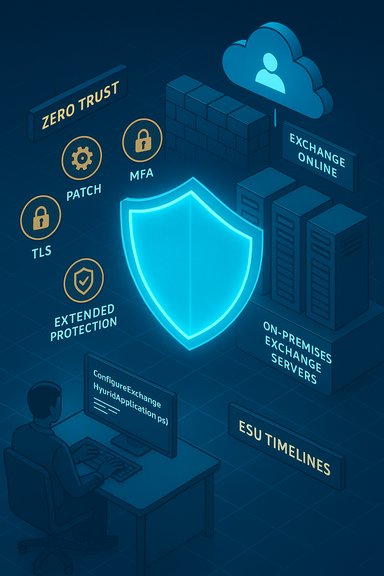 Background
Microsoft Exchange Server occupies a unique, high‑value position in enterprise infrastructure: it handles mail flow, integrates with identity systems, and often bridges on‑premises environments with Microsoft 365. That combination makes Exchange a frequent target for attackers, and recent security workstreams in 2025 — including emergency hotfixes, targeted hardening changes, and end‑of‑support announcements — have put on‑prem Exchange squarely back in the spotlight. Microsoft’s hybrid model changes this calculus because a compromise of an on‑prem Exchange role can permit escalation into Exchange Online when legacy trust patterns exist between the two environments. CISA’s newly published “Microsoft Exchange Server Security Best Practices,” produced in coordination with the NSA and international partners, is intentionally concise and prescriptive: it’s a practical consolidation of steps administrators should adopt immediately — from patch discipline and decommissioning end‑of‑life (EOL) servers to configuration hardening (TLS, Extended Protection, Kerberos over NTLM), administrative separation, and modern authentication with multifactor controls. The guidance explicitly warns that threat activity targeting Exchange persists and that misconfigured or unpatched servers continue to be “high risk.” Why this alert matters now
A confluence of events makes the guidance more than theoretical:- Microsoft’s October 2025 cumulative updates included critical fixes and, importantly, signposted that Exchange Server 2016 and 2019 reached end of public support on October 14, 2025; organizations that cannot upgrade were offered a time‑limited Extended Security Update (ESU) bridge through April 14, 2026. Continuing to operate EOL Exchange without mitigations raises the attack surface substantially.
- A hybrid‑specific privilege escalation class of issues (notably CVE‑2025‑53786 and related hybrid trust concerns) prompted Microsoft to change hybrid architecture recommendations: the industry must move from a shared first‑party service principal to a tenant‑scoped Dedicated Exchange Hybrid App, and administrators must run cleanup and credential rotation steps to remove legacy trusted keys. Microsoft introduced scripts and an updated Hybrid Configuration Wizard (HCW) to automate much of this work.
- Multiple incident responses in 2025 emphasized that adversaries will chain on‑prem footholds to gain cloud privileges; CISA previously issued Emergency Directives and other high‑urgency communications focused on hybrid Exchange remediation. The new best‑practices guide synthesizes those requirements into a compact operational checklist targeted at both government and private sector administrators.
What the NSA/CISA best‑practices guide covers (practical summary)
The government guidance is short and to the point — a deliberate operational playbook — with the most actionable items summarized as follows:- Maintain a disciplined patching cadence and apply Microsoft security updates promptly.
- Migrate or decommission Exchange servers that have reached end of public support (Exchange 2016/2019), and treat ESU only as a short bridge, not a long‑term strategy.
- Ensure the Exchange Emergency Mitigation Service (EM service) remains enabled when suggested mitigations are needed prior to applying patches.
- Apply security baselines and built‑in protections (Defender for Exchange/Endpoint features where available).
- Restrict administrative access: use dedicated administrative workstations (DAWs), network segmentation, and role‑based access control (RBAC).
- Harden authentication and encryption: enforce modern TLS, HTTP Strict Transport Security (HSTS), Extended Protection for Authentication (EPA), and prefer Kerberos over NTLM.
- Adopt Modern Authentication/OAuth and require multifactor authentication (MFA) for privileged accounts.
- Configure certificate‑based signing and care for PowerShell serialization protections.
- Use the dedicated hybrid app model for hybrid environments; run the provided scripts (ConfigureExchangeHybridApplication.ps1) and the Service Principal Clean‑Up Mode to rotate or remove legacy keyCredentials.
- Disable unnecessary Exchange roles and legacy protocols, and use web application firewalls (WAFs) or reverse proxies for OWA/EAC exposure.
- Use strict transport protection and download domains for OWA to limit CSRF and cookie theft risks.
- Enforce split permissions and separation of duties for Exchange administration.
What administrators must do now — a prioritized, actionable runbook
The following sequence compresses the guidance into a defensible operational plan that can be executed under incident or urgent hardening timelines.- Inventory and triage
- Run an Exchange Health Checker across all Exchange servers and map CU/build numbers and hybrid participation.
- Identify internet‑facing and hybrid‑bridging servers first; these are highest risk.
- Patch and validate
- Apply applicable April/October 2025 hotfixes and the latest cumulative updates for your Exchange build. Ensure that the installed SU/CU matches Microsoft’s KB guidance for your SKU.
- Test in a staging/pilot ring that mirrors mail flow and hybrid features before broad deployment.
- Hybrid app and credential hygiene
- Create and enable the Dedicated Exchange Hybrid App using ConfigureExchangeHybridApplication.ps1 or the updated HCW.
- After validation, run Service Principal Clean‑Up Mode to remove legacy keyCredentials and rotate any remaining service principal secrets. Do not remove credentials prematurely — validate across all on‑prem servers first.
- Harden authentication & transport
- Enforce Modern Authentication, disable Basic Auth, enable MFA for all admins and delegated workflows.
- Enable Extended Protection (EPA) where supported; validate NTLM/Kerberos settings and channel binding. Consider impact on older clients before broad enforcement.
- Reduce exposure
- Remove or isolate unused Exchange roles; apply firewall ACLs to management interfaces; use WAFs or reverse proxies for EAC/OWA.
- Enforce strict TLS configurations and HSTS on public exchange endpoints.
- Decommission EOL servers
- If on Exchange 2016/2019, plan immediate migration to Exchange SE or Exchange Online; ESU is a temporary bridge only. Record decommissioning timelines and don't rely on ESU as a permanent solution.
- Detection and telemetry
- Correlate on‑prem IIS/PowerShell/Exchange logs with Entra ID and Exchange Online telemetry in a centralized SIEM.
- Add hunts for suspicious token issuance, anomalous hybrid admin operations, unusual ECP/PowerShell churn, and forged mail headers.
- Incident readiness
- Prepare IR playbooks: capture volatile evidence (memory, logs), assume lateral movement, rotate service and admin credentials if compromise suspected, and engage forensics/IR partners quickly.
Technical highlights and notable product changes to verify before acting
- Dedicated Hybrid App and HCW changes: Microsoft released ConfigureExchangeHybridApplication scripts and an updated Hybrid Configuration Wizard designed to create a tenant‑scoped hybrid service principal; administrators should run these per Microsoft guidance and verify that the shared service principal no longer contains tenant keyCredentials after cleanup.
- Export‑ExchangeCertificate change: October 2025 SUs block use of Export‑ExchangeCertificate for the Exchange Auth Certificate and its private key; use MonitorExchangeAuthCertificate for troubleshooting instead of exporting the private key. This is a security hardening measure that may affect automation or backups that relied on exported keys. Confirm any automation referencing Export‑ExchangeCertificate and adjust accordingly.
- End of public support for 2016/2019: Confirm whether a given Exchange estate is supported or requires ESU enrollment and plan migration timelines; public SUs for Exchange 2016/2019 ended in October 2025 with paid ESUs limited through April 14, 2026. This is central to long‑term risk posture.
Strengths of the government guidance and Microsoft’s response
- Concision and operational focus: The CISA/NSA guide is intentionally short — a pragmatic, checklist‑style product that busy administrators can act on immediately rather than wading through lengthy technical theory. That makes it useful in high‑urgency, patch‑and‑harden situations.
- Coordinated public/private messaging: Microsoft’s technical blog posts and the vendor’s provided scripts (HCW and ConfigureExchangeHybridApplication) align with CISA/NSA guidance, reducing ambiguity and giving administrators concrete remediation steps to follow.
- Emphasis on systemic fixes: Moving from shared first‑party principals to tenant‑scoped dedicated hybrid applications is an architectural solution that materially reduces the implicit trust surface and reduces the ability for an on‑prem compromise to be trivially escalated into the cloud.
Risks, tradeoffs, and limitations to be mindful of
- Operational disruption vs security: Some recommended changes — certificate rotations, Service Principal cleanup, or disabling legacy auth — can disrupt hybrid coexistence features (free/busy, MailTips) if not sequenced and tested carefully. Administrators must pilot and validate changes; premature cleanup of shared credentials before every on‑prem server is updated can cause outages.
- Dependence on customer action: The core mitigations require administrators to apply patches, change hybrid architecture and rotate credentials — tasks that can be slow in large enterprises. Patch lag and complex estate heterogeneity will leave residual exposure even after advisories are published.
- Detection blind spots: Hybrid trust abuse can produce limited cloud audit trails; on‑prem activity that issues or reuses hybrid tokens may not always create obvious cloud indicators. Full detection requires cross‑domain logging and behavioral baselining, which many organizations lack.
- Unverified exploitation claims: While advisories and vendors have expressed high concern, some public reporting of large‑scale exploitation may be inconsistent across trackers. Where precise exploitation claims or exposure counts are quoted, treat those numbers with caution and verify against organizational telemetry and vendor advisories.
Detection, hunting, and indicators to deploy now
- Correlate IIS/W3SVC logs with Exchange PowerShell and Entra ID logs. Look for:
- Suspicious POSTs to EWS or hybrid endpoints and anomalous Authorization cookie values.
- Unexpected ECP/PowerShell sessions or increased frequency of mailbox‑admin changes.
- Short‑lived token issuance events that coincide with administrative actions from an on‑prem host.
- SIEM hunts and EDR rules:
- Hunt for process chains where w3wp.exe or Exchange services spawn cmd/powershell with Base64‑encoded arguments (common in post‑exploit staging).
- Monitor outbound connections from Exchange hosts to unexpected endpoints.
- Flag sudden new service principals, credential additions, or RBAC role assignments in Entra ID.
- Preventive monitoring:
- Block management interfaces from the internet; require jump hosts or VPNs for admin access.
- Enable Defender for Endpoint detection rules and IDS/IPS signatures provided by vendors for recent Exchange/WSUS advisories.
The broader operational picture: WSUS and other tier‑0 concerns
The Exchange guidance arrives amid a broader stream of Tier‑0 warnings: October 2025 saw emergency out‑of‑band updates for other critical infrastructure services such as WSUS (Windows Server Update Services), where remote code execution flaws and public proof‑of‑concepts amplified urgency across patch teams. Treat Exchange and management services like WSUS as Tier‑0 infrastructure: their compromise has disproportionate downstream effects and therefore demands accelerated remediation and segmentation.Executive summary for leadership: three facts to present now
- Exchange server misconfiguration or delayed patching can allow an on‑prem compromise to be used to escalate into Exchange Online and your tenant controls; CISA and NSA now treat Exchange misconfiguration as high risk.
- Exchange Server 2016 and 2019 reached end of public support on October 14, 2025; ESU is a limited bridge only until April 14, 2026. Plan migrations or paid ESU enrollments immediately.
- Immediate priorities for IT spending and approvals: (1) patching and test rollouts for Exchange/WSUS/management plane, (2) investment in logging/SIEM to correlate on‑prem and cloud telemetry, and (3) incident response retainers and rapid credential rotation procedures.
Final assessment and outlook
The combination of vendor hardening (dedicated hybrid app, export restrictions on the Auth Certificate), government consolidation of best practices, and the EOL timeline for Exchange 2016/2019 creates a decisive operational moment: organizations that treat the guidance as advisory rather than mandatory risk persistent exposure. The good news is practical: the recommended mitigations are concrete, implementable, and supported by Microsoft tooling and scripts. The bad news is logistical — many enterprises will struggle to apply changes quickly across complex estates while avoiding operational disruption.Adopting the guidance — prioritized patching, migration off EOL builds, dedicated hybrid app adoption, credential rotation, and hardened authentication and transport — materially reduces the most dangerous attack vectors that turn an on‑prem foothold into a full tenant compromise. Where timelines or exact claims remain uncertain, verify the specific KB/update mappings against Microsoft’s Update Guide and correlate vendor advisories with actual telemetry in environment‑specific discovery before taking incident‑level actions. This is a pivotal hardening window: execute the runbook, validate each step, and assume attackers will attempt to weaponize any lingering weaknesses while the estate remains heterogeneous. The task is achievable, but only with disciplined inventory, prioritized patch windows, and operational coordination between Exchange, identity (Entra ID), and endpoint teams.
Source: Forbes NSA Issues Microsoft Exchange Server ‘High-Risk Of Compromise’ Alert
