

CISA and the NSA have issued coordinated, high‑urgency guidance for organisations running on‑premises or hybrid Microsoft Exchange Server and Windows Server Update Services (WSUS) after active exploitation of a critical WSUS vulnerability (CVE‑2025‑59287) and continued targeting of Exchange infrastructure, stressing immediate patching, zero‑trust controls, and operational hardening to prevent SYSTEM‑level compromise and supply‑chain style abuse.
Microsoft’s October 2025 security workstream included an emergency out‑of‑band (OOB) cumulative update to address a remote code execution (RCE) vulnerability in Windows Server Update Services (WSUS) tracked as CVE‑2025‑59287. The bug is a classic unsafe deserialization issue in WSUS web service endpoints that allows unauthenticated attackers to send crafted requests and achieve code execution in the WSUS process context—typically running at SYSTEM privilege. Microsoft published SKU‑specific OOB packages on October 23–24, 2025 that must be installed and followed by a reboot to complete remediation. At the same time, government cyber agencies led by CISA and the NSA, working with international partners, released consolidated hardening and operational guidance for Microsoft Exchange Server administrators. That guidance emphasizes foundational controls—zero‑trust principles, restricting administrative access, multifactor authentication (MFA), transport and protocol hardening (TLS, HSTS, Kerberos, SMB), decommissioning end‑of‑life servers, and rigorous patching baselines—to defend the messaging tier that remains a high‑value target for attackers. Both advisories elevate the treatment of WSUS and Exchange from routine server hygiene to tier‑0 infrastructure: trusted services whose compromise materially increases enterprise blast radius.
Executives should prioritise funding and staffing for:
The immediate actions are unambiguous: inventory your WSUS and Exchange estates, apply Microsoft’s out‑of‑band WSUS fixes and reboot, isolate or block unreachable WSUS endpoints until patched, and implement the CISA/NSA hardening checklist for Exchange—starting with MFA, administrative restriction, and protocol hardening. Prioritise detection of the exact indicators described above and preserve full forensic artifacts if exploitation is suspected; these steps convert urgent guidance into operationally measurable outcomes.
Source: teiss https://www.teiss.co.uk/news/cisa-a...re-wsus-and-microsoft-exchange-servers-16641/
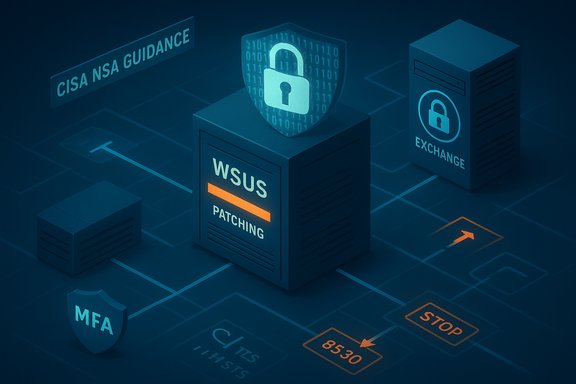 Background
Microsoft’s October 2025 security workstream included an emergency out‑of‑band (OOB) cumulative update to address a remote code execution (RCE) vulnerability in Windows Server Update Services (WSUS) tracked as CVE‑2025‑59287. The bug is a classic unsafe deserialization issue in WSUS web service endpoints that allows unauthenticated attackers to send crafted requests and achieve code execution in the WSUS process context—typically running at SYSTEM privilege. Microsoft published SKU‑specific OOB packages on October 23–24, 2025 that must be installed and followed by a reboot to complete remediation. At the same time, government cyber agencies led by CISA and the NSA, working with international partners, released consolidated hardening and operational guidance for Microsoft Exchange Server administrators. That guidance emphasizes foundational controls—zero‑trust principles, restricting administrative access, multifactor authentication (MFA), transport and protocol hardening (TLS, HSTS, Kerberos, SMB), decommissioning end‑of‑life servers, and rigorous patching baselines—to defend the messaging tier that remains a high‑value target for attackers. Both advisories elevate the treatment of WSUS and Exchange from routine server hygiene to tier‑0 infrastructure: trusted services whose compromise materially increases enterprise blast radius.The WSUS RCE (CVE‑2025‑59287): technical précis and operational impact
What the vulnerability is and why it matters
- Root cause: unsafe deserialization of an AuthorizationCookie or similar serialized payload in WSUS web services, where legacy .NET deserialization (e.g., BinaryFormatter‑style patterns) reconstructs objects without adequate type restrictions, enabling execution of attacker‑controlled payloads.
- Privilege and vector: remote, unauthenticated HTTP(S) requests against WSUS management endpoints (commonly on TCP 8530/8531) can trigger code execution under SYSTEM, giving attackers full control over the WSUS host.
- Trust anchor risk: WSUS is a trusted internal update distributor; a compromised WSUS can be used to alter catalogs, manipulate approvals, or push malicious payloads that endpoints will accept—turning one server break into enterprise‑wide distribution.
Timeline — disclosure, proof‑of‑concept, and active exploitation
- October 14, 2025: initial fixes were included in Patch Tuesday, but follow‑up analysis found the initial update incomplete for some SKUs.
- Mid‑October 2025: public proof‑of‑concept exploit code began to circulate.
- October 23–24, 2025: Microsoft issued SKU‑specific out‑of‑band cumulative updates that bundle necessary servicing stack updates; the OOB packages supersede the October 14 rollups and require a reboot.
- October 23–24, 2025: multiple security vendors and national CERTs observed scanning and exploitation attempts against internet‑accessible WSUS endpoints, and CISA added the CVE to its Known Exploited Vulnerabilities (KEV) catalog, imposing accelerated remediation expectations for federal agencies.
Observed post‑exploit behavior (what incident responders have reported)
- WSUS worker processes (w3wp.exe) or wsusservice.exe spawning cmd.exe → powershell.exe.
- Execution of Base64‑encoded PowerShell delivered via command line (-EncodedCommand/-ec), reading commands from custom headers to conceal actions.
- Reconnaissance commands (whoami, net user /domain, ipconfig /all) and exfiltration to external webhook endpoints.
CISA & NSA guidance for Exchange and WSUS: core recommendations
The joint guidance packages and advisories make clear that the immediate WSUS patching event sits within a broader risk landscape that includes Microsoft Exchange servers. The guidance is practical and prescriptive—prioritise containment now, and institute long‑term structural changes.Short‑term and emergency actions (must‑do)
- Patch WSUS immediately: Install the Microsoft OOB update corresponding to your server SKU and reboot WSUS hosts. This is the definitive vendor fix.
- If you cannot patch right away:
- Disable the WSUS Server Role (if acceptable operationally), or
- Block inbound TCP 8530/8531 at the host firewall to render WSUS non‑operational (note: blocking at the perimeter alone may be insufficient).
- Inventory: Identify all Windows servers with the WSUS Server Role enabled; prioritise hosts reachable from untrusted networks.
- Hunt for indicators immediately in IIS, WSUS logs, and EDR — specifically search for malformed AuthorizationCookie entries or process chains where w3wp.exe/wsusservice.exe spawned command shells.
Exchange hardening and systemic controls
Agencies recommend a comprehensive hardening checklist for Exchange servers that mirrors zero‑trust principles and operational best practices:- Enforce Zero‑Trust: deny‑by‑default access, least privilege, and strict network segmentation around management and messaging infrastructure.
- Restrict administrative access: remove direct internet‑facing admin paths, use dedicated administrative workstations, and enforce role‑based access control (RBAC).
- Multifactor authentication (MFA): require MFA for all privileged accounts and delegated admin operations; disable legacy Basic Authentication and NTLM where possible.
- Transport and protocol hardening:
- Enforce modern TLS configurations and HTTP Strict Transport Security (HSTS) on Exchange endpoints.
- Audit and phase out NTLM, strengthen Kerberos deployment and channel binding.
- Harden SMB settings to limit anonymous access and signing exceptions.
- Decommission end‑of‑life (EOL) Exchange servers: migrate EOL instances off of production networks or retire them into fully isolated maintenance environments; unsupported servers must not be internet‑reachable.
- Patch discipline and baselines: adopt stricter patch cadences for tier‑0 assets; document and enforce security baselines (CIS, DISA, Microsoft security baselines).
Practical incident response and detection guidance
Immediate investigative steps (ordered)
- Isolate any WSUS host that shows IOC evidence (IIS logs showing POSTs to ClientWebService endpoints, process spawn chains, or base64 PowerShell execution).
- Preserve volatile evidence: capture memory, disk images, IIS logs, WSUS SoftwareDistribution logs, and related security/event logs for forensic analysis.
- Rotate credentials used by WSUS/Exchange servers and any service accounts if compromise is suspected; assume lateral movement until proven otherwise.
- Engage IR: involve internal incident response teams or third‑party forensic specialists to determine scope and eradication steps.
Detection rules and IOCs to deploy now
- IIS/W3SVC logs with POSTs to:
- /SimpleAuthWebService/SimpleAuth.asmx
- /ClientWebService/Client.asmx
- /ReportingWebService/ReportingWebService.asmx
- ApiRemoting30/WebService.asmx (look for anomalous AuthorizationCookie values).
- Process chains: w3wp.exe or wsusservice.exe → cmd.exe → powershell.exe with -EncodedCommand payloads; search for suspicious child processes and encoded commands in telemetry.
- Unusual outbound connections from WSUS hosts to webhooks or IPs not associated with your update infrastructure.
- EDR/IPS signatures: apply vendor rule packs for CVE‑2025‑59287; many vendors released IDS/IPS and EDR detections within hours of PoC publication.
Operational tradeoffs and communications for leadership
Hardening WSUS and Exchange involves tradeoffs between availability and immediate security. Disabling WSUS or blocking ports will stop internal patch distribution until services are restored, which may temporarily increase exposure to other vulnerabilities. Communicate these tradeoffs to executives with three clear facts: the vulnerability allowed unauthenticated SYSTEM execution on WSUS hosts; Microsoft released an OOB update on October 23–24, 2025 that must be installed followed by a reboot; and multiple vendors observed weaponisation and exploitation activity in the wild. Use these facts to secure fast approvals for emergency mitigations.Executives should prioritise funding and staffing for:
- Rapid patch deployment windows for tier‑0 systems.
- Incident response and forensic retainers.
- Investment in segmentation and management plane VPNs or zero‑trust access brokers to reduce internet exposure of critical services.
Strengths and limitations of the response so far — critical analysis
Notable strengths
- Rapid vendor fix: Microsoft issued OOB cumulative packages and bundled SSUs to make remediation less error‑prone; this reduced the window where incomplete patching would leave systems vulnerable.
- Coordinated public/private telemetry: several security vendors, national CERTs, and service providers published congruent IOCs and detection playbooks quickly, enabling defenders to act within hours of public PoC circulation.
- Government escalation: adding CVE‑2025‑59287 to CISA’s KEV catalog focused federal priorities and signalling high urgency to the private sector.
Potential risks and gaps
- Public PoC accelerates attacker activity: publication of exploit details reduces defenders’ remediation window and increases opportunistic scanning and exploitation. Several providers warned that PoC publication preceded widescale scanning.
- Incomplete telemetry in many orgs: smaller organisations and those with limited EDR/SIEM coverage may not detect subtle exploitation steps (custom headers, short‑lived powershell sessions), producing blind spots for post‑exploit lateral movement.
- Exposure counts are fluid and unverifiable: public estimates of internet‑exposed WSUS instances varied widely across scanners (roughly 2,500–8,000 reported by different projects). Treat these numbers as directional, not definitive. When flagging exposure statistics, use caution and validate with multiple independent scan datasets.
- Attribution remains uncertain: while some reporting hints at sophisticated actors, public attribution is premature without forensic evidence; agencies and vendors caution against definitive claims absent extended investigation. Flag attribution claims as tentative.
Prioritised remediation checklist (straightforward, actionable)
- Inventory: list WSUS and Exchange hosts, management exposure, and service account privileges.
- Patch WSUS: apply Microsoft’s OOB cumulative update for your SKU and reboot. Verify KB install and OS build.
- If unable to patch immediately: disable the WSUS Server Role OR block inbound TCP 8530/8531 on the host firewall. Do not revert mitigations until the OOB update is installed.
- Harden Exchange: enforce MFA, disable Basic/legacy authentication, apply TLS/HSTS, implement RBAC for admins, and decommission EOL servers or move them to isolated maintenance networks.
- Hunt and validate: search IIS/WSUS logs, EDR traces, and network logs for POSTs to WSUS endpoints, w3wp/wsusservice process child processes, and Base64 PowerShell execution.
- Preserve evidence and assume lateral movement if exploitation is confirmed: isolate, capture memory/disk, rotate credentials, and engage IR.
- Post‑remediation: validate WSUS catalog integrity and update distribution hygiene; review patching windows and move critical update infrastructure behind management VPNs or to cloud‑managed patching where appropriate (after risk assessment).
Long‑term defensive changes that organisations should budget for now
- Treat update infrastructure (WSUS, internal SCCM/ConfigMgr, patch proxies) as tier‑0 assets with dedicated monitoring, hardened images, and restricted administrative access.
- Migrate toward zero‑trust management planes: use jump hosts, conditional access, and ephemeral admin sessions; reduce direct internet reachability of management endpoints.
- Retire or compensate for legacy serialization frameworks: remove BinaryFormatter and similar unsafe deserializers from internal code and replace them with safe serializers and strict type whitelisting.
- Implement robust emergency patching playbooks for OOB updates and practice them; include communications plans for expected update interruptions when WSUS is temporarily disabled.
What to tell auditors and regulators (concise messaging)
- Confirm that the organisation applied the correct Microsoft OOB package for each WSUS SKU and performed the required reboot; document KB and build numbers.
- Record any temporary mitigations (disable WSUS or host‑level port blocks) with timestamps and business impact assessments.
- Preserve forensic artifacts and a timeline of discovery/remediation to support any required incident reporting to regulators or partners.
Final assessment and cautionary flags
CVE‑2025‑59287 is a high‑impact, actively weaponised vulnerability because it combines unauthenticated, network‑accessible attack surface with SYSTEM privilege and the trust inherent in update distribution. Government and industry responses—Microsoft’s OOB fixes, CISA’s KEV listing, and the joint Exchange hardening guidance from CISA/NSA and international partners—are appropriate and proportionate. However, defenders must remain pragmatic: public PoCs and mixed telemetry mean exploitation opportunities will continue while inventories remain incomplete and EDR coverage is uneven. Organisations should assume a worst‑case posture until internal telemetry proves otherwise, and treat WSUS and Exchange as crown‑jewels for zero‑trust protection and continuous monitoring.The immediate actions are unambiguous: inventory your WSUS and Exchange estates, apply Microsoft’s out‑of‑band WSUS fixes and reboot, isolate or block unreachable WSUS endpoints until patched, and implement the CISA/NSA hardening checklist for Exchange—starting with MFA, administrative restriction, and protocol hardening. Prioritise detection of the exact indicators described above and preserve full forensic artifacts if exploitation is suspected; these steps convert urgent guidance into operationally measurable outcomes.
Source: teiss https://www.teiss.co.uk/news/cisa-a...re-wsus-and-microsoft-exchange-servers-16641/
