

CISA on May 21, 2026 republished ABB’s advisory for three medium-severity flaws in B&R Automation Runtime’s System Diagnostics Manager, affecting Automation Runtime versions before 6.4 and potentially enabling session takeover, browser-session script execution, or malicious formula injection through generated CSV files. The advisory is not a panic siren, and ABB’s own language makes clear that exploitation depends on network access, user interaction, or both. But it is exactly the kind of industrial-control-system bulletin that deserves attention because the vulnerable surface is diagnostic, familiar, and easy to underestimate. In operational technology, “medium” rarely means “minor”; it often means “one bad network assumption away from becoming interesting.”
The headline number here is CVSS 6.1 for two of the issues and 4.2 for the predictable identifier flaw, all in the comfortable middle of the vulnerability scale. That is the sort of rating that can sink in an enterprise patch queue behind browser zero-days, VPN pre-auth bugs, and whatever fresh catastrophe has landed in the identity stack this week. In a conventional IT environment, that triage may even be rational.
Industrial systems punish that habit. B&R Automation Runtime is not another desktop utility; it is middleware used to run applications on B&R target systems, with deployments in energy and other critical-infrastructure-adjacent environments. The affected component, System Diagnostics Manager, is a web-accessible diagnostic interface exposed through the Automation Runtime web server.
That context changes the reading of the advisory. A reflected cross-site scripting bug in a consumer web app is one thing; a reflected XSS bug in a diagnostic panel reachable from a production engineering network is another. The browser may be the point of execution, but the operational trust boundary is the real asset.
ABB and CISA both lean on the same underlying message: SDM should not be enabled unless it is required, and it should not be reachable from places where untrusted users, links, or traffic can interact with it. That sounds basic because it is basic. It is also the exact basic rule that gets violated in real plants, labs, commissioning environments, and hurried remote-support setups.
It also means defenders get the rare advantage of time. The initial ABB advisory appeared in October 2025, with a revision a week later adding CVE-2025-11498. CISA’s May 2026 republication does not appear to introduce a new exploit chain; it increases visibility by converting and posting ABB’s CSAF advisory through the ICS advisory channel.
That timing is worth spelling out because security teams often treat CISA republication as if it were the moment a vulnerability became real. In this case, the vendor fix has existed since Automation Runtime 6.4. The May 2026 CISA notice is a distribution event, not the beginning of remediation.
Still, republication has practical force. Many asset owners do not continuously monitor every vendor PSIRT page, especially across mixed OT fleets where automation, safety, networking, and Windows systems each have their own advisory channels. A CISA ICS advisory is often the point at which a plant security engineer, managed service provider, or corporate risk team finally sees the issue in the same queue as the rest of the operational risk register.
ABB says SDM is disabled by default in Automation Runtime 6. That is the most important mitigating fact in the advisory, and it should prevent a large class of systems from being exposed by accident. But “disabled by default” is not the same as “not present,” and it is certainly not the same as “not enabled anywhere in the field.”
Diagnostic tooling has a habit of becoming permanent infrastructure. It is switched on during commissioning, left available for troubleshooting, opened to a maintenance VLAN, bookmarked by an engineer, and rediscovered years later during an audit. By then, the original reason for enabling it may have vanished, but the risk remains.
The advisory’s recommended posture is blunt: do not enable SDM when it is not required, and do not expose it outside properly secured production networks. That is not vendor boilerplate; it is the architectural fix that matters even more than the patch. If an attacker cannot reach the diagnostic surface and cannot lure a user into interacting with it, these particular vulnerabilities lose much of their value.
None of that sounds like cinematic remote compromise. The attacker has work to do. A user must click a link for the XSS case, and the CSV issue adds an additional step: the generated file has to be manually opened. The session identifier flaw requires guessing or predicting a session ID, and ABB notes that SDM does not currently process session-specific data or implement authentication mechanisms at the session level.
That last detail is easy to misread. If session takeover does not grant obvious privileged access inside SDM, then CVE-2025-3449 may be less dangerous than the phrase “take over already established sessions” suggests. But it is still a signal that the component’s session semantics were not designed with hostile network conditions in mind.
The more interesting pattern is how the user’s browser becomes the attacker’s bridge into an industrial diagnostic context. Reflected XSS and CSV injection are not exotic weaknesses. They are old web-application failures wearing OT clothing. Their relevance comes from where the web page lives and who is likely to open it.
Engineers click links. Vendors send links. Integrators share links in tickets, chats, emails, QR codes, and field-service documentation. Maintenance teams often work under time pressure, from laptops that bridge corporate and production contexts, while dealing with equipment that is already misbehaving. The advisory’s own workaround language names exactly these channels: email, social media, messaging services, comment-enabled webpages, and QR codes.
That is not paranoia. It is a realistic map of how modern industrial work actually happens. The air-gapped plant is more mythology than baseline; remote access, vendor support, and segmented-but-connected engineering networks are now ordinary. When a vulnerability needs a user to click a crafted SDM link, the right question is not whether users click links. They do.
The CSV injection issue is a particularly good example of a low-glamour bug with practical consequences. CSV files are the duct tape of operations: exported, emailed, imported, attached to tickets, and opened in spreadsheet software without ceremony. Formula injection turns that mundane workflow into an execution path inside the user’s desktop environment, depending on how the file is opened and how spreadsheet protections are configured.
That is useful, and not only for compliance teams. The industrial ecosystem is fragmented by design. An energy operator may run Windows endpoints, domain controllers, VPN appliances, engineering workstations, PLC tooling, HMI software, historians, safety systems, and embedded runtimes from a dozen vendors. The security team may have great visibility into Microsoft Patch Tuesday and terrible visibility into automation-runtime advisories.
CISA’s ICS program exists in part to close that visibility gap. A vendor PDF on an ABB or B&R site may be enough for customers already subscribed to the right feed. A CISA advisory puts the issue in front of organizations whose vulnerability management processes are keyed to government advisories, sector alerts, or centralized risk dashboards.
The downside is that republication can create chronology confusion. The public advisory history shows ABB’s initial release in October 2025, an October 2025 update adding the CSV formula issue, and CISA republication on May 21, 2026. Teams that see only the CISA date may think this is brand-new. Teams that saw the ABB advisory last autumn may be tempted to ignore the republication. The right response is simpler: check whether SDM is enabled, check whether Automation Runtime is below 6.4, and act according to exposure.
Patching automation runtime software is not the same as patching a web browser. Asset owners have to account for uptime requirements, validation, vendor support, change-control windows, safety implications, and the possibility that a seemingly routine software update affects application behavior. CISA explicitly reminds organizations to perform impact analysis and risk assessment before deploying defensive measures.
That caveat is often mistaken for hesitation. It is not. It is a recognition that operational availability is part of security in OT, not an excuse to do nothing. A rushed patch that disrupts a production line can create its own safety and business risks, while an unpatched diagnostic surface reachable from a flat network creates a different class of risk.
The sensible path is staged. Identify affected versions, determine whether SDM is enabled, map who can reach it, and then schedule the update based on actual exposure. A controller with SDM disabled and no reachable web diagnostic interface is not in the same category as a controller with SDM enabled on a network accessible to contractor laptops and remote-support pathways.
The persistence of these recommendations is not evidence that CISA has run out of ideas. It is evidence that the foundational controls remain unevenly implemented. Vulnerabilities like these are dangerous precisely when diagnostic services are reachable from too many places and when the line between an engineering workstation, a vendor remote session, and a production controller is too casually drawn.
Segmentation is not just about blocking internet scanners. It is about containing the consequences of ordinary mistakes. If an engineer clicks a malicious SDM link from a corporate mailbox, the link should not be able to interact with a live controller interface. If a vendor support laptop joins a maintenance network, it should not inherit broad visibility into every diagnostic endpoint in the plant.
External web application firewalls may mitigate reflected XSS in some deployments, and ABB mentions that possibility. But a WAF in front of an industrial diagnostic interface is a compensating control, not a substitute for keeping that interface off hostile paths. The more fundamental question is whether the diagnostic page should be reachable by the user in the first place.
The XSS case is browser-centered. The CSV injection case is spreadsheet-centered. The operational workflow probably involves Windows engineering workstations, Microsoft Office or another spreadsheet tool, email clients, chat applications, remote-access clients, and documentation portals. In other words, the exploitability of a controller-side diagnostic weakness may depend heavily on the hygiene of ordinary Windows endpoints.
That should change how IT teams think about OT advisories. They are not someone else’s embedded problem. A malicious link delivered to a Windows workstation can be the user-interaction step that brings an OT vulnerability to life. A generated CSV opened on a Windows desktop can be the second-stage action that converts a diagnostic export into a security event.
This is where corporate IT and plant engineering need better shared language. IT teams understand phishing, browser isolation, macro restrictions, endpoint detection, and network segmentation. OT teams understand controller availability, maintenance windows, firmware compatibility, and process risk. Vulnerabilities like this sit exactly between those worlds.
Do not enable SDM if it is unnecessary. Do not access SDM through untrusted hyperlinks. Do not place active systems outside secured production networks. Do not allow unauthorized interaction with systems that should be physically and logically protected. This is old-school advice because the failure mode is old-school: a diagnostic service reachable from the wrong trust zone.
There is also an implied distinction between installed risk and exploitable risk. Automation Runtime below 6.4 may be affected, but exploitability depends on configuration and network placement. That distinction matters for prioritization, yet it should not become a loophole for indefinite deferral.
The safest interpretation is that Automation Runtime 6.4 is the durable fix, while disabling or isolating SDM is the immediate exposure reducer. Organizations that cannot patch quickly should still be able to reduce risk meaningfully by verifying SDM status and enforcing access boundaries. Organizations that can patch should avoid treating segmentation as a reason not to.
Those conditions are real, but so are the environments that satisfy them. A plant with weak segmentation, shared engineering accounts, legacy remote-access pathways, and informal vendor support workflows can turn conditional bugs into plausible incidents. The vulnerability score does not know whether your maintenance network is tidy or chaotic.
The other complication is forensic visibility. If a reflected XSS attack succeeds against a diagnostic interface, or if a CSV export is weaponized and opened on a workstation, the evidence may be scattered across web server logs, browser history, endpoint telemetry, email records, and user recollection. That is not the neat shape of a single exploit against a single server. It is a workflow compromise.
This is why the advisory’s lack of known exploitation should be comforting but not sedating. No known exploitation means defenders can avoid panic. It does not mean they can avoid inventory, exposure review, and change planning.
Where SDM is required, the next question is who can reach it. Access should be limited to known engineering hosts, maintenance jump boxes, or tightly controlled support paths. If a user can reach SDM from a general corporate browsing session, the organization has already accepted more risk than the advisory assumes.
The third question is how users are trained to reach diagnostic interfaces. Bookmarked internal portals, documented jump-host workflows, and controlled remote-support processes are boring by design. Clicking SDM links from email, chat, QR codes, or third-party pages is exactly the behavior the advisory warns against.
The fourth question is whether exported diagnostic data is treated as potentially active content. CSV is too often treated as plain text with columns, when in practice it can trigger spreadsheet behavior. Security teams should make sure endpoint and Office policies reflect that reality, especially on engineering workstations that handle data from industrial systems.
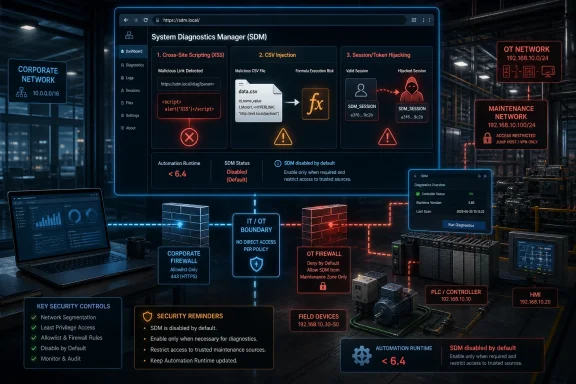 The Dangerous Part Is Not the Score, It Is the Setting
The headline number here is CVSS 6.1 for two of the issues and 4.2 for the predictable identifier flaw, all in the comfortable middle of the vulnerability scale. That is the sort of rating that can sink in an enterprise patch queue behind browser zero-days, VPN pre-auth bugs, and whatever fresh catastrophe has landed in the identity stack this week. In a conventional IT environment, that triage may even be rational.Industrial systems punish that habit. B&R Automation Runtime is not another desktop utility; it is middleware used to run applications on B&R target systems, with deployments in energy and other critical-infrastructure-adjacent environments. The affected component, System Diagnostics Manager, is a web-accessible diagnostic interface exposed through the Automation Runtime web server.
That context changes the reading of the advisory. A reflected cross-site scripting bug in a consumer web app is one thing; a reflected XSS bug in a diagnostic panel reachable from a production engineering network is another. The browser may be the point of execution, but the operational trust boundary is the real asset.
ABB and CISA both lean on the same underlying message: SDM should not be enabled unless it is required, and it should not be reachable from places where untrusted users, links, or traffic can interact with it. That sounds basic because it is basic. It is also the exact basic rule that gets violated in real plants, labs, commissioning environments, and hurried remote-support setups.
ABB Found the Bugs Before Attackers Made a Campaign Out of Them
The advisory says ABB’s internal security analysis identified the vulnerabilities, and ABB had no reports of exploitation when the advisory was issued. That matters. It means this is not, at least based on the public record, a post-incident cleanup notice or an admission that a threat actor has been living off the land through B&R diagnostic pages.It also means defenders get the rare advantage of time. The initial ABB advisory appeared in October 2025, with a revision a week later adding CVE-2025-11498. CISA’s May 2026 republication does not appear to introduce a new exploit chain; it increases visibility by converting and posting ABB’s CSAF advisory through the ICS advisory channel.
That timing is worth spelling out because security teams often treat CISA republication as if it were the moment a vulnerability became real. In this case, the vendor fix has existed since Automation Runtime 6.4. The May 2026 CISA notice is a distribution event, not the beginning of remediation.
Still, republication has practical force. Many asset owners do not continuously monitor every vendor PSIRT page, especially across mixed OT fleets where automation, safety, networking, and Windows systems each have their own advisory channels. A CISA ICS advisory is often the point at which a plant security engineer, managed service provider, or corporate risk team finally sees the issue in the same queue as the rest of the operational risk register.
The System Diagnostics Manager Is a Convenience Surface With Security Consequences
SDM is the sort of feature that makes sense until it becomes part of the attack surface. A web page that displays key diagnostic information about a running controller is useful to engineers, integrators, and support staff. It is also a tempting place for weaker assumptions about input handling, session state, and user interaction to linger.ABB says SDM is disabled by default in Automation Runtime 6. That is the most important mitigating fact in the advisory, and it should prevent a large class of systems from being exposed by accident. But “disabled by default” is not the same as “not present,” and it is certainly not the same as “not enabled anywhere in the field.”
Diagnostic tooling has a habit of becoming permanent infrastructure. It is switched on during commissioning, left available for troubleshooting, opened to a maintenance VLAN, bookmarked by an engineer, and rediscovered years later during an audit. By then, the original reason for enabling it may have vanished, but the risk remains.
The advisory’s recommended posture is blunt: do not enable SDM when it is not required, and do not expose it outside properly secured production networks. That is not vendor boilerplate; it is the architectural fix that matters even more than the patch. If an attacker cannot reach the diagnostic surface and cannot lure a user into interacting with it, these particular vulnerabilities lose much of their value.
Three Bugs, One Pattern: The Browser Becomes the Bridge
The three CVEs are different on paper, but they rhyme. CVE-2025-3449 concerns predictable numbers or identifiers in SDM, allowing an unauthenticated network-based attacker to take over already established sessions under the right conditions. CVE-2025-3448 is reflected cross-site scripting, where a crafted link can cause arbitrary JavaScript to run in the context of the victim’s browser session. CVE-2025-11498 is CSV formula injection, where malicious formula content can be placed into a generated CSV file that a user must then open.None of that sounds like cinematic remote compromise. The attacker has work to do. A user must click a link for the XSS case, and the CSV issue adds an additional step: the generated file has to be manually opened. The session identifier flaw requires guessing or predicting a session ID, and ABB notes that SDM does not currently process session-specific data or implement authentication mechanisms at the session level.
That last detail is easy to misread. If session takeover does not grant obvious privileged access inside SDM, then CVE-2025-3449 may be less dangerous than the phrase “take over already established sessions” suggests. But it is still a signal that the component’s session semantics were not designed with hostile network conditions in mind.
The more interesting pattern is how the user’s browser becomes the attacker’s bridge into an industrial diagnostic context. Reflected XSS and CSV injection are not exotic weaknesses. They are old web-application failures wearing OT clothing. Their relevance comes from where the web page lives and who is likely to open it.
User Interaction Is Not a Comfort Blanket in OT
Security advisories often downgrade risk when user interaction is required, and the CVSS vectors here reflect that. In traditional vulnerability scoring, a bug that needs someone to click a malicious link is less severe than one that can be exploited silently over the network. That is reasonable as a scoring convention, but it can be misleading as an operational assumption.Engineers click links. Vendors send links. Integrators share links in tickets, chats, emails, QR codes, and field-service documentation. Maintenance teams often work under time pressure, from laptops that bridge corporate and production contexts, while dealing with equipment that is already misbehaving. The advisory’s own workaround language names exactly these channels: email, social media, messaging services, comment-enabled webpages, and QR codes.
That is not paranoia. It is a realistic map of how modern industrial work actually happens. The air-gapped plant is more mythology than baseline; remote access, vendor support, and segmented-but-connected engineering networks are now ordinary. When a vulnerability needs a user to click a crafted SDM link, the right question is not whether users click links. They do.
The CSV injection issue is a particularly good example of a low-glamour bug with practical consequences. CSV files are the duct tape of operations: exported, emailed, imported, attached to tickets, and opened in spreadsheet software without ceremony. Formula injection turns that mundane workflow into an execution path inside the user’s desktop environment, depending on how the file is opened and how spreadsheet protections are configured.
CISA’s Republication Is a Visibility Move, Not a Fresh Alarm
CISA’s page makes clear that the advisory is a verbatim republication of ABB PSIRT SA25P003 through a CSAF conversion process. That phrasing is bureaucratic, but it matters. CISA is not claiming independent editorial authorship of the vendor’s technical findings; it is amplifying the advisory through its industrial-control-system distribution channel.That is useful, and not only for compliance teams. The industrial ecosystem is fragmented by design. An energy operator may run Windows endpoints, domain controllers, VPN appliances, engineering workstations, PLC tooling, HMI software, historians, safety systems, and embedded runtimes from a dozen vendors. The security team may have great visibility into Microsoft Patch Tuesday and terrible visibility into automation-runtime advisories.
CISA’s ICS program exists in part to close that visibility gap. A vendor PDF on an ABB or B&R site may be enough for customers already subscribed to the right feed. A CISA advisory puts the issue in front of organizations whose vulnerability management processes are keyed to government advisories, sector alerts, or centralized risk dashboards.
The downside is that republication can create chronology confusion. The public advisory history shows ABB’s initial release in October 2025, an October 2025 update adding the CSV formula issue, and CISA republication on May 21, 2026. Teams that see only the CISA date may think this is brand-new. Teams that saw the ABB advisory last autumn may be tempted to ignore the republication. The right response is simpler: check whether SDM is enabled, check whether Automation Runtime is below 6.4, and act according to exposure.
The Patch Is Straightforward; The Maintenance Window Is Not
ABB says the problem is corrected in Automation Runtime 6.4. In a consumer or cloud software context, that sentence would be the end of the story. Upgrade, restart, move on. In industrial environments, it is the beginning of negotiation.Patching automation runtime software is not the same as patching a web browser. Asset owners have to account for uptime requirements, validation, vendor support, change-control windows, safety implications, and the possibility that a seemingly routine software update affects application behavior. CISA explicitly reminds organizations to perform impact analysis and risk assessment before deploying defensive measures.
That caveat is often mistaken for hesitation. It is not. It is a recognition that operational availability is part of security in OT, not an excuse to do nothing. A rushed patch that disrupts a production line can create its own safety and business risks, while an unpatched diagnostic surface reachable from a flat network creates a different class of risk.
The sensible path is staged. Identify affected versions, determine whether SDM is enabled, map who can reach it, and then schedule the update based on actual exposure. A controller with SDM disabled and no reachable web diagnostic interface is not in the same category as a controller with SDM enabled on a network accessible to contractor laptops and remote-support pathways.
Segmentation Remains the Control Everybody Praises and Underfunds
The advisory’s recommended practices read like the OT security canon: minimize network exposure, keep control system devices off the internet, place control networks behind firewalls, isolate them from business networks, and use secure remote access when it is required. None of this is new. None of it is optional.The persistence of these recommendations is not evidence that CISA has run out of ideas. It is evidence that the foundational controls remain unevenly implemented. Vulnerabilities like these are dangerous precisely when diagnostic services are reachable from too many places and when the line between an engineering workstation, a vendor remote session, and a production controller is too casually drawn.
Segmentation is not just about blocking internet scanners. It is about containing the consequences of ordinary mistakes. If an engineer clicks a malicious SDM link from a corporate mailbox, the link should not be able to interact with a live controller interface. If a vendor support laptop joins a maintenance network, it should not inherit broad visibility into every diagnostic endpoint in the plant.
External web application firewalls may mitigate reflected XSS in some deployments, and ABB mentions that possibility. But a WAF in front of an industrial diagnostic interface is a compensating control, not a substitute for keeping that interface off hostile paths. The more fundamental question is whether the diagnostic page should be reachable by the user in the first place.
Windows Shops Should Care Even When the Runtime Is Not Windows
For WindowsForum readers, the obvious question is why this belongs in the same mental bucket as Windows security. The answer is that OT compromises rarely respect platform boundaries. The vulnerable runtime may live on B&R target systems, but the interaction path often runs through Windows laptops, browsers, VPN clients, spreadsheets, identity systems, and file shares.The XSS case is browser-centered. The CSV injection case is spreadsheet-centered. The operational workflow probably involves Windows engineering workstations, Microsoft Office or another spreadsheet tool, email clients, chat applications, remote-access clients, and documentation portals. In other words, the exploitability of a controller-side diagnostic weakness may depend heavily on the hygiene of ordinary Windows endpoints.
That should change how IT teams think about OT advisories. They are not someone else’s embedded problem. A malicious link delivered to a Windows workstation can be the user-interaction step that brings an OT vulnerability to life. A generated CSV opened on a Windows desktop can be the second-stage action that converts a diagnostic export into a security event.
This is where corporate IT and plant engineering need better shared language. IT teams understand phishing, browser isolation, macro restrictions, endpoint detection, and network segmentation. OT teams understand controller availability, maintenance windows, firmware compatibility, and process risk. Vulnerabilities like this sit exactly between those worlds.
ABB’s Mitigations Are Conservative Because the Real Enemy Is Reachability
The advisory’s mitigating factors are notable for what they do not promise. ABB does not say the bugs are harmless. It does not tell customers to rely on obscurity, and it does not suggest that SDM’s disabled-by-default posture is enough for every environment. Instead, the advice keeps returning to exposure.Do not enable SDM if it is unnecessary. Do not access SDM through untrusted hyperlinks. Do not place active systems outside secured production networks. Do not allow unauthorized interaction with systems that should be physically and logically protected. This is old-school advice because the failure mode is old-school: a diagnostic service reachable from the wrong trust zone.
There is also an implied distinction between installed risk and exploitable risk. Automation Runtime below 6.4 may be affected, but exploitability depends on configuration and network placement. That distinction matters for prioritization, yet it should not become a loophole for indefinite deferral.
The safest interpretation is that Automation Runtime 6.4 is the durable fix, while disabling or isolating SDM is the immediate exposure reducer. Organizations that cannot patch quickly should still be able to reduce risk meaningfully by verifying SDM status and enforcing access boundaries. Organizations that can patch should avoid treating segmentation as a reason not to.
Medium-Severity Bugs Become High-Friction Incidents
There is a reason industrial advisories often feel anticlimactic to people raised on exploit chains and emergency browser updates. Many OT vulnerabilities do not come with a public exploit, a ransomware crew name, or a screenshot of a shell. They come with awkward conditional phrasing: if enabled, if reachable, if a user clicks, if a file is opened.Those conditions are real, but so are the environments that satisfy them. A plant with weak segmentation, shared engineering accounts, legacy remote-access pathways, and informal vendor support workflows can turn conditional bugs into plausible incidents. The vulnerability score does not know whether your maintenance network is tidy or chaotic.
The other complication is forensic visibility. If a reflected XSS attack succeeds against a diagnostic interface, or if a CSV export is weaponized and opened on a workstation, the evidence may be scattered across web server logs, browser history, endpoint telemetry, email records, and user recollection. That is not the neat shape of a single exploit against a single server. It is a workflow compromise.
This is why the advisory’s lack of known exploitation should be comforting but not sedating. No known exploitation means defenders can avoid panic. It does not mean they can avoid inventory, exposure review, and change planning.
The Practical Test Is Whether SDM Is Actually Needed
The cleanest operational question is not “How bad are these CVEs?” It is “Why is SDM enabled here?” If the answer is vague, historical, or based on convenience rather than a current operational requirement, disabling it may deliver a faster security gain than any patch committee can approve.Where SDM is required, the next question is who can reach it. Access should be limited to known engineering hosts, maintenance jump boxes, or tightly controlled support paths. If a user can reach SDM from a general corporate browsing session, the organization has already accepted more risk than the advisory assumes.
The third question is how users are trained to reach diagnostic interfaces. Bookmarked internal portals, documented jump-host workflows, and controlled remote-support processes are boring by design. Clicking SDM links from email, chat, QR codes, or third-party pages is exactly the behavior the advisory warns against.
The fourth question is whether exported diagnostic data is treated as potentially active content. CSV is too often treated as plain text with columns, when in practice it can trigger spreadsheet behavior. Security teams should make sure endpoint and Office policies reflect that reality, especially on engineering workstations that handle data from industrial systems.
The Action Plan Hidden Inside a Modest Advisory
This is not the kind of vulnerability notice that should produce a dramatic weekend shutdown across every B&R site. It is the kind that should produce a disciplined, documented check of version, configuration, reachability, and user workflow. The organizations that handle it well will be the ones that already know where their diagnostic surfaces are.- Automation Runtime versions before 6.4 are the affected branch for the three SDM vulnerabilities described in the advisory.
- Automation Runtime 6.4 is the vendor-corrected version, but deployment should still follow OT change-control and impact-analysis practices.
- SDM is disabled by default in Automation Runtime 6, so the highest-priority discovery task is confirming whether it has been enabled in real deployments.
- Systems with SDM enabled and reachable from broad engineering, corporate, vendor, or remote-access networks deserve faster attention than isolated systems with SDM disabled.
- Users should not access SDM through untrusted hyperlinks, and teams should treat CSV exports from diagnostic workflows as potentially dangerous active content.
- Network segmentation, firewalling, and controlled remote access remain the difference between a medium advisory and a serious operational incident.
References
- Primary source: CISA
Published: 2026-05-21T12:00:00+00:00

ABB B&R Automation Runtime | CISA
www.cisa.gov
- Related coverage: johnsoncontrols.com
- Related coverage: br-automation.com
Use of insecure algorithm for self-signed certificates
Automation Runtime and mapp Viewwww.br-automation.com
