

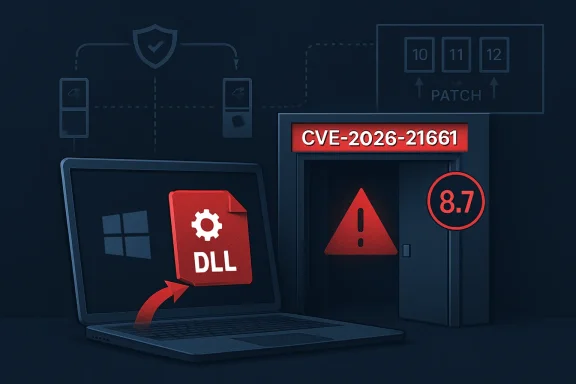
CISA on May 5, 2026 republished a Johnson Controls advisory warning that CEM AC2000 versions 10.6, 11.0, and 12.0 contain a high-severity DLL hijacking flaw, CVE-2026-21661, that can let a standard local user escalate privileges on the host machine. That sentence sounds narrow, almost reassuring: local access, no remote exploitation, no reported attacks. But in physical security systems, “local” is not the same as “low consequence.” The advisory is a reminder that access-control software sits at the awkward intersection of Windows endpoint hygiene, building security, and industrial-control risk.
The vulnerability at issue is an uncontrolled search path element, better known in Windows circles as DLL hijacking. In plain English, the affected application can be tricked into loading the wrong dynamic-link library from a location an attacker can influence. If that application runs with elevated privileges, the attacker’s code can inherit a more powerful security context than the user originally had.
That is why the CVSS 3.1 score lands at 8.7, firmly in high-severity territory, even though the attack vector is local. The advisory describes low attack complexity, low privileges required, no user interaction, and a changed scope, with high confidentiality and integrity impact and low availability impact. This is not a wormable internet-facing bug, but it is a clean privilege-escalation path once an attacker has a foothold.
For ordinary desktop software, that might be filed under “patch in the next maintenance window.” For an access-control platform deployed in commercial facilities, government environments, manufacturing, transport, and energy, it has a different flavor. CEM AC2000 is not just another Windows application; it is part of the machinery that decides who can move through a building, when, and under what rules.
The uncomfortable lesson is that physical security software often depends on the same Windows assumptions that enterprise IT has spent decades trying to harden. Search paths, service accounts, local admin sprawl, shared workstations, and legacy client software all become part of the control plane. A bug that begins as a DLL loading mistake can become a governance problem when the host sits inside a badged-door ecosystem.
That shift is good in many ways. Centralized identity, better audit trails, automated provisioning, and integration with video and visitor-management systems can make facilities safer and easier to run. But the price of that integration is that weaknesses familiar to Windows administrators now matter to facilities teams, and weaknesses familiar to facilities teams now matter to Windows administrators.
A privilege-escalation flaw in an access-control management host does not automatically unlock every door. It does, however, raise the stakes around who can touch that host, what software is installed on it, and whether ordinary user accounts are allowed to interact with privileged processes. If the server or client workstation is treated like a kiosk, a shared admin box, or a convenience terminal in a security office, “standard user” may be a lower bar than the risk model assumes.
That is the danger of reading “not remotely exploitable” as “not urgent.” Attack chains are rarely built from one glamorous vulnerability. They are built from boring steps: phishing, weak credentials, remote access, local execution, privilege escalation, persistence, and then movement toward the systems that actually matter.
The reason this class keeps returning is that it hides in the seams between application behavior, installer choices, working directories, permissions, and operational habits. A developer may assume a path is safe. An installer may grant broad write permissions. An admin may run a client from a directory where ordinary users can write files. A service may load a component without a fully qualified path.
On paper, the fix is straightforward: specify safe paths, constrain permissions, and ensure the application loads only trusted libraries from trusted locations. In practice, products with long lifecycles, customer-specific deployments, and legacy Windows assumptions can carry these issues for years. Physical security software is especially exposed to that reality because many deployments are conservative by design.
That conservatism is understandable. Facilities teams do not casually change software that controls badge access for airports, plants, offices, hospitals, or government sites. But the same reluctance that reduces operational disruption can also keep brittle configurations alive long after the rest of the enterprise has moved on.
The harder question is what “apply the update” means in a real facility. Access-control systems often have server components, operator workstations, integrations, controller communications, reporting functions, and occasionally bespoke workflows that grew up around local business practices. Even when the software update itself is routine, the testing around it may not be.
This is where the CISA language about impact analysis and risk assessment matters. In IT, emergency patching often means accepting some application risk to reduce security exposure. In operational environments, especially ones linked to doors, gates, alarms, or regulated areas, the patch decision has to account for both cyber risk and physical continuity.
Still, a high-severity local privilege escalation should not be left to drift. The right response is not panic; it is disciplined scheduling. Security teams should identify affected versions, validate which hosts run CEM AC2000 components, confirm whether operator workstations are in scope, and coordinate with facilities before moving to the vendor-recommended releases.
Privilege escalation is the connective tissue of intrusions. Attackers often enter with limited rights and then look for a way to become more powerful on the machine they already control. If that machine has privileged access to a physical security application, or if it stores credentials and configuration data for one, the value of escalation rises quickly.
The advisory also says the vulnerability is not exploitable remotely. That narrows the initial attack surface, but it does not remove exposure from environments where remote desktop access, VPN access, jump boxes, vendor support tools, or shared workstations are part of daily operations. A local exploit can be reachable from afar if the attacker can first obtain an interactive session.
This is why defenders should think in attack paths rather than labels. “Local” describes how the exploit is triggered; it does not describe how the attacker got there, what they can do afterward, or how important the compromised host is to the business.
A badging system wants HR data. A visitor-management system wants email integration. A security operations center wants video, alarms, maps, and reporting. A managed service provider wants remote support. Executives want dashboards. Every useful integration pushes the system closer to the business network, and every bridge creates a new reason to revisit the threat model.
That does not mean organizations should retreat to isolated islands of technology. It means segmentation has to be real, documented, and tested. A firewall rule that nobody understands is not a security boundary. A VPN that lands vendors inside a flat network is not a compensating control. A domain-joined security workstation with broad local permissions is not a harmless convenience.
The best-run environments increasingly treat physical security systems as critical enterprise platforms. They are inventoried, patched, monitored, backed up, and included in incident-response exercises. They are not left to the facilities closet simply because the software happens to control doors rather than spreadsheets.
That creates a coordination problem. Facilities may own the application. Security operations may own the consequences. IT may own the servers, domain policies, EDR tooling, backups, and remote access. Procurement may own the vendor relationship. Nobody owns the risk unless the organization deliberately assigns it.
A practical response starts with inventory. Which CEM AC2000 versions are deployed? Which hosts run server components? Which hosts run operator clients? Which service accounts are involved? Which users can log on locally? Which directories are writable by standard users? Which remote-access paths can reach those machines?
The next step is privilege review. If a standard user can interact with an application path that a privileged CEM AC2000 process later uses, the organization has a risk beyond this specific CVE. If operators routinely use shared accounts, if vendor support accounts are overprivileged, or if local administrators are not controlled, patching the vendor bug closes one door while leaving several windows open.
The same vulnerability on a lab workstation and on a physical security management server are not equivalent. The same exploit on a rarely used client and on a 24/7 badging workstation are not equivalent. The same “local” requirement in a locked server room and on a shared security desk machine are not equivalent.
That is why asset context matters more than severity theater. Organizations should not treat every CVSS 8.7 as an existential crisis. They should, however, treat a CVSS 8.7 in an access-control environment as a reason to ask sharper questions about privilege, segmentation, and operational dependency.
The advisory’s affected sectors underline the point. Critical manufacturing, commercial facilities, government services, transportation, and energy are not fringe deployments. They are the places where physical access and operational continuity matter. When the software governing that access has a privilege-escalation flaw, the risk discussion moves beyond the endpoint.
CEM AC2000 is vendor software that organizations install, operate, and rely on for a security-critical business function. It has versions, releases, advisories, mitigations, and hardening guidance. It also has operational inertia. That combination is exactly what supply-chain risk looks like in the real world: not a mysterious dependency buried in code, but a product whose update cadence must fit into business operations.
The vulnerability was reported by Tom Hulme of CSACyber, according to the advisory. That detail matters because coordinated disclosure is the healthier version of the story. A researcher reports a bug, the vendor produces mitigations, CISA republishes the advisory, and customers get a chance to act before known exploitation appears.
But disclosure only works if customers have a path to action. If the organization cannot identify affected systems, cannot schedule an update, cannot contact the vendor, or cannot test the change without risking building operations, then the advisory becomes a piece of paper rather than a security control.
Vendor support arrangements are especially important here. Many building systems depend on integrators or support providers that need periodic access. That access may be well controlled, logged, and time-bound. It may also be a standing VPN account, a remote desktop path, or a support tool installed years ago and rarely reviewed.
The right control is not simply “ban remote access.” That is unrealistic in many distributed facilities and can harm resilience when something breaks after hours. The better control is to make remote access explicit: named accounts, multifactor authentication, just-in-time access where possible, restricted network reach, session logging, and periodic review.
If a support path can land a technician or attacker on a CEM AC2000 host as a standard user, CVE-2026-21661 gives defenders a reason to care about what happens next. The patch addresses the known bug. The access review addresses the broader pattern.
Security teams should review writable directories in and around the application, especially where binaries or libraries are loaded. They should verify that ordinary users cannot write to application install paths, plugin directories, service working directories, or locations used by scheduled tasks. They should also confirm that endpoint detection and application-control policies apply to physical security hosts, not just ordinary office endpoints.
Logging deserves attention as well. If an attacker abuses a local privilege-escalation flaw, defenders may see unusual file writes, suspicious DLL loads, new services, modified scheduled tasks, or unexpected child processes from trusted application binaries. Those signals are easy to miss if building-security servers are excluded from monitoring because they are “sensitive” or “owned by facilities.”
Backups and recovery are part of the same story. Access-control systems contain configuration data, user databases, schedules, and audit trails. A security incident that corrupts or manipulates those systems can create operational confusion even if doors do not dramatically swing open. Clean, tested backups remain one of the least glamorous and most important controls.
Phishing and social engineering are common ways attackers obtain the first foothold that local exploits then expand. A malicious attachment, a fake support request, a stolen credential, or a remote-access lure can put an attacker on a workstation with limited rights. From there, a local privilege-escalation flaw becomes a way to turn inconvenience into control.
This matters in physical security environments because operators are often trained around safety, access procedures, and incident response, not necessarily around the latest endpoint attack chains. A security desk may be excellent at challenging a person without a badge and still vulnerable to a convincing email about a software update or visitor-management issue.
Training should be role-specific. The people who operate access-control systems should know not only that phishing exists, but why their workstation is valuable. When users understand that their terminal can influence physical access, security advice becomes less abstract.
If the answer is “facilities,” the organization may miss the Windows and network controls that make the difference between exposure and resilience. If the answer is “IT,” the organization may underestimate operational constraints around doors, badges, alarms, and regulated areas. If the answer is “security,” the organization may identify the risk without owning the maintenance path.
The mature answer is joint ownership with clear roles. Facilities owns operational requirements. IT owns platforms and access controls. Cybersecurity owns risk assessment, monitoring, and incident response. Procurement and vendor management ensure support channels and maintenance entitlements are usable when a patch lands.
That sounds bureaucratic until the day a high-severity advisory appears and nobody knows whether the affected system is on version 10.6, 11.0, 12.0, or something older. Asset ownership is not paperwork; it is the difference between a 48-hour response and a month of archaeology.
CEM AC2000 is not unique in that respect. Building management systems, video platforms, badge systems, HVAC controllers, alarm systems, and industrial gateways have all moved into the software-defined enterprise. They may not carry the cultural prestige of cloud-native platforms, but attackers do not care about prestige. They care about leverage.
This advisory should therefore be read as part of a larger convergence story. The boundary between cyber and physical security is no longer conceptual. It runs through Windows hosts, network segments, service accounts, VPN concentrators, and maintenance contracts.
The organizations that handle this well will be the ones that stop treating physical security software as a special exception. Special operational requirements, yes. Special exemption from patching, monitoring, access control, and inventory, no.
Source: CISA Johnson Controls CEM AC2000 | CISA
 The Local Bug That Should Not Be Dismissed as Local
The vulnerability at issue is an uncontrolled search path element, better known in Windows circles as DLL hijacking. In plain English, the affected application can be tricked into loading the wrong dynamic-link library from a location an attacker can influence. If that application runs with elevated privileges, the attacker’s code can inherit a more powerful security context than the user originally had.That is why the CVSS 3.1 score lands at 8.7, firmly in high-severity territory, even though the attack vector is local. The advisory describes low attack complexity, low privileges required, no user interaction, and a changed scope, with high confidentiality and integrity impact and low availability impact. This is not a wormable internet-facing bug, but it is a clean privilege-escalation path once an attacker has a foothold.
For ordinary desktop software, that might be filed under “patch in the next maintenance window.” For an access-control platform deployed in commercial facilities, government environments, manufacturing, transport, and energy, it has a different flavor. CEM AC2000 is not just another Windows application; it is part of the machinery that decides who can move through a building, when, and under what rules.
The uncomfortable lesson is that physical security software often depends on the same Windows assumptions that enterprise IT has spent decades trying to harden. Search paths, service accounts, local admin sprawl, shared workstations, and legacy client software all become part of the control plane. A bug that begins as a DLL loading mistake can become a governance problem when the host sits inside a badged-door ecosystem.
Access Control Has Become an IT System With Real-World Consequences
The phrase “access control” still evokes card readers, turnstiles, guards, and locked doors. Modern systems, however, are databases, Windows services, thick clients, web interfaces, APIs, controllers, and integrations with HR systems and identity platforms. They are physical security products, but they increasingly behave like enterprise applications.That shift is good in many ways. Centralized identity, better audit trails, automated provisioning, and integration with video and visitor-management systems can make facilities safer and easier to run. But the price of that integration is that weaknesses familiar to Windows administrators now matter to facilities teams, and weaknesses familiar to facilities teams now matter to Windows administrators.
A privilege-escalation flaw in an access-control management host does not automatically unlock every door. It does, however, raise the stakes around who can touch that host, what software is installed on it, and whether ordinary user accounts are allowed to interact with privileged processes. If the server or client workstation is treated like a kiosk, a shared admin box, or a convenience terminal in a security office, “standard user” may be a lower bar than the risk model assumes.
That is the danger of reading “not remotely exploitable” as “not urgent.” Attack chains are rarely built from one glamorous vulnerability. They are built from boring steps: phishing, weak credentials, remote access, local execution, privilege escalation, persistence, and then movement toward the systems that actually matter.
DLL Hijacking Is Old, Boring, and Still Dangerous
DLL hijacking is not a new class of bug. Windows applications have long depended on dynamic libraries, and the order in which Windows searches for those libraries has been a recurring source of security mistakes. If an application looks in an unsafe directory before it looks in a trusted one, an attacker may be able to place a malicious DLL where the application will find it first.The reason this class keeps returning is that it hides in the seams between application behavior, installer choices, working directories, permissions, and operational habits. A developer may assume a path is safe. An installer may grant broad write permissions. An admin may run a client from a directory where ordinary users can write files. A service may load a component without a fully qualified path.
On paper, the fix is straightforward: specify safe paths, constrain permissions, and ensure the application loads only trusted libraries from trusted locations. In practice, products with long lifecycles, customer-specific deployments, and legacy Windows assumptions can carry these issues for years. Physical security software is especially exposed to that reality because many deployments are conservative by design.
That conservatism is understandable. Facilities teams do not casually change software that controls badge access for airports, plants, offices, hospitals, or government sites. But the same reluctance that reduces operational disruption can also keep brittle configurations alive long after the rest of the enterprise has moved on.
The Patch Guidance Is Simple; The Deployment Story Is Not
Johnson Controls’ remediation guidance is specific. CEM AC2000 12.0 users should move to 12.0 Release 10, 11.0 users should move to 11.0 Release 9, and 10.6 users should move to 10.6 Release 3. That is the clean vendor answer, and for organizations already current within those major versions, it may be a manageable update.The harder question is what “apply the update” means in a real facility. Access-control systems often have server components, operator workstations, integrations, controller communications, reporting functions, and occasionally bespoke workflows that grew up around local business practices. Even when the software update itself is routine, the testing around it may not be.
This is where the CISA language about impact analysis and risk assessment matters. In IT, emergency patching often means accepting some application risk to reduce security exposure. In operational environments, especially ones linked to doors, gates, alarms, or regulated areas, the patch decision has to account for both cyber risk and physical continuity.
Still, a high-severity local privilege escalation should not be left to drift. The right response is not panic; it is disciplined scheduling. Security teams should identify affected versions, validate which hosts run CEM AC2000 components, confirm whether operator workstations are in scope, and coordinate with facilities before moving to the vendor-recommended releases.
“No Known Exploitation” Is a Status, Not a Strategy
CISA says it has no reports of public exploitation specifically targeting this vulnerability. That is useful context, but it is not a risk waiver. Many local privilege-escalation bugs do not become famous because they are used quietly after initial access, not because they are irrelevant.Privilege escalation is the connective tissue of intrusions. Attackers often enter with limited rights and then look for a way to become more powerful on the machine they already control. If that machine has privileged access to a physical security application, or if it stores credentials and configuration data for one, the value of escalation rises quickly.
The advisory also says the vulnerability is not exploitable remotely. That narrows the initial attack surface, but it does not remove exposure from environments where remote desktop access, VPN access, jump boxes, vendor support tools, or shared workstations are part of daily operations. A local exploit can be reachable from afar if the attacker can first obtain an interactive session.
This is why defenders should think in attack paths rather than labels. “Local” describes how the exploit is triggered; it does not describe how the attacker got there, what they can do afterward, or how important the compromised host is to the business.
The Real Boundary Is Between Business IT and Building Systems
CISA’s recommended practices read like familiar ICS guidance: minimize network exposure, keep control systems away from the public internet, place control networks and remote devices behind firewalls, and isolate them from business networks. None of that is surprising. The problem is that access-control environments are often precisely where clean separation breaks down.A badging system wants HR data. A visitor-management system wants email integration. A security operations center wants video, alarms, maps, and reporting. A managed service provider wants remote support. Executives want dashboards. Every useful integration pushes the system closer to the business network, and every bridge creates a new reason to revisit the threat model.
That does not mean organizations should retreat to isolated islands of technology. It means segmentation has to be real, documented, and tested. A firewall rule that nobody understands is not a security boundary. A VPN that lands vendors inside a flat network is not a compensating control. A domain-joined security workstation with broad local permissions is not a harmless convenience.
The best-run environments increasingly treat physical security systems as critical enterprise platforms. They are inventoried, patched, monitored, backed up, and included in incident-response exercises. They are not left to the facilities closet simply because the software happens to control doors rather than spreadsheets.
Windows Administrators Have a Role Here
For Windows admins, this advisory should feel familiar. The vulnerability class is Windows-native, the mitigation depends on vendor updates, and the surrounding controls are standard endpoint and network hygiene. The difference is the asset owner may not sit in IT.That creates a coordination problem. Facilities may own the application. Security operations may own the consequences. IT may own the servers, domain policies, EDR tooling, backups, and remote access. Procurement may own the vendor relationship. Nobody owns the risk unless the organization deliberately assigns it.
A practical response starts with inventory. Which CEM AC2000 versions are deployed? Which hosts run server components? Which hosts run operator clients? Which service accounts are involved? Which users can log on locally? Which directories are writable by standard users? Which remote-access paths can reach those machines?
The next step is privilege review. If a standard user can interact with an application path that a privileged CEM AC2000 process later uses, the organization has a risk beyond this specific CVE. If operators routinely use shared accounts, if vendor support accounts are overprivileged, or if local administrators are not controlled, patching the vendor bug closes one door while leaving several windows open.
The CVSS Score Tells Only Part of the Story
CVSS is useful because it gives defenders a common language. An 8.7 high-severity score should get attention, and the vector string explains why: local access is balanced by low complexity, low required privilege, no interaction, changed scope, and significant confidentiality and integrity impact. But CVSS cannot fully express where a product lives inside an organization.The same vulnerability on a lab workstation and on a physical security management server are not equivalent. The same exploit on a rarely used client and on a 24/7 badging workstation are not equivalent. The same “local” requirement in a locked server room and on a shared security desk machine are not equivalent.
That is why asset context matters more than severity theater. Organizations should not treat every CVSS 8.7 as an existential crisis. They should, however, treat a CVSS 8.7 in an access-control environment as a reason to ask sharper questions about privilege, segmentation, and operational dependency.
The advisory’s affected sectors underline the point. Critical manufacturing, commercial facilities, government services, transportation, and energy are not fringe deployments. They are the places where physical access and operational continuity matter. When the software governing that access has a privilege-escalation flaw, the risk discussion moves beyond the endpoint.
The Supply Chain Is Not Just Cloud APIs and Open Source Packages
Security teams have spent the last several years obsessing over software supply chains, and rightly so. But the conversation often centers on cloud services, developer dependencies, CI/CD pipelines, and internet-facing applications. Building systems, access-control suites, and industrial-adjacent platforms belong in the same conversation.CEM AC2000 is vendor software that organizations install, operate, and rely on for a security-critical business function. It has versions, releases, advisories, mitigations, and hardening guidance. It also has operational inertia. That combination is exactly what supply-chain risk looks like in the real world: not a mysterious dependency buried in code, but a product whose update cadence must fit into business operations.
The vulnerability was reported by Tom Hulme of CSACyber, according to the advisory. That detail matters because coordinated disclosure is the healthier version of the story. A researcher reports a bug, the vendor produces mitigations, CISA republishes the advisory, and customers get a chance to act before known exploitation appears.
But disclosure only works if customers have a path to action. If the organization cannot identify affected systems, cannot schedule an update, cannot contact the vendor, or cannot test the change without risking building operations, then the advisory becomes a piece of paper rather than a security control.
Remote Access Is the Quiet Multiplier
CISA’s warning about VPNs is easy to skim past, but it deserves attention. VPNs are not magic tunnels of trust; they are access mechanisms that inherit the security posture of the devices and identities using them. A local-only vulnerability can become operationally relevant if remote users can reach and log into the affected host.Vendor support arrangements are especially important here. Many building systems depend on integrators or support providers that need periodic access. That access may be well controlled, logged, and time-bound. It may also be a standing VPN account, a remote desktop path, or a support tool installed years ago and rarely reviewed.
The right control is not simply “ban remote access.” That is unrealistic in many distributed facilities and can harm resilience when something breaks after hours. The better control is to make remote access explicit: named accounts, multifactor authentication, just-in-time access where possible, restricted network reach, session logging, and periodic review.
If a support path can land a technician or attacker on a CEM AC2000 host as a standard user, CVE-2026-21661 gives defenders a reason to care about what happens next. The patch addresses the known bug. The access review addresses the broader pattern.
The Hardening Work Around the Patch May Matter More Than the Patch Window
Updating to the recommended CEM AC2000 releases is the headline action, but the surrounding hardening work is where organizations will either reduce risk meaningfully or merely reset the clock until the next advisory. DLL hijacking vulnerabilities thrive when filesystem permissions and execution contexts are sloppy. Those are local hygiene issues, not just vendor issues.Security teams should review writable directories in and around the application, especially where binaries or libraries are loaded. They should verify that ordinary users cannot write to application install paths, plugin directories, service working directories, or locations used by scheduled tasks. They should also confirm that endpoint detection and application-control policies apply to physical security hosts, not just ordinary office endpoints.
Logging deserves attention as well. If an attacker abuses a local privilege-escalation flaw, defenders may see unusual file writes, suspicious DLL loads, new services, modified scheduled tasks, or unexpected child processes from trusted application binaries. Those signals are easy to miss if building-security servers are excluded from monitoring because they are “sensitive” or “owned by facilities.”
Backups and recovery are part of the same story. Access-control systems contain configuration data, user databases, schedules, and audit trails. A security incident that corrupts or manipulates those systems can create operational confusion even if doors do not dramatically swing open. Clean, tested backups remain one of the least glamorous and most important controls.
The Social-Engineering Advice Is Not Boilerplate
The advisory includes standard warnings about unsolicited links, attachments, email scams, and phishing. For a local privilege-escalation vulnerability, that might look like generic filler. It is not.Phishing and social engineering are common ways attackers obtain the first foothold that local exploits then expand. A malicious attachment, a fake support request, a stolen credential, or a remote-access lure can put an attacker on a workstation with limited rights. From there, a local privilege-escalation flaw becomes a way to turn inconvenience into control.
This matters in physical security environments because operators are often trained around safety, access procedures, and incident response, not necessarily around the latest endpoint attack chains. A security desk may be excellent at challenging a person without a badge and still vulnerable to a convincing email about a software update or visitor-management issue.
Training should be role-specific. The people who operate access-control systems should know not only that phishing exists, but why their workstation is valuable. When users understand that their terminal can influence physical access, security advice becomes less abstract.
The Patch Is a Test of Asset Ownership
Every advisory like this quietly asks an organizational question: who is responsible? If the answer is “Johnson Controls,” the organization has misunderstood shared risk. The vendor must fix the product, but the customer must know where it runs, how it is configured, who can access it, and when it can be updated.If the answer is “facilities,” the organization may miss the Windows and network controls that make the difference between exposure and resilience. If the answer is “IT,” the organization may underestimate operational constraints around doors, badges, alarms, and regulated areas. If the answer is “security,” the organization may identify the risk without owning the maintenance path.
The mature answer is joint ownership with clear roles. Facilities owns operational requirements. IT owns platforms and access controls. Cybersecurity owns risk assessment, monitoring, and incident response. Procurement and vendor management ensure support channels and maintenance entitlements are usable when a patch lands.
That sounds bureaucratic until the day a high-severity advisory appears and nobody knows whether the affected system is on version 10.6, 11.0, 12.0, or something older. Asset ownership is not paperwork; it is the difference between a 48-hour response and a month of archaeology.
The Door System Belongs in the Same Room as the Domain Controller
WindowsForum readers know the pattern. A product that once lived outside mainstream IT slowly becomes networked, integrated, domain-aware, remotely supported, and operationally critical. Then one day a vulnerability advisory arrives, and the organization discovers the system is both too important to patch casually and too exposed to ignore.CEM AC2000 is not unique in that respect. Building management systems, video platforms, badge systems, HVAC controllers, alarm systems, and industrial gateways have all moved into the software-defined enterprise. They may not carry the cultural prestige of cloud-native platforms, but attackers do not care about prestige. They care about leverage.
This advisory should therefore be read as part of a larger convergence story. The boundary between cyber and physical security is no longer conceptual. It runs through Windows hosts, network segments, service accounts, VPN concentrators, and maintenance contracts.
The organizations that handle this well will be the ones that stop treating physical security software as a special exception. Special operational requirements, yes. Special exemption from patching, monitoring, access control, and inventory, no.
The AC2000 Advisory Leaves Little Room for Comfortable Assumptions
The concrete response to CVE-2026-21661 is not complicated, but it does require coordination. The larger lesson is that “local” and “physical security” together should prompt analysis, not dismissal.- Organizations running CEM AC2000 12.0 should plan to upgrade to 12.0 Release 10.
- Organizations running CEM AC2000 11.0 should plan to upgrade to 11.0 Release 9.
- Organizations running CEM AC2000 10.6 should plan to upgrade to 10.6 Release 3.
- Security teams should treat affected AC2000 hosts as high-value systems and review local logon rights, writable paths, service permissions, and remote-access routes.
- Facilities, IT, and cybersecurity teams should coordinate testing and deployment rather than letting the advisory sit between departments.
- The absence of known public exploitation should inform urgency, not replace mitigation.
Source: CISA Johnson Controls CEM AC2000 | CISA
