

A newly published CISA advisory warns that Airleader Master — a widely deployed compressed-air control and monitoring platform — contains a critical file‑upload vulnerability that can be exploited to achieve remote code execution on affected installations. The advisory assigns the flaw CVE‑2026‑1358, gives it a CVSS v3.1 base score of 9.8 (Critical), and states that Airleader Master versions up to and including 6.381 are affected; CISA reports that Airleader recommends upgrading to version 6.386 or later to remediate the issue. rview
Airleader Master is an industrial control product used to manage compressed‑air stations and associated devices through an embedded web interface and service. It is deployed in industrial and critical‑infrastructure contexts worldwide and supports web‑based visualization, Modbus/OPC connectivity, and remote management features that make it useful — and, when vulnerabilities exist, attractive to adversaries. The Airleader product family and its web visualization components are documented on the vendor’s product pages.
The CISA advisory (ICSA‑26‑043‑10) describes an Unrestricted Upload of File with Dangerous Type (CWE‑434) that permits unauthenticated uploads to multiple webpages running with maximum privileges inside the product. In practical terms, the vulnerability allows an attacker who can submit an upload request to place a file the web server will accept and execute, opening a direct path to remote code execution (RCE) on the appliance. CISA notes the vulnerability affects many critical infrastructure sectors and that trted by a security researcher at SySS GmbH.
Airleader’s product line has seen multiple web‑interface vulnerabilities in recent years — the 2025 CVEs for path traversal and authenticated upload leading to RCE underline a repeating pattern where web features are a common weakness. That pattern reinforces two practical points for procurement and operations teams: insist on secure‑by‑design controls for web components in vendor products, and ensure your procurement contracts require timely vendor security advisories and patch distribution through authenticated channels.
Above all, do not wait for exploitation to implement these controls. Treat CISA’s advisory as both a specific incident response trigger and as a broader call to harden how your organization manages web‑enabled ICS devices.
— End of article.
Source: CISA Airleader Master | CISA
Airleader Master is an industrial control product used to manage compressed‑air stations and associated devices through an embedded web interface and service. It is deployed in industrial and critical‑infrastructure contexts worldwide and supports web‑based visualization, Modbus/OPC connectivity, and remote management features that make it useful — and, when vulnerabilities exist, attractive to adversaries. The Airleader product family and its web visualization components are documented on the vendor’s product pages.
The CISA advisory (ICSA‑26‑043‑10) describes an Unrestricted Upload of File with Dangerous Type (CWE‑434) that permits unauthenticated uploads to multiple webpages running with maximum privileges inside the product. In practical terms, the vulnerability allows an attacker who can submit an upload request to place a file the web server will accept and execute, opening a direct path to remote code execution (RCE) on the appliance. CISA notes the vulnerability affects many critical infrastructure sectors and that trted by a security researcher at SySS GmbH.
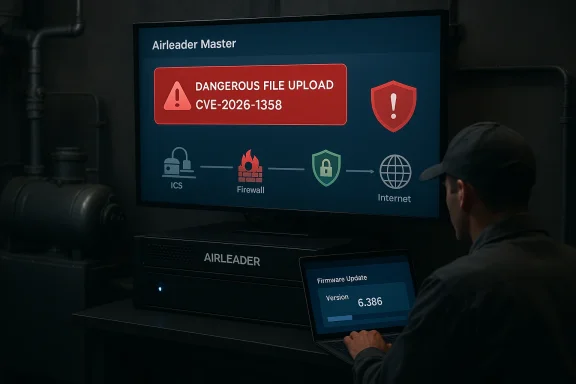 What the advisory actually says (concise, verifiable summary)
- The vulnerability identifier is CVE‑2026‑1358 and the flaw type is CWE‑434: Unrestrwith Dangerous Type.
- Affected product: Airleader Master (Airleader GmbH); affected .
- Impact: Unauthenticated remote attackers can upload files to web pages running at maximum privileges, and successful exploitation could result in remote code execution against the server software. CISA rated the issue CVSS v3.1 = 9.8 (Critical)vice recorded by CISA: upgrade Airleader Master to version 6.386 or later. The advisory also points operators to contact Airleader for mitigation assistance.
- CISA credited Lomeli of SySS GmbH**. The vendor and researcher attribution is included in the advisory.
Why this is important: technical and operational impact
Attack surface and exploitability
- CWE‑434 issues commonly allow an attacker to upload a web shell (JSP, PHP, ASP, etc.) or other server‑side payload to a web application that will store and then execute the uploaded content. When the web server is allowed to save and then interpret or execute uploaded files — especially on appliances with embedded app servers — this becomes a fast path to arbitrary command execution and persistent access. CISA’s advisory explicitly calls out RCE as a plausible consequence, which matches the classic exploitation chain for CWE‑434.
- CISA’s vector string (CVSS:3.1/AV:N/AC:L/PR:N/UI:N/S:U/C:network‑accessible, no privileges required, no user interaction, and high impact — in short, a remote, unauthenticated RCE with little to impede an attacker. That combination is why the advisory’s severity is classified as Critical.
Why ICS/OT operators should care
- Airleader devices are commonly used in m food and agriculture, water/wastewater, and other sectors cited by CISA. If an Airleader controller or server is exposed — directly or indirectly — to attacker‑accessible networks, the device becomes a high‑value foothold for attackers seeking to disrupt operations, pivot into corporate networks, or tamper with process controls. CISA explicitly lists the critical sectors potentially affected.
- ICS appliances frequently run with elevated privileges, and many installations still use default ac policies, or are accessible from corporate networks. Historically, similar upload‑to‑RCE flaws in web‑enabled control products have led to complete system takeovers and lateral movement. For context, Airleader products were previously the subject of file‑upload and path‑traversal CVEs in 2025 (for example, CVE‑2025‑46612), demonstrating a pattern where web upload panels have been a recurring risk in the product line.
Technical analysis — how CWE‑434 becomes RCE in practice
Typical exploitation sequence
- Attacker locates an upload endpoint (e.g., a web form, component like “Panel Designer” or “wizard/workspace.jsp”) that accepts files without robust file‑type validation.
- Attacker uploads a server‑side executable script or artifact (JSP, ASPX, PHP, binary drop) disguised to pass superficial filters or targeted at endpoints that do not validate content type.
- The application stores the file into the web root or another directory the application server will execute, or a path traversal enables placement into an executable directory.
- Attacker accesses the uploaded file via HTTP, triggering the server to interpret and run the payload, producing an interactive shell or one‑shot command execution.
- Using the shell, the attacker can deploy persistence, exfiltrate data, alter configurations, or pivot.
Why unauthenticated uploads happen
- Insufficient server‑side validatid extension checks.
- Acceptance of content types based on client‑supplied metadata (MIME) rather than server‑side inspection.
- Missing whitelist or enforcement of allowed file extensions and content scanning (e.g., refusing server‑side script extensions entirely).
- Web modules that run with elevated permissions (e.g., administrative dashboards) and accept file uploads for templating or panel design features. Past advisories for Airleader show a Panel Designer component has been an attack vector.
What administrators must do now — prioritized action plan
CISA’s advisory includes vendor remediation and recommended mitigations. Based on the advisory and general ICS security best practice, here is an urgent, practical playbook for operators:- Identify and inventory:
- List all Airleader Master installations and their exact firmware/software versions. Confirm whether any instance is at or below 6.381. If you have records in your CMDB, cross‑check them immediately. Inventory is step one: you cannot mitigate what you cannot find.
- Patch as directed (highest priority if feasiblvendor‑recommended update to version 6.386 or later if that is available and tested for your environment. CISA reports this upgrade as the vendor’s fix. If you manage production OT systems, stage the upgrade in a test environment first, following your OT change‑control process. Note: I could not find an independently posted Airleader vendor advisory confirming the 6.386 release at the time of writing; operators should contact Airleader support directly to obtain the authenticated patch artifact and patch notes.
- Contain exposure immediately (if you cannot patch right away):
- Remove any Airleader instances from direct internet exposure.
- Place the devices behind strict firewalls and access lists; only allow management connections from vetted jump hosts or an engineering VLAN.
- Block HTTP/HTTPS access from untrusted networks to the device’s web interface.
- Where possible, restrict uploads at network perimeter devices (web proxies, WAF rules) to prevent known dangerous upload patterns. CISA reiterates minimizing network exposure for ICS devices as an immediate defensive measure.
- Harden credentials and access:
- Enforce strong, unique passwords for all admin accounts. Rotate edentials.
- Implement multi‑factor authentication for management interfaces where supported.
- Limit administrative roles to named, monitored accounts only. Historical Airleader advisories show default or weak admin credentials have been a factor in past exploit chains; addressing credentials reduces risk of successful exploitation.
- Detection and logging:
- Increase logging of any file upload endpoints, monitoring for POSTs to upload endpoints, large payloads, or suspicious content types (e.g., JSP, ASPX, shell scripts).
- Monitor for new/unknown files in web‑visible directories and for unexpected web requests that directly access uploaded scripts.
- Forward logs to a central SIEM and create alerts for any detection of web shell behaviors or unusual process spawns.
- Incident readiness:
- If exploitation is suspected, snapshfilesystem and memory if possible), isolate the host, and perform forensic analysis. Preserve logs and backups. Report suspected incidents to your security team and to national authorities as required. CISA encourages reporting incidents to help track adversary activity.
Recommended technical mitigations (detailed)
- Enforce server‑side file validatable extensions and validate content signatures and magic bytes for uploaded files. Reject any server‑side executable file types.
- Sanitize and normalize paths before writing files; disallow upload destinations under the web root.
- Run web components under least privilege and use chroot/jailing where possible so that even if a file is written it cannot be executed.
- Employ runtime application self‑protection (RASP) or file‑integrity monitoring on appliances where supported.
- Use a Web Application Firewall (WAF) to block suspicious file upload patterns and known exploit payloads as a compensating control while a patch is pending.
- Regularly scan appliances with authenticated vulnerability scanners and schedule periodic pentests focused on web upload surfaces; a number of prior Airleader advisories came via third‑party testing.
Vendor response and verification (what we can confirm and what remains unverified)
- CISA’s advisory states the vendor recommends upgrading to 6.386. That recommendation is recorded in the advisory text and included in the remedial actions. Operators should treat the CISA advisory as authoritative for the vulnerability and mitigation steps it documents.
- I attempted to verify the vendor release notes or a public visory explicitly announcing version 6.386 and the CVE details; at the time of writing, the public vendor site lists product pages and specs but does not (in the pages returned by public search) present a clear security‑advisory page that mirrors the CISA text. For that reason, operators should obtain the patch and release notes directly from Airleader support or from an authenticated vendor channel before applying any upgrade. Treat any patch obtained outside of vendor channels with caution and verify cryptographic hashes.
- CISA credits the finder as a SySS researcher (Angel Lomeli). SySS is a known German penetration‑testing/research firm and has published prior advisories and findings on industrial products, including Airleader‑related issues in earlier years. That lends credibility to the researcher attribution in the advisory. Still, always confirm vendor patches and test them in your environment.
Broader context: Airleader’s security history and precedent
- Airleader products have appeared in publicly tracked CVEs in 2025 for web upload and path traversal issues (for example, the Panel Designer arbitrary file upload leading to RCE documented in CVE‑2025‑46612). Those prior CVEs show a pattern in which the product’s web‑based panels and upload features have been recurring vectors for serious vulnerabilities. This history increases the urgency for operators to treat the current advisory as a high priority and to scrub any web‑accessible panels for risky functionality.
- Industrial‑grade web UIs that implement creative features (wizard interfaces, dashboard panels, templating engines) often ship with file upload functionality for convenience. Without strict sanitization and execution isolation, convenience becomes a critical threat vector. The Airleader advisories of 2025 and now the CISA advisory for 2026 illustrate this general industry pattern.
Detection and forensics checklist (for security teams)
- Look for newly created files in web directory trees that are not part of normal deployment bundles.
- Alert on requests that contain suspicious multipart/form‑data upload payloads with executable extensions (.jsp, .php, .aspx, .war, .jar, etc.).
- Monitor for outbound connections initiated by the appliance to unusual hosts (indicative of shells calling home).
- Review integrity of service binaries and web application archives; compare to golden images.
- If a suspected compromise is found, preserve the entire VM or appliance image andgs, process lists, and cron/task schedules. Consider involving a digital forensics specialist for ICS environments.
Risk assessment — who is at highest risk, and why
- Facilities with Airleader Master devices exposed to the internet — or reachable from corporate IT networks that have internet access — are at the greateSA explicitly urges minimization of network exposure and isolation of control‑system networks.
- Organizations that have weak credential policies, shared or default administrative accounts, or insufficient logging are more likely to see rapid compromise if an upload exploit is used. Historical Airleader advisories have repeatedly flagged weak default credentials as enablers for exploit chains in related CVEs, so securing authentication posture is essential.
- The most serious operational impact would be in sectors where compressed‑air controls are tightly coupled to production or safety systems — manufacturing lines, chemical plants, food processing, and criticadowntime or deliberate misconfiguration can have immediate safety or economic consequences. CISA lists these sectors in the advisory.
Strengths and limitations of the advisory and mitigations
Notable strengths
- CISA’s advisory is clear, actionable, and prioritized. It provides the CVE, affected versions, a CVSS scredit, and a recommended vendor update — the essential elements busy operators need to triage and plan actions.
- The advisory reiterates standard, high‑value ICS mitigations (segmentation, minimization of internet exposure, VPN and jump host usage) that align withnciples. Those recommendations are practical and appropriate for time‑sensitive mitigation.
Limitations / caveats
- At the time of this article, I was unable to locate a public vendor‑hosted advisory on Airleader’s site that reproduces the same patch/version details as CISA (noting that Airleader’s product pages are available publicly). Given the stakes, operators should obtain the patch directly from Airleader via authenticated vendor support channels and validate release hashes. This is an important verification step before deployment.
- The advisory notes “no known public exploitation” at publication time. That is not reassurance that exploitation will lly, once a critical CVE is published, exploit development accelerates. Treat “no known exploitation” as a narrow‑window lull rather than safety.
- The advisory references remediation by version number only; administrators must validate compatibility and test in OT staging env a vendor release without testing can disrupt operations as easily as an exploit can. Follow OT change‑management processes.
- Immediately inventory all Airleader Master devices and confirm versions.
- If you are on ≤ 6.381, plan to apply the vendor‑recommended upgrade to 6.386 or later after verifying the patch via Airleader support and testing in a staging environment.
- If you cannot patch immediately: isolate devices, restrict web access to jump hosts, tighten fplement WAF or upload filtering where feasible.
- Strengthen credentials, enforce MFA for management, and rotate any default/shared passwords.
- Increase logging and deploy detection rules for suspicious upload activity and new web‑root files; forward logs tong.
- Conduct a focused pentest or vulnerability scan of your Airleader instances to verify remediation and to hunt for indicators of compromise. SySS and other researchers have previously disclosed related issues, demonstrating the value of proactive testing.
Closing analysis: what this advisory tells us about ICS web UIs and procurement
This advisory is a reminder that modern ICS devices increasingly expose complex web management features that, while convenient, expand the attack surface dramatically. The combination of web‑upload functionality, rich dashboarding tools, and embedded application servers requires vendors to build hardened upload handling and execution isolation from the start. Operators must treat web‑facing management consoles as high‑risk assets: they should be isolated, monitored, and patched on a schedule aligned with security priorities rather than convenience.Airleader’s product line has seen multiple web‑interface vulnerabilities in recent years — the 2025 CVEs for path traversal and authenticated upload leading to RCE underline a repeating pattern where web features are a common weakness. That pattern reinforces two practical points for procurement and operations teams: insist on secure‑by‑design controls for web components in vendor products, and ensure your procurement contracts require timely vendor security advisories and patch distribution through authenticated channels.
Above all, do not wait for exploitation to implement these controls. Treat CISA’s advisory as both a specific incident response trigger and as a broader call to harden how your organization manages web‑enabled ICS devices.
— End of article.
Source: CISA Airleader Master | CISA
