

Background
The headline here is straightforward, but the operational significance is not. GNSS receivers sit in the timing, positioning, and synchronization layer of modern infrastructure, which means they are often treated as utility devices until something goes wrong. That attitude is exactly why vulnerabilities in this category matter: when a receiver is trusted, lightly monitored, and reachable on a network, it can become a leverage point rather than just another box on a shelf.
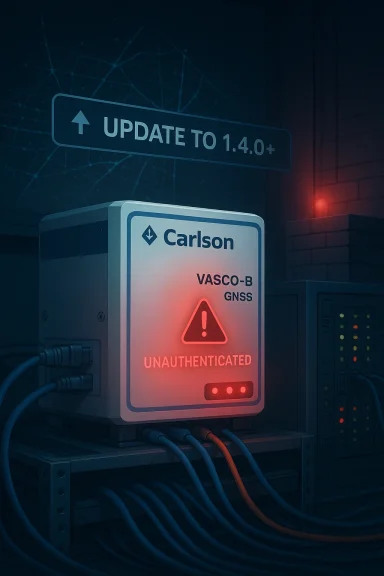
CISA’s advisory says the Carlson Software VASCO-B GNSS Receiver lacks an authentication mechanism, allowing an attacker with network access to directly access and modify configuration and operational functions without credentials. That maps to CWE-306: Missing Authentication for Critical Function, which is one of the most dangerous classes of control-plane failures because it removes the first barrier between a remote actor and a live device. In plain terms, this is not a “weak password” issue; it is a “no lock on the door” issue.
The severity score also tells part of the story. A CVSS 3.1 base score of 9.4 indicates remote reachability, low complexity, and high operational impact. CISA’s stated impact is especially important: successful exploitation could enable a remote attacker to alter critical system functions or disrupt device operation, which moves the issue beyond confidentiality into integrity and availability territory. For industrial and infrastructure-adjacent devices, that is usually the combination defenders worry about most.
Another notable aspect of the advisory is how quickly it was published and how plainly it is framed. CISA’s release date is April 23, 2026, and the agency’s remediation advice is direct: update to version 1.4.0 or greater and reduce exposure wherever possible. That combination of a hard version threshold and a strong network-hardening recommendation usually means defenders should treat the issue as both a patching problem and an architecture problem.
At a broader level, the advisory is a reminder that GNSS security is no longer niche. Timing and location systems underpin everything from field operations to synchronization-dependent enterprise workflows, and a compromised receiver can create effects that appear far from the original device. That makes this disclosure especially relevant to operators who may never think of a positioning appliance as part of the security perimeter.
What CISA Says
CISA’s summary is unusually direct: an attacker with network access could access and modify the receiver’s configuration and operational behavior without credentials. That statement matters because it points to a control surface that may be fully exposed once the device is reachable, rather than merely vulnerable after a login bypass or a chained exploit. When a product has no authentication gate for critical functions, the attack path is much shorter than defenders would like.
Key advisory facts
The advisory identifies the affected product as Carlson Software VASCO-B GNSS Receiver and states that all versions prior to 1.4.0 are affected. It lists the issue as CVE-2026-3893, with a critical 9.4 score and the weakness category Missing Authentication for Critical Function. Those details make the case unusually clean from a triage perspective: if the device is in that version range, it is exposed by definition.
CISA also notes the product is deployed worldwide and places it in the Critical Manufacturing sector. That matters because industrial and precision-infrastructure devices are often distributed across plants, sites, and contractor-managed environments where asset visibility is incomplete. If a device is not accurately inventoried, a fix can exist on paper while the real fleet remains exposed in practice.
- Affected version: before 1.4.0
- CVE: CVE-2026-3893
- Severity: CVSS 9.4 critical
- Weakness class: CWE-306 missing authentication
- Recommended fix: update to 1.4.0 or greater
Why the wording matters
The phrase “without needing credentials” is the critical detail. It means the issue is not about an ordinary authentication failure under edge conditions; it is about a missing enforcement point on the device itself. In security terms, that often translates into a much broader set of possible actions, because once the attacker can speak to the management or control interface, the device may assume they are trusted.
That is why this type of flaw is dangerous even when the device is not directly internet-facing. Many operational systems are reachable through segmented business networks, remote-support jump paths, or vendor-maintained access channels. Any one of those trust paths can become the entry point if the product does not demand authentication before accepting critical commands.
Why GNSS Receivers Matter
GNSS receivers are often underestimated because they are not flashy endpoints. They do not resemble a server room compromise or a ransomware outbreak, but they can influence downstream systems that depend on timing, location, or synchronized state. That makes integrity a first-class concern, not a secondary one.
Operational dependence
In manufacturing and precision environments, GNSS-based timing can support process coordination, logging, telemetry alignment, and other operational tasks that depend on consistent reference signals. If an attacker can alter receiver configuration, they may not need to “break” the device in a dramatic way to cause harm. Small configuration changes can still produce outsized operational effects when the device is part of a broader control chain.
The threat also extends beyond obvious outages. A malicious actor could potentially degrade timing quality, disrupt synchronization, or introduce subtle misconfigurations that are harder to detect than a full crash. That sort of low-noise manipulation is often more useful to attackers than noisy destruction because it can persist longer and delay detection.
- Timing and synchronization errors can ripple into dependent systems.
- Configuration tampering may be harder to spot than a device outage.
- Operational trust in the receiver can become a single point of failure.
- “Internal-only” exposure is still exposure if the trust boundary is weak.
The trust problem
The real issue is trust inheritance. Once a device is accepted as a reliable reference source, other systems may consume its output without questioning it every time. That is efficient in normal operations, but it becomes dangerous if the device’s management plane can be altered remotely without authentication.
This is why the advisory is more than a routine embedded-device patch notice. It is a warning that a trusted operational component may be easier to manipulate than its operators assume. Trust in infrastructure is only as strong as the access controls protecting the components that provide it.
Technical Risk Profile
The vulnerability is classified as missing authentication for a critical function, which is one of the bluntest forms of access-control failure. Unlike a logic bug deep in a parser or a memory corruption flaw that needs chaining, this class often gives an attacker a direct route to privileged behavior if they can reach the interface. That is part of why the score is so high.
Attack preconditions
The advisory says the attacker needs network access. That sounds limiting at first, but in real deployments it is often the easiest prerequisite to satisfy. A device reachable from a flat internal segment, a maintenance VLAN, or a remote-access path may be far less isolated than documentation suggests.
Because no credentials are required, the attack complexity remains low. An attacker would not need to brute-force an account, steal a token, or wait for a user to log in. They would simply need a reachable path to the vulnerable service and enough knowledge of the interface to invoke the relevant function.
- Requires network reachability, not local access
- Does not require valid credentials
- Can target configuration and operational controls directly
- Likely to be attractive to opportunistic attackers once public details circulate
Impact analysis
CISA rates confidentiality impact as low, but integrity and availability are both high. That is a useful clue to how defenders should think about the flaw: the main danger is not data theft, but unauthorized change and disruption. In infrastructure-adjacent devices, those two outcomes can be enough to create cascading operational issues.
The score of 9.4 is also a reminder that “critical” is not just a label attached to a CVE; it reflects a combination of reachability, privilege requirements, and effect. Low friction plus high impact is the worst combination for a network-facing control device.
Vendor Remediation
Carlson Software’s official remediation path, as reflected in the advisory, is to update to version 1.4.0 or greater. That is the cleanest possible answer from a patching standpoint, but operationally it still requires verification that the device can be updated safely and that the update actually lands on every deployed unit.
What defenders should verify
An effective response should begin with asset identification. Teams need to know where every VASCO-B unit is deployed, what version it runs, and whether any devices sit on networks that are broader than necessary. Without that inventory, patching becomes a guessing game, and guessing games are exactly how industrial exposures linger.
It is also worth checking whether the update process itself requires downtime or on-site access. In many industrial deployments, the hardest part is not downloading the fix but scheduling the maintenance window and proving that the replacement firmware preserves required functionality. That is why remediation plans often fail at the last mile even when the vulnerability is well understood.
- Identify all VASCO-B GNSS Receiver assets.
- Confirm whether any unit is below 1.4.0.
- Review network exposure and remote-access paths.
- Apply the vendor update to 1.4.0 or later.
- Validate post-update behavior and configuration integrity.
Patch versus exposure
A patched device can still be a problem if it remains too exposed. CISA explicitly recommends minimizing network exposure and ensuring control system devices are not accessible from the internet. That advice is not generic boilerplate; it is a recognition that even a corrected device may remain an attractive target if its management surface is easy to reach.
This is where defense in depth matters. Patching addresses the flaw, but segmentation, firewalls, and restricted remote access reduce the chance that a vulnerability can be exploited before patching is complete or after new issues appear. The best remediation is the one that survives imperfect asset inventories and real-world maintenance delays.
Network Exposure and Segmentation
CISA’s guidance emphasizes minimizing network exposure, placing control-system networks behind firewalls, and isolating them from business networks. That set of recommendations is especially relevant for a device like this because the advisory itself says exploitation requires network access. If access is the prerequisite, then access control is the first defensive layer.
The practical security model
In practice, this means the receiver should not be left broadly reachable from user networks, contractor segments, or the public internet. If a device only needs to talk to a narrow set of systems, then the network should reflect that reality. Overly permissive routing is a common reason industrial vulnerabilities become incidents instead of advisories.
Remote access deserves special scrutiny. CISA recommends VPNs when remote access is required, while also warning that VPNs are not a magic shield. That is a useful reminder that the true question is not “Do we have VPN?” but “What can reach the device once the tunnel is up?”
- Remove unnecessary internet exposure
- Segment operational devices from general business traffic
- Restrict remote administration to tightly controlled paths
- Use firewalls to enforce least privilege at the network layer
- Treat VPN access as a control, not a cure-all
Why segmentation still matters
Segmentation buys time, and time is valuable when a device is vulnerable. Even if a flaw exists, a segmented device is harder to find, harder to abuse, and harder to pivot through. That does not eliminate risk, but it meaningfully shrinks the blast radius.
This is especially important for critical manufacturing environments, where equipment often has longer replacement cycles and more complicated maintenance dependencies. A vulnerability that looks simple on paper can become operationally messy if the device sits in a place where patching requires production coordination, vendor approval, or physical access.
Broader Lessons for Industrial and Infrastructure Teams
The Carlson disclosure is a good example of why industrial cybersecurity is really about governance as much as code quality. A device with missing authentication is not just a technical mistake; it is evidence that operational trust may have been assumed too early in the product lifecycle. That kind of assumption is hard to undo after deployment.
Procurement and lifecycle lessons
Organizations buying GNSS or other operational appliances should be asking harder questions about authentication design, update cadence, and support horizon. If a device can influence critical functions, then the vendor’s security posture is part of the procurement decision, not an afterthought. Security debt in infrastructure products often becomes migration debt later.
This also reinforces the value of version tracking. A device fleet can look healthy at a distance while still containing one or more units frozen on an old build. If the fix threshold is 1.4.0, then version visibility becomes a control objective, not just an IT housekeeping task.
- Ask vendors how authentication is implemented for critical functions
- Verify update mechanisms before purchase
- Track versions at the individual-device level
- Treat management interfaces as sensitive assets
- Plan for lifecycle replacement, not just emergency patching
Operational reality
Many industrial deployments rely on “temporary” exceptions that become permanent. That can include shared administrative access, broad internal reachability, or exception-based remote support. The problem is that attackers love permanent exceptions, because they are often the easiest things to discover and abuse.
The most useful response, then, is not only to patch this one advisory but to revisit the assumptions around every similar device in the environment. If a GNSS receiver can be altered remotely without authentication, there may be other appliances in the same environment that deserve the same scrutiny. One advisory often reveals a wider control-plane problem.
Strengths and Opportunities
The good news is that this is a relatively clean disclosure from a defense standpoint. CISA has identified the affected product family, the vulnerable version range, the root weakness class, and the recommended fix. That gives operators a concrete path to reduce exposure quickly if they can inventory their deployed devices accurately.
It also creates an opportunity to strengthen broader industrial hygiene, not just patch one receiver. Teams can use the event to review segmentation, remote access, version management, and asset ownership across all similar devices. Sometimes a single critical advisory becomes the forcing function that finally gets neglected infrastructure documented and segmented properly.
- Clear affected range: all versions before 1.4.0
- Clear fix path: upgrade to 1.4.0 or later
- Clear weakness class: missing authentication
- Useful trigger for asset inventory cleanup
- Good moment to harden remote access and firewall rules
- Opportunity to review similar embedded devices for the same flaw pattern
Risks and Concerns
The biggest concern is that the flaw is simple to understand and likely simple to abuse if the device is reachable. Missing authentication for a critical function is the sort of weakness that can turn into a real-world incident quickly once the vulnerable device is exposed inside a flat network or through a poor remote-access path.
Another concern is incomplete visibility. Organizations often do not maintain perfect inventories of embedded or site-specific operational devices, especially when the equipment is purchased outside central IT channels. That makes patching slower and creates a dangerous gap between advisory publication and actual remediation.
- Unknown asset inventory can delay fixes
- Broad internal network reachability increases exploitation risk
- Remote-support exceptions may be wider than intended
- Operational downtime may slow patch deployment
- Compromised configuration could affect downstream systems
- Lack of public exploitation is not the same as lack of attacker interest
A final concern is timing. CISA says there is no known public exploitation at this time, but that is a snapshot, not a guarantee. For an attacker looking for easy leverage, a network-reachable device with missing authentication is exactly the kind of issue that gets attention once it becomes widely known.
Looking Ahead
The next thing to watch is adoption of the vendor fix. If Carlson Software’s 1.4.0 release is straightforward to deploy, the risk should drop quickly for organizations that can find and update all affected units. If deployment proves operationally difficult, the exposure window may last much longer than the advisory suggests.
It will also be important to watch for whether defenders use this as a cue to audit the rest of their operational-device fleet. One missing authentication flaw often signals a broader trust boundary problem, and organizations that treat it that way are more likely to reduce future exposure before the next advisory arrives. That is where the real value of an ICS bulletin lies: not just in the patch it recommends, but in the habits it forces organizations to examine.
- Confirm whether any VASCO-B units remain below 1.4.0
- Reduce or eliminate direct network exposure
- Review all remote-access paths and support exceptions
- Validate that configuration changes are authenticated
- Audit adjacent GNSS or control devices for similar flaws
The broader lesson is that industrial devices do not have to be glamorous to be dangerous. If a receiver can shape critical timing or operational behavior, then its management plane belongs in the same security conversation as servers, switches, and controllers. The Carlson VASCO-B advisory is a reminder that in modern infrastructure, the quiet devices are often the ones that deserve the loudest attention.