

A new high-severity advisory from the Cybersecurity and Infrastructure Security Agency (CISA) warns that EV charging management software from EV Energy — branded as ev.energy — contains a cluster of authentication and session-handling flaws that, if exploited, could give attackers administrative control over charging infrastructure or disrupt charging services through denial-of-service (DoS) techniques. The advisory lists four coordinated CVE entries tied to the vendor and assigns a near-critical CVSS rating, and CISA’s recommended defensive actions focus on network isolation, hardened remote access, and rapid risk assessment for operators. rview
ev.energy (sometimes styled ev.energy) is a UK-based energy‑software company that operates an EV charging orchestration and smart‑charging platform used by utilities, fleets, and residential customers to schedule and manage EV charging. The company markets load‑management features, tariff-aware scheduling, and integrations with a broad set of Level‑2 chargers and EV telematics; external profiles show the company is headquartered in London and works with international utility customers.
The newly publicized advisory is part of CISA’s ongoing series of Industrial Control Systems (ICS) advisories, which in recent years have increasingly featured electric‑vehicle charging systems and related grid‑edge equipment as attackers broaden their focus into energy and transportation sectors. Security reporting and industry analysis show a sharp rise in disclosed ICS vulnerabilities and that attackers are increasingly interested in OT/ICS targets that can produce operational disruption.
What follows is a clear, technical, and operational explanation of the advisory, a rundown of immediate steps operators should take, an assessment of likely attacker methods and impacts, and practical advice for fleet managers, utilities, site‑owners, and integrators who rely on ev.energy-managed fleets or char## What CISA reported (executive summary)
Taken together, these weaknesses form an attack surface that can bridge standard web‑application attacks with OT impact: administrative takeover of charge‑point management consoles can have immediate operational consequences for vehicles, drivers, and grid balancing.
Note of caution: at the time of publication, public CVE database records and third‑party trackers might lag an agency advisory; verify CVE entries and paTRE, and the vendor’s security bulletins before taking irreversible operational actions. Where a patch is available, follow your normal change control and risk assessment process before deployment.
Operators and policymakers must treat EV charging ecosystems as critical infrastructure and apply ICS‑grade security thinking: rigorous segmentation, authenticated operations, encrypted telemetry, signed updates, and incident‑response playbooks that include customer communication. Companies like ev.energy provide valuable grid‑balancing services, but the value proposition must be matched with robust security commitments and accountable disclosure practices. Evidence from industry reporting shows ICS advisories are more frequent and severe, reinforcing the need for immediate, systematic hardening across the supply chain.
Operators must act immediately: assume exposure, harden network and access controls, rotate credentials, and demand clear, timely remediation and transparency from vendors. Utilities, fleets, and commercial site owners should treat vendor security posture as a procurement priority going forward, and security teams should incorporate EV charging infrastructure into their ICS threat models.
The technical community and vendors can and must do betteivers grid and consumer benefits at scale, but those benefits depend on secure, auditable, and resilient platforms. Until patches are widely deployed and vendors adopt FT‑grade security practices for charging orchestration, the safest course for risk‑sensitive operators is to apply CISA’s defensive checklist: minimize exposure, enforce strong access controls, and monitor aggressively for anomalies.
Source: CISA EV Energy ev.energy | CISA
ev.energy (sometimes styled ev.energy) is a UK-based energy‑software company that operates an EV charging orchestration and smart‑charging platform used by utilities, fleets, and residential customers to schedule and manage EV charging. The company markets load‑management features, tariff-aware scheduling, and integrations with a broad set of Level‑2 chargers and EV telematics; external profiles show the company is headquartered in London and works with international utility customers.
The newly publicized advisory is part of CISA’s ongoing series of Industrial Control Systems (ICS) advisories, which in recent years have increasingly featured electric‑vehicle charging systems and related grid‑edge equipment as attackers broaden their focus into energy and transportation sectors. Security reporting and industry analysis show a sharp rise in disclosed ICS vulnerabilities and that attackers are increasingly interested in OT/ICS targets that can produce operational disruption.
What follows is a clear, technical, and operational explanation of the advisory, a rundown of immediate steps operators should take, an assessment of likely attacker methods and impacts, and practical advice for fleet managers, utilities, site‑owners, and integrators who rely on ev.energy-managed fleets or char## What CISA reported (executive summary)
- CISA identified four high‑severity vulnerabilities affecting ev.energy’s platform and associated charging‑station services; the advisory lists the corresponding CVE identifiers and classifies the combined risk a
- The advisory states the vulnerable product set includes all versions of the ev.energy platform (ev.energy vers: all/*), meaning operators should assume management interfaces and public‑facing services may be affected until vendor patches are confirmed.
- The technical weaknesses are centered on missing authentication for critical functions, improper restriction of excessive authenticatiient rate limiting), insufficient session expiration, and insufficient protection of credentials — weaknesses that can enable administrative takeover, credential harvesting, session replay, and DoS-induced service disruption.
- CISA’s advisory assigns a high CVSS severity (CVE cluster: CVSS Vendor Equipment Vulnerabiadvisory summary) and recommends defensive measures such as minimizing network exposure, placing control networks behind firewalls, isolating OT from business networks, and using secure remote access when required.
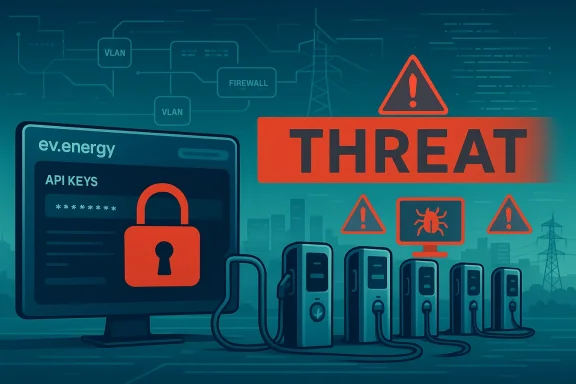 Why these vulnerability classes are dangerous for EV charging
Missing authentication for critical functions
Charging management platforms expose functions that affect when and how chargers operate, firmware or configuration updates, and user or operator privileges. If those functions are callable without proper authentication or authorization checks, an attacker can:- Remotely change charging schedules, preventing vehicles from charging during critical windows.
- Push malicious configurations or commands to charging stations that cause service outages or hardware faults.
- Elevate privileges to perform administrative actions across fleets of chargers.
Improper restriction of excessive authentication attempts
Lack of rate limiting and brute‑force protection allows attackers to enumerate accounts and crack credentials at scale. When paired with default or reused credentials (a common pattern in IoT/OT ecosystems), attackers can quickly obtain valid administrative access.Insufficient session expiration
Long‑lived sessions or sessions that don’t properly expire create replay and session fixation opportunities. Attackers who can capture session tokens (for example, via exposed logs, misconfigured proxies, or credential leakage) may be able to impersonate legitimate administrative users.Insufficiently protected credentials
Storing or transmitting credentials in weakly protected forms (e.g., plaintext, reversible encryption, or predictable hashing) enables credential theft and lateral movement. In an operational environment, stolen service credentials are one of the fastest routes to broad compromise.Taken together, these weaknesses form an attack surface that can bridge standard web‑application attacks with OT impact: administrative takeover of charge‑point management consoles can have immediate operational consequences for vehicles, drivers, and grid balancing.
Technical detail: how an attack might unfold (threat model)
- Reconnaissance: The attacker locates public‑facing management endpoints or mobile‑app backends, scans for exposed ports and API endpoints, and probes for weak authentication or session handling.
- Credential harvesting or brute force: If the platform accepts weak or reused credentials and lacks rate limiting, the attacker obtains valid credentials by password spraying, credential stuffing, or by exploiting unsecured credential storage.
- Session replay or token theft: Using intercepted or predictable session tokens, the attacker impersonates an administrative session.
- Command and control: From the management console, the attacker issues changes to charger configurations (schedules, firmware, or operational state) or issues mass‑disconnect commands that induce denial of service.
- Persistence and lateral movement: The attacker installs backdoors, steals API keys or billing credentials, and expands access to adjacent systems (utility telemetry, customer portals).
le because public reports of EV‑charger and ICS compromises show attackers exploit a mix of web‑app and OT weaknesses; CISA warns that these classes of issues can lead to admin takeover or DoS.
Immediate actions for operators and site owners (what to do in the next 24–72 hours)
If you manage a fleet integrated with ev.energy, or a utility program that uses ev.energy’s platform, take the following actions now:- Assume exposure until proven otherwise. Treat the ev.energy service endpoinanaged through that platform as potentially compromised.
- Minimize network exposure:
- Remove direct Internet access to any charging‑station management interfaces. Put them behind a firewall and require VPN or controlled jump hosts for remote access.
- Enforce multi‑factor authentication (MFA) for all administrative accounts and remote access gateways. Require strong, unique credentials for service and API accounts.
- Implement strict rate‑limiting and account lockouts on management interfaces. If your edge appliances or controllers lack built‑in rate limiting, put an upstream web‑application firewall (WAF) or API gateway in front of them.
- Rotate and harden credentials immediately:
- Change passwords for administrative accounts, service accounts, and API keys used by integrations.
- Replace any credentials that are embedded in scripts or stored in configuration files in cleartext.
- Check logs and telemetry for signs of suspicious access:
- Look for failed logins, unusual IP addresses, anomalous API calls, and any sudden configuration changes.
- Correlate access times with operational impact (e.g., mass stop/start events or repeated firmware update attempts).
- Isolate charging‑site control networks from corporate IT networks: enforce VLAN segmentation, firewall rules, and deny‑by‑default inbound filtering.
- Contact your vendor and confirm remediation timelines:
- Open a support ticket with ev.energy and request patch status, IOCs, and an incident response contact.
- Demand proof of patch testing and a clear versioned remediation plan if a vendor fix is available.
- Prepare an incident plan:
- If you detect signs of compromise, be ready to take affected chargers offline, revoke API keysown good configurations.
- Preserve logs and evidence; coordinate with national CERTs or CISA as needed.
Detection: what to look for in logs and monitoring
- Repeated failed authentication attempts and subsequent successful logins from anomalous IPs (credential stuffing or brute force attempts).
- Creation or modification of administrative user accounts.
- Unexpected API calls that trigger bulk operations (e.g., stop‑all, mass reconfigure, firmware rollouts).
- Long‑lived session tokens with no corresponding re‑authentication events.
- Unusual inter‑process or out‑of‑band traffic from chargers to unknown hosts.
Patching and vendor coordination: what we know and what remains unclear
CISA’s advisory names the affected product and CVE IDs and makes a broad call for mitigation, but the advisory text shared by defenders does not list a vendor patch version in the public excerpt we analyzed; CISA’s immediate mitigation guidance therefore centers on network controls and access hardening. Operators must contact ev.energy for targeted patch information and follow the vendor’s recommended update process.Note of caution: at the time of publication, public CVE database records and third‑party trackers might lag an agency advisory; verify CVE entries and paTRE, and the vendor’s security bulletins before taking irreversible operational actions. Where a patch is available, follow your normal change control and risk assessment process before deployment.
Operational impact scenarios — plausible but avoidable
- Localized DoS: An attacker disrupts a municipal or commercial site by sending management commands that suspend charging across a site for several hours. This causes immediate user disruption and potential contractual penalties for fleet operators.
- Mass schedule manipulation: Attackers alter charge schedules in a way that shifts aggregate charging to peak times, increasing local demand and causing grid stress or higher energy costs.
- Credential exfiltration and billing fraud: Compromised management consoles may expose billing records, customer PII, or integration keys that enable fraudulent use of third‑party charging networks.
- Supply-chain/telemetry poisoning: Attackers alter telemetry to mask device states; operators continue to push faulty firmware because monitoring systems show nominal health.
Longer‑term risk management: build resilience into EV ecosystems
EV charging ecosystems are not just apps — they are a hybrid of IT and industrial control systems. That hybrid nature means defense must be layered and cross‑disciplinary:- Adopt defense‑in‑depth for OT: segmentation, allow‑listing, strict remote access controls, and continuous monitoring are foundational.
- Treat charging‑site endpoints as critical infrastructure: enforce strict lifecycle management, update policies, and remove unsupported devices that cannot be patched. Recent government guidance and binding directives emphasize aggressive lifecycle management for edge devices.
- Vendor security obligations: require Secure Development Lifecycle (SDL) evidence, regular third‑party code reviews, and transparent vulnerability disclosure programs from charging software vendors and integrators.
- Incident readiness: maintain tested playbooks for charging‑infrastructure incidents, including communications for drivers, fleets, and utility partners.
What fleet managers, utilities, and commercial site owners should demand from ev.energy and other vendors
- Fix timelines and CVE reconciliation: a clear patch schedule tied to CVE identifiers and reproducible test cases.
- Signed firmware and secure update mechanisms that validate integrity before applying changes to chargers.
- Hardened default configurations that enforce MFA, strong cryptography, and short session lifetimes out of the box.
- Robust logging, auditing, and an easy way for customers to export evidence for investigations.
- Coordinated disclosure: vendors must publish advisories with IOCs and recommended mitigations and notify directly affected customers.
Caveats, verification notes, and unanswered questions
- CISA’s advisory text we relied on (upl defenders) lists the CVE identifiers and the high combined CVSS figure; however, public mirrors like the National Vulnerability Database or vendor advisories may take time to reflect the full details. Operators should validate CVE metadata and patch availability through es and NVD/MITRE entries before assuming fixed remediation exists.
- At the time the advisory was published, CISA reported no known public exploitation specifically targeting these vulnerabilities. That is an important but fragile fact: lack of known exploitation is not proof of safety. Active scanning and rapid detection are required.
- Our reporting and guidance draw on the advisory language and industry best practices; specific technical remediation steps (for example, exact API endpoints to block or precise configuration flags) must come from vendor documentation and should be tested in non‑production environments first.
Broader perspective: what this means for EV charging security
This advisory is another marker in a clear trend: as EV adoption grows, the enabling software layers — mobile apps, cloud orchestration, API backends, and charger firmware — become attractive targets for attackers. EV charging systems are now a convergence point for consumer apps and grid operations, which means security failures have both privacy/financial and safety/operational implications.Operators and policymakers must treat EV charging ecosystems as critical infrastructure and apply ICS‑grade security thinking: rigorous segmentation, authenticated operations, encrypted telemetry, signed updates, and incident‑response playbooks that include customer communication. Companies like ev.energy provide valuable grid‑balancing services, but the value proposition must be matched with robust security commitments and accountable disclosure practices. Evidence from industry reporting shows ICS advisories are more frequent and severe, reinforcing the need for immediate, systematic hardening across the supply chain.
Practical checklist — hardened posture for ev.energy users (quick reference)
- Immediate (0–24 hours)
- Isolate management interfaces from the Internet; restrict access to known admin IPs.
- Enforce MFA for all administrative accounts.
- Rotate all administrative and API credentials.
- Enable logging and back up logs off‑site.
- Short term (24–72 hours)
- Implement rate limiting and account lockout policies.
- Verify session timeout settings and reduce session lifetime.
- Deploy a WAF in front of management APIs where practical.
- Medium term (72 hours–30 days)
- Coordinate with vendor for patches; test in staging and roll out with rollback plans.
- Conduct an architecture review to ensure network segmentation and least‑privilege access.
- Run threatd search historical logs for suspicious patterns.
- Ongoing
- Subscribe to CISA/National CERT advisories and vendor security bulletins.
- Maintain an inventory of all charging assets and their firmware/software versions.
- Require vendors to provide post‑patch verification and evidence of remediation.
Conclusion
CISA’s advisory about ev.energy’s platform is a sharp reminder that the software underpinning EV charging is now a critical security frontier. The reported flaws — ranging from missing authentication to weak session controls — are precisely the kinds of web‑application and credential‑handling failures that translate quickly into operational impact in the world of EV charging.Operators must act immediately: assume exposure, harden network and access controls, rotate credentials, and demand clear, timely remediation and transparency from vendors. Utilities, fleets, and commercial site owners should treat vendor security posture as a procurement priority going forward, and security teams should incorporate EV charging infrastructure into their ICS threat models.
The technical community and vendors can and must do betteivers grid and consumer benefits at scale, but those benefits depend on secure, auditable, and resilient platforms. Until patches are widely deployed and vendors adopt FT‑grade security practices for charging orchestration, the safest course for risk‑sensitive operators is to apply CISA’s defensive checklist: minimize exposure, enforce strong access controls, and monitor aggressively for anomalies.
Source: CISA EV Energy ev.energy | CISA
