

Stryker’s March 2026 network disruption has quickly become more than a vendor incident: it is now a warning shot about how endpoint management systems can be turned into high-value attack paths when administrative controls are too broad, too trusted, or too easy to abuse. On March 18, 2026, CISA said it was aware of malicious activity targeting endpoint management systems at U.S. organizations and pointed directly to the March 11 cyberattack against Stryker’s Microsoft environment as the trigger for its alert. The agency’s message is blunt: organizations that rely on Microsoft Intune or similar tools should harden them now, because attackers may increasingly use legitimate management software to operate inside networks while looking like normal administrators. (stryker.com)
The core issue here is not a new vulnerability in the classic sense. Instead, CISA is describing a more uncomfortable reality for defenders: if adversaries gain access to endpoint management platforms, they can use trusted administrative channels to push configurations, scripts, and device actions at scale. That means the management plane itself becomes the battleground, and a compromise there can ripple outward faster than many endpoint security teams expect. (learn.microsoft.com)
Stryker’s public updates show how disruptive that scenario can be in practice. The company said on March 11, 2026, that it was experiencing a global network disruption in its Microsoft environment as a result of a cyberattack, but at that time it had no indication of ransomware or malware and believed the incident was contained. By March 13, it was still telling customers that it was working to understand the full impact and continuing to investigate the incident with government and law-enforcement partners. (stryker.com)
CISA’s alert also matters because it arrives at a moment when Microsoft has been pushing stronger defaults around privileged access. Microsoft already requires MFA for sign-ins to the Azure portal, Microsoft Entra admin center, and Microsoft Intune admin center for CRUD operations, and it has been expanding multi-admin approval capabilities inside Intune. That means the direction of travel is clear: the platform is becoming more secure, but only if organizations actually turn on and operationalize the controls that Microsoft and CISA are now emphasizing. (learn.microsoft.com)
That is why the agency is urging organizations to adopt Microsoft’s newly released best practices for securing Intune, while also applying the same principles to other endpoint management platforms. The recommendations are not just Intune-specific tuning tips. They are a blueprint for reducing blast radius, limiting standing privilege, and adding a second set of eyes before sensitive changes are applied. (learn.microsoft.com)
The company also said it had business continuity measures in place and was keeping stakeholders informed as it learned more. That is the right public posture, but it also underscores a harder truth: even if the attack does not become a full-scale ransomware crisis, disruption to a Microsoft-based environment can still affect internal operations, support workflows, and customer confidence. In a healthcare-adjacent supply chain, time lost to investigation can be nearly as damaging as the technical compromise itself. (stryker.com)
Microsoft’s own guidance now reflects that reality. Its tenant security recommendations emphasize using scope tags and RBAC to segment administrative access, and its Intune documentation describes multi-admin approval as a safeguard against compromised administrative accounts. The company has also broadened those protections in 2026 to cover more policy types, including settings catalog configuration policies and device compliance policies. (learn.microsoft.com)
The third control is Multi Admin Approval. Microsoft says this feature requires a second administrative account to approve changes before sensitive actions are applied. That matters because it breaks the “single compromised admin equals instant fleet-wide impact” model. In effect, it forces the attacker to defeat two privileged workflows instead of one. (learn.microsoft.com)
Microsoft also notes that, starting in October 2024, MFA is required for sign-ins to the Azure portal, Microsoft Entra admin center, and Microsoft Intune admin center for CRUD operations, with Phase 2 expanding to Azure CLI, PowerShell, mobile app, IaC tools, and REST API endpoints beginning October 1, 2025. In other words, the baseline is already changing, and many organizations are now living through that transition whether they planned for it or not. (learn.microsoft.com)
That broader strategy fits Microsoft’s Secure Future Initiative and its push toward stronger default protections. Microsoft has already mandated MFA for administrative sign-ins to key control-plane services, and it recommends phishing-resistant methods for important roles. The company’s message is effectively that privileged access must be earned continuously, not assumed permanently. (learn.microsoft.com)
Healthcare organizations often live with a difficult balance: they need centralized management to keep large device fleets safe and compliant, but they also need resilience against account takeover and malicious internal-style actions. CISA’s alert is essentially a reminder that centralization without guardrails can become a single point of failure. In regulated environments, availability and integrity are both security outcomes. (learn.microsoft.com)
The next step is to examine the logging and alerting around approval workflows. Microsoft notes that Intune logs request and approval activity, but it also says Intune does not send notifications when new requests are created or when request status changes. That means teams need deliberate monitoring and human communication paths, not just platform defaults. (learn.microsoft.com)
Another concern is operational friction. Security teams may resist tighter admin controls if they fear slower change windows or more approval overhead, but that tradeoff is usually less costly than a compromised management plane. The challenge is to design processes that are both secure and workable, especially in high-availability environments.
That tension is the defining feature of modern enterprise security. The tools are better than they used to be, but they are also more interconnected, more cloud-centric, and more reliant on trust in privileged workflows. As a result, the organizations that do best will be the ones that treat endpoint management as critical infrastructure, not as a background utility.
Source: CISA CISA Urges Endpoint Management System Hardening After Cyberattack Against US Organization | CISA
 Overview
The core issue here is not a new vulnerability in the classic sense. Instead, CISA is describing a more uncomfortable reality for defenders: if adversaries gain access to endpoint management platforms, they can use trusted administrative channels to push configurations, scripts, and device actions at scale. That means the management plane itself becomes the battleground, and a compromise there can ripple outward faster than many endpoint security teams expect. (learn.microsoft.com)Stryker’s public updates show how disruptive that scenario can be in practice. The company said on March 11, 2026, that it was experiencing a global network disruption in its Microsoft environment as a result of a cyberattack, but at that time it had no indication of ransomware or malware and believed the incident was contained. By March 13, it was still telling customers that it was working to understand the full impact and continuing to investigate the incident with government and law-enforcement partners. (stryker.com)
CISA’s alert also matters because it arrives at a moment when Microsoft has been pushing stronger defaults around privileged access. Microsoft already requires MFA for sign-ins to the Azure portal, Microsoft Entra admin center, and Microsoft Intune admin center for CRUD operations, and it has been expanding multi-admin approval capabilities inside Intune. That means the direction of travel is clear: the platform is becoming more secure, but only if organizations actually turn on and operationalize the controls that Microsoft and CISA are now emphasizing. (learn.microsoft.com)
Why This Alert Matters
CISA alerts rarely single out one incident unless the lesson is broader than the victim. Here, the lesson is that endpoint management software is a force multiplier for both defenders and attackers. If an adversary can manipulate Intune, they do not need to bruteforce every workstation individually; they can use a single privileged foothold to distribute changes across the fleet. (learn.microsoft.com)That is why the agency is urging organizations to adopt Microsoft’s newly released best practices for securing Intune, while also applying the same principles to other endpoint management platforms. The recommendations are not just Intune-specific tuning tips. They are a blueprint for reducing blast radius, limiting standing privilege, and adding a second set of eyes before sensitive changes are applied. (learn.microsoft.com)
The strategic takeaway
The strategic takeaway is that identity has become the new perimeter in endpoint administration. If an attacker steals a privileged account or social-engineers an admin, the attacker may inherit the same control plane used by IT to protect the enterprise. That turns ordinary admin hygiene into a first-order security control rather than a back-office concern. (learn.microsoft.com)Practical implications
For security teams, this means the best place to start is not with exotic threat hunting, but with governance. CISA and Microsoft are pointing to least privilege, phishing-resistant MFA, and multi-admin approval because these controls attack the problem where it lives: privileged workflows. If those workflows are hardened, the attacker’s path becomes slower, noisier, and easier to interrupt. (learn.microsoft.com)- Reduce the number of people who can make high-impact changes.
- Require stronger identity proof for privileged accounts.
- Add approval gates for destructive or fleet-wide actions.
- Treat management-plane access as a crown-jewel asset.
- Assume trusted software can be abused if credentials are compromised.
What Happened at Stryker
Stryker’s incident is important because it involved a major U.S.-based medical technology firm with a broad digital footprint and customer-facing operational dependencies. The company said its Microsoft environment was disrupted by a cyberattack and repeatedly emphasized that it had no indication of ransomware or malware, while also noting that the incident was contained. That distinction matters because it suggests a disruption model that may have been focused on access, control, or trust relationships rather than a simple encrypt-and-extort event. (stryker.com)The company also said it had business continuity measures in place and was keeping stakeholders informed as it learned more. That is the right public posture, but it also underscores a harder truth: even if the attack does not become a full-scale ransomware crisis, disruption to a Microsoft-based environment can still affect internal operations, support workflows, and customer confidence. In a healthcare-adjacent supply chain, time lost to investigation can be nearly as damaging as the technical compromise itself. (stryker.com)
Why Stryker became the reference point
Stryker became the reference point because it was early, public, and specific enough to illustrate the risk. CISA’s alert does not claim that the Stryker incident is identical to every other compromise, but it uses the case as evidence that organizations should expect malicious activity aimed at endpoint management systems. That framing is deliberate: the agency wants defenders to extrapolate from one incident to a broader class of attacks. (stryker.com)- The company disclosed the disruption on March 11, 2026.
- It said the issue affected its Microsoft environment.
- It reported no ransomware or malware indicators at the time.
- It said the incident appeared contained.
- It continued to provide customer-facing updates as the investigation progressed.
Microsoft Intune as a Target
Microsoft Intune is widely used to manage devices, configurations, compliance, scripts, and mobile workflows across enterprises. That makes it efficient, but it also creates a concentration of power: whoever controls the management plane can shape the behavior of many endpoints at once. For attackers, that is an attractive return on effort, especially when the target organization already trusts those management actions by design. (learn.microsoft.com)Microsoft’s own guidance now reflects that reality. Its tenant security recommendations emphasize using scope tags and RBAC to segment administrative access, and its Intune documentation describes multi-admin approval as a safeguard against compromised administrative accounts. The company has also broadened those protections in 2026 to cover more policy types, including settings catalog configuration policies and device compliance policies. (learn.microsoft.com)
Why legitimate tooling is so dangerous in the wrong hands
The danger is not that Intune is inherently insecure. The danger is that it is trusted. A malicious change pushed through a legitimate admin channel may blend into ordinary operations, which makes detection harder and response slower. This is exactly the kind of abuse CISA is trying to preempt by pushing organizations to harden the management layer before attackers exploit it. (learn.microsoft.com)- Intune can reach many endpoints quickly.
- Admin actions can have large and immediate impact.
- Trusted operations are harder to distinguish from malicious ones.
- Compromised privilege can bypass many endpoint controls.
- Policy-driven change is efficient, but only if governance is strong.
The Hardening Controls CISA Wants
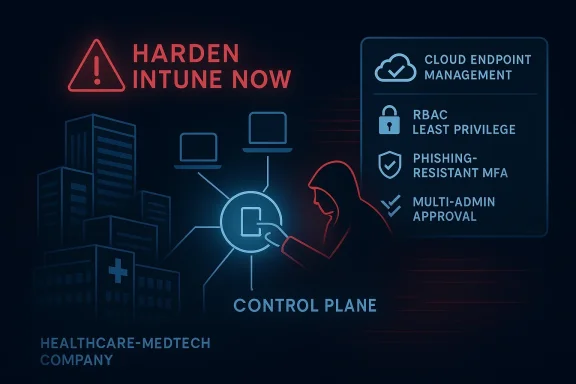
CISA’s recommendations are remarkably aligned with modern Zero Trust practice. The first is least privilege: use Microsoft Intune RBAC to assign the minimum permissions necessary for each role, and scope those permissions as narrowly as practical. The second is phishing-resistant MFA and privileged access hygiene, using Microsoft Entra ID controls such as Conditional Access, MFA, risk signals, and privileged access controls to block unauthorized privileged actions. (learn.microsoft.com)The third control is Multi Admin Approval. Microsoft says this feature requires a second administrative account to approve changes before sensitive actions are applied. That matters because it breaks the “single compromised admin equals instant fleet-wide impact” model. In effect, it forces the attacker to defeat two privileged workflows instead of one. (learn.microsoft.com)
Least privilege is not a slogan
Least privilege sounds simple, but in real environments it is hard to maintain because operations teams naturally accumulate access over time. CISA’s advice is a reminder that standing privilege should be treated as technical debt. The less power one account has, the less damage a stolen token or password can do before detection. (learn.microsoft.com)MFA must be hard to phish
Microsoft’s guidance is specifically about phishing-resistant MFA, not just any second factor. That distinction is critical, because attacker tradecraft has adapted around weak or prompt-based MFA. Microsoft explicitly recommends stronger methods for privileged roles and warns administrators to register the correct methods before enforcing the policy, or risk tenant lockout. That warning is not theoretical; it is the price of doing security correctly rather than cosmetically. (learn.microsoft.com)Multi Admin Approval changes the game
Multi Admin Approval is more than a bureaucracy layer. It is a compensating control for environments where privileged compromise is a realistic threat, and it is increasingly relevant as Intune extends approval requirements to more policy types. Microsoft’s February 2026 update broadened this feature to cover additional configuration and compliance policies, which makes the model more useful for day-to-day security governance. (techcommunity.microsoft.com)- Use RBAC to constrain who can act.
- Require phishing-resistant MFA for privileged identities.
- Enforce Conditional Access and risk signals.
- Add approval workflows for sensitive operations.
- Treat policy changes as security events, not admin conveniences.
Why Privileged Identity Is the Real Battleground
The most interesting part of this alert is how clearly it links endpoint management to identity security. Microsoft’s own guidance on Entra admin roles says that privileged administrative accounts are frequent targets and that phishing-resistant MFA reduces the risk of compromise. That is a strong admission, and it reflects the broader industry shift toward identity-centric defense. (learn.microsoft.com)Microsoft also notes that, starting in October 2024, MFA is required for sign-ins to the Azure portal, Microsoft Entra admin center, and Microsoft Intune admin center for CRUD operations, with Phase 2 expanding to Azure CLI, PowerShell, mobile app, IaC tools, and REST API endpoints beginning October 1, 2025. In other words, the baseline is already changing, and many organizations are now living through that transition whether they planned for it or not. (learn.microsoft.com)
The enterprise reality
For enterprises, this means privileged access reviews can no longer be a quarterly checkbox exercise. If the same account can approve device wipes, scripts, compliance policies, and RBAC changes, then that account becomes a critical attack target. Segmentation, approval, and logging are not optional polish; they are core controls. (learn.microsoft.com)The consumer-adjacent lesson
Consumers do not manage Intune tenants, but they absolutely feel the downstream effects when enterprise endpoints are compromised. A managed laptop can be a gateway into email, collaboration platforms, remote access, and internal services. When endpoint management is abused, the fallout may reach customers, patients, and partners long before anyone notices the original compromise. (learn.microsoft.com)- Identity compromise can precede endpoint compromise.
- Privileged accounts need stronger protection than ordinary users.
- Approval workflows reduce the speed of malicious change.
- Break-glass accounts should be excluded carefully and managed separately.
- Logs and alerts need to cover approval activity, not just endpoint events.
How Microsoft Is Responding
Microsoft’s posture suggests that it sees the same risk CISA sees. Its Intune tenant-security guidance emphasizes scope tags, RBAC, and reduced blast radius, while its multi-admin approval documentation describes a two-person approval pattern for protected changes. The fact that Microsoft is still expanding those protections in 2026 suggests the company is trying to make secure administration the normal path, not a niche hardening exercise. (learn.microsoft.com)That broader strategy fits Microsoft’s Secure Future Initiative and its push toward stronger default protections. Microsoft has already mandated MFA for administrative sign-ins to key control-plane services, and it recommends phishing-resistant methods for important roles. The company’s message is effectively that privileged access must be earned continuously, not assumed permanently. (learn.microsoft.com)
Why the timing matters
The timing matters because CISA is not asking organizations to wait for a new patch cycle or a product update. It is asking them to deploy existing controls better and faster. That is often the reality of cyber defense: the necessary capabilities already exist, but the exposure persists because configuration discipline lags behind attacker opportunity. (learn.microsoft.com)- Microsoft is pushing Zero Trust-aligned tenant security.
- MFA enforcement is already part of the admin baseline.
- Multi-admin approval is expanding across more Intune actions.
- Scope tags and RBAC remain foundational segmentation tools.
- The platform is moving toward stronger guardrails, but adoption still varies.
The Healthcare and Critical Infrastructure Angle
This is not just an IT story; it is a healthcare and critical infrastructure story. Stryker operates in a sector where uptime, trust, and coordinated operations matter directly to patient care, and the company’s own messaging shows it was working to preserve continuity while investigating the disruption. That makes endpoint management hardening especially relevant for hospitals, medtech vendors, and suppliers that rely on remote administration and connected workflows. (stryker.com)Healthcare organizations often live with a difficult balance: they need centralized management to keep large device fleets safe and compliant, but they also need resilience against account takeover and malicious internal-style actions. CISA’s alert is essentially a reminder that centralization without guardrails can become a single point of failure. In regulated environments, availability and integrity are both security outcomes. (learn.microsoft.com)
Why this resonates beyond one company
The wider lesson is that many sectors now use the same cloud management stack for endpoints, identity, and policy enforcement. That creates a common attack surface that crosses industry boundaries. Once defenders in one sector learn that lesson the hard way, the playbook becomes relevant to everyone else almost immediately. (learn.microsoft.com)- Healthcare has high availability requirements.
- Medical technology firms often depend on Microsoft ecosystems.
- Managed devices can affect clinical and operational workflows.
- Supply-chain partners inherit some of the same risks.
- Shared cloud tools create shared exposure patterns.
What Security Teams Should Do Now
The immediate response should be operational, not theoretical. Security teams should inventory privileged Intune and Entra roles, verify MFA method strength, and look for places where broad admin rights have accumulated over time. They should also identify which high-impact actions are protected by multi-admin approval and where that coverage remains incomplete. (learn.microsoft.com)The next step is to examine the logging and alerting around approval workflows. Microsoft notes that Intune logs request and approval activity, but it also says Intune does not send notifications when new requests are created or when request status changes. That means teams need deliberate monitoring and human communication paths, not just platform defaults. (learn.microsoft.com)
A practical sequence
A useful rollout sequence is straightforward:- Review all Intune and Entra admin roles for excess privilege.
- Enforce phishing-resistant MFA for privileged roles.
- Exclude and protect break-glass accounts with care.
- Enable Multi Admin Approval for the highest-impact actions first.
- Validate audit logging, alerting, and response procedures. (learn.microsoft.com)
Strengths and Opportunities
CISA’s alert has the virtue of being actionable rather than abstract. It points defenders toward existing controls that can be implemented now, and that makes it easier for security leaders to justify work that may otherwise be deprioritized in favor of visible but less impactful tools. It also creates an opportunity to align endpoint management hardening with broader identity and Zero Trust programs.- Least privilege can be tightened without major platform changes.
- Phishing-resistant MFA reduces reliance on easily phished factors.
- Multi Admin Approval creates a strong friction point for attackers.
- Scope tags and RBAC help segment access by role or business unit.
- Audit logs provide a clear trail for investigations and reviews.
- Microsoft’s expanding approval features improve policy coverage over time.
- CISA’s guidance can be applied beyond Intune to other endpoint tools.
Risks and Concerns
The biggest risk is implementation drift. Many organizations believe they already have strong controls, but the real-world configuration often includes broad roles, exception paths, stale accounts, and approval workflows that are either incomplete or rarely tested. That gap between policy and practice is exactly where attackers thrive.Another concern is operational friction. Security teams may resist tighter admin controls if they fear slower change windows or more approval overhead, but that tradeoff is usually less costly than a compromised management plane. The challenge is to design processes that are both secure and workable, especially in high-availability environments.
- Overly broad admin roles can persist for years.
- Weak MFA methods may still be in use for privileged users.
- Break-glass accounts can become hidden weak points.
- Approval workflows may not cover every sensitive action.
- Logging may exist but not be actively monitored.
- Urgent maintenance can pressure teams to bypass controls.
- Misconfiguration during rollout can lock out administrators.
Looking Ahead
The next phase of this story will likely involve two parallel tracks. First, more organizations will audit their Intune and Entra configurations in response to CISA’s alert and Microsoft’s guidance. Second, threat actors will continue testing whether compromised identity and management planes can be weaponized faster than defenders can harden them.That tension is the defining feature of modern enterprise security. The tools are better than they used to be, but they are also more interconnected, more cloud-centric, and more reliant on trust in privileged workflows. As a result, the organizations that do best will be the ones that treat endpoint management as critical infrastructure, not as a background utility.
What to watch
- Additional CISA guidance on endpoint management abuse.
- Follow-on disclosures from affected organizations and vendors.
- Broader adoption of phishing-resistant MFA for administrators.
- Expansion of multi-admin approval across more management actions.
- Increased scrutiny of cloud management logs and admin behavior.
Source: CISA CISA Urges Endpoint Management System Hardening After Cyberattack Against US Organization | CISA
