

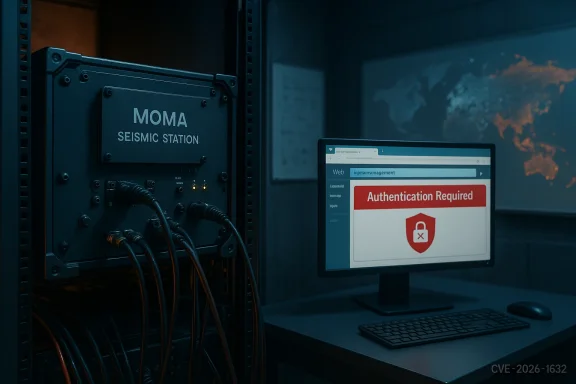
CISA has published an industrial control systems advisory warning that RISS SRL’s MOMA Seismic Station firmware up to and including v2.4.2520 (CVE‑2026‑1632) exposes its web management interface without requiring authentication — a design failing that permits unauthenticated remote actors to read and change device configuration, extract device data, or remotely reset the device, creating a high‑risk denial‑of‑service and integrity threat for seismic monitoring deployments. rview
Seismic monitoring gear like the MOMA Seismic Station is not consumer IoT — these appliances are often installed at critical monitoring sites, research facilities, industrial plants, and dams where seismic signals feed safety and operational decision systems. The MOMA advisories single out a classical but severe class of failure: missing authentication for critical functions (CWE‑306). In plain terms, the device’s built‑in web UI or management API responds to administrative requests without validating who is calling, or whether they are authorized to perform the operation. That flips a management interface from a defensive control into an attacker-accessible control plane.
CISA’s advisory rattical (CVSS v3.1 9.1) and explicitly lists real-world impacts: remote configuration modification, data acquisition by unauthenticated actors, and remote resetting of devices. The advisory also flags the device family as deployed worldwide across multiple critical infrastructure sectors including energy, water, transportation, and critical manufacturing — which emphasizes that exploitation is not limited to a single site or sector.
CISA’s advisory states that RISS SRL did not respond to CISA’s coordination request at the time the advisory was published. The advisory therefore lists vendor contact information for users to reach out to (info@riss-srl.com) but does not provide a vendor-supplied patch in the advisory text. Where vendor coordination does not exist, CISA and ICS practitioners treat compensating controls as the immediate line of defense.
CISA’s canonical mitigations for this sort of issue (and replicated across other ICS advisories) are straightforward and operationally proven:
But defenders must also be cautious:
Immediate, concrete actions for MOMA operators:
Source: CISA RISS SRL MOMA Seismic Station | CISA
Seismic monitoring gear like the MOMA Seismic Station is not consumer IoT — these appliances are often installed at critical monitoring sites, research facilities, industrial plants, and dams where seismic signals feed safety and operational decision systems. The MOMA advisories single out a classical but severe class of failure: missing authentication for critical functions (CWE‑306). In plain terms, the device’s built‑in web UI or management API responds to administrative requests without validating who is calling, or whether they are authorized to perform the operation. That flips a management interface from a defensive control into an attacker-accessible control plane.
CISA’s advisory rattical (CVSS v3.1 9.1) and explicitly lists real-world impacts: remote configuration modification, data acquisition by unauthenticated actors, and remote resetting of devices. The advisory also flags the device family as deployed worldwide across multiple critical infrastructure sectors including energy, water, transportation, and critical manufacturing — which emphasizes that exploitation is not limited to a single site or sector.
 Why this matters: operational ri
Missing authentication is not a theoretical bug
When an embedded device treats requests to administrative endpoints as if they were already authenticated, exploitation is trivial wherever the device is network reachable. The attacker model is simple:- Attack vector: network (any attacker with TCP/IP reachability).
- Privileges required: none — the endpoints grant access without credentials.
- Complexity: low — no human interaction required and the functions are often accessible via a simple HTTP(S) call.
- Automation: high — internet scanners and vulnerability scanners can enumerate and fingerprint devices en masse.
Concrete impacts in seismic deployments
Seismic monitorinwarning chains, research archives, and operational alarms. Specific real‑world effects from a compromised MOMA device could include:- Falsified telemetry: attackers could alter timestamps or magnitudes, undermining scientific and operational integrity.
- Data loss or exfiltration: unauthenticated reads could let adversaries collect sensitive sensor data or internal logs.
- Denial of service: remote resets or malicious configuration could take a station offline, creating monitoring gaps.
- Pivot risk: engineering stations and aggregation servers (often Windows hosts) that integrate MOMA feeds may be exposed to lateral movement if attackers persist on the instrument.
Technical summary of the issue (what the advisory reports)
- Affected product: RISS SRL — MOM- Affected versions: v2.4.2520 and prior**.
- Vulnerability class: Missing Authentication for Critical Function (CWE‑306).
- CVE: CVE‑2026‑1632 (as published in the advisory).
- Impact: unauthenticated attackers can modify configuration, acquire device data, or remotely reset the device.
- CVSS (as reported): v3.1 base score 9.1 (CRITICAL) with vector indicating network attackability, no privileges, and high confidentiality/integrity impact.
CISA’s advisory states that RISS SRL did not respond to CISA’s coordination request at the time the advisory was published. The advisory therefore lists vendor contact information for users to reach out to (info@riss-srl.com) but does not provide a vendor-supplied patch in the advisory text. Where vendor coordination does not exist, CISA and ICS practitioners treat compensating controls as the immediate line of defense.
CISA’s canonical mitigations for this sort of issue (and replicated across other ICS advisories) are straightforward and operationally proven:
- posure**: ensure affected devices are not reachable from the Internet.
- Network segmentation: place devices on a dedicated OT network and isolate them from business networks.
- Firewalling and ACLs: restrict management interfaces to a small set of maintenance hosts and management jump boxes.
- Secure remote access: if remote management is required, use hardened VPNs or jump hosts with strong MFA, while recognizing these add complexity and need to be kept current.
Practical incident response checklist (operational triage for defenders)
If you operate MOMA Seismic Station units (or manage networks that host them), prioritize the following steps now:- Inventory (Immediate)
- Identify each MOMA device: model, firmware version, serial number, and IP address.
- Record whether each unit is reachable from the Internet, DMZ, or business networks.
- Containment (Immediate)
- Block public and untrusted network access to management ports at the perimeter firewall.
- Move devices into an OT VLAN with strict ACLs permitting management only from known jump hosts.
- If possible, disable web management interfaces at the device or on upstream proxies until a fix is available.
- Monitoring & detection (Immediate)
- Enable logging on perimeter devices and the devices themselves where possible. Monitor for:
- Unexpected configuration changes.
- Reboots or resets originating from unknown IPs.
- Unauthenticated GET/POST calls to management endpoints.
- Deploy IDS/IPS rules to flag unauthenticated attempts against known management endpoints.
- Access control hardening (short term)
- Require out‑of‑band or MFA protected access for any remote maintenance.
- Implement least‑privilege access on maintenance hosts; avoid shared service accounts.
- Vendor coordination & escalation (short term)
- Contact RISS SRL (info@riss-srl.com) to request:
- Confirmation of affected versions.
- A vendor timeline for a firmware update or mitigation.
- Exact endpoints and API paths that are unauthenticated (to allow defenders to construct detection signatures).
- Replacement planning (medium term)
- If vendor remediation is not forthcoming, plan for device replacement or additional network compensations, especially for mission‑critical monitoring points.
- Incident response rehearsal (medium term)
- Conduct a tabletop/responder drill that assumes one or more stations are tampered with; validate recovery and alternate monitoring channels.
Detection and forensic guidance for Windows/IT teams
Although the impacted devices are embedded hardware, the cast of adversary actions often involves Windows infrastructure (engineering workstations, collection servers, or jump hosts). Windows Add detection signatures for any management HTTP(S) endpoints used by MOMA devices and forward logs to SIEM for correlation.- Monitor Windows jump hosts for:
- Unusual processes that perform automated HTTP calls to device IPs.
- New or unexpected scheduled tasks that reach out to MOMA addresses.
- Anomalous outbound connections to unknown IPs coinciding with device resets.
- Collect packet captures (pcap) when suspicious activity is seen; preserve device logs to assist vendor triage or law enforcement if needed.
- Maintain an audit trail for any manual vendor‑directed maintenance performed on devices.
Risk analysis: who should be most worried
The advisory states that MOMA devices are deployed across multiple critical infrastructure sectors. Operators who should consider this a high‑urgency event include:- Research institutions and universities with seismic arrays.
- Dams and hydropoly on seismic data for structural monitoring.
- Energy companies that correlate seismic events with operational safety.
- Transportation and heavy‑industry sites that use on‑site seismic sensors for protective actions.
Strengths and limits of the advisory; what defenders should verify
CISA advisories are strong for rapid, practical guidance: they usually include a concise vulnerability classification, CVE assignment, affected product versions, and mitigation recommendations. That makes them valuable triage inputs for defenders who must decide quickly whether to isolate, patch, or replace. The MOMA advisory follows this pattern.But defenders must also be cautious:
- Vendor specifics matter: the advisory lists affected versions through v2.4.2520, but real inventories must be checked. Firmware branches or hardware revisions sometimes produce exceptions; confirm each device’s actual firmware string before assuming it is or isn’t vulnerable.
- “No known public exploitation” is a snapshot. As many prior advisories show, low‑complexity, network‑accessible problems are very quickly weaponized once public details appear, so assume a short horizon from disclosure to attack if devices remain reachable.
- If RISS SRL is unresponsive or if the product is end‑of‑life, vendor remediation may be slow or nonexistent — and that forces defenders into long‑term compensating controls or replacement planning.
missing‑authentication ICS advisories keep recurring
Across many recent ICS advisories, the same root issues reappear: embedded web servers without server‑side authentication checks, exposed telemetrnt‑side secrets. The pattern matters because:- Embedded web UIs were often built for convenience with access controls left to network architecture (assume the network is trusted), but modern threat landscapes break that assumption.
- Many ICS devices have long service lifecycles; EoL devices persist in the field and may not receive security fixes.
- Operational constraints often make immediate replacement impractical; hence the emphasis on network segmentation and compensating controls in CISA guidance.
Recommended long-term actions for asset owners and procurement teams
- Product security minimums (policy)
- Require vendors to demonstrate secure defaults: no unauthenticated management endpoints enabled out of the box.
- Demand a clear, supported update and EoL timeline before purchase.
- Inventory and asset management
- Maintain authoritative inventories of all embedded devices, firmware versions, and maintenance contacts.
- Network architecture
- Design OT networks so instruments are unreachable from the general corporate network and the public Internet.
- Supplier security assessments
- Integrate PSIRT responsiveness into procurement scoring; vendors that do not coordinate on vulnerability disclosure should be downgraded or avoided.
- Replacement and modernization planning
- For devices in safety‑critical roles, maintain a funded replacement roadmap to remove unsupported or insecure appliances before they become single points of failure.
What we know (verified) and what remains to be confirmed
Verified:- CISA published an advisory showing MOMA Seismic Station up to v2.4.2520 exposes management functions without authentication (CWE‑306) and assigned CVE‑2026‑1632 with a high severity rating.
- CISA’s recommended immediate mitigations are consistent with prior ICS missing‑auth cases: minimize exposure, firewall/segment, and only use secure remote rmed by operators:
- Whether RISS SRL will publish an authenticated firmware update and the exact timeline for a vendor fix.
- The full scope of affected firmware branches or hardware SKUs at each deployment site — operators must verify their own inventories.
- Any evidtation in the wild after the advisory’s publication; remember that “no known exploitation” can change rapidly.
Final analysis and recommended next steps
This a high‑urgency operational security event because it exposes an unauthenticated administrative plane on devices deployed in safety‑ and mission‑critical contexts. The attack model is simple and scalable; defenders should therefore assume a near‑term window of increased risk.Immediate, concrete actions for MOMA operators:
- Perform an inventory sweep and isolate any devices with firmware ≤ v2.4.2520 from untly network‑level compensations (firewall ACLs, OT VLANs, jump hosts with MFA) and tighten monitoring for management endpoint access.
- Contact RISS SRL (info@riss-srl.com) for vendor guidance and insist on a firmware fix; concurrently plan for replacement if the vendor is nonresponsive or if the product is EoL.
- Reassess procurement and lifecycle policies to prioritize products that ship with secure defaults and active PSIRT programs.
- Build or refine ICS control network segmentation and detection capabilities that assume product bugs will appear and that devices may be unfixable in the field.
Source: CISA RISS SRL MOMA Seismic Station | CISA
