

Civmec’s public unveiling of an “Arafura Capability Enhancement” at the Indo‑Pacific International Maritime Exposition in Sydney has re‑opened a practical debate inside Australian naval and industrial circles: can the Royal Australian Navy’s lightly armed Arafura‑class offshore patrol vessels (OPVs) be affordably upgraded into modular, mission‑flexible littoral escorts that plug capability gaps without upending schedule, cost or doctrine?
The Arafura class (Project SEA 1180 Phase 1) is a six‑vessel OPV family derived from Lürssen’s PV‑80 design, built to perform constabulary tasks such as fisheries protection, border patrol, and disaster relief rather than high‑end blue‑water combat. The type displaces roughly 1,600–1,625 tonnes and measures about 80 metres overall; the first hull entered service in mid‑2025. The program has a chequered procurement history: originally intended as a 12‑ship class and envisioned as a modular "one‑hull-to‑rule‑many‑missions" solution (including hydrographic survey and mine warfare variants), it suffered schedule delays, integration headaches—most notably the cancellation of the planned 40 mm main gun—and industrial transfer complications between Osborne and Henderson yards. The 2023 Defence Strategic Review (and subsequent program reassessments) trimmed the acquisition to six OPVs and re‑cast their role from a Tier‑3 surface combatant to primarily constabulary duties. Industrial ownership also changed: Lürssen Australia’s shipbuilding business was acquired by Civmec in 2025, consolidating design, production and sustainment under the Western Australia‑based engineering and fabrication firm. Civmec now leads construction of the four Western Australian hulls and has staged a public pitch for capability insertions that the company describes as “low‑risk” and modular.
Source: psnews.com.au Civmec floats capability upgrades for navy's Arafura-class OPVs | PS News
 Background
The Arafura class (Project SEA 1180 Phase 1) is a six‑vessel OPV family derived from Lürssen’s PV‑80 design, built to perform constabulary tasks such as fisheries protection, border patrol, and disaster relief rather than high‑end blue‑water combat. The type displaces roughly 1,600–1,625 tonnes and measures about 80 metres overall; the first hull entered service in mid‑2025. The program has a chequered procurement history: originally intended as a 12‑ship class and envisioned as a modular "one‑hull-to‑rule‑many‑missions" solution (including hydrographic survey and mine warfare variants), it suffered schedule delays, integration headaches—most notably the cancellation of the planned 40 mm main gun—and industrial transfer complications between Osborne and Henderson yards. The 2023 Defence Strategic Review (and subsequent program reassessments) trimmed the acquisition to six OPVs and re‑cast their role from a Tier‑3 surface combatant to primarily constabulary duties. Industrial ownership also changed: Lürssen Australia’s shipbuilding business was acquired by Civmec in 2025, consolidating design, production and sustainment under the Western Australia‑based engineering and fabrication firm. Civmec now leads construction of the four Western Australian hulls and has staged a public pitch for capability insertions that the company describes as “low‑risk” and modular. What Civmec proposed at Indo‑Pac
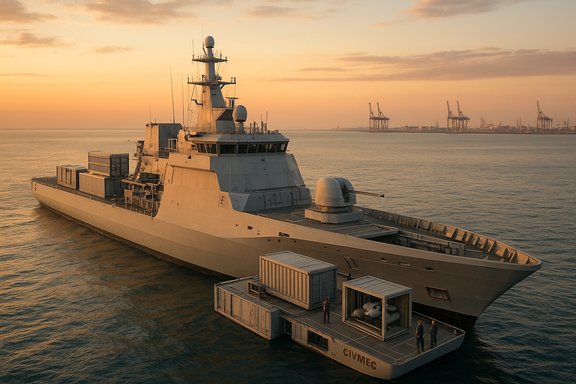
Civmec’s exhibit model and briefings detailed a package of containerised and shipboard upgrades assembled under the label Arafura Capability Enhancement. The main elements were:- Replacement of the interim 25 mm Bushmaster/Typhoon mount with a larger, ship‑weight main gun (Civmec highlighted the Bofors 57 mm Mk3 as the logical fit).
- Containerised mission modules for unmanned systems: ISO containers configured to host reconnaissance Unmanned Aerial Vehicles (UAVs) or loitering munitions, enabling rapid role change.
- A stern‑facing quadruple launcher for Kongsberg Naval Strike Missile (NSM) with a containerised command and control centre.
- An Anti‑Submarine Warfare (ASW) package based on the Thales CAPTAS‑1 variable‑depth sonar (VDS) delivered in a 20‑ft containerised mission module.
Technical feasibility: what would actually be required?
Hull, deck and weight margins
The Arafura hull is based on a mature PV‑80 design with a generous mission deck and an 80 m flight deck. That geometry is what enables Civmec’s pitch: the class can host containerised systems without gross structural alterations. Adding tie‑down points, dedicated power and cooling links, and local reinforcement under container cradles are relatively low‑risk modifications compared with deep structural or stability changes. Civmec has framed these as simple physical and software adjustments rather than ship re‑designs.Main gun upgrade
The Bofors 57 mm Mk3 is widely used on PV‑80 derivatives and offers programmable ammunition, a good rate of fire, and multi‑mission effects (surface, air and limited land attack). Fitting a 57 mm would increase mass and recoil loads compared to the interim 25 mm mount; but the parent PV‑80 design incorporates a 57 mm option in many export variants, easing integration risk. The practical tasks would be deck reinforcement, combat system integration, magazine arrangements for ammunition handling and safe routing of sensors and control interfaces into the ship’s combat management system (CMS).Containerised NSM and modular launchers
Australia has committed to Kongsberg NSM as its new anti‑ship capability, and RAN integration programs are already underway for Anzac‑ and Hobart‑class ships, with local production elements established. The concept of containerised launchers is not novel: modular launcher canisters and shore/test variants exist, and industry has demonstrated blast‑proof containerised systems. Yet containerised NSM launchers introduce serious questions: safe blast separation from the hull, missile canister handling and loading at sea, magazine management, and secure C2 integration with ship sensors and targeting datalinks. Even if the module is self‑contained, the ship’s CMS and rules of engagement must be able to accommodate an externally mounted, forward or aft‑facing strike system. The hardware side is feasible; the certification and operational employment envelope will be the heavier lift.CAPTAS‑1 VDS in a container
Thales explicitly designed CAPTAS‑1 for smaller platforms and containerised mission modules. The system’s lightweight footprint (the manufacturer cites an integrated system weight in the order of nine tonnes and ISO‑container compatibility) makes it attractive for OPVs to gain organic ASW sensing without permanent hull alterations. Thales has already trialled CAPTAS‑1 in containerised formats aboard auxiliary vessels and has delivered multiple versions to export customers—validating the technical premise. Still, the ship needs space, winch foundations, cable routing, a sheltered console and trained sonar operators; those are programmatic requirements, not merely equipment buys.Strategic context and the capability gap
The Arafura class occupies a grey zone between coastal patrol boats and multi‑role frigates. With a declared constabulary emphasis following the Defence Strategic Review, their immediate missions are low‑intensity: fisheries protection, border security and civil support. At the same time, the RAN is in a period of fleet expansion and transition—pursuing new general‑purpose frigates under Project SEA 3000 and integrating NSM across major surface combatants—creating a short‑to‑medium‑term production and capability gap. Civmec argues that modular inserts could provide a force multiplier for littoral tasks while higher‑end platforms operate forward. Two strategic drivers make this attractive to Defence planners:- Persistent surveillance and local deterrence around major ports and critical infrastructure without diverting Hunter/Hobart‑class ships.
- An industrial opportunity to smooth shipyard workloads at Henderson between delivery of the OPV tranche and ramp‑up for SEA 3000 frigates.
Industrial and programmatic benefits
Civmec’s proposition is attractive from an industrial perspective:- It leverages existing shipyard capacity and integrates sovereign suppliers (e.g., local NSM launcher manufacturing and container integration).
- Containerised modules reduce long lead times and permit staged buy decisions—Defence can trial a capability on a single hull before wider rollout.
- Modular inserts can be applied to other vessels or to allied partners, improving exportability and sustainment economies of scale.
Operational and doctrinal risks
- Survivability and escalation
Up‑arming OPVs—even modestly—changes their risk profile. OPVs lack the survivability features (armour, redundancy, decoys, VLS, layered AD defence) of true combatants. Deploying containerised NSM and a 57 mm main gun into contested littoral zones could expose hulls beyond their design survivability, turn constabulary missions into targets for escalation, and impose political constraints on where RAN is willing to operate them. - Certification and integration complexity
Containerised equipment still requires integration tests: shock, electromagnetic compatibility, CMS interoperability, weapons safety, and live‑fire clearance. These are non‑trivial and can drive cost and schedule if done opportunistically. The Navy’s previous experience with the 40 mm integration problems on Arafura underscores how weapons integration can stall programs. - Logistics and sustainment
Modular kits require dedicated logistics chains for spare parts, munitions, trained operators and maintenance. If modules are swapped frequently between hulls, inventory management, spares provisioning, and training complexity increase—especially across a small six‑hull class. - Rules of engagement and legal considerations
Equipping OPVs with longer‑range strike weapons like NSM raises legal, diplomatic and operational policy issues for constabulary missions. Commanders and policymakers would need clear doctrine governing the circumstances in which such weapons are carried, brought to bear, or disembarked. - Cost and opportunity cost
Upgrades are not free. Funding containerised ASW suites, missile launchers and a new main gun across multiple ships would compete with higher‑priority acquisitions (e.g., SEA 3000 frigates, submarine sustainment). There is a risk of creating partially capable platforms that neither fully fulfill constabulary needs nor match combatant standards.
A pragmatic roadmap: how Defence could adopt Civmec’s concept without destabilising schedules
If the Government and Defence were to consider an uptake, a staged, evidence‑based approach reduces risk:- Conduct a single‑ship demonstrator program (pilot upgrade) with controlled objectives: validate mountings, CMS links, launcher safety and CAPTAS‑1 deploy/recovery in Australian waters.
- Run an Integrated Acceptance Test and Live‑Fire Demonstration for the 57 mm and NSM containerised module under Navy and industry oversight.
- Develop a container logistics and training package—doctrine, manuals, maintenance contracts—before wider rollout.
- Implement a graduated rules‑of‑use policy that constrains the modules’ deployment to appropriate threat bands and ensures political oversight.
- Evaluate operational outcomes and cost per capability year against alternatives (e.g., additional Cape‑class or tasking more frigates) and decide on limited fleet expansion or retrofit.
Cost, procurement and sovereign industry implications
Civmec’s offer aligns with Australia’s desire to deepen sovereign capability, particularly for munitions and launcher assemblies where local content is rising. Kongsberg’s NSM program in Australia includes domestic manufacturing elements, and Thales’ CAPTAS deliveries reflect an international supply chain that can be domiciled locally for sustainment. However, the true costs will be multi‑year: procurement, certification, personnel training and depot maintenance. The government must decide whether to fund a capability insertion program (a discrete procurement) or require industry to deliver the upgrades under existing shipbuilding contracts—which has different incentives and constraints.The political and strategic calculus
Two political realities shape any decision:- Defence is balancing the need for more numerous hulls against demands for higher survivability and lethality in a contested Indo‑Pacific. The 2023 Defence Strategic Review reprioritised more survivable surface combatants, which is why the Arafura fleet was trimmed from 12 to six and re‑designated for constabulary roles. Any re‑armament must therefore be carefully justified against the government’s strategic posture.
- Fleet readiness and industrial continuity matter. A capability insertion that extends the Arafura production run could smooth a projected shipyard gap at Henderson, but this industrial argument may conflict with capability priorities for the Hunter/SEA 3000 timelines.
What remains unverified or speculative
- Civmec’s public materials correctly show containerised concepts and the assertion that only minor deck tie‑downs and combat system software updates would be required. The technical minimalism of that claim is plausible, but the programmatic reality (testing time, live‑fire clearances, shock and EMI certification) typically requires more than a software patch and extra lashing points. This discrepancy should be treated with caution until formal integration studies and Defence acceptance trials are completed.
- The idea that upgrades would be bought and fielded quickly enough to meaningfully bridge the Henderson production gap is attractive but speculative: funding rounds, procurement approvals and testing cycles commonly add 12–36 months to capability insertion timelines. Any plan that assumes “rapid” fielding needs explicit timeline and funding commitments.
Bottom line: opportunity with caveats
Civmec’s Arafura Capability Enhancement is a credible, technically grounded modular concept that maps neatly onto the Arafura hullform and Australia’s industrial intent to build sovereign capability. The combination of a 57 mm main gun, containerised NSM launchers, UAV/loitering‑munition modules, and CAPTAS‑1 VDS represents a pragmatic way to lift the OPV’s utility for littoral escort, port defence and ASW screening tasks without attempting to re‑engineer the platform into a frigate‑class combatant. Thales’ CAPTAS‑1 is explicitly designed for containerised use aboard small ships, and Australia’s NSM acquisition program makes missile integration a logical step. Yet operational and political limits remain. Up‑arming OPVs alters the class’ doctrine, increases risk to hulls not designed for high‑end combat, and necessitates expensive certification and sustainment commitments. The Navy and Government will need to weigh whether modular inserts produce better bang‑for‑buck than buying more capable hulls, expanding drone fleets, or accelerating frigate production.Recommendations for policymakers and shipbuilders
- Treat the Civmec proposal as a demonstrator candidate: fund a single‑ship proof‑of‑concept to validate integration, crew procedures and operational value.
- Build a cross‑agency governance cell (Defence, Treasury, industry) to assess logistics, policy and rules‑of‑use for containerised strike systems.
- Require transparent costed options: (A) trial only non‑kinetic modules (UAVs, ISR), (B) trial CAPTAS‑1 ASW container, (C) trial combined lethal modules including 57 mm and NSM container—each with clear test schedules and go/no‑go decision points.
- Use lessons learned to inform SEA 3000 and broader modularisation doctrine: if containerised capabilities yield outsized operational flexibility, ensure the new frigate class designs include container handling and modular interfaces as standard.
Conclusion
Civmec’s pitch is a pragmatic industry response to both capability shortfalls and industrial realities: containerised upgrades could increase the operational utility of the Arafura class while creating sovereign jobs and smoothing shipyard throughput. Technically, the core elements—Bofors 57 mm integration, containerised NSM launchers, UAV/loitering munition modules and Thales CAPTAS‑1 in a 20‑ft ISO format—are each feasible and supported by existing industry products and Australian acquisition trends. But feasibility is not the same as desirability. The real question for Canberra is strategic: does Australia want a more lethal, modular OPV force that blurs constabulary and combat roles, or should scarce funds accelerate survivable, higher‑end platforms while leaving OPVs to lower‑intensity maritime security? A cautious, evidence‑based demonstrator program—backed by rigorous testing, clear doctrine and funding—offers the cleanest path to assess whether Civmec’s upgrade concept can deliver operational value without producing unforeseen risk or cost overruns.Source: psnews.com.au Civmec floats capability upgrades for navy's Arafura-class OPVs | PS News
