

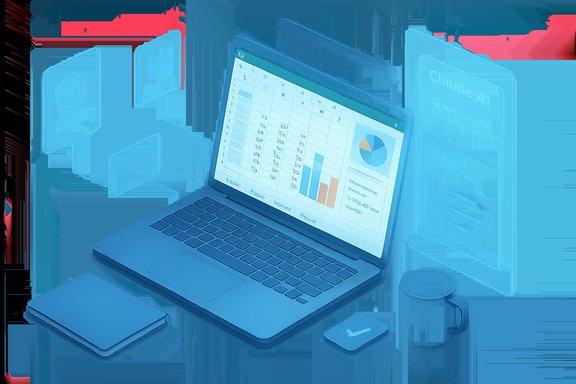
Anthropic has placed Claude directly inside Microsoft Excel with a limited research preview — a sidebar add‑in that can read, edit, and explain spreadsheet changes at the cell level while connecting to licensed market data and prebuilt financial “Agent Skills,” setting up a direct product‑level challenge to Microsoft’s Copilot inside the very tool finance teams live in every day.
Excel remains the connective tissue of corporate finance, FP&A, investment banking and audit — a single file format that encodes models, valuations, reconciliations and regulatory outputs. Embedding a capable large‑language model (LLM) inside Excel is therefore an architectural shortcut to enterprise adoption: the assistant arrives where the work already happens, not in a separate interface. Anthropic’s Claude for Excel is being distributed as a limited beta (research preview) to paid Max, Team and Enterprise customers via a waitlist, with an initial cohort of roughly 1,000 testers before broader availability. The feature set is purposefully verticalized for finance: Claude appears as an interactive sidebar that can traverse multi‑sheet workbooks, inspect formula dependency graphs, fix broken formulas, create draft models from natural‑language prompts, and — crucially for regulated workflows — provide navigable, cell‑level explanations and tracked edits intended to support auditability. Anthropic pairs the Excel integration with a set of prebuilt “Agent Skills” (for tasks like discounted cash flow modeling, comps analysis and earnings analysis) and connectors to licensed market data providers such as LSEG, Moody’s, Aiera, Egnyte and others — a strategy aimed at building a financial‑services data moat around Claude’s outputs. Microsoft, meanwhile, has been turning Copilot into an agentic layer inside Office with features such as the COPILOT in‑cell function and Agent Mode for Excel; Microsoft has also made Anthropic models selectable backends for Copilot in Researcher and Copilot Studio, creating a multi‑model environment where Anthropic can both supply model backends into Microsoft’s platform and compete with a vendor‑owned experience inside the same app.
Claude’s move into Excel is a tactical escalation in the enterprise AI contest: it reframes the battleground from the cloud to the spreadsheet cell, and it forces IT, legal and finance teams to reconcile the upside of automation with the immutable needs of traceability and governance. The next phase of this story will hinge on independent benchmarks, auditable deployments inside regulated workflows, and whether the market’s appetite for verticalized, data‑connected assistants outpaces the hard work that governance requires.
Source: varindia.com Claude AI Joins Excel, Challenging Microsoft Copilot
 Background / Overview
Excel remains the connective tissue of corporate finance, FP&A, investment banking and audit — a single file format that encodes models, valuations, reconciliations and regulatory outputs. Embedding a capable large‑language model (LLM) inside Excel is therefore an architectural shortcut to enterprise adoption: the assistant arrives where the work already happens, not in a separate interface. Anthropic’s Claude for Excel is being distributed as a limited beta (research preview) to paid Max, Team and Enterprise customers via a waitlist, with an initial cohort of roughly 1,000 testers before broader availability. The feature set is purposefully verticalized for finance: Claude appears as an interactive sidebar that can traverse multi‑sheet workbooks, inspect formula dependency graphs, fix broken formulas, create draft models from natural‑language prompts, and — crucially for regulated workflows — provide navigable, cell‑level explanations and tracked edits intended to support auditability. Anthropic pairs the Excel integration with a set of prebuilt “Agent Skills” (for tasks like discounted cash flow modeling, comps analysis and earnings analysis) and connectors to licensed market data providers such as LSEG, Moody’s, Aiera, Egnyte and others — a strategy aimed at building a financial‑services data moat around Claude’s outputs. Microsoft, meanwhile, has been turning Copilot into an agentic layer inside Office with features such as the COPILOT in‑cell function and Agent Mode for Excel; Microsoft has also made Anthropic models selectable backends for Copilot in Researcher and Copilot Studio, creating a multi‑model environment where Anthropic can both supply model backends into Microsoft’s platform and compete with a vendor‑owned experience inside the same app. What Claude for Excel actually does
Core capabilities (at a glance)
- In‑app sidebar assistant: Claude is embedded as a task pane inside Excel so users can keep working in the workbook while conversing with the assistant.
- Read and analyze: The assistant parses multi‑sheet workbooks, inspects formula chains, and summarizes assumptions, drivers and key risks in a model.
- Edit and build: Claude can modify cells, autotune formulas, fix errors (e.g., #REF!, circular references) and generate new worksheets or draft models from prompts.
- Cell‑level transparency: Every edit is accompanied by explanations and navigable citations that point to the exact cells and formulas used in the assistant’s reasoning — a feature pitched as an auditability control.
- Live connectors & Agent Skills: Direct integrations to licensed market data and document systems let Claude fetch real‑time quotes, credit reports, earnings transcripts and private‑equity analytics; prebuilt skills automate multi‑step analyst tasks.
How it differs from macros, add‑ins and clipboard bots
Claude attempts to operate on the workbook as a graph of dependencies rather than a stream of copy/paste operations. That means the assistant tries to preserve formatting, maintain formula references, and explain why a change was made — not merely what changed. This is an important distinction for finance teams because blind bulk edits or automated macros can break downstream reports and audit trails; Claude’s design seeks to reduce that risk by surfacing the provenance of decisions.Competitive context: Claude vs Microsoft Copilot
Two simultaneous fronts
- Microsoft has native Copilot features embedded in Excel — the COPILOT formula, Agent Mode and agent‑driven automation — rolled out through Microsoft’s Frontier and Copilot programs.
- Anthropic is shipping a dedicated, vendor‑owned add‑in optimized for finance workflows and licensed data connectors while Microsoft also offers Anthropic models as selectable backends inside Copilot’s agent surfaces. This creates both competition for screen real estate and an operationally complex multi‑model environment for IT teams.
Where Claude claims an edge
- Vertical specialization: Finance‑centric Agent Skills and direct market‑data connectors mean Claude’s responses can be populated with institutional‑grade inputs rather than generic web knowledge, which matters for valuation and credit work.
- Cell‑level auditability: The tracked edit trail and navigable citations are designed to meet compliance and internal audit needs more directly than freeform Copilot outputs.
- Vendor experience: Anthropic packages the experience as a single product under its commercial terms and governance, which some customers may prefer rather than selectively enabling Anthropic models inside Microsoft’s Copilot infrastructure.
Where Copilot still holds advantages
- Distribution & governance: Copilot ships natively inside Microsoft 365 and can be administered through tenant controls and Microsoft’s admin center, simplifying deployment for organizations already standardized on Microsoft licensing.
- Platform consolidation: Many enterprises prefer a single vendor stack for compliance and procurement reasons; adding a second vendor add‑in introduces policy, legal and support complexity.
Data connectors and the “finance data moat”
Anthropic’s strategy extends beyond the UI: it has built a connector ecosystem to licensed financial vendors and enterprise systems via its Model Context Protocol (MCP). Notable partner feeds and integrations mentioned in vendor materials and reporting include LSEG (Workspace, Financial Analytics), Moody’s, Aiera (earnings‑call transcripts), Chronograph (private equity analytics), Egnyte (secure document rooms), MT Newswires and others. These connectors let Claude ingest authoritative, up‑to‑date inputs for valuations, credit work and event monitoring. This approach builds a defensible product position in finance because model outputs are only as good as their inputs. By wiring Claude to paywalled, high‑quality data sources, Anthropic reduces the gap between a plausible natural‑language answer and an audit‑traceable, market‑calibrated conclusion. However, the commercial contracts, data‑use terms, and redistribution rights that govern those feeds will be essential procurement considerations before firms feed Claude outputs into client deliverables or regulatory filings.Claims of productivity gains: what’s verifiable and what to treat cautiously
Anthropic and partner materials quote impressive improvements from early deployments — figures such as ~20% productivity gains at larger institutions and dramatic reductions in review times at insurers. These numbers have been repeated in multiple trade outlets and press reports. For example, Anthropic materials and third‑party reporting cite customer results like Norges Bank Investment Management (NBIM) estimating a ~20% productivity improvement and AIG reporting a multi‑fold reduction in business‑review timelines with improved data accuracy. Those are important early proof points, but they should be treated as vendor‑reported outcomes unless independently audited. Independent coverage from trade press confirms the existence of production deployments and customer testimonials, yet third‑party, reproducible benchmarks and regulatory attestations are still forthcoming. In other words: the traction signals are meaningful, but due diligence (blind tests, audit checks, independent benchmarks) is essential before accepting vendor‑reported percentage improvements as universal.Practical risks, limitations and governance traps
- Model errors and hallucinations: LLMs remain prone to confidently stated but incorrect outputs. In finance, plausible errors can cascade and cause regulatory, financial or reputational damage. Vendor materials emphasize “human‑in‑the‑loop” review; organizations must enforce that.
- Incomplete feature support: The initial preview explicitly excludes or limits support for advanced Excel artifacts such as complex VBA macros, some PivotTable operations and certain workbook protections. Teams reliant on bespoke VBA logic should validate functionality before adopting Claude at scale.
- Audit trail persistence: A navigable annotation in a sidebar is helpful — but auditors will ask how those traces persist in enterprise version control, DMS retention, or regulatory evidence packages. Confirm whether logs are exported, tamper‑resistant and tied to user identities and workbook versions.
- Data licensing and redistribution: Live market and research connectors come with contractual terms. Legal teams must confirm that data provider licenses permit the use patterns intended (e.g., redistribution inside generated reports, storage in downstream systems, and retention for compliance).
- Cost predictability: Agentic workflows with chained API calls, licensed data pulls and frequent inference can create non‑trivial operational expenses. IT and finance must model per‑user inference and data access costs under realistic usage patterns.
- Vendor & cloud footprint: Anthropic’s models are often hosted on third‑party clouds; Microsoft’s approach of offering multi‑model choice means model execution may cross cloud boundaries. That can affect compliance postures and data residency commitments.
A practical implementation checklist for IT and finance leaders
- Start small, with low‑risk workstreams — begin pilots on internal models, not client‑facing regulatory reports.
- Require tenant admin opt‑in — deploy via Microsoft AppSource or the 365 admin center with group‑based rollout and role restrictions.
- Instrument full telemetry — capture per‑request inputs, model metadata, outputs, and costs; link to SIEM and observability dashboards.
- Enforce human sign‑off gates — mandate reviewer approvals for any workbook edits that feed into reports or trading signals.
- Validate on real prompts — run blind comparisons: Claude vs Copilot vs human baseline using your typical datasets and workflows; measure hallucination rate, correction time and human edit percentages.
- Clarify legal terms for connectors — have procurement and legal confirm SLAs, permitted use, and re‑distribution rights for each data feed.
- Document retention and audit export — ensure cell‑level logs and explanations can be exported, versioned and preserved in your document management system.
Governance patterns that actually work
- Treat AI assistants like new vendors: include them in vendor risk reviews, SOC2/ISO37001 checks, and contractual terms that forbid using client data to train models unless explicitly permitted.
- Map acceptable use cases at the tenant level: define where Claude or Copilot outputs may be used (internal analysis, pre‑client drafts, final client deliverables). Maintain explicit approvals for high‑impact use.
- Require reproducibility checks: when an AI edits a model that eventually feeds into an audit filing, ensure the sequence of operations is reproducible by a human reviewer and that the logged evidence is immutable.
The broader competitive landscape and what to watch next
Embedding verticalized assistants into productivity surfaces is now a multi‑track race. Microsoft is both a platform provider and a buyer of third‑party models; Anthropic is simultaneously a model supplier to Microsoft Copilot and a direct competitor with its own add‑in. Other vendors (Google, xAI, smaller specialist firms) are pursuing in‑app assistants or plug‑ins, while data vendors deepen their certification paths to be COP‑compliant and audit‑ready. Key signals to monitor over the coming months:- Whether independent third‑party audits reproduce vendor‑reported productivity gains on representative business prompts.
- How the major data providers publish MCP integration documentation and commercial terms that clarify use cases and redistribution rights.
- The pace at which Microsoft and Anthropic converge or differentiate features (e.g., persistent edit trails, macro support, offline governance).
Critical analysis: strengths, opportunities and systemic risks
Strengths and opportunities
- Productivity upside is real: Automating repetitive model construction, normalizing feeds, and generating initial writeups can reallocate analyst time to higher‑value judgment tasks. Early deployments suggest meaningful time savings.
- Auditability focus is sensible: Exposing cell‑level citations and tracked edits is the right design choice for regulated finance; it acknowledges that explainability and provenance matter more than novelty.
- Data connectors create defensibility: Licensed integrations reduce guesswork and make Claude’s outputs materially more useful for valuation and credit work, where timely market context matters.
Systemic risks and unresolved challenges
- Governance overhead will rise: Multi‑model, cross‑cloud execution increases procurement, legal and compliance complexity; organizations must invest resources to govern where each model is allowed to run and how outputs are used.
- Overconfidence and trust decay: As assistants repeatedly produce plausible outputs, humans can develop over‑trust. Without enforced review processes, that complacency can allow small model errors to become large operational failures.
- Dependency on licensed data and vendor economics: The value of Claude in finance depends on continued access to paywalled data. That access comes at cost and contractual complexity; organizations must model those recurring fees against productivity gains.
- Lack of independent verification: Many of the most attractive performance numbers remain vendor or customer‑reported. Objective, reproducible benchmarking by neutral third parties will be essential before broad regulatory acceptance.
Bottom line and recommended next steps for Windows‑focused finance teams
Claude for Excel is a consequential product move: it brings an enterprise‑grade LLM into Excel with explicit attention to audit trails and licensed financial data, and it arrives at a time when Microsoft is both a partner and a rival. For Windows‑centric finance operations the pragmatic approach is clear:- Treat Claude for Excel as a powerful drafting and automation assistant, not an autonomous decision maker. Require human sign‑off for any downstream, client‑facing, or regulatory content.
- Run a controlled pilot that measures accuracy, human edit rates, and downstream impact on reports; compare outcomes with Copilot and in‑house baselines.
- Lock down telemetry, logging and exportable audit trails; verify how annotations persist in your document management and versioning systems.
- Engage procurement and legal early to negotiate clear terms for each data connector and confirm permitted use cases.
Claude’s move into Excel is a tactical escalation in the enterprise AI contest: it reframes the battleground from the cloud to the spreadsheet cell, and it forces IT, legal and finance teams to reconcile the upside of automation with the immutable needs of traceability and governance. The next phase of this story will hinge on independent benchmarks, auditable deployments inside regulated workflows, and whether the market’s appetite for verticalized, data‑connected assistants outpaces the hard work that governance requires.
Source: varindia.com Claude AI Joins Excel, Challenging Microsoft Copilot
