

Anthropic has just pushed Claude into the spreadsheet that underpins modern finance, releasing a limited beta of Claude for Excel, opening direct, auditable AI workflows inside Microsoft Excel while simultaneously wiring Claude to licensed, real‑time market feeds and prebuilt analyst workflows — a move designed to challenge Microsoft Copilot and reshape how banks, asset managers, and insurers use generative AI in production.
Anthropic packaged the new capabilities under a broader “Claude for Financial Services” push announced in late October 2025. The company framed the release as a research preview targeted at paid Max, Team and Enterprise customers, with an initial, limited cohort on a waitlist for the Excel beta. The public announcement described three linked initiatives: a native Excel add‑in, a set of real‑time data connectors to major financial information vendors, and preconfigured “Agent Skills” that automate common analyst tasks such as DCF modeling and earnings analysis. Two independent trackers of the field documented the same timeline and scope: Anthropic’s product blog and contemporaneous reporting by industry outlets confirmed the October 27 product update and the availability model (limited research preview / waitlist).
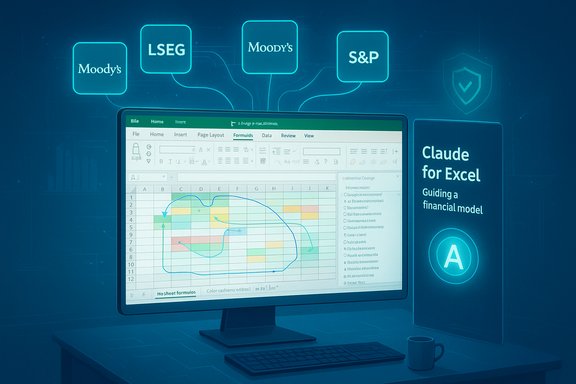
Key named integrations in the October update include major market and research vendors such as LSEG (London Stock Exchange Group), Moody’s, Aiera, Chronograph, Egnyte, and MT Newswires, alongside previously announced links to S&P Capital IQ, Morningstar, FactSet, PitchBook, Daloopa, Snowflake and Databricks. These connectors were positioned as a way to avoid manual copy/paste, maintain data provenance, and reduce hallucination risk by grounding outputs in licensed feeds. Why this matters: the factual quality of the inputs drives the reliability of AI outputs. A model given Bloomberg‑quality pricing or Moody’s credit assessments is operating from materially better evidence than a general web‑trained model. That advantage creates a commercial moat: licensed data contracts are expensive, non‑fungible, and difficult for competitors to replicate quickly.
Notable customer claims repeated in company pages and press coverage include Norges Bank Investment Management (NBIM) reporting an estimated ~20% productivity gain (equivalent to roughly 213,000 hours) and AIG reporting multi‑fold compression in underwriting review timelines and improved data accuracy figures. These quotes appear on Anthropic’s customer pages and in multiple industry publications repeating the vendor‑provided figures. Important editorial note: these are client‑reported outcomes and in many cases are published via vendor case pages or press releases. They are compelling but should be treated as company‑reported metrics until independently audited or disclosed in regulatory filings. Purchasers and governance teams should insist on reproducible KPIs and raw usage telemetry as part of proof‑of‑value tests.
Key governance risks for Claude deployments:
Enterprises should treat the announcement as both an opportunity and a governance challenge: run disciplined pilots, insist on telemetry and reproducibility, stress‑test failure modes, and validate vendor and client productivity claims with real, representative data. When Claude for Excel is used within a controlled, audited environment it can unlock real time savings and higher throughput; when used without controls it risks introducing cascading errors to precisely the business areas where mistakes are least forgivable.
Anthropic has put its flag in the spreadsheet. The next phase will be decided not by model architecture alone, but by which vendor can deliver verifiable accuracy, transparent audit trails, predictable commercial terms, and enterprise‑grade governance — the very checklist that controls which innovations migrate from early adopters into the day‑to‑day infrastructure of global finance.
Source: sportsdende.com.br Anthropic rolls out Claude AI for finance, integrates with Excel to rival Microsoft Copilot - Sports Dendê - o esporte com tempero baiano
 Background / Overview
Anthropic packaged the new capabilities under a broader “Claude for Financial Services” push announced in late October 2025. The company framed the release as a research preview targeted at paid Max, Team and Enterprise customers, with an initial, limited cohort on a waitlist for the Excel beta. The public announcement described three linked initiatives: a native Excel add‑in, a set of real‑time data connectors to major financial information vendors, and preconfigured “Agent Skills” that automate common analyst tasks such as DCF modeling and earnings analysis. Two independent trackers of the field documented the same timeline and scope: Anthropic’s product blog and contemporaneous reporting by industry outlets confirmed the October 27 product update and the availability model (limited research preview / waitlist). Why Excel is the new battlefield for finance AI
Microsoft Excel is not an optional tool inside investment banks, asset managers, or corporate finance teams — it is the operational fabric for modeling, valuation and regulatory reporting. Embedding an AI that can actually edit formulas, preserve dependencies, and point to specific cells moves the battlefield from the cloud to the desktop and creates a direct contest with Microsoft’s Copilot that already lives inside Office.- Excel is the lingua franca of finance: valuations, reconciliations, and pitchbooks live as .xlsx artifacts.
- Embedding AI inside Excel lowers adoption friction: analysts keep existing workflows and gain assistant‑driven productivity inside the file they already trust.
- The audit question is central: finance teams demand explainability and traceability — not just answers. Claude’s design explicitly attempts to surface cell‑level citations and change logs to build that traceability.
What Claude for Excel actually does — the technical snapshot
Claude’s Excel add‑in is designed as an interactive sidebar assistant that can:- Read, traverse, and summarize multi‑sheet models and formula chains.
- Modify cells and preserve formula dependencies and formatting.
- Debug common formula errors and explain fixes with navigable cell references.
- Build new worksheets or full draft models from natural‑language prompts.
- Track and annotate each edit so reviewers can jump straight to the cells that matter.
Implementation details worth noting
- The initial preview explicitly excludes certain advanced constructs in the first release (for example, some complex VBA macros and PivotTable workflows are limited), so teams that rely on bespoke macros should test carefully.
- Edits are tracked and annotated in a way that is meant to be navigable by human reviewers, but organizations must verify how those trails persist in audit systems (version control, VCS, DMS retention policies).
- Claude connects to enterprise and licensed data via a connector framework (Anthropic’s Model Context Protocol and partner MCP servers), meaning enterprise data stays under contractual controls rather than being scraped from the open web.
Building a data moat: the new battleground of licensed feeds and connectors
Perhaps the most consequential part of Anthropic’s rollout isn’t the Excel UI but the set of licensed connectors that feed Claude with high‑quality financial information. Anthropic announced partnerships that give Claude access to market data, credit ratings, transcripts, private‑market analytics and document repositories — a catalog intended to supply the factual backbone for analytical outputs.Key named integrations in the October update include major market and research vendors such as LSEG (London Stock Exchange Group), Moody’s, Aiera, Chronograph, Egnyte, and MT Newswires, alongside previously announced links to S&P Capital IQ, Morningstar, FactSet, PitchBook, Daloopa, Snowflake and Databricks. These connectors were positioned as a way to avoid manual copy/paste, maintain data provenance, and reduce hallucination risk by grounding outputs in licensed feeds. Why this matters: the factual quality of the inputs drives the reliability of AI outputs. A model given Bloomberg‑quality pricing or Moody’s credit assessments is operating from materially better evidence than a general web‑trained model. That advantage creates a commercial moat: licensed data contracts are expensive, non‑fungible, and difficult for competitors to replicate quickly.
Agent Skills: packaging analyst workflows into productized automations
Anthropic packaged six new prebuilt “Agent Skills” aimed squarely at the daily workstream of junior and mid‑level analysts. These include:- Discounted cash flow (DCF) modeling with FCF projections, WACC calculation, scenario toggles and sensitivity tables.
- Comparable company (comps) analyses with refreshable multiples and operating metrics.
- Earnings analysis that ingests transcript data and highlights guidance changes and management commentary.
- Document‑to‑Excel extraction flows that pull data rooms or diligence docs into structured spreadsheets.
- Initiating coverage and company profile templates for research production.
- Pitchbook teasers and buyer‑list generation workflows.
Benchmarks, performance and the limits of current models
Anthropic pointed to benchmark performance on finance‑oriented tests to support its positioning. Independent measurement firm Vals.ai’s Finance Agent benchmark lists Claude Sonnet 4.5 as the top performer with 55.3% accuracy on the Finance Agent suite — notably ahead of other frontier general‑purpose models but far from perfect. A few important caveats:- Benchmarks are synthetic and instructive, but not definitive: real‑world enterprise prompts, proprietary data shapes, and tool‑use integration matter more than benchmark scores alone.
- A 55% top score indicates meaningful progress but underscores that the technology is not yet ready to operate without human oversight on audit‑critical tasks.
- Vendor reports of superior internal performance (for example, Opus 4 performance in internal competitions) are useful signals but should be validated by purchasers with live, representative tests. Anthropic’s product materials and demonstrations reference other internal benchmark results that buyers should verify in pilot programs.
Traction and the customer narrative — vendor claims vs. verifiable results
Anthropic’s materials and customer pages highlight marquee deployments at large institutions — names that carry weight in procurement and security reviews. The company lists strategic clients including large sovereign wealth, insurer, and asset management organizations and quotes senior executives reporting material productivity impacts.Notable customer claims repeated in company pages and press coverage include Norges Bank Investment Management (NBIM) reporting an estimated ~20% productivity gain (equivalent to roughly 213,000 hours) and AIG reporting multi‑fold compression in underwriting review timelines and improved data accuracy figures. These quotes appear on Anthropic’s customer pages and in multiple industry publications repeating the vendor‑provided figures. Important editorial note: these are client‑reported outcomes and in many cases are published via vendor case pages or press releases. They are compelling but should be treated as company‑reported metrics until independently audited or disclosed in regulatory filings. Purchasers and governance teams should insist on reproducible KPIs and raw usage telemetry as part of proof‑of‑value tests.
Regulatory, legal and governance risk — the delicate balance
Financial services is a heavily regulated sector where algorithmic decisioning can carry civil and criminal liability. The current U.S. federal regulatory posture has fluctuated across administrations, but enforcement at the state level and consumer‑protection lawsuits are already shaping behavior: recent settlements have shown regulators are willing to penalize biased or improperly audited AI use in lending and credit contexts.Key governance risks for Claude deployments:
- Model hallucinations and cascading errors — even small numeric mistakes can propagate across a model and produce erroneous client deliverables or mispriced trades.
- Data licensing restrictions — commercial market data often has redistribution limits; organizations must confirm that outputs used in client materials comply with vendor licenses.
- Audit trails and non‑repudiation — tracked edits and cell‑level annotations are useful but not sufficient; firms need tamper‑resistant logging, identity tying, and retention policies to meet audit standards.
- Bias and fairness — underwriting and credit decisions using AI must be stress‑tested for disparate impact under state and federal laws, and institutions should maintain close human oversight in decision flows.
Competitive landscape — not just Microsoft vs. Anthropic
The financial AI market is crowded and strategic:- Microsoft embeds Copilot into Excel and has pivoted Copilot into a multi‑model platform where Anthropic’s models can be used as backends. Microsoft’s depth of tenant controls, admin tooling and cloud integration gives it a massive distribution advantage.
- OpenAI remains a dominant force via GPT models and its partnership with Microsoft; many enterprises run OpenAI models within their own governance stacks.
- Domain specialists — models and products trained specifically on financial text (for example, Bloomberg‑style datasets or BloombergGPT‑like initiatives) may outperform generalist models on narrow tasks.
- Bank‑built assistants — major institutions (e.g., Goldman Sachs) are also building internal agents, reducing some demand for third‑party vendors.
Practical checklist for IT, Risk and Finance teams (what to test before wide rollout)
- Run blind quality comparisons across your real prompts:
- Compare Claude (via Excel add‑in), Copilot (with different backends), and any internal baselines on representative, high‑risk tasks.
- Verify audit logging and retention:
- Ensure every AI action is timestamped, tied to a user identity, and preserved in an immutable audit trail.
- Confirm licensing and redistributability:
- Validate that vendor connectors’ contractual terms permit the intended use of generated materials in client deliverables.
- Stress test failure modes:
- Inject malformed formulas, corrupted inputs, and nested macros to observe behavior and rollback safety.
- Simulate cost and latency:
- Model expected query volumes and price per inference to avoid unexpected cloud spend.
- Define use‑level policy:
- Classify where AI outputs are allowed (internal analysis only, draft client materials, automated publish), and enforce policy via admin controls.
- Train users and maintain human‑in‑the‑loop:
- Roll out with mandatory training, signoff gates for client deliverables, and a clear escalation path for suspected model errors.
Security and data governance specifics
- Prefer tenant‑level or VPC‑isolated deployment models where possible; confirm where inference and context processing occur.
- Require encryption in transit and at rest for connector traffic and data caches.
- Audit vendor data handling policies: ensure customer data is not reused for model training unless explicitly contracted.
- Integrate AI usage telemetry into existing SIEM and change management dashboards to surface anomalous model edits.
Strengths, weaknesses and a balanced assessment
Strengths- Domain focus: prebuilt Agent Skills reduce time to value for standard analyst tasks.
- Data grounding: licensed connectors materially improve factual grounding and reduce hallucination risk.
- UX fit: embedding Claude inside Excel meets users in their existing workflows, lowering change resistance.
- Vendor momentum: high‑profile customer references help procurement and proofs‑of‑value.
- Accuracy ceiling: state‑of‑the‑art finance benchmarks show meaningful but incomplete accuracy (top score ~55% on Finance Agent), meaning human oversight remains mandatory.
- Governance complexity: adding third‑party add‑ins and cross‑model choices increases the compliance burden compared to a single‑vendor stack.
- Vendor‑reported metrics: productivity claims from customers (e.g., NBIM, AIG) should be validated; many figures originate in vendor materials and press reproduction.
- Coverage gaps: early preview limitations (complex macros, some PivotTable workflows) mean not every team will see immediate utility.
What this means for Windows and enterprise desktop teams
- Desktop teams must treat Claude for Excel like any other third‑party add‑in: inventory, approval workflows, and tenant controls are required.
- Policy makers should map allowed uses (internal drafts vs. regulatory deliverables) and ensure that AI edits show up in records used for reporting.
- Endpoint security must be aware of the add‑in’s connector behavior: verify that data flows to licensed provider endpoints and that any local caching meets corporate data‑loss prevention (DLP) rules.
Conclusion
Anthropic’s Excel integration and the surrounding suite of financial connectors and Agent Skills mark a clear escalation in the enterprise AI race for finance. The company has effectively combined model reasoning capability with licensed data and workflow automation to target the highest‑value, highest‑risk vertical where explainability and provenance matter most. The result is a product that can accelerate analyst productivity materially when used with appropriate guardrails, but it is not a turnkey replacement for human judgment — yet.Enterprises should treat the announcement as both an opportunity and a governance challenge: run disciplined pilots, insist on telemetry and reproducibility, stress‑test failure modes, and validate vendor and client productivity claims with real, representative data. When Claude for Excel is used within a controlled, audited environment it can unlock real time savings and higher throughput; when used without controls it risks introducing cascading errors to precisely the business areas where mistakes are least forgivable.
Anthropic has put its flag in the spreadsheet. The next phase will be decided not by model architecture alone, but by which vendor can deliver verifiable accuracy, transparent audit trails, predictable commercial terms, and enterprise‑grade governance — the very checklist that controls which innovations migrate from early adopters into the day‑to‑day infrastructure of global finance.
Source: sportsdende.com.br Anthropic rolls out Claude AI for finance, integrates with Excel to rival Microsoft Copilot - Sports Dendê - o esporte com tempero baiano
