

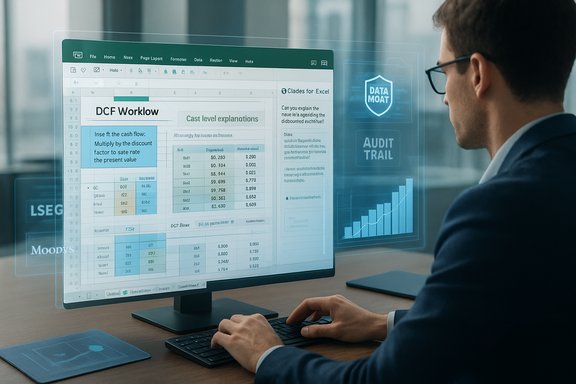
Anthropic has pushed Claude from chat assistant to spreadsheet coworker, rolling out a beta "Claude for Excel" add‑in and a broad set of licensed data connectors and prebuilt finance workflows designed to put the AI directly into the temple of modern finance: Microsoft Excel.
Background: why this matters right now
Finance runs on spreadsheets, licensed market data, and auditable workflows. Embedding an LLM that can read, edit and generate workbooks inside Excel is more than a productivity play — it’s an attempt to rewire where analysts create value, how compliance verifies it, and who controls the data pipelines that underpin investment decisions.Anthropic frames the move as an expansion of its Claude for Financial Services product: a beta Excel add‑in that lives in a sidebar, plus new market and research connectors (LSEG, Moody’s, Aiera, Third Bridge, Chronograph, Egnyte, MT Newswires and others), and packaged “Agent Skills” that automate common analyst tasks such as discounted cash‑flow (DCF) builds and earnings analysis. The timing adds pressure to a crowded field: Microsoft has opened Copilot to multiple model suppliers — including Anthropic’s own Claude models — and claims to be evolving Excel into an agentic platform of its own. The result is a direct, product‑level contest inside the single tool most analysts spend their day in.
Overview: what Claude for Excel promises
Claude for Excel is offered as a research preview to Anthropic’s paid Max, Team and Enterprise tiers, with an initial limited cohort intended to collect feedback before a wider rollout. The company says the add‑in runs from a sidebar inside Excel and can:- Read and analyze multi‑sheet workbooks and traverse formula dependencies;
- Modify cells and formulas while preserving formula integrity and formatting;
- Build new workbooks or populate templates from prompts;
- Debug formula errors and explain fixes;
- Track and annotate every edit with cell‑level explanations that let reviewers jump to the referenced cells.
The technical surface: how it fits into enterprise stacks
Claude’s data integrations are delivered via Anthropic’s Model Context Protocol (MCP), an open protocol designed to let models pull in licensed data from external vendors while preserving provenance metadata. Partners are publishing MCP servers so enterprise clients can route licensed feeds into Claude without manual ingestion. The LSEG collaboration, for example, provides Workspace and Financial Analytics content via MCP for phased use inside Claude deployments. Anthropic also supports direct links to internal enterprise systems such as Snowflake and Databricks, enabling Claude to use a firm’s own data alongside third‑party feeds. The company warns that initial previews do not yet support all advanced Excel constructs (complex VBA macros, some PivotTable workflows) and emphasizes the beta research nature of the feature.Data connectors and the "data moat" strategy
Anthropic’s product announcement doubled as a partner announcement: it added several high‑quality, licensed data feeds and integrations that together form an information stack matching many finance teams’ needs.Notable connector categories announced or confirmed by partners:
- Real‑time market data and analytics: London Stock Exchange Group (LSEG) — Workspace and Financial Analytics via MCP.
- Credit and company data: Moody’s — credit ratings and company-level datasets for compliance and credit analysis.
- Earnings calls and event transcripts: Aiera — investor event transcripts and vote/earnings summaries.
- Expert, primary‑research content: Third Bridge — expert interviews and qualitative diligence content integrated via Aiera’s MCP feeds.
- Private capital operational data: Chronograph — portfolio monitoring and valuations for private equity workflows.
- Real‑time financial news: MT Newswires — multi‑asset news and market alerts.
- Secure internal document access: Egnyte — governed access to internal data rooms and investment documents.
Agent Skills: packaged workflows for the analyst’s daily grind
Anthropic shipped a set of pre‑configured Agent Skills — essentially templates and step sequences Claude can execute — to address routine analyst tasks. Key examples include:- Discounted Cash Flow (DCF) builder with free cash flow projections, WACC calculations, scenario toggles, and sensitivity tables;
- Comparable company analysis (comps) with live multiple pulls and operating metrics;
- Earnings analysis that parses transcripts and financials to extract guidance changes and management commentary;
- Due diligence packs that convert data room documents into structured Excel outputs (customer lists, contract terms, financial schedules);
- Initiating coverage reports combining industry context, company deep dives and a valuation framework.
Benchmarks and claims: Sonnet 4.5, Vals AI, and the performance story
Anthropic spotlights its Sonnet 4.5 (branded Claude Sonnet 4.5) as the model powering many of the new finance capabilities. The company claims Sonnet 4.5 “topped the Finance Agent benchmark from Vals AI at 55.3% accuracy.” Vals AI’s public benchmarking pages show a multifaceted picture: their Finance Agent / CorpFin rankings and historic updates indicate Sonnet variants rank among the top models across several releases, but reported accuracy numbers and leaderboard positions have varied across benchmark revisions. Vals.ai itself frames the Finance Agent benchmark as an entry‑level analyst test composed of hundreds of tasks, and it publishes frequent updates as new models are tested. Important caveats and what to watch for:- Benchmarks are useful directional metrics, but they measure model behavior on curated tasks — not the messy, bespoke spreadsheets and contractual obligations analysts face day‑to‑day. Treat them as comparative rather than dispositive evidence of production readiness.
- Anthropic’s 55.3% claim and Vals.ai’s leaderboard entries appear to reference related but not always identical benchmark slices. Different dataset versions, tool access (search, EDGAR, web) or task definitions can yield materially different scores. Where vendors report single numbers, ask for the underlying test suite and configuration.
Enterprise traction and customer claims (what Anthropic and partners report)
Anthropic’s announcement and collateral include customer testimonials and quantified productivity claims from marquee clients. These include:- Norges Bank Investment Management (NBIM) — CEO Nicolai Tangen: “We estimate that we have achieved ~20% productivity gains—equivalent to 213,000 hours,” with Claude helping query Snowflake, monitor newsflow and speed proxy voting workflows.
- AIG — CEO Peter Zaffino: “Compressed the timeline to review business by more than 5x in our early rollouts while simultaneously improving our data accuracy from 75% to over 90%.”
- Bridgewater/AIA Labs and the Commonwealth Bank of Australia are cited as early pilots leveraging Claude for internal automation and fraud/case workflows.
Competitive dynamics: how Anthropic’s move confronts Microsoft and others
Microsoft has explicitly opened Copilot to Anthropic models and made Sonnet/Opus options available inside Microsoft 365 Copilot’s Researcher and Copilot Studio, even while rolling its own agentic features directly into Excel. That multiplies the product choices available to enterprises: they can use Copilot with OpenAI, Anthropic, or other models, or they can install a vendor‑owned add‑in like Claude for Excel. Key strategic contrasts for CIOs and procurement teams:- Microsoft Copilot: deep, native integration inside Microsoft 365, tenant governance controls and consolidated admin tooling. Model choice is mediated inside Copilot, giving enterprises a single console for policy and deployment.
- Anthropic Claude for Excel: vendor‑owned add‑in optimized for finance, broad connector ecosystem to premium data vendors (MCP), and verticalized agent skills — at the cost of an additional vendor relationship and cross‑cloud inference paths.
Risks, governance and regulatory context
Deploying an LLM that edits the authoritative financial model used for regulatory filings, valuations or underwriting exposes firms to several concrete risks:- Hallucinations and cascading errors: a single misattributed formula change can propagate through a DCF or capital model and produce materially wrong outputs. Anthropic’s own guidance stresses human review for audit‑critical work.
- Data licensing and redistribution: pulling licensed content into generated outputs raises contractual questions about redistribution and derivative use; firms must confirm entitlements with each data vendor before embedding outputs into client deliverables.
- Cross‑cloud inference and data residency: Anthropic models are often hosted outside Microsoft’s trust boundary (AWS/Bedrock or other clouds), which can complicate compliance with residency or processing rules unless mitigated by confidentiality and contractual terms. Microsoft and Anthropic documentation note this architecture explicitly.
- Liability and discrimination risk: ungoverned models used in lending, underwriting or pricing may produce biased or disparate outcomes; regulators have already taken enforcement action in AI‑driven lending cases, creating a patchwork of state and federal risks. Anthropic positions the product with a human‑in‑the‑loop default to reduce such exposures.
- Map data flows and document where model inference occurs and what data is transmitted.
- Require admin opt‑in and per‑group policy controls via the Microsoft 365 admin center or enterprise configuration.
- Instrument full audit logging: per‑request metadata, who invoked the agent, workbook diffs, and the source attribution for every injected cell.
- Run blind quality comparisons against human baselines and in‑house rules (reconciliation tests, unit checks).
- Legal sign‑offs on data licensing for any third‑party vendor content surfaced in outputs.
Practical deployment recommendations for finance and IT leaders
If your firm is evaluating Claude for Excel or similar offerings, adopt a staged, empirical program:- Start small and high‑value: pilot with a single team (e.g., FP&A or research associates) on clearly scoped tasks that are low risk but measurable.
- Define success metrics: human edit rate, time saved per task, downstream reconciliation discrepancies, and per‑request cost.
- Test failure modes: inject malformed inputs, corrupted sheets and unusual accounting treatments to see how the assistant behaves.
- Run side‑by‑side comparisons: evaluate Claude, Copilot (OpenAI backend), in‑house scripts and human baselines on identical prompts.
- Lock governance into the onboarding playbook: require human sign‑offs, version control snapshots and periodic audits for production use.
Strengths, limitations and the road ahead
Strengths:- Domain focus: prebuilt Agent Skills and licensed data connectors match real analyst workflows and materially reduce manual copy/paste and reconciliation work.
- Auditability features: cell‑level explanations and navigable change tracking address a core enterprise need — transparency inside spreadsheets.
- Commercial ecosystem: partnerships with LSEG, Moody’s, Aiera, Third Bridge and Chronograph provide a robust data foundation that improves factual grounding.
- Benchmark and real‑world gap: benchmark wins are meaningful but do not eliminate the need for human checks in production; reported accuracy rates still imply substantial manual supervision.
- Vendor‑reported metrics: productivity numbers cited by Anthropic and clients are persuasive indicators of traction, but they are vendor‑reported and should be validated inside your own business context.
- Governance complexity: multi‑model, multi‑vendor deployments increase the IT surface area; organizations must upgrade policy, logging and legal playbooks before broad rollouts.
What to ask vendors and partners before signing up
- Where does inference happen and where are requests logged? Is there a verifiable, tamper‑resistant audit trail?
- What exact datasets and licences will be accessible inside your tenant, and do those contracts permit redistribution in client deliverables?
- Can the vendor provide reproducible benchmark artifacts (test deck, tool access, task definitions) used in public performance claims? Ask for the underlying suite, not just headline numbers.
- How does the vendor enforce human‑in‑the‑loop policies and can you configure mandatory sign‑offs for specific outputs?
Conclusion
Anthropic’s Claude for Excel is the most explicit effort yet to place a commercial LLM where financial analysts already work, and to back that interface with licensed market data and packaged workflows. The combination of an in‑sheet agent, high‑quality connectors and prebuilt Agent Skills is a credible product‑market fit for institutions that want measurable productivity gains without abandoning auditability.At the same time, the technology is not a turnkey replacement for human expertise. Benchmarks and vendor case studies show state‑of‑the‑art progress, but real‑world finance demands reproducible, provable outputs and ironclad contractual controls over data and inference. The sensible path for most institutions is disciplined pilots that lock governance into the rollout pipeline, require measurable validation, and treat the assistant as a powerful co‑pilot rather than an autonomous decision‑maker. If Claude can consistently edit spreadsheet models, refresh them from licensed market feeds, and leave an incontrovertible audit trail at the cell level — without hallucinating a decimal point — Anthropic will have done something more consequential than winning a benchmark. It will have proven that generative AI can be integrated into the most exacting workflows of global finance.
Source: gamenexus.com.br Anthropic rolls out Claude AI for finance, integrates with Excel to rival Microsoft Copilot - GameNexus
