

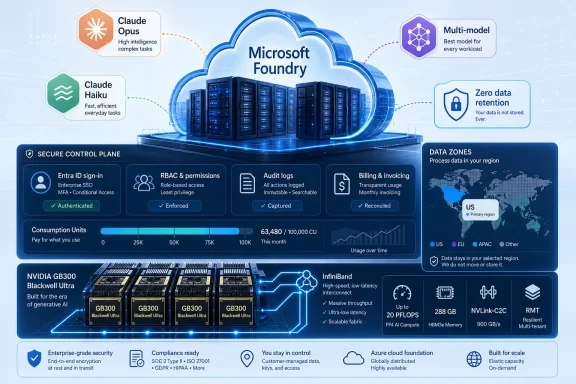
Anthropic made Claude generally available in Microsoft Foundry on June 29, 2026, bringing Claude Opus 4.8 and Claude Haiku 4.5 to Azure customers through the Messages API, with Azure identity, billing, networking, governance, and data-zone controls wrapped around the deployment. The headline is model choice, but the real story is procurement gravity. Microsoft is turning Azure into the place where enterprises can buy, govern, meter, and contain rival frontier models without leaving the Microsoft control plane. For IT departments, that may matter more than which chatbot wins a benchmark this quarter.
For years, Microsoft’s AI story was easy to summarize and hard to challenge: OpenAI supplied the frontier models, Azure supplied the cloud, and Copilot supplied the distribution. Claude’s arrival in Microsoft Foundry does not erase that story, but it complicates it in a way that feels deliberate. Microsoft is no longer merely selling access to its preferred model partner; it is selling the management layer through which large companies will consume models from multiple AI labs.
That is a subtler and more durable position. If OpenAI, Anthropic, Google, Meta, or some future model shop trades places on the leaderboard, Microsoft can still make Azure the place where the enterprise relationship lives. The buyer may think it is choosing Claude, but the invoice, identity boundary, role assignment, private networking posture, and governance policy can all remain Microsoft-shaped.
This is why Foundry matters. It is not just a catalog of models, and it is not just a developer portal with a friendlier name. It is Microsoft’s attempt to make AI model consumption look like the rest of enterprise cloud consumption: deployable, auditable, billable, permissioned, and eventually boring enough to pass through a change advisory board.
Claude’s presence strengthens that pitch because Anthropic has credibility with developers, security teams, and organizations that like its constitutional-AI branding and coding performance. Microsoft benefits from that credibility without needing to own it. Anthropic benefits from Azure’s enterprise footprint without needing to persuade every CIO to sign a separate cloud and procurement relationship.
The Azure-hosted Claude option lets organizations apply familiar identity and access controls to Anthropic’s models. That means administrators can manage access through Entra ID, use Azure role-based access control, and apply the governance policies already used elsewhere in the tenant. In practical terms, the AI model becomes another controlled resource rather than a shadow service expensed on a corporate card.
That is the kind of plumbing developers rarely celebrate and enterprise IT quietly demands. The last two years of generative AI have been defined by a mismatch between individual enthusiasm and institutional risk tolerance. Employees discovered powerful tools faster than legal, compliance, finance, and security teams could approve them. Foundry is Microsoft’s answer to that mismatch: bring the models into the approved estate rather than pretending workers will stop using them.
The billing story is equally important. Claude Consumption Units appearing on the Azure invoice sounds like an accounting footnote, but consolidated billing changes adoption behavior. If customers can apply existing Microsoft Azure Consumption Commitment spend toward Claude usage, AI experimentation becomes easier to justify inside organizations that already negotiated large Azure agreements.
Procurement is not glamorous, but it is destiny in enterprise software. A model that is technically available but commercially awkward will lose to a slightly less convenient model that fits an existing contract. Microsoft knows this because Microsoft has spent decades turning licensing friction into distribution advantage.
For those organizations, the question is not simply whether a model is smart enough. It is where the data goes, who processes it, how long it is retained, and whether the answers to those questions can survive an audit. Foundry’s Azure-native deployment gives Microsoft and Anthropic a cleaner answer than “trust our API.”
Zero data retention is a particularly important part of the pitch. When enabled, Anthropic says it does not retain prompts or outputs after API calls complete. For high-sensitivity workloads, that can be the difference between an AI pilot staying trapped in a lab and being approved for production use.
Still, zero retention should not be mistaken for zero risk. Prompts can still leak secrets into logs if developers instrument applications carelessly. Agents can still retrieve data they should not see if permissions are too broad. Outputs can still become business records subject to retention requirements once they land in downstream systems. The cloud provider can reduce friction, but it cannot absolve customers of architecture.
That is the uncomfortable truth behind every enterprise AI launch. Vendors sell governance as a feature, but governance is a practice. Azure can provide controls; customers still have to design roles, classify data, monitor usage, and decide which workflows deserve autonomous model access in the first place.
The first phase of the AI boom rewarded exclusivity. Having the hottest model mattered more than having the widest menu. The next phase rewards orchestration. Companies want to route different tasks to different models, compare cost and latency, avoid single-vendor dependency, and maintain leverage in negotiations.
Microsoft’s relationship with OpenAI remains foundational to Copilot, Azure OpenAI Service, and Microsoft’s AI identity in the market. But a cloud platform that only offers one family of frontier models risks looking less like a platform and more like a reseller. Foundry is Microsoft’s way of saying that Azure is where models compete under enterprise rules.
There is also a defensive logic. Amazon has made Anthropic central to its own AI strategy, while Google has Gemini and Vertex AI. If Microsoft wants Azure to be credible as a neutral enterprise AI substrate, it cannot ask customers to treat OpenAI as the answer to every workload. Claude’s arrival helps Microsoft argue that Azure is not just OpenAI’s preferred runway but a broader control plane for AI.
The irony is that openness here reinforces lock-in. The more model choice Microsoft offers inside Azure, the less reason customers have to leave Azure to get choice. That is platform strategy in its purest form.
Claude in Foundry gives Anthropic a route into organizations that might otherwise default to OpenAI because Azure OpenAI Service is already approved. It also gives Anthropic visibility in Microsoft’s model catalog at the moment when enterprises are formalizing their AI platforms. That timing matters. Once a company standardizes on a model routing layer, governance process, and internal AI development workflow, displacement becomes harder.
The announcement also preserves a dual-path strategy. Customers can use Azure-hosted Claude for Azure-native authentication, governance, billing, and data-zone controls. They can also use the “hosted on Anthropic” option, formerly Foundry Preview, when they need features or variants not yet enabled in the Azure-hosted environment.
That distinction is important because parity rarely arrives on day one. Model providers move quickly, cloud integrations move carefully, and enterprise features often lag raw API features. Microsoft and Anthropic say they intend to align the two deployment modes over time, but customers should assume that the newest Claude capability may appear first in Anthropic’s own environment before it becomes fully available in Azure-hosted form.
This is the trade-off enterprises know well. The native vendor endpoint may move faster. The cloud-hosted enterprise wrapper may govern better. Foundry’s job is to make that trade-off explicit rather than forcing teams into unofficial workarounds.
The AI industry has spent the last several years learning that models are not abstract intelligence floating in the cloud. They are capital-intensive systems tied to accelerator availability, networking fabrics, power envelopes, data-center capacity, and scheduling economics. When Microsoft, Nvidia, and Anthropic announced their strategic partnership in late 2025, the message was that frontier AI deployment would be a three-body problem: model lab, cloud provider, and chip supplier.
For customers, the hardware stack mostly matters when it shows up as latency, throughput, regional availability, or price. The GB300 NVL72 and Quantum-X800 language signals that Microsoft and Nvidia want enterprises to see this as serious production infrastructure for agentic workloads, not a best-effort preview running wherever spare capacity exists.
Nvidia also has a platform agenda of its own. The company is pushing deeper into agent infrastructure, developer tools, and reference designs that specify how identity, credentials, network access, and runtime policies should be managed. That is a natural extension of its position: once GPUs are the scarce substrate for AI, Nvidia has every incentive to shape the software patterns that keep those GPUs central.
The result is a launch that looks like an Anthropic announcement but reads like an industry alignment. Microsoft controls the cloud relationship. Anthropic supplies the model. Nvidia supplies the accelerator architecture and increasingly the agent infrastructure vocabulary. Enterprise customers get one more model, but they also get a preview of how concentrated the AI stack is becoming.
Prompt caching can change the economics of applications with long, repeated context. Extended reasoning features can help with complex planning and analysis, though they also require careful evaluation because more visible reasoning does not automatically mean more reliable reasoning. Tool streaming matters for agents because it gives applications a way to coordinate model output with external systems in something closer to real time.
The deeper integration point is Foundry Agent Service, where Claude can act as a reasoning engine for multi-step planning, tool use, and automation across enterprise applications. That is where the launch leaves the safe territory of chat completion and enters the messier world of agents. The difference is not semantic. A chatbot suggests; an agent acts.
Enterprises are excited by that shift because internal work is full of repetitive, cross-system tasks. They are also nervous because cross-system tasks are exactly where permissions, auditability, and failure modes become dangerous. A model that can draft an email is one kind of risk. A model that can inspect a ticket, query a database, update a record, call a workflow, and notify a customer is another.
Foundry gives Microsoft a chance to make agentic AI feel administrable. Whether it succeeds will depend less on the presence of Claude and more on the surrounding controls: scoped credentials, human approval patterns, logging, sandboxing, network restrictions, and policy enforcement that survives real-world developer pressure.
But “more comfortable” is not the same as “fully approved.” Regulated industries still need to map AI usage to their own obligations. That includes data classification, retention, explainability where required, vendor risk management, incident response, and human oversight for consequential decisions. No model deployment option eliminates those duties.
The most realistic near-term use cases will be internal and bounded. Code assistance, document analysis, knowledge-base drafting, compliance triage, support summarization, and workflow copilots are more likely than fully autonomous decision systems. Claude’s strengths in reasoning and writing make it attractive for these tasks, but the deployment wrapper makes it easier to put those tasks in front of risk committees.
The danger is that the word “agentic” becomes a permission slip. Vendors have embraced the term because it promises productivity beyond chat. IT leaders should treat it as a risk category. The more tools an agent can use, the more important it becomes to constrain what those tools can reach.
That is where Azure-native identity and governance become more than procurement conveniences. They are the mechanism by which organizations can make agents less terrifying. The best enterprise AI systems will not be the ones that give models unlimited access to everything; they will be the ones that make narrow, auditable delegation easy.
By placing Claude usage inside Azure billing, Microsoft lets organizations use existing cloud financial operations practices. Budgets, chargebacks, tagging discipline, procurement approvals, and commitment drawdown all become part of the conversation. That is helpful, but it also means AI spend will face the same scrutiny as any other cloud spend once the novelty wears off.
The MACC angle is particularly powerful. If a company has already committed to spend a large amount on Azure, the ability to count Claude usage toward that commitment changes the internal business case. A department that might struggle to justify a new vendor can position Claude as part of already planned cloud consumption.
This is also where Microsoft gains leverage over model providers. If Azure becomes the enterprise purchasing channel for multiple models, Microsoft can influence packaging, pricing visibility, and customer expectations. The model lab supplies the intelligence, but the cloud provider controls the commercial interface.
For customers, the caution is to avoid confusing invoice consolidation with cost optimization. Putting Claude on the Azure bill does not automatically make workloads efficient. Developers still need to design for caching, choose smaller models where appropriate, monitor runaway agents, and evaluate whether a frontier model is necessary for a task at all.
This matters for WindowsForum readers because Microsoft’s AI strategy is not confined to the cloud. The same identity, governance, and management instincts that shape Azure also shape Windows, Microsoft 365, Defender, Intune, and Copilot. Microsoft’s preferred future is one in which AI models, agents, endpoints, documents, identities, and security signals all participate in a managed enterprise fabric.
That fabric could be useful. It could also be constraining. The more AI capabilities are mediated through Microsoft’s administrative stack, the more organizations may depend on Microsoft’s definitions of safe deployment, supported integrations, and acceptable model access. The platform that solves governance sprawl can also become the platform that limits architectural imagination.
Still, most enterprise IT teams are not asking for maximal theoretical freedom. They are asking for something they can deploy without creating a governance emergency. Foundry’s promise is that model choice and administrative control can coexist. Claude’s arrival makes that promise more credible.
The long-term question is whether Foundry becomes a neutral model marketplace or a Microsoft-shaped funnel. The difference will show up in how quickly third-party models receive feature parity, how transparent pricing remains, how portable applications are across model providers, and whether customers can move workloads without rewriting their governance model from scratch.
That is where the next phase of AI will be won or lost. Model capability is advancing quickly, but enterprise adoption is gated by trust and control. A model that can reason through a complex workflow is impressive. A model that can do so while respecting least privilege, staying inside a data zone, producing useful logs, and fitting an existing invoice is deployable.
This is why Microsoft’s language around “agentic applications” should be read carefully. It is not merely chasing a buzzword. It is positioning Azure as the operational substrate for AI systems that act across business domains. In that world, the orchestration layer may become as strategically important as the model itself.
Anthropic’s Claude is a strong fit for that pitch because it has earned a reputation for coding, structured reasoning, and enterprise-friendly behavior. But reputations in AI are volatile. A model family can lead one quarter and trail the next. The stable value is the control plane that lets organizations evaluate, swap, govern, and pay for those models without starting over.
For Windows and Microsoft administrators, this launch is another sign that AI management will become part of ordinary infrastructure management. The same people who worry about conditional access, privileged roles, endpoint compliance, and data loss prevention will increasingly be asked to worry about model access, prompt flows, tool permissions, and agent behavior.
 Microsoft Is Selling Model Choice Without Surrendering the Platform
For years, Microsoft’s AI story was easy to summarize and hard to challenge: OpenAI supplied the frontier models, Azure supplied the cloud, and Copilot supplied the distribution. Claude’s arrival in Microsoft Foundry does not erase that story, but it complicates it in a way that feels deliberate. Microsoft is no longer merely selling access to its preferred model partner; it is selling the management layer through which large companies will consume models from multiple AI labs.That is a subtler and more durable position. If OpenAI, Anthropic, Google, Meta, or some future model shop trades places on the leaderboard, Microsoft can still make Azure the place where the enterprise relationship lives. The buyer may think it is choosing Claude, but the invoice, identity boundary, role assignment, private networking posture, and governance policy can all remain Microsoft-shaped.
This is why Foundry matters. It is not just a catalog of models, and it is not just a developer portal with a friendlier name. It is Microsoft’s attempt to make AI model consumption look like the rest of enterprise cloud consumption: deployable, auditable, billable, permissioned, and eventually boring enough to pass through a change advisory board.
Claude’s presence strengthens that pitch because Anthropic has credibility with developers, security teams, and organizations that like its constitutional-AI branding and coding performance. Microsoft benefits from that credibility without needing to own it. Anthropic benefits from Azure’s enterprise footprint without needing to persuade every CIO to sign a separate cloud and procurement relationship.
The Azure Wrapper Is the Product
The most important phrase in this launch is not “Claude Opus 4.8.” It is “Microsoft Entra ID.” That may sound absurd if you are comparing models in a terminal, but it is the difference between a demo and an enterprise rollout.The Azure-hosted Claude option lets organizations apply familiar identity and access controls to Anthropic’s models. That means administrators can manage access through Entra ID, use Azure role-based access control, and apply the governance policies already used elsewhere in the tenant. In practical terms, the AI model becomes another controlled resource rather than a shadow service expensed on a corporate card.
That is the kind of plumbing developers rarely celebrate and enterprise IT quietly demands. The last two years of generative AI have been defined by a mismatch between individual enthusiasm and institutional risk tolerance. Employees discovered powerful tools faster than legal, compliance, finance, and security teams could approve them. Foundry is Microsoft’s answer to that mismatch: bring the models into the approved estate rather than pretending workers will stop using them.
The billing story is equally important. Claude Consumption Units appearing on the Azure invoice sounds like an accounting footnote, but consolidated billing changes adoption behavior. If customers can apply existing Microsoft Azure Consumption Commitment spend toward Claude usage, AI experimentation becomes easier to justify inside organizations that already negotiated large Azure agreements.
Procurement is not glamorous, but it is destiny in enterprise software. A model that is technically available but commercially awkward will lose to a slightly less convenient model that fits an existing contract. Microsoft knows this because Microsoft has spent decades turning licensing friction into distribution advantage.
Data Residency Becomes a Competitive Feature, Not a Compliance Afterthought
The launch gives customers the option to process inference in a global or US data zone, with Claude hosted in Azure and Anthropic operating inference as the data processor. That arrangement is aimed directly at companies that have treated frontier AI as interesting but operationally difficult because prompts and outputs can contain regulated, confidential, or commercially sensitive information.For those organizations, the question is not simply whether a model is smart enough. It is where the data goes, who processes it, how long it is retained, and whether the answers to those questions can survive an audit. Foundry’s Azure-native deployment gives Microsoft and Anthropic a cleaner answer than “trust our API.”
Zero data retention is a particularly important part of the pitch. When enabled, Anthropic says it does not retain prompts or outputs after API calls complete. For high-sensitivity workloads, that can be the difference between an AI pilot staying trapped in a lab and being approved for production use.
Still, zero retention should not be mistaken for zero risk. Prompts can still leak secrets into logs if developers instrument applications carelessly. Agents can still retrieve data they should not see if permissions are too broad. Outputs can still become business records subject to retention requirements once they land in downstream systems. The cloud provider can reduce friction, but it cannot absolve customers of architecture.
That is the uncomfortable truth behind every enterprise AI launch. Vendors sell governance as a feature, but governance is a practice. Azure can provide controls; customers still have to design roles, classify data, monitor usage, and decide which workflows deserve autonomous model access in the first place.
Microsoft’s OpenAI Relationship Looks Less Exclusive Because It Has To
Claude in Foundry will inevitably be read as another sign that Microsoft is hedging its OpenAI bet. That interpretation is not wrong, but it is incomplete. Microsoft is not walking away from OpenAI; it is broadening Azure’s model marketplace because enterprise buyers increasingly expect optionality.The first phase of the AI boom rewarded exclusivity. Having the hottest model mattered more than having the widest menu. The next phase rewards orchestration. Companies want to route different tasks to different models, compare cost and latency, avoid single-vendor dependency, and maintain leverage in negotiations.
Microsoft’s relationship with OpenAI remains foundational to Copilot, Azure OpenAI Service, and Microsoft’s AI identity in the market. But a cloud platform that only offers one family of frontier models risks looking less like a platform and more like a reseller. Foundry is Microsoft’s way of saying that Azure is where models compete under enterprise rules.
There is also a defensive logic. Amazon has made Anthropic central to its own AI strategy, while Google has Gemini and Vertex AI. If Microsoft wants Azure to be credible as a neutral enterprise AI substrate, it cannot ask customers to treat OpenAI as the answer to every workload. Claude’s arrival helps Microsoft argue that Azure is not just OpenAI’s preferred runway but a broader control plane for AI.
The irony is that openness here reinforces lock-in. The more model choice Microsoft offers inside Azure, the less reason customers have to leave Azure to get choice. That is platform strategy in its purest form.
Anthropic Gets Enterprise Distribution Without Becoming a Microsoft Subsidiary
For Anthropic, the deal solves a different problem. The company has strong mindshare among developers and enterprise AI teams, but cloud distribution is expensive and politically complicated. Meeting large customers where they already operate is easier than asking those customers to build a parallel AI procurement and governance stack.Claude in Foundry gives Anthropic a route into organizations that might otherwise default to OpenAI because Azure OpenAI Service is already approved. It also gives Anthropic visibility in Microsoft’s model catalog at the moment when enterprises are formalizing their AI platforms. That timing matters. Once a company standardizes on a model routing layer, governance process, and internal AI development workflow, displacement becomes harder.
The announcement also preserves a dual-path strategy. Customers can use Azure-hosted Claude for Azure-native authentication, governance, billing, and data-zone controls. They can also use the “hosted on Anthropic” option, formerly Foundry Preview, when they need features or variants not yet enabled in the Azure-hosted environment.
That distinction is important because parity rarely arrives on day one. Model providers move quickly, cloud integrations move carefully, and enterprise features often lag raw API features. Microsoft and Anthropic say they intend to align the two deployment modes over time, but customers should assume that the newest Claude capability may appear first in Anthropic’s own environment before it becomes fully available in Azure-hosted form.
This is the trade-off enterprises know well. The native vendor endpoint may move faster. The cloud-hosted enterprise wrapper may govern better. Foundry’s job is to make that trade-off explicit rather than forcing teams into unofficial workarounds.
Nvidia Is the Third Name in the Fine Print
The launch also puts Nvidia’s hardware story in the foreground. Claude in Microsoft Foundry is running on Nvidia’s GB300 Blackwell Ultra GPUs, with Quantum-X800 InfiniBand networking behind the deployment. That detail is not incidental branding. Inference at this scale is a supply-chain story as much as a software story.The AI industry has spent the last several years learning that models are not abstract intelligence floating in the cloud. They are capital-intensive systems tied to accelerator availability, networking fabrics, power envelopes, data-center capacity, and scheduling economics. When Microsoft, Nvidia, and Anthropic announced their strategic partnership in late 2025, the message was that frontier AI deployment would be a three-body problem: model lab, cloud provider, and chip supplier.
For customers, the hardware stack mostly matters when it shows up as latency, throughput, regional availability, or price. The GB300 NVL72 and Quantum-X800 language signals that Microsoft and Nvidia want enterprises to see this as serious production infrastructure for agentic workloads, not a best-effort preview running wherever spare capacity exists.
Nvidia also has a platform agenda of its own. The company is pushing deeper into agent infrastructure, developer tools, and reference designs that specify how identity, credentials, network access, and runtime policies should be managed. That is a natural extension of its position: once GPUs are the scarce substrate for AI, Nvidia has every incentive to shape the software patterns that keep those GPUs central.
The result is a launch that looks like an Anthropic announcement but reads like an industry alignment. Microsoft controls the cloud relationship. Anthropic supplies the model. Nvidia supplies the accelerator architecture and increasingly the agent infrastructure vocabulary. Enterprise customers get one more model, but they also get a preview of how concentrated the AI stack is becoming.
The Messages API Gives Developers Familiar Claude, Not Just a Catalog Tile
For developers, the practical win is access to Claude through the Messages API, including features such as prompt caching, extended thinking, and tool streaming. Those capabilities matter because they support the workloads Claude is often chosen for: code development, structured reasoning, multi-step task execution, and agentic workflows that need to call tools rather than merely answer questions.Prompt caching can change the economics of applications with long, repeated context. Extended reasoning features can help with complex planning and analysis, though they also require careful evaluation because more visible reasoning does not automatically mean more reliable reasoning. Tool streaming matters for agents because it gives applications a way to coordinate model output with external systems in something closer to real time.
The deeper integration point is Foundry Agent Service, where Claude can act as a reasoning engine for multi-step planning, tool use, and automation across enterprise applications. That is where the launch leaves the safe territory of chat completion and enters the messier world of agents. The difference is not semantic. A chatbot suggests; an agent acts.
Enterprises are excited by that shift because internal work is full of repetitive, cross-system tasks. They are also nervous because cross-system tasks are exactly where permissions, auditability, and failure modes become dangerous. A model that can draft an email is one kind of risk. A model that can inspect a ticket, query a database, update a record, call a workflow, and notify a customer is another.
Foundry gives Microsoft a chance to make agentic AI feel administrable. Whether it succeeds will depend less on the presence of Claude and more on the surrounding controls: scoped credentials, human approval patterns, logging, sandboxing, network restrictions, and policy enforcement that survives real-world developer pressure.
Regulated Industries Get a Better Argument, Not a Free Pass
The launch will be especially appealing to banks, healthcare organizations, insurers, public-sector agencies, and large manufacturers that have been cautious about generative AI. These are the buyers that like the idea of frontier models but dislike ambiguous data handling, separate vendor contracts, and unmanaged employee usage. Azure-hosted Claude gives them a more comfortable starting point.But “more comfortable” is not the same as “fully approved.” Regulated industries still need to map AI usage to their own obligations. That includes data classification, retention, explainability where required, vendor risk management, incident response, and human oversight for consequential decisions. No model deployment option eliminates those duties.
The most realistic near-term use cases will be internal and bounded. Code assistance, document analysis, knowledge-base drafting, compliance triage, support summarization, and workflow copilots are more likely than fully autonomous decision systems. Claude’s strengths in reasoning and writing make it attractive for these tasks, but the deployment wrapper makes it easier to put those tasks in front of risk committees.
The danger is that the word “agentic” becomes a permission slip. Vendors have embraced the term because it promises productivity beyond chat. IT leaders should treat it as a risk category. The more tools an agent can use, the more important it becomes to constrain what those tools can reach.
That is where Azure-native identity and governance become more than procurement conveniences. They are the mechanism by which organizations can make agents less terrifying. The best enterprise AI systems will not be the ones that give models unlimited access to everything; they will be the ones that make narrow, auditable delegation easy.
The Cost Conversation Moves From Tokens to Commitments
Claude Consumption Units appearing as a single line item on the Azure invoice may sound less interesting than model quality, but it will shape adoption. AI cost management has already become a problem for teams that moved from experiments to production. Token pricing is simple in theory and unpredictable in practice, especially when agents loop, retrieve context, call tools, or retry failed steps.By placing Claude usage inside Azure billing, Microsoft lets organizations use existing cloud financial operations practices. Budgets, chargebacks, tagging discipline, procurement approvals, and commitment drawdown all become part of the conversation. That is helpful, but it also means AI spend will face the same scrutiny as any other cloud spend once the novelty wears off.
The MACC angle is particularly powerful. If a company has already committed to spend a large amount on Azure, the ability to count Claude usage toward that commitment changes the internal business case. A department that might struggle to justify a new vendor can position Claude as part of already planned cloud consumption.
This is also where Microsoft gains leverage over model providers. If Azure becomes the enterprise purchasing channel for multiple models, Microsoft can influence packaging, pricing visibility, and customer expectations. The model lab supplies the intelligence, but the cloud provider controls the commercial interface.
For customers, the caution is to avoid confusing invoice consolidation with cost optimization. Putting Claude on the Azure bill does not automatically make workloads efficient. Developers still need to design for caching, choose smaller models where appropriate, monitor runaway agents, and evaluate whether a frontier model is necessary for a task at all.
Foundry Is Becoming the AI Control Plane Microsoft Always Wanted
Microsoft Foundry sits at the intersection of several Microsoft ambitions: model catalog, developer tooling, agent framework, governance layer, and enterprise marketplace. Claude’s general availability strengthens each of those roles. It gives Foundry a serious non-OpenAI model, a high-profile proof point for multi-model strategy, and a reason for organizations to standardize AI development inside Azure.This matters for WindowsForum readers because Microsoft’s AI strategy is not confined to the cloud. The same identity, governance, and management instincts that shape Azure also shape Windows, Microsoft 365, Defender, Intune, and Copilot. Microsoft’s preferred future is one in which AI models, agents, endpoints, documents, identities, and security signals all participate in a managed enterprise fabric.
That fabric could be useful. It could also be constraining. The more AI capabilities are mediated through Microsoft’s administrative stack, the more organizations may depend on Microsoft’s definitions of safe deployment, supported integrations, and acceptable model access. The platform that solves governance sprawl can also become the platform that limits architectural imagination.
Still, most enterprise IT teams are not asking for maximal theoretical freedom. They are asking for something they can deploy without creating a governance emergency. Foundry’s promise is that model choice and administrative control can coexist. Claude’s arrival makes that promise more credible.
The long-term question is whether Foundry becomes a neutral model marketplace or a Microsoft-shaped funnel. The difference will show up in how quickly third-party models receive feature parity, how transparent pricing remains, how portable applications are across model providers, and whether customers can move workloads without rewriting their governance model from scratch.
The Agent Race Now Runs Through the Boring Parts of IT
The most hyped version of this launch is that enterprises can now build more powerful autonomous agents with Claude on Nvidia hardware inside Azure. That is true, but it is not the most useful way to understand the announcement. The more important version is that agent deployment is being dragged into the boring parts of IT: identity, billing, networking, audit logs, contracts, and policy.That is where the next phase of AI will be won or lost. Model capability is advancing quickly, but enterprise adoption is gated by trust and control. A model that can reason through a complex workflow is impressive. A model that can do so while respecting least privilege, staying inside a data zone, producing useful logs, and fitting an existing invoice is deployable.
This is why Microsoft’s language around “agentic applications” should be read carefully. It is not merely chasing a buzzword. It is positioning Azure as the operational substrate for AI systems that act across business domains. In that world, the orchestration layer may become as strategically important as the model itself.
Anthropic’s Claude is a strong fit for that pitch because it has earned a reputation for coding, structured reasoning, and enterprise-friendly behavior. But reputations in AI are volatile. A model family can lead one quarter and trail the next. The stable value is the control plane that lets organizations evaluate, swap, govern, and pay for those models without starting over.
For Windows and Microsoft administrators, this launch is another sign that AI management will become part of ordinary infrastructure management. The same people who worry about conditional access, privileged roles, endpoint compliance, and data loss prevention will increasingly be asked to worry about model access, prompt flows, tool permissions, and agent behavior.
The Practical Read for Azure Shops
The immediate lesson is not that every Azure customer should rush Claude into production. It is that Microsoft has made the enterprise path to Claude much smoother, and that will change the internal politics of AI adoption. Teams that previously could not get Anthropic through procurement may now have a sanctioned route.- Organizations already standardized on Azure can evaluate Claude without building a separate identity, billing, and governance relationship from scratch.
- Teams with strict data-handling requirements should examine the Azure-hosted deployment, US data-zone option, and zero data retention settings before approving sensitive workloads.
- Developers should test whether Messages API features such as prompt caching, extended thinking, and tool streaming behave consistently with their existing Claude applications.
- IT leaders should treat agentic workflows as privileged automation, not as chatbots with better branding.
- Finance teams should watch Claude Consumption Units closely because consolidated billing makes adoption easier but does not prevent uncontrolled AI spend.
- Architects should compare Azure-hosted Claude with the hosted-on-Anthropic option when they need newer features, different model variants, or faster platform updates.
References
- Primary source: verdict.co.uk
Published: Tue, 30 Jun 2026 08:27:13 GMT
- Official source: learn.microsoft.com
Deploy and use Claude models in Microsoft Foundry - Microsoft Foundry | Microsoft Learn
Deploy Claude models in Microsoft Foundry and integrate powerful AI into your applications. Discover how to use Claude Mythos, Fable, Opus, Sonnet, and Haiku.learn.microsoft.com - Official source: azure.microsoft.com
- Official source: support.claude.com
Use Claude in Microsoft Foundry | Claude Help Center
support.claude.com
- Official source: blogs.microsoft.com
Microsoft, NVIDIA and Anthropic announce strategic partnerships - The Official Microsoft Blog
Anthropic to scale Claude on Azure Anthropic to adopt NVIDIA architecture NVIDIA and Microsoft to invest in Anthropic Today Microsoft, NVIDIA and Anthropic announced new strategic partnerships. Anthropic is scaling its rapidly-growing Claude AI model on Microsoft Azure, powered by NVIDIA, which...blogs.microsoft.com - Related coverage: wccftech.com
NVIDIA's Blackwell Ultra GB300 Now Powers Anthropic's Claude Models on Microsoft Azure, Targeting Autonomous Enterprise Agents
Anthropic has announced the general availability of its Claude AI models on Microsoft Azure, powered by NVIDIA's Blackwell Ultra GPUs.wccftech.com
- Official source: claude.com
Claude in Microsoft Foundry | Claude by Anthropic
Run Claude in Microsoft Foundry, hosted on Azure and operated by Anthropic, with Azure authentication, billing, and governance.claude.com - Official source: techcommunity.microsoft.com
- Official source: devblogs.microsoft.com
What's new in Microsoft Foundry | February 2026 | Microsoft Foundry Blog
Explore Microsoft Foundry February 2026 featuring Claude Opus and Sonnet models for advanced reasoning and efficiency.devblogs.microsoft.com - Related coverage: aintelligencehub.com
Claude on Microsoft Foundry now GA on NVIDIA Blackwell Ultra silicon | AIntelligenceHub
Microsoft, NVIDIA, and Anthropic are shipping the first enterprise Claude deployment on NVIDIA's Blackwell Ultra silicon inside Microsoft Foundry, the Azure-native model catalog, per NVIDIA's blog. aintelligencehub.com
- Related coverage: windowsreport.com
Claude Models Are Now Generally Available in Microsoft Foundry on Azure
Claude models are now generally available in Microsoft Foundry on Azure, giving enterprises new options for AI agents and cloud deployment. windowsreport.com
- Related coverage: techradar.com
Anthropic locks in massive Azure deal to fuel Claude expansion across global clouds and reshape enterprise AI access worldwide | TechRadar
Claude models integrate into the Microsoft Foundry platform for enterprise deploymentwww.techradar.com - Related coverage: windowscentral.com
NVIDIA joins Microsoft’s push on Claude — piling billions into Anthropic’s future | Windows Central
Claude’s arrival on Azure signals a major shift in the competitive AI cloud landscape.www.windowscentral.com - Related coverage: itpro.com
Satya Nadella says “our multi-model approach goes beyond choice’ as Microsoft adds Claude AI models to 365 Copilot | IT Pro
Users can choose between both OpenAI and Anthropic models in Microsoft 365 Copilotwww.itpro.com - Official source: cdn-dynmedia-1.microsoft.com