

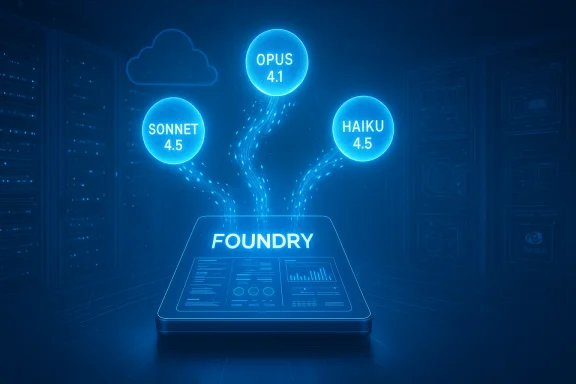
Microsoft’s announcement that Anthropic’s Claude models are now available in Microsoft Foundry marks a major expansion of Azure’s model catalog and a strategic shift in how enterprises will source frontier AI inside Microsoft’s ecosystem. The integration makes Claude Sonnet 4.5, Claude Opus 4.1, and Claude Haiku 4.5 available in public preview for Foundry customers and embeds Claude as the reasoning core inside Foundry’s Agent Service—while coordinated commercial commitments between Anthropic, Microsoft and NVIDIA underpin the scale and engineering promises that accompany the product rollout.
Anthropic and Microsoft announced an expanded partnership that brings the most recent Claude variants to Microsoft Foundry and surfaces them across Microsoft 365 Copilot and Copilot Studio, positioning Azure as a multi-model platform where enterprises can route workloads to either Claude or GPT frontier models from a single control plane. The public materials describe Sonnet 4.5 as the leading agent-and-coding model, Opus 4.1 for specialized reasoning tasks, and Haiku 4.5 as the fast, cost-optimized variant for high-throughput or latency-sensitive scenarios. Beyond product access, the announcement was packaged with large-scale commercial and engineering commitments: Anthropic has committed to purchase a substantial amount of Azure compute capacity over multiple years, and NVIDIA and Microsoft are reported to be making staged investments and co-engineering commitments to optimize Claude on NVIDIA architectures. Reported headline numbers in coverage and vendor materials include roughly a $30 billion Azure compute purchase commitment by Anthropic and investment pledges framed as “up to” $10 billion from NVIDIA and “up to” $5 billion from Microsoft, plus references to a potential dedicated compute footprint described as up to one gigawatt of electrical capacity. These figures have been widely reported in vendor and press briefings but should be read as staged, conditional commitments rather than immediate cash transfers or an overnight deployment of 1 GW of hardware.
Microsoft Foundry’s expansion to include Anthropic’s Claude family is not just another product update—it is a strategic inflection point for enterprise AI procurement and agent operations. The right next step for Windows-centric and Azure-first organizations is deliberate: run measured pilots to validate model fit and governance, demand clear SLAs and data-residency guarantees, and build AgentOps capabilities that make agentic automation auditable, safe, and economically predictable.
Source: LatestLY Microsoft Brings Claude Models to Foundry, Expands Azure’s Access to Frontier AI Tool | LatestLY
 Background / Overview
Anthropic and Microsoft announced an expanded partnership that brings the most recent Claude variants to Microsoft Foundry and surfaces them across Microsoft 365 Copilot and Copilot Studio, positioning Azure as a multi-model platform where enterprises can route workloads to either Claude or GPT frontier models from a single control plane. The public materials describe Sonnet 4.5 as the leading agent-and-coding model, Opus 4.1 for specialized reasoning tasks, and Haiku 4.5 as the fast, cost-optimized variant for high-throughput or latency-sensitive scenarios. Beyond product access, the announcement was packaged with large-scale commercial and engineering commitments: Anthropic has committed to purchase a substantial amount of Azure compute capacity over multiple years, and NVIDIA and Microsoft are reported to be making staged investments and co-engineering commitments to optimize Claude on NVIDIA architectures. Reported headline numbers in coverage and vendor materials include roughly a $30 billion Azure compute purchase commitment by Anthropic and investment pledges framed as “up to” $10 billion from NVIDIA and “up to” $5 billion from Microsoft, plus references to a potential dedicated compute footprint described as up to one gigawatt of electrical capacity. These figures have been widely reported in vendor and press briefings but should be read as staged, conditional commitments rather than immediate cash transfers or an overnight deployment of 1 GW of hardware. What Microsoft Foundry now offers: product details and immediate capabilities
Claude in Foundry: models, access, and deployment patterns
- Models available: Claude Sonnet 4.5, Claude Opus 4.1, and Claude Haiku 4.5 are listed as available in public preview via Microsoft Foundry’s catalog. These models are exposed as deployable endpoints inside Foundry’s serverless deployment model and can be consumed through Foundry APIs and SDKs.
- Integration surfaces: The Claude variants are accessible in Foundry Agent Service (where Microsoft positions Claude as the agentic reasoning core), selectable as backends in Microsoft 365 Copilot’s Researcher tool and Copilot Studio, and previewed in agent-driven Excel flows for formula generation and data analysis.
- Developer experience: Foundry supports Python, TypeScript, and C# SDKs with Microsoft Entra authentication, enabling enterprises to integrate Claude into existing application lifecycles, CI/CD pipelines, and identity-governed production environments. The deployment model is serverless with regional options and an advertised “Global Standard” rollout and a US DataZone coming soon.
How Microsoft positions each Claude variant
- Claude Sonnet 4.5: Marketed as the frontier Sonnet model optimized for complex agents, advanced coding tasks, and deep, multi-step reasoning. Sonnet is presented as the highest-capability option for agent orchestration and “using computers” style tasks.
- Claude Opus 4.1: Positioned for specialized reasoning and focused, long-horizon problems that require sustained attention to detail. It’s the choice for domain-heavy and precision-demanding tasks.
- Claude Haiku 4.5: Presented as the fastest and most cost-efficient option at about one-third the cost of Sonnet while delivering near-frontier performance for many coding and agent tasks—ideal for high-volume sub-agents, real-time support, and latency-sensitive applications.
Technical specifics and what’s verifiable
Supported features and enterprise primitives
Foundry’s Claude deployments support key enterprise capabilities that Foundry already exposes for other models: code execution tools, web search/fetch, vision inputs, tool use and chaining, prompt caching, long-context handling, and observability via Foundry’s governance tooling. Enterprises can route calls, instrument telemetry, and apply tenant-level governance in the same way they would for other Foundry models. These integration points are explicitly called out in vendor materials and Microsoft’s Foundry documentation.Context window and long-horizon claims
Anthropic has emphasized Claude’s long-context capabilities across the Sonnet and Opus families, and vendor materials advertise extended-context handling suitable for agent chains and long-running workflows. The precise usable context length and real-world throughput for specific enterprise workloads depend on configuration, tokenization, and tool pipelines; these are implementation details buyers must benchmark in their own environment. Vendor-reported context numbers should be validated with representative benchmarks before production deployment.Pricing and billing model
Claude in Foundry is described as being eligible for existing Azure commercial agreements (including Microsoft Azure Consumption Commitment arrangements), simplifying billing and procurement for customers that already run on Azure. Anthropic and Microsoft materials reference per-million-token pricing at model-tier levels on the Claude Developer Platform (e.g., different $/token rates for Sonnet vs Haiku), but Foundry’s marketplace pricing can vary by region and may be updated—review published pricing in Foundry at the time of procurement. Pricing numbers are vendor-published and subject to change.Strategic context: compute, co-engineering, and the three‑way alignment
The product announcement is tightly coupled to a larger industrial pact linking Anthropic, Microsoft, and NVIDIA. Public briefings and press coverage present the package as three linked elements:- Compute commitment by Anthropic to acquire large-scale Azure capacity (reported around $30 billion in multi-year commitments).
- NVIDIA co-engineering and investment, targeting optimizations for Grace Blackwell and future Vera Rubin-class systems and an investment framework reported as up to $10 billion.
- Microsoft’s investment and distribution pledge, including making Claude a first-class model on Azure and product surfaces and an investment framed as up to $5 billion.
Why this matters for enterprise IT and Windows-focused organizations
Immediate operational wins
- Single-platform model choice: For teams that standardize on Azure identity, billing, and observability, Foundry now offers an operationally simpler path to test and route between Claude and GPT family models without spinning up separate cloud relationships. That reduces procurement friction and shortens time-to-proof for agent projects.
- Integrated Copilot surfaces: Claude is now selectable as a backend in Microsoft 365 Copilot and Copilot Studio, which gives business users and knowledge workers access to alternate reasoning engines inside familiar workflows (e.g., Researcher in Copilot and agent mode in Excel). This is a practical advantage for organizations that want to experiment with multiple frontier models for different tasks.
- Developer-friendly tooling: The availability of SDKs and Entra-based authentication means enterprises can adopt Claude in their existing CI/CD pipelines, reducing friction for internal developer teams and making it easier to build production-grade agents under centralized governance.
Strategic implications and trade-offs
- Model diversity vs. vendor concentration: While offering multiple frontier models on a single platform increases choice, the larger compute/investment deal ties Anthropic, NVIDIA and Microsoft more closely together. That improves performance and predictability for Claude on Azure but raises questions about market concentration and circular finance (investments by vendors that are also service providers). These structural shifts deserve scrutiny by procurement and legal teams.
- Governance and data residency: Enterprises must validate dataflow, telemetry, and residency guarantees. Microsoft’s Foundry governance primitives help, but how requests are routed (e.g., to Anthropic-managed infrastructure vs. entirely Azure-hosted inference) matters for compliance and regulatory posture—customers should request explicit SLAs and data residency commitments during the procurement phase.
- Operational dependency on hardware roadmaps: Co-engineering with NVIDIA promises optimizations for Blackwell/Vera Rubin platforms that can materially reduce cost per token. But it also introduces a portability asymmetry: models heavily tuned for NVIDIA rack topologies may require additional work to run efficiently elsewhere. Organizations that require multi-cloud portability must plan for that trade-off.
Security, compliance, and governance concerns — practical checklist
Enterprises should approach Foundry + Claude adoption with a tight AgentOps discipline. At a minimum, IT leaders should:- Require explicit data residency and telemetry retention schedules for prompt logs, embeddings, and vector indices.
- Validate model provenance and training-data claims where relevant to regulated workloads; insist on attestations for PII handling and data retention.
- Run representative performance and safety benchmarks (including hallucination rates, tool-use safety checks, and adversarial prompt tests) before any mission-critical rollout.
- Map the attack surface for agentic automation (tool invocation, code execution, file generation) and apply least-privilege controls and invocation whitelists.
- Insist on contractual SLAs that cover latency, availability, audit logs, and third-party incident response (including cross-vendor incident playbooks if workloads span multiple clouds).
Risk analysis: strengths and potential hazards
Strengths and opportunities
- Faster enterprise adoption: Consolidating more frontier models into Foundry lowers integration friction and can substantially shorten pilots-to-production timelines for agent-driven applications.
- Hardware-aware TCO improvements: Co-engineering with NVIDIA has the potential to reduce inference and training costs when models are optimized for Blackwell/Vera Rubin architectures, improving tokens-per-second and energy efficiency for large-scale workloads.
- Operational scale and reliability: Reserved compute commitments provide Anthropic with more predictable capacity, which should reduce throttling risk and improve availability for large customers that require continuous inference throughput.
Potential hazards and cautions
- Circular financing and concentration: The tri-party alignment—where infrastructure providers take stakes and model builders commit to buying compute—creates a feedback loop that increases market concentration and raises governance questions for regulators and enterprise buyers. These headline investments should be treated as strategic commitments subject to tranche conditions.
- Portability and lock-in risk: Deep optimizations for NVIDIA hardware and Azure-hosted services can yield performance gains, but they can also increase the cost and complexity of switching providers in the future. Enterprises that prioritize multi-cloud portability should explicitly include portability and exit clauses in procurement contracts.
- Environmental and facilities impact: The “one gigawatt” scale framing highlights the significant power, cooling and facility demands of frontier model hosting. Converting electrical headroom into usable compute capacity takes time and has real environmental and permitting implications.
- Vendor reported performance claims: Benchmarks published by vendors (e.g., claims about Sonnet’s top coding scores or Haiku’s cost-efficiency) are useful directional indicators but should be validated with independent, workload-specific tests before enterprise adoption. Vendor figures and benchmark methodologies should be carefully reviewed.
Practical rollout guidance for Windows and Azure-centric teams
Implementing Claude models in Foundry can accelerate real business use cases—but it should be done in controlled stages.Recommended phased approach
- Discovery pilot (2–6 weeks)
- Select representative use cases (e.g., Researcher workflows, agent-led spreadsheet automation, or a coding-assistant sub-agent).
- Run baseline tests on both Sonnet and Haiku to compare quality vs latency and cost.
- Validate identity, telemetry, and data-flow boundaries.
- Controlled production pilot (1–3 months)
- Deploy agent in a sandbox tenant with enforced least privilege and monitoring.
- Implement prompt caching, rate limiting, and cost monitoring.
- Run safety and hallucination mitigation tests and capture metrics for ROI analysis.
- Scale and governance (Ongoing)
- Define model-selection policies (e.g., route heavy reasoning to Sonnet, high-throughput to Haiku).
- Add runbooks for incident response across Microsoft, Anthropic and NVIDIA dependencies.
- Reassess portability needs and include contractual protections for exit and data retrieval.
Key technical checks before full production
- Confirm that model endpoints you select are covered by the necessary compliance and regional data-residency options required by your organization.
- Benchmark latency and throughput under representative workloads; Haiku may provide significant throughput cost advantages for sub-agent parallels.
- Validate the cost model using tokenized usage patterns and prompt-caching options; some models can be dramatically cheaper when using prompt caching and batching.
Broader market and policy implications
This move underscores a larger industry trend where cloud providers, chip vendors, and model labs are forming deeper strategic alignments that blend procurement, equity and co‑engineering. That industrial consolidation can speed capability delivery and reduce supply uncertainty for model builders, but it also concentrates control of frontier AI stacks in the hands of a few large players—creating potential systemic risks that warrant regulatory and procurement attention. Enterprises and policymakers should watch for:- How circular financial structures affect competition and pricing.
- Whether co-engineered model optimizations make multi-cloud portability harder and increase switching costs.
- How environmental and infrastructure demands scale alongside model deployment commitments.
Conclusion
Microsoft’s decision to bring Anthropic’s Claude Sonnet 4.5, Opus 4.1, and Haiku 4.5 into Microsoft Foundry is a consequential product and industry development. For enterprise customers, it means faster access to alternate frontier models inside a familiar Azure governance and billing surface—one platform where teams can select the best model for a task, whether that’s deep reasoning, specialized problem solving, or high-throughput agent orchestration. At the same time, the surrounding industrial commitments—large Azure compute purchases by Anthropic and co‑investments and co‑engineering with NVIDIA and Microsoft—signal a deeper structural realignment in how frontier AI capacity will be provisioned and optimized. Those commitments promise performance and cost benefits but introduce real trade-offs around concentration, portability and governance that every IT leader should evaluate through careful pilots, explicit contractual protections, and robust AgentOps practices.Microsoft Foundry’s expansion to include Anthropic’s Claude family is not just another product update—it is a strategic inflection point for enterprise AI procurement and agent operations. The right next step for Windows-centric and Azure-first organizations is deliberate: run measured pilots to validate model fit and governance, demand clear SLAs and data-residency guarantees, and build AgentOps capabilities that make agentic automation auditable, safe, and economically predictable.
Source: LatestLY Microsoft Brings Claude Models to Foundry, Expands Azure’s Access to Frontier AI Tool |
LatestLY