

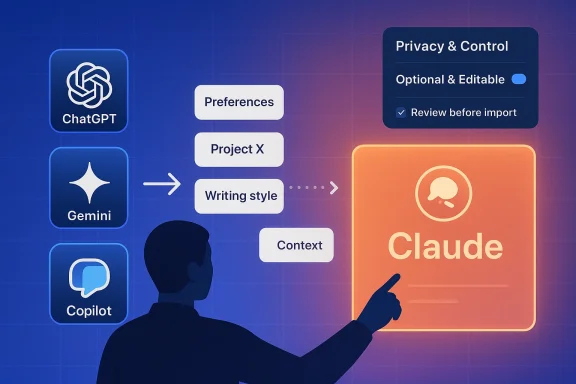
Switching to Claude no longer means starting your AI relationship from zero. Anthropic has added a memory import flow that lets users bring over context from services such as ChatGPT, Gemini, and Copilot, turning what used to be a tedious reset into a guided copy-and-paste process. That matters because memory is increasingly the thing that separates a generic chatbot from a genuinely useful assistant. It also sharpens the competition between Claude and OpenAI at a moment when users are unusually willing to look elsewhere.
For most of the consumer AI era, switching assistants has been a pain point hiding in plain sight. You could move accounts, upload files, and rebuild prompts, but the real loss was always the accumulated context: preferences, recurring projects, writing style, and the small behavioral details that make an assistant feel personal rather than merely competent. Anthropic’s new import flow is designed to reduce that switching cost and preserve the sense that your AI already knows you.
That shift is not happening in a vacuum. Anthropic introduced memory for Claude in 2025 and continued expanding it into 2026, including a release-note update that says Claude can remember relevant context and generate a memory summary. Anthropic also says its memory controls are optional and can be adjusted at any time, which reflects the broader industry trend toward selective persistence rather than endless hoarding.
The timing is important. Claude’s recent momentum has been widely noted, including reports that it reached the top of Apple’s free-app charts, while social chatter about leaving ChatGPT has intensified. Anthropic appears to be leaning into that moment by making Claude feel not just like a better model, but like an easier destination for people already invested elsewhere.
The import tool itself is conceptually simple, but strategically clever. Rather than relying on brittle interoperability between platforms, Claude gives users a ready-made prompt that asks their old assistant to list its stored memories and learned context. The user then copies that output into Claude’s memory preferences workflow, where Claude formats it into a usable memory set. That is not true direct backend-to-backend transfer, but it is still a practical bridge for most users.
That distinction matters because memory is not a single universal format. Different assistants store different kinds of contextual signals, and some keep more explicit memory entries than others. Claude’s prompt essentially normalizes that mismatch by asking for the assistant’s stored memories, preferences, recurring topics, and style instructions in one code block, which the user can then curate before importing.
The practical benefit is obvious: users can preserve the habits that make AI output more useful. If you have already trained one chatbot to know your tone, your project names, your preferred frameworks, or your aversion to certain styles of response, you do not want to rebuild all of that one session at a time. Claude’s approach makes the migration feel less like a reset and more like a handoff. That is the real value proposition.
That makes the feature more useful than a straight transcript dump, but also more subjective. Users have to decide which pieces of context are worth carrying forward and which ones are just old noise. In other words, Claude is offering a migration tool, but it still expects some editorial judgment from the human.
There is also a timing advantage. Multiple reports in March 2026 linked Claude’s rise with user frustration around ChatGPT, and Claude was widely reported to have surged in the app rankings. Whether or not every individual switch is permanent, the optics are clear: Anthropic wants to be the recipient of migration momentum rather than merely the beneficiary of model enthusiasm.
A more subtle reason is that memory creates retention. Once a user imports carefully curated preferences, the assistant becomes harder to abandon. That is good for product stickiness, but it is also good for user experience because it reduces the chance that a new session will feel cold or repetitive. Better onboarding is only part of the story; the deeper play is long-term engagement.
Once the other assistant returns that memory summary, you can review it before importing. That review step is not trivial. Users may find old preferences, outdated projects, or even personal details they no longer want to keep alive in a new system. The ability to prune before import is one of the better design choices here because it turns migration into curation.
After cleaning up the list, the user pastes it into Claude and confirms the add-to-memory action. Claude then displays a formatted list of what it has learned. From there, the test is straightforward: start a new chat and ask Claude what it knows about you. If the import succeeded, the assistant should reflect the newly added context.
The feature also changes the comparison calculus. If ChatGPT once had the advantage of being the place where your memory lived, Claude has now turned that into a portable asset. In practice, that means users can evaluate Claude on output quality, reasoning style, and workflow fit rather than on the sunk cost of prior setup. That is a meaningful shift in competitive framing.
Still, users should be realistic about what will and will not transfer. A memory summary may capture preferences and recurring themes, but it will not recreate every nuance of prior conversations. Anyone expecting a perfect one-to-one translation of an AI relationship may be disappointed, especially if the source assistant’s memory model was selective or inconsistent.
This is especially important because imported memory is often more revealing than ordinary prompts. A list of recurring topics can accidentally surface sensitive details, stale assumptions, or personal information that no longer belongs in the record. Claude’s import flow gives users a chance to inspect before committing, which is the right design for a feature that touches identity, memory, and privacy at once.
There is also an architectural issue. Once memory becomes a cross-platform asset, users will increasingly expect portability and deletion to work cleanly across vendors. That is a tall order in a fragmented ecosystem, and it highlights why memory will remain a product policy problem, not just a UX feature. Convenience and control have to coexist.
The interesting twist is that portability may now become a selling point. If one company can help users move memory from another, it can position itself as the friendlier destination. That does not eliminate lock-in, but it softens the cost of experimentation and makes users more willing to try competitors. Paradoxically, portability can increase adoption even as it lowers friction to leave.
We are also seeing a broader convergence between memory, projects, and integrations. Claude’s product surface now includes memory, projects, integrations, file handling, and chat controls, which suggests Anthropic sees long-term value in being the place where work context lives. That makes memory import less of a one-off gimmick and more of a foundation for an ecosystem.
Anthropic’s commercial documentation and support pages show a strong emphasis on settings, retention, integrations, and workspace-specific controls. That matters because enterprise buyers will not accept a consumer-style “just paste it in” workflow without safeguards. They will want to know where memory is stored, who can modify it, and whether it can be cleared consistently across teams and projects.
There is a likely split between individual and organizational value. A solo professional can use memory import to preserve personal productivity habits, while a company may care more about stable prompt conventions, recurring deliverables, and compliance-sensitive boundaries. The more memory becomes embedded in work, the more it resembles configuration management.
Another concern is that the import flow may encourage people to transfer too much personal information without thinking carefully about the destination. Memory is useful precisely because it is sticky, but that stickiness can become a privacy issue if users do not prune it first. Anthropic’s own advice to review the imported list is a tacit acknowledgment that human judgment still matters.
There is also a broader market risk: if every vendor builds its own memory system with only partial portability, users may become locked into whichever assistant they trust earliest. That could slow meaningful interoperability while making memory a new front in platform competition. In the long run, the industry could end up with more siloed context, not less.
The next phase will probably be judged less by whether the feature exists and more by whether it feels seamless, trustworthy, and easy to control. If Anthropic can keep memory optional, transparent, and editable while expanding the kinds of context it can preserve, Claude could become the assistant people are most willing to invest in long term. If not, memory will remain a nice-to-have feature rather than a real moat.
Source: ZDNET Switching to Claude? Here's how to take your ChatGPT memories with you
 Background
For most of the consumer AI era, switching assistants has been a pain point hiding in plain sight. You could move accounts, upload files, and rebuild prompts, but the real loss was always the accumulated context: preferences, recurring projects, writing style, and the small behavioral details that make an assistant feel personal rather than merely competent. Anthropic’s new import flow is designed to reduce that switching cost and preserve the sense that your AI already knows you.That shift is not happening in a vacuum. Anthropic introduced memory for Claude in 2025 and continued expanding it into 2026, including a release-note update that says Claude can remember relevant context and generate a memory summary. Anthropic also says its memory controls are optional and can be adjusted at any time, which reflects the broader industry trend toward selective persistence rather than endless hoarding.
The timing is important. Claude’s recent momentum has been widely noted, including reports that it reached the top of Apple’s free-app charts, while social chatter about leaving ChatGPT has intensified. Anthropic appears to be leaning into that moment by making Claude feel not just like a better model, but like an easier destination for people already invested elsewhere.
The import tool itself is conceptually simple, but strategically clever. Rather than relying on brittle interoperability between platforms, Claude gives users a ready-made prompt that asks their old assistant to list its stored memories and learned context. The user then copies that output into Claude’s memory preferences workflow, where Claude formats it into a usable memory set. That is not true direct backend-to-backend transfer, but it is still a practical bridge for most users.
What Claude’s Memory Import Actually Does
Claude’s memory import feature is best understood as a guided export-and-reimport workflow. It does not magically clone one chatbot’s database into another. Instead, it helps the user extract a summary of what the old assistant knows, then feed that information into Claude in a structured way.That distinction matters because memory is not a single universal format. Different assistants store different kinds of contextual signals, and some keep more explicit memory entries than others. Claude’s prompt essentially normalizes that mismatch by asking for the assistant’s stored memories, preferences, recurring topics, and style instructions in one code block, which the user can then curate before importing.
The practical benefit is obvious: users can preserve the habits that make AI output more useful. If you have already trained one chatbot to know your tone, your project names, your preferred frameworks, or your aversion to certain styles of response, you do not want to rebuild all of that one session at a time. Claude’s approach makes the migration feel less like a reset and more like a handoff. That is the real value proposition.
Why the feature is different from ordinary chat history
Chat history and memory are related, but they are not the same thing. A transcript preserves what you said in the past; memory preserves what the assistant believes it should continue to remember about you. Claude’s import system is aimed at the second category, which is why it asks for condensed preferences and recurring context rather than raw logs of everything you ever typed.That makes the feature more useful than a straight transcript dump, but also more subjective. Users have to decide which pieces of context are worth carrying forward and which ones are just old noise. In other words, Claude is offering a migration tool, but it still expects some editorial judgment from the human.
- It preserves preferences, not just transcripts.
- It targets recurring context across conversations.
- It encourages user review before import.
- It treats memory as editable, not permanent.
Why Anthropic Is Doing This Now
The most obvious answer is competition. Memory is one of the clearest differentiators in consumer AI because it determines whether an assistant feels cumulative or stateless. If a user has spent months teaching ChatGPT how they write, think, or work, switching can be psychologically costly; Anthropic is trying to erase that friction.There is also a timing advantage. Multiple reports in March 2026 linked Claude’s rise with user frustration around ChatGPT, and Claude was widely reported to have surged in the app rankings. Whether or not every individual switch is permanent, the optics are clear: Anthropic wants to be the recipient of migration momentum rather than merely the beneficiary of model enthusiasm.
A more subtle reason is that memory creates retention. Once a user imports carefully curated preferences, the assistant becomes harder to abandon. That is good for product stickiness, but it is also good for user experience because it reduces the chance that a new session will feel cold or repetitive. Better onboarding is only part of the story; the deeper play is long-term engagement.
The competitive logic
Anthropic is not just competing on model quality. It is competing on continuity, convenience, and trust. In a crowded market where many systems can already draft text or summarize files, the winner may be the assistant that requires the least repeated explanation.- Lower switching friction
- Higher user retention
- Better first-week experience
- More compelling reasons to stay paid
- A cleaner story for users leaving rivals
How the Import Flow Works
The process is deliberately low-tech. You start in Claude’s memory settings, where the import option is exposed either through the dedicated memory import page or through the Privacy settings if you are already using Claude. Anthropic then supplies instructions you can copy and paste into the other service to request a list of stored memories.Once the other assistant returns that memory summary, you can review it before importing. That review step is not trivial. Users may find old preferences, outdated projects, or even personal details they no longer want to keep alive in a new system. The ability to prune before import is one of the better design choices here because it turns migration into curation.
After cleaning up the list, the user pastes it into Claude and confirms the add-to-memory action. Claude then displays a formatted list of what it has learned. From there, the test is straightforward: start a new chat and ask Claude what it knows about you. If the import succeeded, the assistant should reflect the newly added context.
A step-by-step look
The workflow is simple enough to explain in a few steps:- Open Claude’s memory import or privacy settings.
- Copy the generated export request prompt.
- Paste that prompt into your other AI assistant.
- Review the returned memory list for accuracy.
- Remove anything you do not want preserved.
- Paste the revised list back into Claude and save it.
- Easy to start
- Easy to audit
- Easy to trim
- Not fully automated
- Dependent on the source assistant
What This Means for ChatGPT Users
For ChatGPT users, the most immediate effect is emotional as much as technical. The barrier to testing Claude has dropped because users no longer have to fear losing months of personalization. That makes Claude a more plausible second home, even for people who are not ready to abandon OpenAI outright.The feature also changes the comparison calculus. If ChatGPT once had the advantage of being the place where your memory lived, Claude has now turned that into a portable asset. In practice, that means users can evaluate Claude on output quality, reasoning style, and workflow fit rather than on the sunk cost of prior setup. That is a meaningful shift in competitive framing.
Still, users should be realistic about what will and will not transfer. A memory summary may capture preferences and recurring themes, but it will not recreate every nuance of prior conversations. Anyone expecting a perfect one-to-one translation of an AI relationship may be disappointed, especially if the source assistant’s memory model was selective or inconsistent.
Consumer impact versus power-user impact
For casual users, the import tool mostly removes annoyance. For heavy users, it could materially change which assistant becomes the default workspace. That is because power users are the people most likely to have accumulated a deep stack of preferences, project references, and formatting habits.- Casual users gain faster onboarding
- Power users gain workflow continuity
- Creators gain style preservation
- Researchers gain topic continuity
- Developers gain tooling and framework recall
Memory, Privacy, and User Control
Anthropic is clearly aware that memory can be both a feature and a liability. The company describes memory as optional and says users can manage what Claude remembers through settings, including the ability to delete stored memory and disable memory generation from chat history. That level of control is essential if the company wants memory to feel helpful rather than invasive.This is especially important because imported memory is often more revealing than ordinary prompts. A list of recurring topics can accidentally surface sensitive details, stale assumptions, or personal information that no longer belongs in the record. Claude’s import flow gives users a chance to inspect before committing, which is the right design for a feature that touches identity, memory, and privacy at once.
There is also an architectural issue. Once memory becomes a cross-platform asset, users will increasingly expect portability and deletion to work cleanly across vendors. That is a tall order in a fragmented ecosystem, and it highlights why memory will remain a product policy problem, not just a UX feature. Convenience and control have to coexist.
Practical privacy takeaways
Users should treat imported memory as something to be audited, not blindly trusted. The safest approach is to assume the old assistant may remember more than you intend to carry forward.- Review every imported entry
- Remove personal data you do not want preserved
- Delete memories you later decide are unnecessary
- Turn off memory generation if you prefer a cleaner slate
- Use memory as a productivity tool, not a repository for everything
The Bigger Industry Trend
Claude’s new import flow is part of a larger industry race to make AI assistants persistent across time. OpenAI, Google, and Anthropic all know that a stateless chatbot is easy to replace, while a system that remembers your work becomes woven into your routine. Memory is therefore becoming one of the most strategic features in consumer AI, even when it is marketed as a convenience.The interesting twist is that portability may now become a selling point. If one company can help users move memory from another, it can position itself as the friendlier destination. That does not eliminate lock-in, but it softens the cost of experimentation and makes users more willing to try competitors. Paradoxically, portability can increase adoption even as it lowers friction to leave.
We are also seeing a broader convergence between memory, projects, and integrations. Claude’s product surface now includes memory, projects, integrations, file handling, and chat controls, which suggests Anthropic sees long-term value in being the place where work context lives. That makes memory import less of a one-off gimmick and more of a foundation for an ecosystem.
Why interoperability matters
Users do not want to manage five disconnected AI personalities. They want one assistant that can move with them across tools, devices, and changing subscriptions. Memory import is one step toward that future, even if the industry is still far from a true standard.- It reduces vendor lock-in fears
- It encourages experimentation
- It rewards user-owned context
- It puts pressure on rivals to improve portability
- It hints at a more interoperable AI future
How Enterprise Teams Should Think About It
For enterprise users, memory is not just personal convenience. It is a workflow control surface. Teams want assistants that understand recurring projects, organizational preferences, and document-handling habits without requiring repeated onboarding every time a user changes roles or tools. Claude’s memory import concept fits that need, but only if admins treat it as part of a broader governance strategy.Anthropic’s commercial documentation and support pages show a strong emphasis on settings, retention, integrations, and workspace-specific controls. That matters because enterprise buyers will not accept a consumer-style “just paste it in” workflow without safeguards. They will want to know where memory is stored, who can modify it, and whether it can be cleared consistently across teams and projects.
There is a likely split between individual and organizational value. A solo professional can use memory import to preserve personal productivity habits, while a company may care more about stable prompt conventions, recurring deliverables, and compliance-sensitive boundaries. The more memory becomes embedded in work, the more it resembles configuration management.
Enterprise implications
- Better continuity for recurring work
- Less time spent re-briefing assistants
- More consistent output across sessions
- Greater need for admin oversight
- Higher sensitivity to retention policy and data handling
Risks and Unintended Consequences
The biggest risk is overconfidence. Users may assume the imported memory is accurate, comprehensive, or current when it may actually contain stale context, incomplete summaries, or preferences that no longer apply. An assistant that “knows” the wrong thing can be worse than one that knows nothing at all.Another concern is that the import flow may encourage people to transfer too much personal information without thinking carefully about the destination. Memory is useful precisely because it is sticky, but that stickiness can become a privacy issue if users do not prune it first. Anthropic’s own advice to review the imported list is a tacit acknowledgment that human judgment still matters.
There is also a broader market risk: if every vendor builds its own memory system with only partial portability, users may become locked into whichever assistant they trust earliest. That could slow meaningful interoperability while making memory a new front in platform competition. In the long run, the industry could end up with more siloed context, not less.
Key concerns to watch
- Imported memory may be outdated
- Users may over-share sensitive details
- Different vendors may interpret memory differently
- Deletion and retention may not feel symmetrical across services
- Convenience could deepen platform lock-in
- “Remembering everything” can create false confidence
Strengths and Opportunities
The memory import feature is a smart product move because it combines user empathy with strategic timing. It acknowledges a real pain point, simplifies migration, and gives Claude a credible reason to win users who are already dissatisfied with other assistants. It also strengthens Claude’s position as a long-term collaborator rather than a temporary tool.- Reduces switching friction
- Preserves personal workflows
- Improves first-day usefulness
- Supports retention for Claude
- Makes memory feel portable
- Reinforces Anthropic’s privacy-control narrative
- Creates a natural upgrade path for power users
Risks and Concerns
The same feature that makes switching easier can also make memory feel heavier and more permanent than it should. If users do not actively manage what gets imported, they may carry forward clutter, mistakes, or sensitive details into a new environment. The feature is helpful, but it should not be mistaken for a guarantee of accuracy or safety.- Stale memories may persist
- Privacy mistakes can be imported too
- Users may trust memory too much
- Incomplete exports can distort context
- Different AI systems may summarize differently
- Administrative governance may be harder for teams
- Portability remains partial, not universal
Looking Ahead
Claude’s memory import feature is likely to matter more than it first appears. On the surface, it is a convenience tool for people switching from ChatGPT or other assistants. In practice, it is a signal that memory is becoming one of the most important battlegrounds in consumer and workplace AI, right alongside model quality and price.The next phase will probably be judged less by whether the feature exists and more by whether it feels seamless, trustworthy, and easy to control. If Anthropic can keep memory optional, transparent, and editable while expanding the kinds of context it can preserve, Claude could become the assistant people are most willing to invest in long term. If not, memory will remain a nice-to-have feature rather than a real moat.
What to watch next
- Whether Anthropic expands memory import to more services
- Whether memory becomes more automated or remains user-curated
- How OpenAI and Google respond with their own portability features
- Whether enterprise admins get deeper controls over imported context
- Whether users report improved usefulness after migration
- Whether privacy controls keep pace with memory growth
Source: ZDNET Switching to Claude? Here's how to take your ChatGPT memories with you
