

Anthropic’s Claude models became generally available in Microsoft Foundry on Azure on June 29, 2026, running end-to-end on Microsoft Azure infrastructure accelerated by Nvidia GB300 Blackwell Ultra systems. The announcement looks, at first glance, like another cloud model-catalog update. It is more important than that. Microsoft is turning model choice into an infrastructure argument, and Claude’s arrival on Azure-owned rails gives enterprises a way to buy Anthropic without treating Anthropic as a separate cloud relationship.
For years, enterprise AI buying has been a negotiation between model quality and operational reality. Developers want the strongest model for the job; procurement, security, compliance, and finance departments want fewer exceptions, fewer contracts, and fewer mystery invoices. Microsoft’s Claude move is aimed directly at that friction.
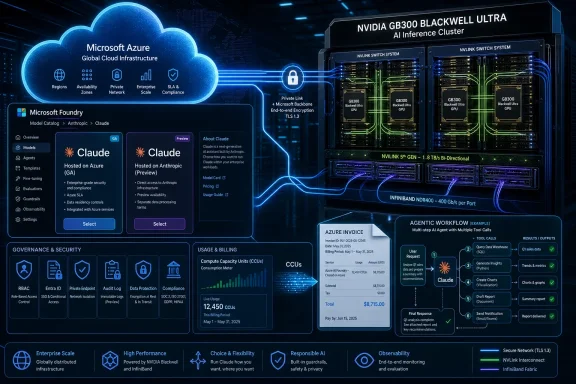
Claude in Microsoft Foundry now comes in two forms: “Hosted on Azure,” which is generally available and runs end-to-end on Azure infrastructure, and “Hosted on Anthropic infrastructure,” which remains in preview. That distinction is not branding trivia. It is the difference between calling a third-party model through a Microsoft portal and actually placing the workload on the Azure infrastructure many enterprises already govern, monitor, and pay for.
The immediate pitch is simple. Azure customers can build with Claude while staying inside Microsoft’s procurement and billing orbit. Usage flows through Azure Marketplace, appears on the Azure invoice, and can count against eligible Microsoft Azure Consumption Commitment spend. For organizations that have spent years building internal controls around Azure subscriptions, resource groups, RBAC, cost management, and data residency policies, that may matter as much as a benchmark score.
This is also a quiet reversal of an assumption that hardened during the first wave of generative AI: that Microsoft’s AI cloud would be synonymous with OpenAI. Microsoft is not walking away from that relationship. But it is making room for a more pragmatic enterprise platform story, where Foundry becomes the place where multiple frontier models compete under Microsoft’s commercial umbrella.
A GB300 NVL72 system combines 72 Blackwell Ultra GPUs with 36 Grace CPUs in a fully liquid-cooled rack-scale design. Nvidia has described the configuration as offering 37TB of fast memory, 130TB/s of NVLink bandwidth, and up to 1,440 petaflops of FP4 Tensor Core performance with sparsity. Those numbers are meant to be enormous, but the more practical point is that they describe a system built for large, fast, interconnected AI workloads rather than isolated chatbot calls.
That matters because the industry’s center of gravity is moving from single-prompt assistants to agentic systems. These applications do not merely answer a question. They fan out across tools, databases, ticketing systems, code repositories, documents, calendars, and business workflows. A useful enterprise agent may call a model dozens or hundreds of times in a single task, and specialized sub-agents may operate in parallel across domains such as finance, legal, support, and engineering.
In that world, inference capacity is not a commodity detail. Latency, throughput, memory, interconnect, and placement become product features. Microsoft and Nvidia are effectively telling CIOs that Claude on Azure is not just available; it is available on infrastructure designed for the expensive, persistent, multi-step workloads enterprises are now being sold.
That is not a minor administrative choice. In large organizations, the hardest part of adopting a new AI provider is often not the SDK. It is the vendor onboarding, data processing review, legal terms, regional policy mapping, identity model, spending approval, and support path. If Claude can be consumed through Azure Marketplace and show up on the same Azure invoice as other cloud consumption, Microsoft has reduced the internal activation energy.
This does not make Claude a Microsoft product in the strict legal sense. Anthropic remains the model provider, and Microsoft’s own documentation frames these as partner offerings with Anthropic as seller and operator for the Claude service. But the customer experience is deliberately Azure-shaped: deploy from Foundry, monitor token usage in Foundry, see rolled-up costs in Azure Cost Management, and handle billing through Microsoft.
That is the kind of detail that changes who can say yes. A developer choosing between models may focus on reasoning quality or coding performance. A bank, manufacturer, hospital network, or government contractor may focus first on whether a workload can fit into existing governance. Hosted-on-Azure Claude is built for that second buyer.
This is a useful hedge for Microsoft. OpenAI remains deeply integrated into Azure, Windows, GitHub, Microsoft 365, and Copilot. But enterprise customers increasingly want model optionality, both for technical and bargaining reasons. A legal summarization workflow, a software engineering assistant, a customer-service agent, and a document-classification pipeline may not all perform best or cheapest on the same model.
Foundry lets Microsoft say: choose the model, but keep the platform. That is a powerful cloud-provider move. It shifts differentiation away from exclusive model access and toward governance, deployment, observability, procurement, and integration with the rest of the Microsoft estate.
There is a risk here, too. The more Microsoft presents Foundry as neutral territory, the more customers will expect parity across providers. If Claude on Azure has different regions, quotas, data-handling terms, feature availability, or latency characteristics from other Foundry models, Microsoft will have to explain those differences clearly. A marketplace full of powerful models is useful only if enterprise teams can understand what they are actually buying.
Anthropic’s broader partnership with Microsoft and Nvidia, announced earlier, put large numbers behind that ambition: a $30 billion Azure compute commitment, additional contracted capacity up to one gigawatt, and planned investments of up to $10 billion from Nvidia and $5 billion from Microsoft. The June 2026 Foundry milestone is where that strategic paperwork becomes a product surface.
It also complicates Anthropic’s cloud posture in a way that may ultimately help it. Anthropic has been closely associated with Amazon Web Services and has also worked with Google Cloud. Claude’s availability through Azure gives Anthropic a more cloud-agnostic enterprise story. If a customer is standardized on AWS, Google Cloud, or Azure, Anthropic can increasingly meet them where their procurement already lives.
That does not mean every Claude experience is interchangeable. The Azure-hosted version, the Anthropic-hosted preview version, and Claude services consumed directly from Anthropic can have different commercial terms, data-processing details, quotas, and operational characteristics. But the direction is clear: Anthropic wants Claude to become infrastructure software, not merely a destination chatbot.
The phrase “AI factory” can sound like marketing fog, but this is what it means in practice. A model provider such as Anthropic needs massive compute. A cloud provider such as Microsoft needs differentiated capacity to attract and retain enterprise workloads. Nvidia supplies the hardware and networking stack that makes the whole arrangement plausible at scale.
The GB300 deployment also reinforces a shift in how AI infrastructure is discussed. During the early generative AI boom, training clusters received most of the attention. Now inference is becoming the expensive, persistent workload that customers actually feel. A successful enterprise agent platform may need to run continuously, serve many departments, maintain low latency, and handle bursts of complex reasoning. That is a very different cost profile from a demo chatbot.
This gives Nvidia a commercial story that extends beyond model training. If every serious cloud wants to host multiple frontier models, and every serious enterprise wants to run agents against private business systems, the demand is not just for bigger training runs. It is for repeatable, high-throughput, high-efficiency inference infrastructure that can be sold, metered, and governed.
Microsoft’s AI strategy increasingly connects cloud-hosted models to tools used by knowledge workers, developers, and IT teams. GitHub Copilot, Microsoft 365 Copilot, Copilot Studio, Foundry Agent Service, Azure management tooling, and Windows-adjacent developer workflows all sit within a broader platform strategy. If Foundry becomes the model-routing and agent-building layer, then the model choices made there will eventually shape the experiences delivered to users on Windows PCs and enterprise endpoints.
For sysadmins, the most relevant issue is control. AI agents that can read documents, write code, query data, open tickets, summarize meetings, and trigger workflows are not just productivity features. They are new privileged actors inside the enterprise. The hosting model, identity boundary, audit trail, data path, and billing meter matter because they determine whether those actors can be governed like the rest of the environment.
That is why Azure-hosted Claude is more than a developer convenience. It gives Microsoft customers another way to say yes to a frontier model while keeping the surrounding operational model familiar. The same organization that already uses Entra ID, Azure policy, Microsoft Defender, Purview, Sentinel, and Azure Cost Management will naturally ask whether its AI agents can live under the same roof.
Microsoft’s documentation says that when a Claude model is available in both versions, the Foundry deployment flow defaults to the Azure-hosted version. That is the right default for enterprise Azure customers, but defaults do not eliminate the need for clarity. Teams need to know which version they deployed, where prompts and outputs are processed, what regional controls apply, and which terms govern exceptional safety review.
The data-processing story is especially important. With Azure-hosted Claude, Azure infrastructure processes prompts and outputs, including request ingress, API services, and GPU inference. Anthropic is still involved as the model provider and operator, and safety-related review may occur under defined circumstances. With Anthropic-hosted Claude, processing can occur on Anthropic-managed infrastructure outside Azure, including outside a selected Azure region for operational reasons.
That distinction will matter most in regulated sectors. A prototype team may not care. A production team handling customer records, intellectual property, source code, medical documentation, or financial data absolutely will. Microsoft’s challenge is to make the safer default obvious without making the alternate path feel like a trap.
Microsoft can now tell customers that Azure is not a one-model shop. It can offer OpenAI models, Anthropic models, open models, specialized models, and partner models through a common platform. That gives Microsoft a defense against customers who might otherwise leave Azure for a specific model available elsewhere.
It also gives customers leverage. If a workload is abstracted through Foundry and governed through Azure, switching models becomes less of a full-stack migration and more of an application and policy decision. It will not be frictionless, especially where prompts, tool schemas, context windows, safety behavior, and pricing differ. But the direction is toward substitutability.
That is good for customers and uncomfortable for model labs. The cloud platforms want frontier models to be premium inventory in a managed marketplace. The model companies want direct customer relationships, brand loyalty, and pricing power. Claude on Azure advances both goals at once, which is why the partnership is strategically useful and inherently tense.
That can simplify procurement, but it can also obscure cost intuition. Engineers still need to size workloads using tokens per minute and requests per minute. Finance teams may see a single CCU meter. Operations teams may see per-model usage in Foundry. Those perspectives must line up, or the organization will discover its AI bill only after an agent has been enthusiastically looping through long documents all month.
The marketplace model also creates a subtle split between “available” and “approved.” A Claude model may be deployable in Foundry, but an organization may still need Azure Marketplace permissions, subscription-level approval, private-offer negotiation, and internal policy signoff. In many companies, the person who can test a model is not the person who can authorize production consumption.
That is not a flaw in Microsoft’s approach; it is the reality of enterprise software. The value of Azure-hosted Claude is that it gives organizations a familiar framework for handling that reality. The risk is that teams mistake a familiar deployment portal for a fully understood operating model.
 Microsoft Makes Claude an Azure Workload, Not Just an API
For years, enterprise AI buying has been a negotiation between model quality and operational reality. Developers want the strongest model for the job; procurement, security, compliance, and finance departments want fewer exceptions, fewer contracts, and fewer mystery invoices. Microsoft’s Claude move is aimed directly at that friction.Claude in Microsoft Foundry now comes in two forms: “Hosted on Azure,” which is generally available and runs end-to-end on Azure infrastructure, and “Hosted on Anthropic infrastructure,” which remains in preview. That distinction is not branding trivia. It is the difference between calling a third-party model through a Microsoft portal and actually placing the workload on the Azure infrastructure many enterprises already govern, monitor, and pay for.
The immediate pitch is simple. Azure customers can build with Claude while staying inside Microsoft’s procurement and billing orbit. Usage flows through Azure Marketplace, appears on the Azure invoice, and can count against eligible Microsoft Azure Consumption Commitment spend. For organizations that have spent years building internal controls around Azure subscriptions, resource groups, RBAC, cost management, and data residency policies, that may matter as much as a benchmark score.
This is also a quiet reversal of an assumption that hardened during the first wave of generative AI: that Microsoft’s AI cloud would be synonymous with OpenAI. Microsoft is not walking away from that relationship. But it is making room for a more pragmatic enterprise platform story, where Foundry becomes the place where multiple frontier models compete under Microsoft’s commercial umbrella.
Blackwell Is the Message Behind the Model
The headline model is Claude, but the strategic object is the machine underneath it. Nvidia says the Azure-hosted Claude deployment runs on GB300 Blackwell Ultra GPUs, using GB300 NVL72 rack-scale systems and Quantum-X800 InfiniBand networking. In plain English, this is not just a GPU instance type; it is the industrialization of inference for the agent era.A GB300 NVL72 system combines 72 Blackwell Ultra GPUs with 36 Grace CPUs in a fully liquid-cooled rack-scale design. Nvidia has described the configuration as offering 37TB of fast memory, 130TB/s of NVLink bandwidth, and up to 1,440 petaflops of FP4 Tensor Core performance with sparsity. Those numbers are meant to be enormous, but the more practical point is that they describe a system built for large, fast, interconnected AI workloads rather than isolated chatbot calls.
That matters because the industry’s center of gravity is moving from single-prompt assistants to agentic systems. These applications do not merely answer a question. They fan out across tools, databases, ticketing systems, code repositories, documents, calendars, and business workflows. A useful enterprise agent may call a model dozens or hundreds of times in a single task, and specialized sub-agents may operate in parallel across domains such as finance, legal, support, and engineering.
In that world, inference capacity is not a commodity detail. Latency, throughput, memory, interconnect, and placement become product features. Microsoft and Nvidia are effectively telling CIOs that Claude on Azure is not just available; it is available on infrastructure designed for the expensive, persistent, multi-step workloads enterprises are now being sold.
The Real Enterprise Feature Is Fewer Exceptions
The most important part of this announcement may be the least glamorous: billing. Claude models in Foundry are billed using Claude Consumption Units, or CCUs, with token usage converted through Anthropic’s per-model token rates. The model calls still behave like model calls, but the invoice rolls up through a Microsoft-compatible commercial mechanism.That is not a minor administrative choice. In large organizations, the hardest part of adopting a new AI provider is often not the SDK. It is the vendor onboarding, data processing review, legal terms, regional policy mapping, identity model, spending approval, and support path. If Claude can be consumed through Azure Marketplace and show up on the same Azure invoice as other cloud consumption, Microsoft has reduced the internal activation energy.
This does not make Claude a Microsoft product in the strict legal sense. Anthropic remains the model provider, and Microsoft’s own documentation frames these as partner offerings with Anthropic as seller and operator for the Claude service. But the customer experience is deliberately Azure-shaped: deploy from Foundry, monitor token usage in Foundry, see rolled-up costs in Azure Cost Management, and handle billing through Microsoft.
That is the kind of detail that changes who can say yes. A developer choosing between models may focus on reasoning quality or coding performance. A bank, manufacturer, hospital network, or government contractor may focus first on whether a workload can fit into existing governance. Hosted-on-Azure Claude is built for that second buyer.
Foundry Is Becoming Microsoft’s Neutral Zone
Microsoft Foundry has been steadily repositioned as more than a model catalog. It is Microsoft’s bid to become the enterprise control plane for AI systems, regardless of whether the underlying model comes from OpenAI, Anthropic, Meta, Mistral, Cohere, xAI, DeepSeek, Hugging Face, Nvidia, or another provider. Claude’s Azure-hosted general availability strengthens that story because it brings a premium frontier model into the tent without requiring customers to exit Microsoft’s cloud.This is a useful hedge for Microsoft. OpenAI remains deeply integrated into Azure, Windows, GitHub, Microsoft 365, and Copilot. But enterprise customers increasingly want model optionality, both for technical and bargaining reasons. A legal summarization workflow, a software engineering assistant, a customer-service agent, and a document-classification pipeline may not all perform best or cheapest on the same model.
Foundry lets Microsoft say: choose the model, but keep the platform. That is a powerful cloud-provider move. It shifts differentiation away from exclusive model access and toward governance, deployment, observability, procurement, and integration with the rest of the Microsoft estate.
There is a risk here, too. The more Microsoft presents Foundry as neutral territory, the more customers will expect parity across providers. If Claude on Azure has different regions, quotas, data-handling terms, feature availability, or latency characteristics from other Foundry models, Microsoft will have to explain those differences clearly. A marketplace full of powerful models is useful only if enterprise teams can understand what they are actually buying.
Anthropic Gets Distribution Without Surrendering Its Identity
For Anthropic, Azure general availability is a commercialization accelerant. Claude already had strong mindshare among developers, security-minded AI users, and enterprises that value its writing, reasoning, and coding capabilities. But model reputation alone does not guarantee enterprise scale. Distribution through the major clouds is how frontier model companies reach customers whose spending is locked inside existing cloud commitments.Anthropic’s broader partnership with Microsoft and Nvidia, announced earlier, put large numbers behind that ambition: a $30 billion Azure compute commitment, additional contracted capacity up to one gigawatt, and planned investments of up to $10 billion from Nvidia and $5 billion from Microsoft. The June 2026 Foundry milestone is where that strategic paperwork becomes a product surface.
It also complicates Anthropic’s cloud posture in a way that may ultimately help it. Anthropic has been closely associated with Amazon Web Services and has also worked with Google Cloud. Claude’s availability through Azure gives Anthropic a more cloud-agnostic enterprise story. If a customer is standardized on AWS, Google Cloud, or Azure, Anthropic can increasingly meet them where their procurement already lives.
That does not mean every Claude experience is interchangeable. The Azure-hosted version, the Anthropic-hosted preview version, and Claude services consumed directly from Anthropic can have different commercial terms, data-processing details, quotas, and operational characteristics. But the direction is clear: Anthropic wants Claude to become infrastructure software, not merely a destination chatbot.
Nvidia Wins When Every Cloud Needs the Same Factory
Nvidia’s role in this announcement is not passive. The company is not simply supplying chips to Azure. It is helping define the reference architecture for frontier-model deployment: Grace CPUs, Blackwell Ultra GPUs, NVLink at rack scale, and InfiniBand across clusters. The more enterprises believe agentic AI requires this class of infrastructure, the stronger Nvidia’s position becomes.The phrase “AI factory” can sound like marketing fog, but this is what it means in practice. A model provider such as Anthropic needs massive compute. A cloud provider such as Microsoft needs differentiated capacity to attract and retain enterprise workloads. Nvidia supplies the hardware and networking stack that makes the whole arrangement plausible at scale.
The GB300 deployment also reinforces a shift in how AI infrastructure is discussed. During the early generative AI boom, training clusters received most of the attention. Now inference is becoming the expensive, persistent workload that customers actually feel. A successful enterprise agent platform may need to run continuously, serve many departments, maintain low latency, and handle bursts of complex reasoning. That is a very different cost profile from a demo chatbot.
This gives Nvidia a commercial story that extends beyond model training. If every serious cloud wants to host multiple frontier models, and every serious enterprise wants to run agents against private business systems, the demand is not just for bigger training runs. It is for repeatable, high-throughput, high-efficiency inference infrastructure that can be sold, metered, and governed.
Windows Shops Should Read This as an Admin Story
Windows enthusiasts may see “Claude on Azure” and think this belongs to cloud architects rather than desktop users. That is only half true. The immediate deployment surface is Azure and Microsoft Foundry, but the downstream impact will be felt through the Microsoft ecosystem that Windows admins already manage.Microsoft’s AI strategy increasingly connects cloud-hosted models to tools used by knowledge workers, developers, and IT teams. GitHub Copilot, Microsoft 365 Copilot, Copilot Studio, Foundry Agent Service, Azure management tooling, and Windows-adjacent developer workflows all sit within a broader platform strategy. If Foundry becomes the model-routing and agent-building layer, then the model choices made there will eventually shape the experiences delivered to users on Windows PCs and enterprise endpoints.
For sysadmins, the most relevant issue is control. AI agents that can read documents, write code, query data, open tickets, summarize meetings, and trigger workflows are not just productivity features. They are new privileged actors inside the enterprise. The hosting model, identity boundary, audit trail, data path, and billing meter matter because they determine whether those actors can be governed like the rest of the environment.
That is why Azure-hosted Claude is more than a developer convenience. It gives Microsoft customers another way to say yes to a frontier model while keeping the surrounding operational model familiar. The same organization that already uses Entra ID, Azure policy, Microsoft Defender, Purview, Sentinel, and Azure Cost Management will naturally ask whether its AI agents can live under the same roof.
The Two-Claude Split Will Test Microsoft’s Clarity
The existence of two Claude hosting options is both a strength and a potential source of confusion. “Hosted on Azure” is generally available and runs on Azure infrastructure. “Hosted on Anthropic infrastructure” remains in preview and runs outside Azure. For technically sophisticated buyers, that is a useful choice. For everyone else, it is a support ticket waiting to happen.Microsoft’s documentation says that when a Claude model is available in both versions, the Foundry deployment flow defaults to the Azure-hosted version. That is the right default for enterprise Azure customers, but defaults do not eliminate the need for clarity. Teams need to know which version they deployed, where prompts and outputs are processed, what regional controls apply, and which terms govern exceptional safety review.
The data-processing story is especially important. With Azure-hosted Claude, Azure infrastructure processes prompts and outputs, including request ingress, API services, and GPU inference. Anthropic is still involved as the model provider and operator, and safety-related review may occur under defined circumstances. With Anthropic-hosted Claude, processing can occur on Anthropic-managed infrastructure outside Azure, including outside a selected Azure region for operational reasons.
That distinction will matter most in regulated sectors. A prototype team may not care. A production team handling customer records, intellectual property, source code, medical documentation, or financial data absolutely will. Microsoft’s challenge is to make the safer default obvious without making the alternate path feel like a trap.
Model Choice Is Becoming a Procurement Weapon
The deeper competitive issue is not whether Claude is better than GPT, Gemini, Llama, Mistral, or any other model on a given day. Model rankings move too quickly for that kind of static analysis to age well. The durable change is that cloud providers are turning model choice into a procurement weapon.Microsoft can now tell customers that Azure is not a one-model shop. It can offer OpenAI models, Anthropic models, open models, specialized models, and partner models through a common platform. That gives Microsoft a defense against customers who might otherwise leave Azure for a specific model available elsewhere.
It also gives customers leverage. If a workload is abstracted through Foundry and governed through Azure, switching models becomes less of a full-stack migration and more of an application and policy decision. It will not be frictionless, especially where prompts, tool schemas, context windows, safety behavior, and pricing differ. But the direction is toward substitutability.
That is good for customers and uncomfortable for model labs. The cloud platforms want frontier models to be premium inventory in a managed marketplace. The model companies want direct customer relationships, brand loyalty, and pricing power. Claude on Azure advances both goals at once, which is why the partnership is strategically useful and inherently tense.
The Fine Print Is Where the AI Budget Lives
The CCU model deserves scrutiny because it represents how AI costs are being normalized for enterprise buyers. Microsoft and Anthropic are not asking customers to think only in raw input and output tokens. They are converting token usage into a billing unit that can be invoiced, discounted, and reconciled through Azure Marketplace.That can simplify procurement, but it can also obscure cost intuition. Engineers still need to size workloads using tokens per minute and requests per minute. Finance teams may see a single CCU meter. Operations teams may see per-model usage in Foundry. Those perspectives must line up, or the organization will discover its AI bill only after an agent has been enthusiastically looping through long documents all month.
The marketplace model also creates a subtle split between “available” and “approved.” A Claude model may be deployable in Foundry, but an organization may still need Azure Marketplace permissions, subscription-level approval, private-offer negotiation, and internal policy signoff. In many companies, the person who can test a model is not the person who can authorize production consumption.
That is not a flaw in Microsoft’s approach; it is the reality of enterprise software. The value of Azure-hosted Claude is that it gives organizations a familiar framework for handling that reality. The risk is that teams mistake a familiar deployment portal for a fully understood operating model.
The Claude-on-Azure Era Arrives With Strings Attached
The practical implications of the announcement are concrete, even if the strategic picture is still forming. Microsoft has given Azure customers a stronger Claude path, Anthropic has gained a major commercialization channel, and Nvidia has put another high-profile workload on Blackwell Ultra infrastructure. The result is a three-party alignment that makes AI agents easier to buy, but not automatically easier to govern.- Claude models in Microsoft Foundry now include a generally available Azure-hosted option that runs end-to-end on Microsoft Azure infrastructure.
- The Anthropic-hosted Claude option remains in preview and carries different infrastructure and data-processing implications.
- Nvidia GB300 Blackwell Ultra systems give Microsoft and Anthropic a high-end inference platform for larger agentic workloads.
- Claude billing through CCUs and Azure Marketplace makes procurement easier for Azure customers, but teams still need token-level cost discipline.
- The arrangement strengthens Microsoft Foundry as a multi-model enterprise AI control plane rather than a storefront for one preferred model.
- Windows and Microsoft 365 administrators should treat this as part of the broader shift toward governed AI agents inside the Microsoft estate.
References
- Primary source: Neowin
Published: 2026-06-29T19:30:15.987065
Loading…
www.neowin.net - Independent coverage: 富途牛牛
Published: Mon, 29 Jun 2026 22:35:47 GMT
Loading…
news.futunn.com - Independent coverage: Moomoo
Published: Mon, 29 Jun 2026 22:35:44 GMT
Loading…
www.moomoo.com - Related coverage: blogs.nvidia.com
Anthropic’s Models Now Run on NVIDIA GB300 in Azure | NVIDIA Blog
Now generally available in Microsoft Foundry, Claude on NVIDIA GB300 Blackwell Ultra gives Azure-native enterprises a new foundation for building autonomous and domain-specific AI agents.blogs.nvidia.com - Related coverage: investing.com
Anthropic launches Claude models on Microsoft Azure powered by NVIDIA GB300 GPUs By Investing.com
Anthropic launches Claude models on Microsoft Azure powered by NVIDIA GB300 GPUswww.investing.com - Official source: learn.microsoft.com
Loading…
learn.microsoft.com
- Official source: azure.microsoft.com
Loading…
azure.microsoft.com - Official source: blogs.microsoft.com
Microsoft, NVIDIA and Anthropic announce strategic partnerships - The Official Microsoft Blog
Anthropic to scale Claude on Azure Anthropic to adopt NVIDIA architecture NVIDIA and Microsoft to invest in Anthropic Today Microsoft, NVIDIA and Anthropic announced new strategic partnerships. Anthropic is scaling its rapidly-growing Claude AI model on Microsoft Azure, powered by NVIDIA, which...blogs.microsoft.com - Official source: support.claude.com
Use Claude in Microsoft Foundry | Claude Help Center
support.claude.com
- Related coverage: tomshardware.com
- Related coverage: techradar.com
Anthropic locks in massive Azure deal to fuel Claude expansion across global clouds and reshape enterprise AI access worldwide | TechRadar
Claude models integrate into the Microsoft Foundry platform for enterprise deploymentwww.techradar.com - Related coverage: windowscentral.com
NVIDIA joins Microsoft’s push on Claude — piling billions into Anthropic’s future | Windows Central
Claude’s arrival on Azure signals a major shift in the competitive AI cloud landscape.www.windowscentral.com - Related coverage: axios.com
Anthropic lands $15 billion investment from Microsoft, Nvidia
The move is the latest in a series of deals that have all the big players partnering with one another.www.axios.com
- Related coverage: nvidianews.nvidia.com
Loading…
nvidianews.nvidia.com - Related coverage: arturmarkus.com
- Official source: cdn-dynmedia-1.microsoft.com