Claude on Azure: Microsoft Nvidia Anthropic Pact Reshapes Enterprise AI

  • Thread Author
Microsoft, Nvidia and Anthropic today announced a sweeping, multibillion-dollar alliance that remaps who builds, powers and sells the large language models shaping enterprise AI — a deal that reportedly includes up to $10 billion in Nvidia commitments, up to $5 billion from Microsoft, and a $30 billion commitment by Anthropic to run Claude on Microsoft Azure.

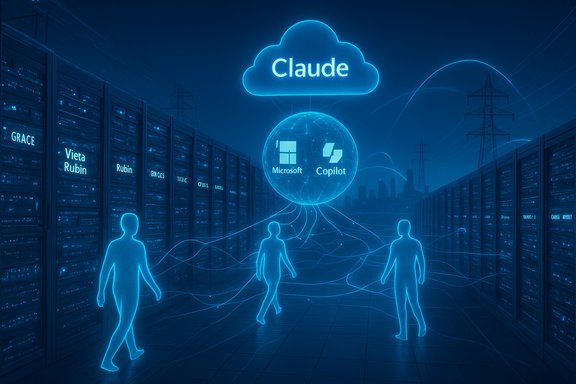
Neon-blue data center where Claude cloud AI connects users to Microsoft Copilot.Background​

Anthropic is the San Francisco–based AI lab behind the Claude family of models, founded by former OpenAI researchers and positioned as one of the few companies competing at frontier‑model scale. Over the last 18 months Anthropic’s enterprise traction has accelerated sharply; Reuters reporting and follow‑on coverage place its revenue run rate in the high single‑digit billions and show aggressive growth targets for 2026. Those growth figures are central to why hyperscalers and chipmakers are lining up to secure a long‑term relationship. This announcement folds three distinct strategic threads into a single public package:
  • Capital and partnership commitments: Nvidia and Microsoft will invest directly in Anthropic while Anthropic commits a multibillion‑dollar Azure compute purchase.
  • Product distribution and integration: Anthropic’s Claude models will be made available in Microsoft’s commercial AI channels (Azure AI Foundry and Microsoft 365 Copilot), expanding enterprise access.
  • Engineering and hardware collaboration: Anthropic and Nvidia will co‑engineer models and systems to optimize Claude for Nvidia architectures (including Grace Blackwell and Vera Rubin families), with an initial compute footprint that could scale toward a gigawatt of Nvidia‑powered capacity.

Deal specifics: the numbers that matter​

The public narrative is straightforward but numerically dramatic:
  • Nvidia — committed up to $10 billion in investments/engagements referenced in coverage.
  • Microsoft — committed up to $5 billion and opened Microsoft Foundry / Copilot channels to Claude models.
  • Anthropic — committed to purchasing $30 billion of Azure compute capacity over time, plus initial contracts for up to 1 gigawatt of Nvidia compute systems.
These headline figures have been independently reported by major outlets and industry trade press; where coverage differs, the consistent elements are the significance of the investments and the size of Anthropic’s cloud‑spend commitment. Several outlets separately highlight that the $30 billion Azure commitment is a long‑term purchase of compute capacity (credits or contracted services) rather than a single upfront cash payment. Important caveat: media coverage has included a range of valuation and revenue estimates for Anthropic (figures like $183B or higher appear in some stories). Those valuation numbers are sensitive to private funding dynamics and may vary by report; they should be treated as approximations rather than audited market caps. The core, verifiable elements are the capital commitments and the compute purchase terms that the companies announced.

Why the parties did this: strategic rationale​

Microsoft: model choice, product differentiation and revenue capture​

Microsoft’s business objective is to broaden its enterprise AI catalog and reduce single‑vendor dependence in its Copilot and Azure offerings. Making Anthropic’s Claude available in Azure AI Foundry and Microsoft 365 Copilot gives Microsoft customer lock‑in benefits (enterprises buying Azure can also buy Claude access on the same cloud), plus the PR win of multi‑model choice when compared to an OpenAI‑heavy strategy. Microsoft’s investment and the $30 billion compute commitment lock in long‑term demand for Azure.

Nvidia: hardware moat and co‑design leverage​

For Nvidia the deal is both commercial and architectural. Securing Anthropic as a repeat customer — plus the right to co‑design — accelerates validation for Nvidia’s upcoming Blackwell‑era accelerators (Grace Blackwell, Vera Rubin). Nvidia’s investment aligns its hardware roadmap with an influential model owner, helping the company capture incremental GPU orders and validate power, thermal, and interconnect choices against real, frontier model workloads. That’s important in a market where system‑level performance and efficiency decisions directly determine chip adoption.

Anthropic: scale, multi‑cloud bargaining power and product distribution​

Anthropic obtains three immediate advantages: capital, engineering access to Nvidia hardware, and broad enterprise distribution inside Microsoft’s vast commercial channels. The $30 billion Azure commitment and the Nvidia compute pipeline secure predictable capacity for training and inference while preserving a multi‑cloud posture (Anthropic continues to use Amazon and Google in other capacities). For a fast‑growing model maker, predictable access to chips and large cloud credits matters as much as cash.

Product integration: Claude across Microsoft platforms​

Microsoft and Anthropic will expand the footprint of specific Claude model variants into Azure AI Foundry and Microsoft 365 Copilot. The named model variants reported in the announcement are Claude Sonnet 4.5, Claude Opus 4.1, and Claude Haiku 4.5. Microsoft also continues to route model selection across Copilot (OpenAI models remain available alongside Claude as part of a multi‑model strategy). Practical consequences for customers:
  • Azure customers will now be able to provision Claude models via Foundry, giving development teams direct access to Anthropic frontiers without moving off Azure.
  • Microsoft 365 Copilot customers eligible for the Frontier program can opt in to use Claude in Researcher, Copilot Studio and other agentic experiences — with the caveat that Anthropic‑hosted endpoints may be routed outside Microsoft‑managed environments (see compliance and data‑routing section).

Compute and infrastructure implications: what “up to 1 gigawatt” actually means​

A recurring technical detail — and a consequential one — is Anthropic’s commitment to contract up to one gigawatt of Nvidia‑powered compute capacity initially. Gigawatt‑scale language is no marketing flourish: a single 1 GW compute footprint corresponds to the kind of power draw that typically powers a small city and implies enormous capital and operational scale. Independent industry analysis and trade reporting place the cost to build a 1 GW AI data center in the multi‑billion‑to‑tens‑of‑billions range and estimate annual electricity bills on the order of roughly $1 billion-plus depending on local pricing. These deployments are large, staged and require upstream grid, permitting, and real‑estate planning. Why this matters:
  • Power and energy — operating at or toward 1 GW requires coordinated deals with utilities, resilience planning, and often very large, long‑term power purchase strategies.
  • Supply chain and sourcing — filling a 1 GW deployment with GPUs, interconnects and accompanying infrastructure locks in vendor supply and shapes vendor profit pools. Nvidia stands to capture a large share; other hardware vendors may be left negotiating secondary roles.
  • Time horizons — data center power can be brought on in stages; mere intention to reach 1 GW does not mean capacity is instantly available. Staged rollouts typically span months or years.

Financial mechanics and circularity risks​

The headline optics — investors/partners putting capital in while Anthropic promises long‑term compute spend with a partner — raise familiar industry questions about circular revenue flows. Reuters and others have explicitly called out the potential for “circular deals,” where one partner’s investment and a vendor’s procurement commitments generate revenue for each other in ways that can obscure underlying profitability and true market demand. That dynamic matters to public investors and regulators given the scale of these commitments. Key observations:
  • The $30 billion Azure commitment is a long‑term procurement of compute — valuable commercial validation for Microsoft but not a guarantee of immediate cash flow in a single year.
  • Investment by Microsoft and Nvidia in Anthropic aligns incentives but blends customer, investor and supplier roles in ways that complicate transparency for outside observers. Analysts will scrutinize whether these arrangements materially alter revenue recognition, margins or market concentration.

Enterprise governance, data routing and compliance — the immediate IT issue​

One of the most consequential operational facts buried in product integration reporting is that Anthropic‑hosted Claude endpoints used via Microsoft Copilot and Foundry may be hosted outside Microsoft‑managed environments and governed by Anthropic’s terms and data processing agreements. Microsoft documentation and multiple IT trade outlets explicitly call this out, and several practical consequences follow for IT and compliance teams. Practical governance points for enterprise IT:
  • Data routing: When a Copilot workflow routes queries to a non‑Microsoft endpoint, tenant data may leave Azure boundaries and be processed under Anthropic’s hosting arrangements. Administrators must vet data‑residency and cross‑border concerns.
  • Admin opt‑in: Anthropic model usage is typically disabled by default and requires admin enablement in the Microsoft 365 admin center, giving organizations control over who can route workloads.
  • Policy and contractual match: Regulated industries (healthcare, finance, government) must reconcile Anthropic’s data processing terms with internal controls, contractual obligations and regional data‑protection laws. Anthropic’s own commitments determine protections when workloads are routed to its endpoints.
Security teams should treat Copilot’s multi‑model routing as a change in data flows and update threat models, DLP rules and audit trails accordingly. Anecdotal reporting on discussion boards and early adopters confirms friction — some organizations have blocked external model access until legal and security reviews are complete.

Competitive landscape: OpenAI, Amazon, Google and the multi‑cloud arms race​

This alliance is a direct strategic response to the multi‑cloud dance that followed earlier big deals — OpenAI’s large Amazon cloud commitment and Google/Anthropic collaborations are two notable moves in the same era of intense cloud competition. The new triangle of Microsoft‑Nvidia‑Anthropic changes the vendor map:
  • Anthropic remains multi‑cloud in practice: Amazon and Google relationships continue alongside the newly amplified Microsoft/Azure deal. That indicates Anthropic’s strategy is to keep options open while extracting more favorable terms from each hyperscaler.
  • For Microsoft, this is a hedge that creates alternative supply within Copilot and Azure product lines; for Nvidia it is a bet that hardware‑centric optimization will remain a core competitive advantage.
Regulators and competition watchers will be looking at whether the cross‑shareholdings and platform tie‑ins create unfair advantages or raise barriers for smaller model makers — a question that some commentators have already framed in the context of market consolidation and the “circular revenue” critiques.

Risks and unanswered questions​

No large strategic tech pact is without risk. The most salient open items are:
  • Execution risk on data center scale: Contracting “up to 1 GW” and actually delivering and powering that capacity involves grid upgrades, long procurement lead times, and potential regulatory friction. Announcements do not equal immediate capacity. Independent analysis shows 1 GW deployments are multi‑year projects with major infrastructure dependencies. This claim is supported by industry reporting and must be treated as a staged objective rather than an immediate operational reality.
  • Valuation and financial transparency: Press reports cite varying valuations and revenue targets for Anthropic. Those numbers are derived from private fundings and internal run‑rate extrapolations; they should be treated cautiously unless confirmed in audited filings. Where reports diverge, the conservative approach is to rely on confirmed company commitments (investments and compute contracts) rather than headline valuations.
  • Regulatory and antitrust scrutiny: The interplay of investment, cloud commitments and distribution could attract regulatory attention in multiple jurisdictions, especially where competition authorities view vertical integration and exclusive routing as potentially exclusionary. The potential for review increases as hyperscalers continue to consolidate AI supply chains.
  • Operational data‑security risks: Routing tenant data to third‑party hosted models changes the security perimeter. Organizations must confirm contractual and technical protections — and in many cases may need to restrict Anthropic model use for sensitive workloads until those contracts are clarified.
  • Market concentration: The deal further concentrates leverage in a short list of model owners, cloud providers and chip vendors. That concentration could increase switching costs for enterprises and intensify pricing leverage for a handful of firms. Analysts will monitor whether this concentration reduces diversity of model architectures or increases vendor lock‑in.

What IT teams and enterprise buyers should do now​

  • Review Copilot and Foundry admin controls and confirm whether Anthropic model routing is enabled for your tenant; the default position in many Microsoft deployments is opt‑out.
  • Map data flows: identify which workloads might be routed to Anthropic endpoints and evaluate whether those flows cross data‑residency or contractual boundaries.
  • Update procurement and security clauses: for organizations planning to use Anthropic‑backed Copilot features, require clear data processing terms, audit rights and information on model‑hosting locations.
  • Prepare for staged capacity changes: treat any promise of gigawatt‑scale compute as a long‑range infrastructure project. Plan migration windows, procurement timelines, and utility engagement accordingly.
These steps are practical and risk‑focused; they do not preclude experimentation with Claude models, but they do insist that pilots be governed and that high‑sensitivity workflows wait for contractual clarity.

Broader market impact — winners, losers and the next 12 months​

  • Winners: Microsoft gains enterprise choice and stickiness; Nvidia gains a marquee workload partner and potential GPU orders; Anthropic gains capital, distribution and hardware alignment. For many enterprise customers, more model options in Azure will feel like a net positive.
  • Losers or pressured actors: Smaller model providers and alternative GPU suppliers will face intensified competition for hyperscale deals. Cloud providers not part of similar investment webs may need to counter with price or specialized features to remain attractive. OpenAI remains a major competitor but now faces an even more complex partnerships landscape.
  • Next‑12‑month watchlist:
  • Regulatory filings or inquiries related to competition concerns or data‑transfer compliance.
  • Concrete timelines for the 1 GW deployments (permits, power purchase agreements, regional announcements).
  • Product rollouts inside Microsoft Copilot and Azure Foundry showing how customers actually consume Claude models and how data routing is implemented in practice.

Conclusion​

This Microsoft‑Nvidia‑Anthropic alliance is an inflection point in the industrialization of generative AI: it marries capital, chips, and cloud distribution at a scale that turns frontier research projects into industrial supply chains. The deal addresses very real operational problems for Anthropic (predictable compute, hardware co‑design and distribution), while giving Microsoft and Nvidia strategic and commercial leverage. At the same time, it raises legitimate questions about data governance, market concentration, and whether such large, circular arrangements will withstand regulatory and investor scrutiny.
For enterprise IT teams the shorthand is simple: the arrival of Claude inside Azure products increases choice and capability, but it also demands renewed attention to admin controls, data routing and contractual protections. For the market at large, the announcement accelerates a trend toward consolidation around a few vertically integrated stacks — and for researchers and engineers it signals that chip‑model co‑design will be a decisive axis of competition going forward.
Source: digitimes Microsoft and Nvidia form multi-billion partnership with Anthropic
 

Microsoft’s recent public posture — confident, acquisitive, and oddly circumspect — reads like a company that knows it sits at the center of a boiling debate: is AI a durable industrial revolution or a market bubble primed to reprice? Satya Nadella’s remarks, Microsoft’s outsized capital commitments, the OpenAI restructuring that carved out a multibillion-dollar stake for Redmond, and a consumer backlash over Copilot pricing together form a clear narrative: Microsoft is moving as if the AI market will both commoditize and consolidate, and it wants to own the rails while protecting its margins. This article unpacks the strategy, the risks, and what it means for Windows users, enterprises, and investors.

A silhouette overlooks a neon-blue futuristic city with a Windows logo on a glass skyscraper.Background / Overview​

Microsoft has spent the last five years converting a strategic relationship with OpenAI into an existential business bet: embed advanced models into Azure, Windows, Office, and the edge; build the compute backbone to host frontier models; and monetize the results through subscriptions, platform fees, and enterprise deals. That bet has accelerated into a public ritual — earnings calls, headline investments, and policy scrutiny — that now sits alongside a broader industry conversation about whether parts of AI are overheated.
Two forces changed the public narrative this year. First, the commercial restructuring of OpenAI into a for‑profit vehicle and Microsoft’s newly disclosed roughly 27% stake made the company’s economic exposure explicit and headline‑worthy. Second, the market reaction to lower‑cost, high‑quality models from new entrants (notably DeepSeek) forced the industry to confront a potential collapse in inference prices and a faster path to commoditization. Both developments were discussed in analyst and advisory notes and in the Smartkarma insight the user provided, which frames Microsoft’s behavior as signaling awareness of those dynamics.

Microsoft and OpenAI: Rebalanced but Still Central​

The new structure, in plain terms​

OpenAI’s October restructuring into a public‑benefit for‑profit structure was a watershed: it created a market valuation (widely reported around $500 billion) and left Microsoft holding a large, explicitly valued equity stake — roughly 27% — in the newly structured OpenAI Group PBC. The deal also formalized a multiyear commercial relationship (including substantial Azure commitments) while codifying limits and safety checks around any declared AGI milestone. These facts matter because they convert what had been a strategic partnership into a near‑term, headline‑driving financial position for Microsoft.

Why Microsoft didn’t just “buy exclusivity”​

The restructured terms show give‑and‑take: Microsoft retains valuable access and long‑term IP rights in key scenarios, but OpenAI gained more flexibility to raise capital and contract with other partners. For Microsoft, the recalibration reduces some exclusivity risk while crystallizing a large asset on its balance sheet. That balance is crucial to understanding Microsoft’s behavior: it’s both protector (of its Azure volume and integration rights) and pragmatist (accepting that the frontier model market must evolve beyond single‑vendor lock‑in).

Nadella’s Signals: “Acting Like There’s a Bubble” Without Saying It​

What Nadella actually said — and why it matters​

In recent investor presentations and the formal earnings transcript, Satya Nadella repeatedly emphasized two points: first, efficiencies in model design and inference will push prices down, and second, cheaper inference will dramatically broaden adoption and spawn many more AI applications. That posture frames commoditization not as a threat but as the accelerant Microsoft prefers — more customers, more payload for Azure, and more opportunities to sell value‑added services on top. His explicit comments on recent low‑cost models (e.g., DeepSeek’s R1) described them as “real innovations” that will make AI “much more ubiquitous,” which, paradoxically, he said is “good news” for a hyperscaler and platform provider like Microsoft. The company’s earnings call transcript records these remarks and the same tenor in public reporting.

Reading the subtext​

There’s a subtle but powerful subtext: Microsoft is signaling to investors and customers that it expects a period of price deflation for model inference, and it is re‑positioning to capture the larger volume that follows. That response is consistent with an industrial playbook — accept lower unit prices to enlarge total addressable market while monetizing higher layers of value (integration, compliance, enterprise SLAs, management tooling).
But there’s also an investor‑facing reality check embedded in Nadella’s words: if token and inference prices fall quickly, the massive capital outlays hyperscalers have committed to today could look overbuilt or misallocated tomorrow. Acting like there’s a bubble — by tightening guidance, highlighting efficiency gains, and embedding cautious language in disclosures — is a defensive posture designed to damp investor panic without triggering one.

The Compute Arms Race: Size, Scale and the $80B Figure​

How big is Microsoft’s bet?​

Multiple company disclosures and market reports converged on a central number this cycle: Microsoft signaled approximately $80 billion of AI‑related capital expenditure for fiscal 2025 as it expanded AI‑optimized datacenter capacity and chip purchases. Whether you call it capex for AI-enabled datacenters, cumulative chip budgets, or an aggregated infrastructure commitment, the headline — tens of billions of dollars — is real and material. The precise accounting treatment varies across press accounts and company presentations, but the scale is the key takeaway: Microsoft is deploying capital at hyperscaler scale to secure long‑term capacity.

Why this matters strategically and economically​

  • It locks in long‑term supply relationships with chip vendors and facilities providers.
  • It creates legacy capacity that, if underutilized, produces utilization and depreciation risk.
  • It strengthens Microsoft’s bargaining power with enterprise customers who want predictable scale and SLAs.
This is the economic tension at the heart of the “bubble” debate: if inference prices fall dramatically, utilization ramps and payback periods may still make the capex rational; if demand lags, the same capex will be a drag on free cash flow and margins.

DeepSeek and the “Sputnik Moment”: A Real Disruptor or a Market Rorschach?​

What DeepSeek did — and why markets reacted​

Early in the year, DeepSeek, a Chinese AI startup, released models and pricing that challenged prevailing assumptions about the minimum compute and capital required to build competitive LLMs. The combination of unusually low reported training and inference costs, rapid public downloads, and aggressive off‑peak pricing sparked market jitters: some investors treated it as proof that the expensive, GPU‑heavy buildouts of western firms were overpaid. Reuters, Fortune, and other outlets chronicled both the technological claims and the market fallout.

Beating the drum of caution​

There are important caveats. Several independent analysts and benchmarkers noted that DeepSeek’s cost claims require careful reading — a low marginal training bill does not necessarily capture prior R&D amortization, dataset curation, or the hidden infrastructure used during development. In plain English: cheap final numbers can mask expensive prior investments. Yet the DeepSeek episode accomplished what such entrants often do: it shortened the perceived moat, pressured pricing expectations, and forced incumbents to make defensive adjustments (pricing changes, partnership re‑evaluations, and product repositioning).

AI in Productivity: Copilot, Price Increases, and Regulatory Backlash​

Microsoft’s consumer monetization strategy hit a snag​

Microsoft’s decision to bundle Copilot into consumer Microsoft 365 plans and to reposition pricing triggered swift regulatory and public scrutiny. In Australia the competition regulator (ACCC) filed proceedings alleging that Microsoft’s communications around the migration to AI‑enabled plans obscured the availability of a lower‑priced “Classic” plan without Copilot. Microsoft publicly apologized to affected subscribers and offered refunds and clearer opt‑out pathways. Those numbers — reported increases in consumer plan prices of roughly 29–45% in some markets — are no small thing for the millions of households affected. The episode is a cautionary example of monetizing AI through subscription bundling without clear, customer‑facing transparency.

The broader product risk​

Bundling AI into a core subscription risks three outcomes: (1) regulatory action for unclear customer communications; (2) consumer churn by price‑sensitive users choosing alternatives; and (3) political heat that accelerates global scrutiny of how AI features are monetized. Microsoft’s apology and remediation in some jurisdictions shows the company recognizes the reputational and legal costs of heavy‑handed monetization.

The “Is It a Bubble?” Debate: Evidence and Counter‑Evidence​

Strong signals of froth​

  • Massive capital flows into capex and private AI valuations have produced concentration risk and valuation froth in parts of the market.
  • The MIT “GenAI Divide” study — widely reported across trade and general media — concluded that a very large share of enterprise pilots produced no measurable P&L impact, suggesting an execution gap between model capability and business value. That gap feeds the argument that capital is chasing narrative rather than substantiated returns.
  • High‑profile investor and insider warnings — including comments from Bill Gates comparing current enthusiasm to the dot‑com era — add to the cautionary tone. Gates explicitly warned that many investments would be “dead ends” even as he praised AI’s long‑run value.

Coherent counterarguments​

  • AI as a generalized technology platform has real, measurable uses in search, developer tooling, content generation, and vertical automation where recurring revenue models can absorb infrastructure costs.
  • Large incumbents have balance sheets and distribution channels capable of smoothing short‑term capex shocks and converting scale into profitable services.
  • Many analysts argue the probable outcome is a painful yet localized correction and consolidation — not systemic financial collapse — because the majority of investment is equity financed rather than debt‑levered.
The sensible middle ground: parts of the ecosystem look frothy (seed‑stage valuations, label‑play startups, speculative services) while the core platform builders and enterprise use cases that show real ROI could endure and expand.

Strengths and Strategic Advantages Microsoft Possesses​

  • Distribution and Integration: Microsoft controls the operating system, productivity apps, and enterprise contracts — a unique distribution bundle for embedding AI features at scale.
  • Azure Scale and Enterprise SLAs: Azure’s global footprint and compliance pedigree remain a compelling choice for regulated industries.
  • Balance Sheet and Cash Flow: Microsoft’s cash generation allows it to make multiyear infrastructure commitments without short‑term solvency risk.
  • Product Ecosystem: Copilot across Office, GitHub, Windows, and Teams creates sticky, multi‑product hooks that competitors find hard to match.
These are not trivial advantages; they explain why many analysts view Microsoft as a likely long‑term winner even if the market re‑rates parts of the AI economy.

Key Risks and Fault Lines​

  • Overdeployment risk: Idle racks and underutilized GPU fleets would create long‑run drag on returns if demand does not scale quickly enough.
  • Monetization friction: Consumer backlash and regulatory scrutiny around Copilot pricing show that monetizing AI via subscription inflation is politically and commercially fraught.
  • Supply concentration: Dependence on a tight set of GPU and fab suppliers can cause price and availability shocks.
  • Execution gap in enterprises: The MIT finding about pilot failures is a blunt reminder that building models is easier than operationalizing them into workflows that generate durable revenue.
Where possible, readers should treat jaw‑dropping single‑figure training cost claims (for example, some public figures attributed to challengers like DeepSeek) with caution; those claims often omit amortized development costs and other hidden inputs.

What This Means for Windows Users, IT Leaders and Investors​

For Windows and consumer users​

  • Expect continued AI integrations into Windows and Office, but also expect more explicit settings and opt‑out controls after regulatory pressure.
  • Device makers and PC builders will increasingly ask whether local on‑device inference or hybrid cloud approaches deliver better value versus full cloud dependency.

For CIOs and enterprise buyers​

  • Demand concrete KPIs for every AI pilot (revenue lift, cycle time reduction, cost per case).
  • Stage capital and measure utilization — preference to vendor models with transparent marginal economics.
  • Build governance and data lineage early — privacy and compliance will be deal determinants in regulated industries.

For investors​

  • Differentiate between platform owners (who can monetize scale) and label‑only plays.
  • Prepare for volatility: sector corrections are likely to prune speculative entrants; winners may emerge with wider moats and better unit economics.
  • Watch utilization metrics and long‑term capex commitments — they are leading indicators of how much of today’s buildout actually turns into productive capacity.

Conclusion​

Microsoft’s public posture — large capital deployments, a major equity position in a restructured OpenAI, defensive product monetization, and cautious public commentary — looks like the behavior of a company bracing for both continued technical progress and market turbulence. Satya Nadella’s language about commoditization and ubiquity is not an admission of defeat; it is a strategic framing designed to turn falling unit economics into broader adoption and service expansion.
That strategy has real logic: if inference prices fall, Microsoft can still capture more value by owning the platform, billing for enterprise integration, and selling higher‑margin management services. But it’s also vulnerable: oversized capex, regulatory friction over consumer pricing, and the execution gap in enterprise adoption are genuine risks.
The smarter framing, and the one investors and IT leaders should internalize, is not a binary “bubble or breakthrough.” It is a conditional thesis: AI will reshape productivity and infrastructure, but capital must be allocated with discipline, measurable outcomes, and an acceptance that the next few years will redistribute value — concentrating it in those who operationalize AI reliably and letting speculative excesses wash away. Smart, staged investment and rigorous operational governance will be the difference between companies that survive the shakeout and those that become historical footnotes.
Source: Smartkarma Microsoft. Acting Like There's An AI Bubble Without Saying There's An AI Bubble - William Keating
 

Back
Top