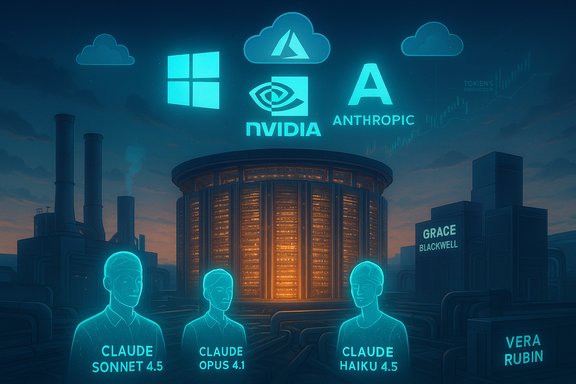
Anthropic’s surprise alliance with Microsoft and NVIDIA rewrites the industrial map for enterprise AI: the startup has pledged roughly $30 billion in Azure compute purchases and options to scale to one gigawatt of NVIDIA-powered capacity, while NVIDIA and Microsoft have pledged up to $10 billion and $5 billion respectively in funding and co‑engineering support—an arrangement that ties model development, chiproadmaps, and cloud distribution together at unprecedented commercial scale.
Anthropic emerged as one of the most consequential independent developers of large language models (LLMs) after its founding by former OpenAI researchers. The company’s Claude family—now spanning variants described as Sonnet, Opus, and Haiku—has grown rapidly in enterprise adoption and sits at the center of a new generation of model-to-infrastructure deals that combine long-term cloud purchases with hardware co‑design and strategic equity commitments. The deal announced in mid‑November expands Anthropic’s multi‑cloud posture: Claude models were already available via Amazon Bedrock and Google Cloud Vertex AI, and this agreement makes Claude broadly available across Microsoft Azure via Azure AI Foundry and Microsoft’s Copilot surfaces. The move positions Claude as one of the few “frontier” models intentionally offered across the three dominant commercial clouds. At the same time, the industry has been layering similarly large infrastructure commitments across vendors. OpenAI’s seven‑year, $38 billion AWS compute agreement is the most notable contemporaneous example, underscoring the scale and tempo of compute procurement in the era of frontier models. Those parallel arrangements are the context in which the Anthropic–Microsoft–NVIDIA pact should be read.
From an engineering perspective, the co‑design partnership between Anthropic and NVIDIA is where the most tangible performance improvements can arise. Joint optimization—tuning models to exploit specific tensor cores, memory hierarchies, and interconnect topologies—often reduces latency and cost per token in production deployments. Those savings matter at scale, but they require rigorous benchmarking and representative workload tests to validate vendor claims.
Conclusion
This three‑way pact confirms what many enterprises and investors already suspected: the AI market is consolidating around a small number of platform players who can marry capital, compute, and distribution. The Anthropic–Microsoft–NVIDIA package is a strategic attempt to lock in the building blocks of that future—compute capacity, chip co‑optimization, and embedded enterprise distribution—but its ultimate value will depend on careful execution, contractual clarity, and the real-world economics of model deployment. Pragmatic, pilot‑driven adoption and rigorous procurement discipline will separate organizations that benefit from this new wave of industrial AI from those that become collateral damage in a rapidly consolidating market.
Source: www.sharewise.com Anthropic Just Became AI’s Hottest Ticket—Backed by Microsoft and NVIDIA
 Background / Overview
Anthropic emerged as one of the most consequential independent developers of large language models (LLMs) after its founding by former OpenAI researchers. The company’s Claude family—now spanning variants described as Sonnet, Opus, and Haiku—has grown rapidly in enterprise adoption and sits at the center of a new generation of model-to-infrastructure deals that combine long-term cloud purchases with hardware co‑design and strategic equity commitments. The deal announced in mid‑November expands Anthropic’s multi‑cloud posture: Claude models were already available via Amazon Bedrock and Google Cloud Vertex AI, and this agreement makes Claude broadly available across Microsoft Azure via Azure AI Foundry and Microsoft’s Copilot surfaces. The move positions Claude as one of the few “frontier” models intentionally offered across the three dominant commercial clouds. At the same time, the industry has been layering similarly large infrastructure commitments across vendors. OpenAI’s seven‑year, $38 billion AWS compute agreement is the most notable contemporaneous example, underscoring the scale and tempo of compute procurement in the era of frontier models. Those parallel arrangements are the context in which the Anthropic–Microsoft–NVIDIA pact should be read. Deal specifics: the numbers, the caveats
The headline commitments
- Anthropic’s compute commitment: approximately $30 billion of Azure compute capacity, deployed over multiple years and described in public statements as a multi‑year reserved spend.
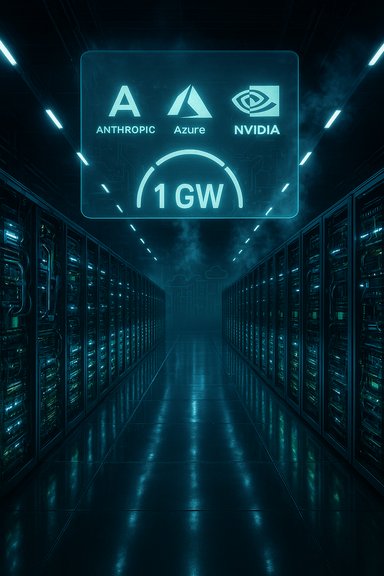
- Dedicated capacity ceiling: public statements framed Anthropic’s option to contract up to one gigawatt of NVIDIA-based compute capacity—an electrical and facilities-scale shorthand that implies tens of thousands of accelerators across AI‑dense data halls.
- NVIDIA’s capital commitment: up to $10 billion of investment in Anthropic, coupled with an explicit technology co‑design partnership to optimize Claude for NVIDIA’s Grace Blackwell and Vera Rubin architectures.
- Microsoft’s capital commitment: up to $5 billion and a commercial guarantee to surface Claude models across Azure AI Foundry and Microsoft Copilot offerings.
Important qualifiers
These headline figures are repeatedly framed as “up to” or multi‑year commitments in vendor materials and reporting. That matters: a $30 billion compute purchase is not a single wire transfer but an aggregation of reserved capacity, phased deployments, and optionality tied to hardware availability, SLAs, and product milestones. Independent reporting corroborates the headlines, but many of the contract-level mechanics (equity dilution, tranche timing, regional rollouts, and precise SLAs) were not disclosed publicly at the time of announcement. Treat the numbers as strategic signals rather than instant cash flows.Why each party signed: strategic benefits (and what they gain)
Anthropic: guaranteed capacity, distribution, and a valuation lift
For Anthropic, the combination of long-duration compute commitments and capital inflows secures predictable infrastructure for scaling Claude across enterprise customers. The Azure tie gives Anthropic deeper integration into Microsoft’s identity, compliance, and deployment surfaces—key advantages for customers seeking governance and tooling around enterprise AI. Reports that the combined package could push Anthropic’s valuation into the hundreds of billions reflect market expectations, but those estimates should be read with caution until term sheets and closing details are public.NVIDIA: demand visibility and co‑design leverage
NVIDIA’s pledge—both investment and co‑engineering—secures long-term demand for its data‑center accelerators and gives NVIDIA direct influence over model optimizations that can showcase the company’s next-generation architectures. Co‑design work (model topology, precision formats, memory/IO strategies) can deliver meaningful TCO and performance gains for Anthropic, while tying Anthropic’s production roadmaps more tightly to NVIDIA’s hardware selling cycles. That’s a powerful commercial and technical alignment.Microsoft: model plurality, enterprise lock‑in, and Azure revenue
For Microsoft, adding Claude to Azure AI Foundry and integrating it into Copilot fortifies its multi‑model enterprise play. Microsoft is no longer a single‑model gatekeeper; it can present customers with competing frontier models inside the same management plane. Importantly, a $30 billion compute pipeline—if realized—anchors Azure revenue streams and deepens enterprise dependency on Azure’s data, identity, and management stacks. Microsoft’s $5 billion commitment is smaller than NVIDIA’s in headline dollars but strategically amplifies Microsoft’s product ecosystem.The technical and operational realities: what “one gigawatt” means
“One gigawatt” is not a GPU count—it’s an electrical footprint. Delivering even part of that capacity requires heavy utility agreements, substations, liquid cooling and rack‑scale engineering, and months-to-years of phased hardware deliveries. Industry analysts translate a gigawatt of AI load into tens of thousands to hundreds of thousands of high-end accelerators plus corresponding networking and systems infrastructure. In practice, that means the deal signals long-term planning for facilities, not an immediate overnight transformation of available compute.From an engineering perspective, the co‑design partnership between Anthropic and NVIDIA is where the most tangible performance improvements can arise. Joint optimization—tuning models to exploit specific tensor cores, memory hierarchies, and interconnect topologies—often reduces latency and cost per token in production deployments. Those savings matter at scale, but they require rigorous benchmarking and representative workload tests to validate vendor claims.
The circular economy critique — and why bears are worried
The headline reaction from skeptics centers on circularity: companies acting as both customers and investors can create feedback loops that inflate narratives and valuations without immediate, equivalent cash profitability. Critics point out two structural risks:- Expectation inflation: Multibillion-dollar commitments create aggressive growth and revenue expectations that may be hard to meet if demand or pricing power softens.
- Execution and realization risk: Committing to buy compute is different from consuming it. If projected workloads fail to materialize, large reserved spends can become stranded or renegotiated, and the balance sheets of suppliers could carry excess capacity risk.
The counterpoint: strategic land grabs and the winner‑take‑most dynamics
The bullish counterargument reframes these arrangements not as pure circularity but as strategic land grabs during a period of acute scarcity: compute capacity, low-latency distribution, and model‑to‑hardware engineering are all scarce resources that incumbents want to secure early. The logic is straightforward:- Locking long-duration demand reduces procurement uncertainty and smooths hardware adoption cycles.
- Deep product integrations (Copilot + Foundry) raise switching costs for enterprise customers by embedding models into productivity workflows and identity stacks.
- Co‑engineering yields efficiency improvements that materially improve unit economics at hyperscale.
Market and investor implications
Valuation and analyst reactions
The combination of compute commitments and capital injections immediately generated valuation chatter about Anthropic reaching valuation ranges “north of $300 billion” in some reporting. Those figures are estimates based on pre‑closing indications and should be treated as provisional until any financing round closes and terms are published. Still, the market reaction underscores how much investor pricing today hinges on expectations of prolonged AI adoption across enterprise workflows.Systemic risk and correlation
The deals increase commercial coupling across a small group of companies: hyperscalers (Microsoft, AWS), chip suppliers (NVIDIA), and model vendors (Anthropic, OpenAI). That concentration raises systemic considerations: a slowdown in model demand or an oversupply of accelerators could depress multiple linked players simultaneously, increasing correlation risk for portfolios heavily weighted to tech megacaps. Analysts advising risk‑conscious investors stress scenario planning that includes slower adoption curves, lower model monetization rates, and hardware oversupply.What this means for enterprise IT teams: practical takeaways
The deal will have several immediate and medium-term implications for IT decision makers—especially those managing Windows and Microsoft‑centric environments.Short-term practical effects
- Model choice inside Microsoft 365 Copilot: Enterprises can expect more selectable model variants inside Microsoft’s Copilot family, enabling comparisons of latency, cost, and output characteristics between Claude and competing models. That widens options but increases the complexity of governance and A/B testing.
- Procurement and SLA diligence: Large reserved‑capacity deals often come with nuanced regional allocations and conditional tranches. IT procurement teams should insist on explicit SLA clauses around capacity guarantees, geographic residency, and exit/change provisions before signing long-term commitments tied to any vendor’s model.
Operational and governance guidance
- Pilot and benchmark: Build representative pilots that measure cost, latency, hallucination rates, and compliance characteristics on your actual workloads. Vendor benchmarks rarely match production conditions.
- Model routing and provenance: If multiple frontier models are available within the same platform, implement clear routing policies that track which model processed which data, and record decision provenance for auditability. Anthropic + Microsoft integration will increase the variety of possible model paths inside an enterprise stack.
- Identity and least‑privilege connectors: Use Entra (Azure AD) policies and agent identity controls to prevent overprivileged agents from performing high‑impact actions automatically. AgentOps discipline matters more when agents are cheaper and easier to run at scale.
Cost modeling
Reserved compute commitments can hide complex egress, metadata, and orchestration costs. Model token pricing is only part of the total cost of ownership. When evaluating offerings, account for:- Network egress and cross‑region transfer costs.
- Data preprocessing and embedding storage costs.
- Monitoring, observability, and human‑in‑the‑loop validation overhead.
Risks beyond finance: competition, regulation, and supply chain
- Competition consolidation: The arrangement increases barriers for smaller model vendors who may lack the capital or distribution hooks to gain enterprise traction, accelerating consolidation in the model provider market.
- Regulatory scrutiny: Large, cross‑owned ecosystems invite antitrust and competition analysis, particularly when cloud providers and chip vendors take equity stakes in model suppliers while also supplying core infrastructure. Expect regulators to examine how these arrangements affect competition and customer choice.
- Supply chain fragility: Scaling to gigawatt-class deployments requires robust supply chains for chips, power, and cooling infrastructure. Any hiccup (chip shortages, utility bottlenecks, permitting delays) could slow deployment and create mismatches between reserved capacity and actual utilization.
How to evaluate the deal two quarters from now: a checklist
When the initial headline enthusiasm has settled, IT and finance leaders should evaluate the realized impact against a concise set of evidence‑based metrics:- Capacity utilization: What percentage of the reserved Azure capacity is active? Are deployment timelines met?
- Unit economics: Has co‑engineering with NVIDIA produced measurable reductions in inference TCO for Anthropic models used in production?
- Vendor neutrality: Has multi‑cloud availability for Claude been preserved in practice, or has Anthropic shifted workloads preferentially to Azure?
- Contract flexibility: Are customers and Anthropic able to renegotiate tranches without punitive terms if demand profiles change?
Final assessment: strategic clarity with execution uncertainty
The Anthropic–Microsoft–NVIDIA announcement is one of the clearest signals yet that the AI infrastructure layer is moving from experimental to industrial scale. The strategic logic is sound: lock in capacity, co‑design hardware and models, and embed products inside large enterprise ecosystems. If executed, these moves can deliver real value to customers and durable revenue streams for providers. But the size of the headline numbers—and the fact they are couched as staged, “up to” commitments—requires caution. The difference between committed and consumed compute will determine whether this deal is a transformative industrial alignment or a leveraged bet that raises concentration and valuation risks across a handful of players. IT leaders should treat the announcement as an operational opportunity to pilot new models while demanding rigorous SLAs, representative benchmarks, and disciplined governance. The next phase will be execution: getting racks online, validating model‑to‑silicon gains, and turning contractual commitments into measurable customer outcomes. Those are technical problems—power, cooling, software stacks, and orchestration—that large vendors have solved before, but not at the scale and speed now being attempted. That makes this not just the industry’s hottest ticket, but also one of its most consequential operational experiments.Conclusion
This three‑way pact confirms what many enterprises and investors already suspected: the AI market is consolidating around a small number of platform players who can marry capital, compute, and distribution. The Anthropic–Microsoft–NVIDIA package is a strategic attempt to lock in the building blocks of that future—compute capacity, chip co‑optimization, and embedded enterprise distribution—but its ultimate value will depend on careful execution, contractual clarity, and the real-world economics of model deployment. Pragmatic, pilot‑driven adoption and rigorous procurement discipline will separate organizations that benefit from this new wave of industrial AI from those that become collateral damage in a rapidly consolidating market.
Source: www.sharewise.com Anthropic Just Became AI’s Hottest Ticket—Backed by Microsoft and NVIDIA