

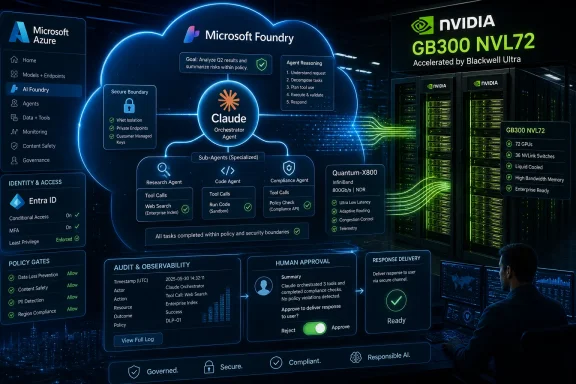
Anthropic’s Claude models are now available in Microsoft Foundry on Azure, running on NVIDIA GB300 Blackwell Ultra infrastructure with NVL72 systems and Quantum-X800 InfiniBand networking, expanding enterprise access to Claude through Microsoft’s cloud AI platform as of late June 2026. The announcement is not just another model-catalog update. It is a signal that the next phase of enterprise AI will be fought less over chatbot interfaces and more over who controls the stack beneath agents: models, cloud contracts, accelerators, networking, identity, and policy. For Windows shops already deep in Microsoft 365, Entra ID, Azure, GitHub, and Copilot, Claude’s arrival on NVIDIA-powered Azure infrastructure changes the procurement conversation from “which model do we like?” to “which platform can we safely let act on our behalf?”
Microsoft spent the first wave of generative AI telling customers that Copilot was the product. The message was simple enough: put AI where people already work, inside Office, Teams, Windows, GitHub, and Dynamics. But the enterprise market has matured quickly, and large customers have become allergic to single-model narratives.
Claude’s deeper arrival in Microsoft Foundry is Microsoft admitting, pragmatically, that the winning AI platform will not be the one with only the house model. It will be the one that gives enterprises enough model choice to keep workloads inside the same governance, billing, observability, and identity perimeter. Azure does not need Claude to replace OpenAI models; Azure needs Claude to prevent customers from leaving Azure when they decide Claude is better for a particular workload.
That is a subtle but important shift. In the consumer market, models compete as brands. In the enterprise market, models compete as deployable components inside a risk-managed architecture. Microsoft’s pitch is not merely that Claude is available, but that Claude can be consumed through the same cloud machinery enterprises already use to deploy applications, manage credentials, restrict network access, and audit activity.
For IT leaders, this matters because model choice without platform integration is often operational theater. A developer can sign up for an API in an afternoon, but a regulated enterprise has to answer harder questions: where the data flows, who can invoke the model, which logs exist, how secrets are stored, how tools are authorized, what happens when the model calls another system, and who gets paged when an agent starts doing the wrong thing very quickly. Foundry’s role is to make those questions feel like normal Azure questions instead of a new category of chaos.
Microsoft’s advantage is not that it suddenly owns the best answer to every AI task. It is that it can make the answer purchasable, governable, and boring. In enterprise infrastructure, boring is not an insult. It is the feature buyers eventually pay for.
That distinction matters because the economics of agents are different from the economics of chatbots. A chatbot often turns one user request into one model response. An agentic system may turn one business request into dozens or hundreds of model calls, searches, validations, code executions, database lookups, and policy checks. If the system is useful, it may also run continuously rather than only when a human asks a question.
This is why NVIDIA keeps talking about accelerated computing, networking, and reference designs rather than just model availability. The bottleneck is not merely whether Claude can produce a good answer. The bottleneck is whether an enterprise can run many Claude-powered workflows at acceptable latency, cost, reliability, and isolation. NVIDIA wants to define the infrastructure template for that world before enterprises build their own messy versions.
The inclusion of Quantum-X800 InfiniBand networking is not decorative. Modern frontier-model workloads depend on moving enormous amounts of data across accelerator clusters efficiently. For training, fine-tuning, high-throughput inference, and multi-agent orchestration at scale, the network becomes part of the computer. NVIDIA’s stack makes that argument explicit: the GPU, the rack, the interconnect, and the software layer are all part of the product.
That is also why the phrase AI factory has become unavoidable in NVIDIA’s language. It is a marketing term, but it captures something real. Enterprises are no longer buying isolated AI experiments; they are trying to build production lines for intelligence. NVIDIA wants those production lines to run on its machinery, whether the application is a customer-service agent, a developer assistant, a medical summarization workflow, or a financial-analysis tool.
Making Claude available in Microsoft Foundry gives Anthropic something more valuable than another press release: access to the enterprise pathways Microsoft already controls. Azure customers can consider Claude without necessarily creating a separate vendor relationship, separate key-management process, separate billing workflow, or separate integration model. That lowers friction, and in enterprise software, lowering friction often matters as much as raising benchmark scores.
There is a defensive dimension here too. Anthropic has major relationships beyond Microsoft, including with other cloud providers and infrastructure partners. Its strategy is not to become a Microsoft-only model company. Its strategy is to be unavoidable across major enterprise clouds, developer tools, and business platforms.
For Microsoft, that creates tension and opportunity. Claude’s availability makes Azure more attractive, but it also reminds customers that the model layer is increasingly portable. If Claude is accessible across multiple clouds, Microsoft has to win on platform experience rather than exclusivity. That is healthier for customers, but it also puts pressure on Microsoft to make Foundry genuinely better than a model directory with Azure branding.
The most important phrase in the announcement may be “specialized sub-agents.” It points toward an architecture where a single AI assistant is no longer the unit of work. Instead, enterprises may deploy collections of narrower agents: one that triages support tickets, one that checks compliance language, one that drafts code changes, one that validates invoices, one that summarizes incident telemetry, and one that escalates exceptions to humans.
Claude’s value in that architecture depends less on being charming in a demo and more on behaving predictably inside a chain of delegated work. That is where platform controls become decisive. A clever model without boundaries is a liability. A capable model inside a controlled workspace becomes a system component.
That should make every sysadmin sit up straight. Enterprises already struggle with human identity, service principals, OAuth permissions, stale credentials, shadow SaaS, overprivileged applications, and supply-chain exposure. Agentic AI adds a new layer: software that interprets goals, chooses tools, generates actions, and may operate across systems that were never designed for probabilistic decision-making.
NVIDIA’s Secure Agent Workspace Reference Design is an attempt to answer that anxiety in infrastructure terms. The promise is a framework for autonomous agents with controls around identity, networking, credentials, and runtime policy. In plain English, it is an attempt to keep the agent in a room with locked doors, monitored tools, and rules about what it can touch.
That is exactly the right battleground. The question for enterprise AI is not whether agents can do useful work; they can. The question is whether organizations can constrain that work well enough to trust it. The bigger the model and the faster the infrastructure, the more important the guardrails become.
The WindowsForum audience knows this pattern because it has played out before. Scripting made administration more powerful, then PowerShell remoting made it more scalable, then cloud APIs made it more distributed. Each leap improved automation while increasing the blast radius of mistakes. AI agents are another automation leap, but with a less deterministic center.
Microsoft’s identity and governance footprint gives it a credible story here. Entra ID, Azure networking, private endpoints, key vaults, managed identities, policy enforcement, logging, and security tooling are the sort of mundane controls that decide whether a pilot becomes production. NVIDIA can provide the accelerated workspace pattern; Microsoft can map it into enterprise administration habits.
Still, no reference design removes responsibility. A badly scoped agent with access to sensitive systems is still dangerous, even if it runs on impressive hardware. The governance work will be tedious, political, and organization-specific. That is not a flaw in the announcement. It is the real work the announcement points toward.
But abstraction does not make hardware irrelevant. The performance and cost of AI workloads are shaped by the hardware underneath, especially for agents that perform multiple reasoning steps or process large context windows. If Azure can deliver Claude with better throughput or economics on NVIDIA’s newest systems, that can change which workloads are practical to run.
The danger is that enterprises will underestimate the cost curve. Agentic systems can look inexpensive during pilots because usage is constrained and humans are watching. Costs rise when agents are embedded into workflows, invoked automatically, allowed to retry, connected to richer context, or asked to coordinate with other agents. A model that seems affordable at chatbot scale can become expensive when it becomes part of every business process.
This is where IT finance and architecture need to become more involved. Token pricing is only one part of the bill. Retrieval infrastructure, storage, logging, evaluation runs, content filtering, network traffic, orchestration, fallback models, and human review all add cost. Faster GPUs may reduce the cost of some inference workloads, but they do not repeal the economics of excessive automation.
Microsoft and NVIDIA are selling efficiency, and they may well deliver it. But efficiency often increases demand. If Claude agents become faster and easier to deploy in Azure, more teams will deploy them. The result could be lower unit costs and higher total spending at the same time.
That is not necessarily bad. Enterprises spend more on platforms that produce value. But the CFO will eventually ask whether the agent saved money, improved revenue, reduced risk, or merely shifted labor into a larger Azure invoice. The winners will be the IT organizations that instrument AI workloads from the start rather than treating cost management as a cleanup task after adoption.
That world is already here. Developers compare Claude, GPT, Gemini, Llama, Mistral, and domain-specific models not because they enjoy complexity, but because different models behave differently. One may be better at code repair, another at summarization, another at structured extraction, another at low-cost classification, another at long-context analysis. The enterprise platform problem is to make that diversity manageable.
Foundry gives Microsoft a way to absorb that complexity into Azure. Instead of pretending there will be one model to rule them all, Microsoft can present itself as the broker: bring your task, choose your model, wire it into an agent, apply policy, monitor usage, and bill it through Azure. That is a stronger enterprise story than model maximalism.
For Windows and Microsoft 365-heavy organizations, the gravitational pull is obvious. If Claude can be used in Foundry, Copilot-related workflows, GitHub development scenarios, and custom Azure applications, then the boundary between “Microsoft AI” and “third-party AI on Microsoft infrastructure” starts to blur. That is exactly what Microsoft wants.
The risk for customers is lock-in at a higher layer. Model choice inside a single platform is still platform dependency. If prompts, evaluations, orchestration logic, monitoring, identity bindings, and agent tools become deeply tied to Foundry, moving to another cloud may be harder even if the model itself is available elsewhere.
That does not mean enterprises should avoid Foundry. It means they should treat Foundry as strategic infrastructure, not just a convenient console. The same procurement discipline applied to databases, Kubernetes platforms, and identity providers now belongs in AI model platforms. Exit paths, abstraction layers, logging formats, and governance portability should be discussed before hundreds of workflows depend on the system.
The enterprise market increasingly wants multiple frontier models for resilience, leverage, and task fit. Microsoft knows this. If Azure were perceived as primarily the OpenAI cloud, customers with Claude preferences might route workloads elsewhere. By bringing Claude deeper into Foundry, Microsoft reduces that risk and positions Azure as a neutral-enough venue for frontier AI.
Neutrality, however, is relative. Microsoft still has its own Copilot ambitions, its own application stack, and its own incentives. It wants model diversity insofar as model diversity strengthens Azure and Microsoft 365. It does not want a future where the cloud becomes a commodity pipe for model vendors.
That is why this announcement feels less like a détente and more like a consolidation move. Anthropic gets enterprise distribution. NVIDIA gets accelerated workloads. Microsoft gets to keep the customer relationship. Each company gains something, and each company gives up a little control.
For customers, the result is useful but not altruistic. The hyperscalers are not opening their platforms because they have suddenly become philosophical pluralists. They are doing it because enterprises demanded choice, and because the cost of losing AI workloads is too high. The practical outcome is still positive: more models in more places, with better infrastructure and more mature controls.
Agents that begin in Azure will act on Microsoft 365 data, identity systems, developer repositories, ticketing platforms, endpoint-management tools, and business applications. In Microsoft-centric organizations, many of those systems ultimately touch Windows users and Windows devices. The agent may not run on the endpoint, but its decisions may change policies, file permissions, support responses, code deployments, or incident workflows that affect the endpoint estate.
That means Windows admins should not wait for an “AI in Windows” feature toggle before paying attention. The first serious AI-driven operational changes may arrive through Azure automation, Copilot Studio workflows, GitHub pull requests, Intune-related processes, or helpdesk integrations. Claude’s availability in Foundry expands the model options behind those workflows.
This is also a security operations story. AI agents will be used for log summarization, alert triage, phishing analysis, vulnerability prioritization, and incident response. Those are high-value uses, but they are also sensitive. An agent that summarizes an incident badly can mislead responders. An agent that calls the wrong remediation tool can disrupt production. An agent that sees too much data becomes a tempting target.
The right approach is not panic. It is disciplined adoption. Treat AI agents like privileged automation until proven otherwise. Scope their permissions narrowly, log their actions, test their failure modes, and keep humans in approval loops for destructive operations. If that sounds like old-fashioned sysadmin caution, good. Old-fashioned caution is underrated during platform shifts.
The biggest concrete takeaways are straightforward:
Microsoft, NVIDIA, and Anthropic each arrive with a different piece of that puzzle. Anthropic supplies the model family and the safety-oriented brand. NVIDIA supplies the accelerated compute stack and the reference architecture language. Microsoft supplies the enterprise cloud wrapper, developer surface, billing relationship, and identity fabric. The combined pitch is that enterprises can build agents powerful enough to matter and controlled enough to trust.
That remains an aspiration, not a guaranteed outcome. Many companies will overbuild, overspend, under-govern, and rediscover painful lessons about automation at scale. But the direction is clear: frontier models are becoming cloud platform components, and the real competition is shifting to the systems that surround them.
The winners in this phase will not be the organizations that deploy the most agents the fastest. They will be the ones that understand that agentic AI is infrastructure, not magic; that model choice is only valuable when paired with governance; and that the fastest accelerator in the world cannot compensate for unclear permissions, weak oversight, or a business process no one bothered to redesign. Claude on NVIDIA-powered Azure gives enterprises another powerful tool, but the hard part begins when they decide what that tool is allowed to do next.
 Microsoft Turns Model Choice Into an Azure Retention Strategy
Microsoft spent the first wave of generative AI telling customers that Copilot was the product. The message was simple enough: put AI where people already work, inside Office, Teams, Windows, GitHub, and Dynamics. But the enterprise market has matured quickly, and large customers have become allergic to single-model narratives.Claude’s deeper arrival in Microsoft Foundry is Microsoft admitting, pragmatically, that the winning AI platform will not be the one with only the house model. It will be the one that gives enterprises enough model choice to keep workloads inside the same governance, billing, observability, and identity perimeter. Azure does not need Claude to replace OpenAI models; Azure needs Claude to prevent customers from leaving Azure when they decide Claude is better for a particular workload.
That is a subtle but important shift. In the consumer market, models compete as brands. In the enterprise market, models compete as deployable components inside a risk-managed architecture. Microsoft’s pitch is not merely that Claude is available, but that Claude can be consumed through the same cloud machinery enterprises already use to deploy applications, manage credentials, restrict network access, and audit activity.
For IT leaders, this matters because model choice without platform integration is often operational theater. A developer can sign up for an API in an afternoon, but a regulated enterprise has to answer harder questions: where the data flows, who can invoke the model, which logs exist, how secrets are stored, how tools are authorized, what happens when the model calls another system, and who gets paged when an agent starts doing the wrong thing very quickly. Foundry’s role is to make those questions feel like normal Azure questions instead of a new category of chaos.
Microsoft’s advantage is not that it suddenly owns the best answer to every AI task. It is that it can make the answer purchasable, governable, and boring. In enterprise infrastructure, boring is not an insult. It is the feature buyers eventually pay for.
NVIDIA Is Selling the Floor Beneath the Agent Boom
The NVIDIA half of this announcement is easy to reduce to GPU branding, but that misses the more interesting point. GB300 NVL72 systems are not being positioned as faster cards for faster prompts. They are being positioned as factory equipment for agentic workloads that may require heavy reasoning, long context, tool use, parallel sub-agents, retrieval, evaluation, and repeated inference loops.That distinction matters because the economics of agents are different from the economics of chatbots. A chatbot often turns one user request into one model response. An agentic system may turn one business request into dozens or hundreds of model calls, searches, validations, code executions, database lookups, and policy checks. If the system is useful, it may also run continuously rather than only when a human asks a question.
This is why NVIDIA keeps talking about accelerated computing, networking, and reference designs rather than just model availability. The bottleneck is not merely whether Claude can produce a good answer. The bottleneck is whether an enterprise can run many Claude-powered workflows at acceptable latency, cost, reliability, and isolation. NVIDIA wants to define the infrastructure template for that world before enterprises build their own messy versions.
The inclusion of Quantum-X800 InfiniBand networking is not decorative. Modern frontier-model workloads depend on moving enormous amounts of data across accelerator clusters efficiently. For training, fine-tuning, high-throughput inference, and multi-agent orchestration at scale, the network becomes part of the computer. NVIDIA’s stack makes that argument explicit: the GPU, the rack, the interconnect, and the software layer are all part of the product.
That is also why the phrase AI factory has become unavoidable in NVIDIA’s language. It is a marketing term, but it captures something real. Enterprises are no longer buying isolated AI experiments; they are trying to build production lines for intelligence. NVIDIA wants those production lines to run on its machinery, whether the application is a customer-service agent, a developer assistant, a medical summarization workflow, or a financial-analysis tool.
Claude Becomes More Useful When It Stops Being a Separate Island
Anthropic has long benefited from a reputation for strong reasoning, careful instruction following, coding ability, and enterprise-friendly safety posture. But reputation alone does not win the Fortune 500. Deployment surface does.Making Claude available in Microsoft Foundry gives Anthropic something more valuable than another press release: access to the enterprise pathways Microsoft already controls. Azure customers can consider Claude without necessarily creating a separate vendor relationship, separate key-management process, separate billing workflow, or separate integration model. That lowers friction, and in enterprise software, lowering friction often matters as much as raising benchmark scores.
There is a defensive dimension here too. Anthropic has major relationships beyond Microsoft, including with other cloud providers and infrastructure partners. Its strategy is not to become a Microsoft-only model company. Its strategy is to be unavoidable across major enterprise clouds, developer tools, and business platforms.
For Microsoft, that creates tension and opportunity. Claude’s availability makes Azure more attractive, but it also reminds customers that the model layer is increasingly portable. If Claude is accessible across multiple clouds, Microsoft has to win on platform experience rather than exclusivity. That is healthier for customers, but it also puts pressure on Microsoft to make Foundry genuinely better than a model directory with Azure branding.
The most important phrase in the announcement may be “specialized sub-agents.” It points toward an architecture where a single AI assistant is no longer the unit of work. Instead, enterprises may deploy collections of narrower agents: one that triages support tickets, one that checks compliance language, one that drafts code changes, one that validates invoices, one that summarizes incident telemetry, and one that escalates exceptions to humans.
Claude’s value in that architecture depends less on being charming in a demo and more on behaving predictably inside a chain of delegated work. That is where platform controls become decisive. A clever model without boundaries is a liability. A capable model inside a controlled workspace becomes a system component.
The Agent Story Is Really a Governance Story
The industry’s public language around AI agents is still too magical. Vendors describe systems that can plan, reason, use tools, and execute tasks across business domains. That sounds impressive, and sometimes it is. But for the people who administer real systems, an agent is also a non-human actor asking for access.That should make every sysadmin sit up straight. Enterprises already struggle with human identity, service principals, OAuth permissions, stale credentials, shadow SaaS, overprivileged applications, and supply-chain exposure. Agentic AI adds a new layer: software that interprets goals, chooses tools, generates actions, and may operate across systems that were never designed for probabilistic decision-making.
NVIDIA’s Secure Agent Workspace Reference Design is an attempt to answer that anxiety in infrastructure terms. The promise is a framework for autonomous agents with controls around identity, networking, credentials, and runtime policy. In plain English, it is an attempt to keep the agent in a room with locked doors, monitored tools, and rules about what it can touch.
That is exactly the right battleground. The question for enterprise AI is not whether agents can do useful work; they can. The question is whether organizations can constrain that work well enough to trust it. The bigger the model and the faster the infrastructure, the more important the guardrails become.
The WindowsForum audience knows this pattern because it has played out before. Scripting made administration more powerful, then PowerShell remoting made it more scalable, then cloud APIs made it more distributed. Each leap improved automation while increasing the blast radius of mistakes. AI agents are another automation leap, but with a less deterministic center.
Microsoft’s identity and governance footprint gives it a credible story here. Entra ID, Azure networking, private endpoints, key vaults, managed identities, policy enforcement, logging, and security tooling are the sort of mundane controls that decide whether a pilot becomes production. NVIDIA can provide the accelerated workspace pattern; Microsoft can map it into enterprise administration habits.
Still, no reference design removes responsibility. A badly scoped agent with access to sensitive systems is still dangerous, even if it runs on impressive hardware. The governance work will be tedious, political, and organization-specific. That is not a flaw in the announcement. It is the real work the announcement points toward.
The Hardware Arms Race Has Entered the Procurement Office
There is a temptation to view GB300 Blackwell Ultra as a detail for hyperscalers and benchmark watchers. Most enterprises will not buy a rack of GB300 NVL72 systems and install them next to the SAN. They will consume the capability through Azure and see it as a model endpoint, a Foundry deployment, or a line item on a cloud bill.But abstraction does not make hardware irrelevant. The performance and cost of AI workloads are shaped by the hardware underneath, especially for agents that perform multiple reasoning steps or process large context windows. If Azure can deliver Claude with better throughput or economics on NVIDIA’s newest systems, that can change which workloads are practical to run.
The danger is that enterprises will underestimate the cost curve. Agentic systems can look inexpensive during pilots because usage is constrained and humans are watching. Costs rise when agents are embedded into workflows, invoked automatically, allowed to retry, connected to richer context, or asked to coordinate with other agents. A model that seems affordable at chatbot scale can become expensive when it becomes part of every business process.
This is where IT finance and architecture need to become more involved. Token pricing is only one part of the bill. Retrieval infrastructure, storage, logging, evaluation runs, content filtering, network traffic, orchestration, fallback models, and human review all add cost. Faster GPUs may reduce the cost of some inference workloads, but they do not repeal the economics of excessive automation.
Microsoft and NVIDIA are selling efficiency, and they may well deliver it. But efficiency often increases demand. If Claude agents become faster and easier to deploy in Azure, more teams will deploy them. The result could be lower unit costs and higher total spending at the same time.
That is not necessarily bad. Enterprises spend more on platforms that produce value. But the CFO will eventually ask whether the agent saved money, improved revenue, reduced risk, or merely shifted labor into a larger Azure invoice. The winners will be the IT organizations that instrument AI workloads from the start rather than treating cost management as a cleanup task after adoption.
Foundry Is Becoming Microsoft’s Control Plane for Model Sprawl
Microsoft Foundry’s strategic role is becoming clearer with each announcement. It is the place where Microsoft wants developers and enterprises to discover models, deploy them, build agents, connect tools, evaluate behavior, and apply governance. In other words, it is the proposed control plane for a world in which no serious company uses only one model.That world is already here. Developers compare Claude, GPT, Gemini, Llama, Mistral, and domain-specific models not because they enjoy complexity, but because different models behave differently. One may be better at code repair, another at summarization, another at structured extraction, another at low-cost classification, another at long-context analysis. The enterprise platform problem is to make that diversity manageable.
Foundry gives Microsoft a way to absorb that complexity into Azure. Instead of pretending there will be one model to rule them all, Microsoft can present itself as the broker: bring your task, choose your model, wire it into an agent, apply policy, monitor usage, and bill it through Azure. That is a stronger enterprise story than model maximalism.
For Windows and Microsoft 365-heavy organizations, the gravitational pull is obvious. If Claude can be used in Foundry, Copilot-related workflows, GitHub development scenarios, and custom Azure applications, then the boundary between “Microsoft AI” and “third-party AI on Microsoft infrastructure” starts to blur. That is exactly what Microsoft wants.
The risk for customers is lock-in at a higher layer. Model choice inside a single platform is still platform dependency. If prompts, evaluations, orchestration logic, monitoring, identity bindings, and agent tools become deeply tied to Foundry, moving to another cloud may be harder even if the model itself is available elsewhere.
That does not mean enterprises should avoid Foundry. It means they should treat Foundry as strategic infrastructure, not just a convenient console. The same procurement discipline applied to databases, Kubernetes platforms, and identity providers now belongs in AI model platforms. Exit paths, abstraction layers, logging formats, and governance portability should be discussed before hundreds of workflows depend on the system.
The OpenAI Shadow Still Hangs Over Azure
No Microsoft AI story can avoid OpenAI. For years, Azure’s AI identity was tightly linked to OpenAI’s models and Microsoft’s massive investment in that partnership. Claude’s expansion through Azure does not erase that history, but it does complicate it.The enterprise market increasingly wants multiple frontier models for resilience, leverage, and task fit. Microsoft knows this. If Azure were perceived as primarily the OpenAI cloud, customers with Claude preferences might route workloads elsewhere. By bringing Claude deeper into Foundry, Microsoft reduces that risk and positions Azure as a neutral-enough venue for frontier AI.
Neutrality, however, is relative. Microsoft still has its own Copilot ambitions, its own application stack, and its own incentives. It wants model diversity insofar as model diversity strengthens Azure and Microsoft 365. It does not want a future where the cloud becomes a commodity pipe for model vendors.
That is why this announcement feels less like a détente and more like a consolidation move. Anthropic gets enterprise distribution. NVIDIA gets accelerated workloads. Microsoft gets to keep the customer relationship. Each company gains something, and each company gives up a little control.
For customers, the result is useful but not altruistic. The hyperscalers are not opening their platforms because they have suddenly become philosophical pluralists. They are doing it because enterprises demanded choice, and because the cost of losing AI workloads is too high. The practical outcome is still positive: more models in more places, with better infrastructure and more mature controls.
Windows Shops Should Read This as an Automation Warning
For Windows administrators, the immediate impact may seem distant. Claude on GB300 in Azure sounds like a cloud AI story, not a Windows endpoint story. But the line between cloud AI and endpoint administration is thinning.Agents that begin in Azure will act on Microsoft 365 data, identity systems, developer repositories, ticketing platforms, endpoint-management tools, and business applications. In Microsoft-centric organizations, many of those systems ultimately touch Windows users and Windows devices. The agent may not run on the endpoint, but its decisions may change policies, file permissions, support responses, code deployments, or incident workflows that affect the endpoint estate.
That means Windows admins should not wait for an “AI in Windows” feature toggle before paying attention. The first serious AI-driven operational changes may arrive through Azure automation, Copilot Studio workflows, GitHub pull requests, Intune-related processes, or helpdesk integrations. Claude’s availability in Foundry expands the model options behind those workflows.
This is also a security operations story. AI agents will be used for log summarization, alert triage, phishing analysis, vulnerability prioritization, and incident response. Those are high-value uses, but they are also sensitive. An agent that summarizes an incident badly can mislead responders. An agent that calls the wrong remediation tool can disrupt production. An agent that sees too much data becomes a tempting target.
The right approach is not panic. It is disciplined adoption. Treat AI agents like privileged automation until proven otherwise. Scope their permissions narrowly, log their actions, test their failure modes, and keep humans in approval loops for destructive operations. If that sounds like old-fashioned sysadmin caution, good. Old-fashioned caution is underrated during platform shifts.
The Announcement’s Most Important Details Are the Least Glamorous
The visible headline is Claude on Azure with NVIDIA’s latest infrastructure. The operational story is more granular: where the model is hosted, how it is billed, how it authenticates, how agents are isolated, what policies apply at runtime, and whether the resulting system can be audited. Those are the details that determine whether this becomes production infrastructure or another executive demo.The biggest concrete takeaways are straightforward:
- Claude’s availability in Microsoft Foundry gives Azure customers another frontier-model option without forcing every team to build a separate procurement and integration path around Anthropic.
- NVIDIA’s GB300 NVL72 and Quantum-X800 InfiniBand stack is aimed at high-throughput agentic workloads, not merely faster chatbot responses.
- The Secure Agent Workspace framing shows that identity, credentials, network boundaries, and runtime policy are becoming central to enterprise AI deployment.
- Microsoft is using model choice to strengthen Azure’s role as the control plane for enterprise AI, even when the model is not Microsoft’s own.
- Enterprises should measure total agent cost, not just model-token pricing, because autonomous workflows can multiply inference calls quickly.
- Windows and Microsoft 365 administrators should treat cloud-hosted agents as part of their operational risk surface, even when the agents do not run locally on Windows PCs.
The Next Enterprise AI Battle Will Be Over Trustable Autonomy
The Claude-on-Azure expansion is best understood as part of a broader industry pivot from “AI as answer engine” to “AI as delegated worker.” That pivot demands more than capable models. It demands infrastructure that can run them efficiently, platforms that can govern them consistently, and administrators who can decide where autonomy ends.Microsoft, NVIDIA, and Anthropic each arrive with a different piece of that puzzle. Anthropic supplies the model family and the safety-oriented brand. NVIDIA supplies the accelerated compute stack and the reference architecture language. Microsoft supplies the enterprise cloud wrapper, developer surface, billing relationship, and identity fabric. The combined pitch is that enterprises can build agents powerful enough to matter and controlled enough to trust.
That remains an aspiration, not a guaranteed outcome. Many companies will overbuild, overspend, under-govern, and rediscover painful lessons about automation at scale. But the direction is clear: frontier models are becoming cloud platform components, and the real competition is shifting to the systems that surround them.
The winners in this phase will not be the organizations that deploy the most agents the fastest. They will be the ones that understand that agentic AI is infrastructure, not magic; that model choice is only valuable when paired with governance; and that the fastest accelerator in the world cannot compensate for unclear permissions, weak oversight, or a business process no one bothered to redesign. Claude on NVIDIA-powered Azure gives enterprises another powerful tool, but the hard part begins when they decide what that tool is allowed to do next.
References
- Primary source: Back End News
Published: 2026-07-01T02:30:13.535483
Loading…
backendnews.net - Related coverage: blogs.nvidia.com
Anthropic’s Models Now Run on NVIDIA GB300 in Azure | NVIDIA Blog
Now generally available in Microsoft Foundry, Claude on NVIDIA GB300 Blackwell Ultra gives Azure-native enterprises a new foundation for building autonomous and domain-specific AI agents.blogs.nvidia.com - Related coverage: investing.com
Anthropic’s first NVIDIA deployment launched at Microsoft Azure By Investing.com
Anthropic’s first NVIDIA deployment launched at Microsoft Azurewww.investing.com - Official source: azure.microsoft.com
Loading…
azure.microsoft.com - Related coverage: tomshardware.com
- Related coverage: dataconomy.com
Anthropic Claude launches on Microsoft Azure Foundry
Anthropic announced that its Claude AI models are now available in Microsoft Foundry on Azure, marking the first deployment ondataconomy.com
- Related coverage: nvidia.com
NVIDIA GB300 NVL72
The NVIDIA GB300 NVL72 features a fully liquid-cooled, rack-scale design that unifies 72 NVIDIA Blackwell Ultra GPUs and 36 Arm based NVIDIA Grace CPUs in a single platform.www.nvidia.com - Related coverage: wccftech.com
NVIDIA's Blackwell Ultra GB300 Now Powers Anthropic's Claude Models on Microsoft Azure, Targeting Autonomous Enterprise Agents
Anthropic has announced the general availability of its Claude AI models on Microsoft Azure, powered by NVIDIA's Blackwell Ultra GPUs.wccftech.com
- Related coverage: tech.yahoo.com
Anthropic’s first NVIDIA deployment launched at Microsoft Azure
Investing.com -- Anthropic said on Monday its Claude family of artificial intelligence models is now available in Microsoft Foundry on Azure, running on NVIDIA’s GB300 Blackwell Ultra GPU systems, marking the AI startup’s first deployment on NVIDIA hardware.tech.yahoo.com
- Related coverage: m.nl.investing.com
Anthropic lanceert Claude-modellen op Microsoft Azure met NVIDIA GB300 GPU’s Door Investing.com
Anthropic lanceert Claude-modellen op Microsoft Azure met NVIDIA GB300 GPU’sm.nl.investing.com - Related coverage: letsdatascience.com
Anthropic Deploys Claude on NVIDIA GB300 in Microsoft Azure | Let's Data Science
Editorial analysis: Access to cloud instances running high-end GPUs materially changes the cost-performance tradeoffs for building agentic, domain-specialized systems, influencing architecture and deployment choices for ML teams. According to Investing.com and NVIDIA's blog... letsdatascience.com
- Related coverage: windowscentral.com
NVIDIA joins Microsoft’s push on Claude — piling billions into Anthropic’s future | Windows Central
Claude’s arrival on Azure signals a major shift in the competitive AI cloud landscape.www.windowscentral.com - Related coverage: techradar.com
Anthropic locks in massive Azure deal to fuel Claude expansion across global clouds and reshape enterprise AI access worldwide | TechRadar
Claude models integrate into the Microsoft Foundry platform for enterprise deploymentwww.techradar.com - Related coverage: axios.com
Anthropic lands $15 billion investment from Microsoft, Nvidia
The move is the latest in a series of deals that have all the big players partnering with one another.www.axios.com
- Related coverage: docs.nvidia.com
- Related coverage: newsroom.ibm.com
IBM and Anthropic Partner to Advance Enterprise Software Development with Proven Security and Governance
PDF documentnewsroom.ibm.com
- Related coverage: nvidianews.nvidia.com
- Official source: learn.microsoft.com
Deploy and use Claude models in Microsoft Foundry - Microsoft Foundry | Microsoft Learn
Deploy Claude models in Microsoft Foundry and integrate powerful AI into your applications. Discover how to use Claude Mythos, Fable, Opus, Sonnet, and Haiku.learn.microsoft.com - Official source: microsoft.com
Loading…
www.microsoft.com - Official source: techcommunity.microsoft.com
Loading…
techcommunity.microsoft.com - Official source: cdn-dynmedia-1.microsoft.com