

Microsoft made Anthropic’s Claude models generally available in Microsoft Foundry on June 29, 2026, giving Azure customers production access to Claude through existing Azure accounts, identity controls, billing relationships, networking choices, and governance systems. The announcement is not merely another model card in a portal. It is Microsoft’s clearest statement yet that enterprise AI will be won less by one “best” model than by the cloud platform that makes multiple frontier models safe, purchasable, observable, and boring enough to run real work.
That last word matters. In the first wave of generative AI, the magic was a chat window. In the enterprise wave, the product is a controlled execution environment where models can touch code, data, tools, tickets, documents, identity systems, and eventually money. Claude arriving in Foundry as a generally available Azure-hosted service is a bet that the next frontier is not the demo, but the deployment pipeline.
For years, Microsoft’s AI story was inseparable from OpenAI. Azure OpenAI Service gave the company an enterprise wedge that neither consumer ChatGPT nor open-source model hosting could fully match: a familiar procurement path, security assurances, regional availability, and integration into the broader Microsoft estate. That strategy worked because it acknowledged something CIOs already knew. A model is only useful in production if the organization can actually approve it.
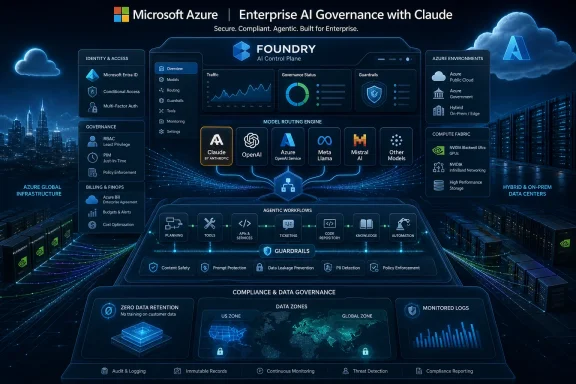
Claude in Foundry extends that same logic to Anthropic. Microsoft is no longer positioning Azure as the place where customers go for one preferred model family. It is trying to make Foundry the control plane where enterprise AI teams compare, route, govern, and deploy frontier models without rebuilding their operational stack each time a new benchmark darling appears.
That is a subtle but important shift. In consumer AI, brand loyalty attaches to the chatbot: ChatGPT, Claude, Gemini, Copilot. In enterprise AI, loyalty tends to attach to the operating environment. If a bank, hospital, manufacturer, insurer, or software vendor can test Claude, OpenAI models, Mistral, DeepSeek, xAI, and open models inside the same governance fabric, the cloud platform becomes the product with the switching power.
Microsoft’s announcement leans hard into this framing. Customers can access Claude through their Azure accounts, authenticate with Microsoft Entra ID, apply Azure role-based access controls, and see consumption on their Azure bill. Claude usage is billed through Claude Consumption Units, with per-model detail in Foundry and eligibility for Microsoft Azure Consumption Commitment drawdown. Those details will sound painfully administrative to hobbyists. They are exactly the details that determine whether enterprise AI projects survive contact with finance, security, legal, and procurement.
The general availability milestone also turns an earlier strategic promise into a purchasable product. Microsoft, NVIDIA, and Anthropic announced a broad partnership in November 2025 to bring Claude to Azure infrastructure powered by NVIDIA systems. Seven months later, Microsoft is saying the production path is open. That timeline matters because enterprise AI announcements often arrive in two flavors: spectacular partnerships and limited previews. GA is where the sales deck becomes a support obligation.
But the more interesting claim from Microsoft is that Claude in Foundry reduces the friction around permission. A development team may already know it wants to try Claude for code review, test generation, customer support triage, contract analysis, or internal research. The hard part is often not writing the first API call. The hard part is proving to the rest of the company that the API call belongs inside an approved operational model.
That means identity has to work. Billing has to work. Network boundaries have to make sense. Data residency has to be explained. Retention behavior has to be documented. Logs, evaluations, usage management, and access policies have to be legible to teams that did not attend the hackathon.
This is where Azure’s gravitational pull becomes Microsoft’s advantage. If a company already uses Entra ID, Azure role-based access control, private networking patterns, Azure billing, and Microsoft’s governance tooling, Foundry gives AI teams a way to say: this new model is not a new shadow platform. It is another controlled capability inside an existing cloud estate.
That is not a small distinction. Many enterprises are already drowning in AI sprawl. Employees subscribe to consumer tools. Developers test APIs with corporate data. Business units buy vertical AI products with unclear model dependencies. Security teams are asked to bless workflows after the fact. Foundry’s pitch is that model experimentation can happen without abandoning institutional controls.
Microsoft’s announcement also emphasizes zero data retention for high-sensitivity workloads, with prompts and completions not retained by Anthropic after the API call completes. That feature will be a major screening criterion for customers dealing with proprietary code, regulated records, export-controlled materials, legal documents, medical information, or sensitive operational data. It does not answer every compliance question, but it addresses one of the most immediate objections to using third-party frontier models in production.
That matters more in 2026 than it did in 2023. The frontier model market is no longer a simple race with one obvious winner. Different models excel at different tasks, pricing changes rapidly, context windows expand, reasoning modes evolve, and customers increasingly want routing strategies rather than religious commitments. A model that is best for one coding workflow may not be best for customer support, document summarization, financial analysis, or low-latency classification.
Microsoft’s model-router language in the announcement points in this direction. The company says customers can automatically route queries to the most appropriate Claude model, with potential savings of up to 50 percent while improving satisfaction. Strip away the marketing gloss and the architectural implication is clear: enterprises will not run every workload through the most expensive model. They will need policies, evaluation loops, and cost controls that decide when to use a premium reasoning model and when to send the task somewhere cheaper.
That is the same transition cloud computing went through years ago. Early cloud adoption often treated virtual machines as generic rented servers. Mature cloud operations became an exercise in placement, scaling, cost optimization, identity, observability, and policy. AI inference is heading in the same direction. The unit of strategy is no longer “which model did we call?” It is “how does the system decide which model, tool, policy, and data source to use for this job?”
Claude in Foundry gives Microsoft a stronger answer to that question. The more serious models it can offer under one Azure-native umbrella, the more Foundry looks like an enterprise AI substrate rather than a catalog. That is good for Microsoft even when the model call itself belongs to Anthropic.
Frontier inference is infrastructure-hungry. As enterprises move from occasional chat completions to agentic workflows, the shape of demand changes. Agents may plan, call tools, inspect results, retry, summarize, escalate, and run evaluations. A single user request can become a chain of model invocations. A coding agent can consume large context windows and generate substantial output. A document agent may combine retrieval, reasoning, and validation. Multiply that across thousands of employees or millions of customer interactions and “model access” becomes a throughput and reliability problem.
Microsoft and NVIDIA want customers to see Azure not only as a place where Claude is available, but as a place where Claude can be operated at scale. That is why the announcement includes customer quotes about sustained throughput, millions of tokens per minute, and enterprise reliability. These are not merely testimonials. They are the contours of the buyer anxiety Microsoft is trying to soothe.
The infrastructure story also reflects the economics of the AI market. NVIDIA supplies the accelerator platform. Microsoft supplies the cloud, compliance surface, and enterprise channel. Anthropic supplies the model family and safety-oriented brand. Each party is selling a different layer of the same production stack, and each depends on the others to turn expensive compute into enterprise revenue.
For WindowsForum readers, this is the part of the story that connects cloud AI to the broader Microsoft ecosystem. The same companies buying Claude in Foundry are often the ones standardizing on Microsoft 365, GitHub, Windows endpoints, Entra identity, Defender, Purview, Teams, and Azure infrastructure. If Foundry becomes the place where agentic workloads are governed, it could influence not just cloud architecture but the everyday tools through which enterprise users encounter AI.
In the enterprise context, acting means calling APIs, querying internal systems, editing files, opening pull requests, triaging incidents, drafting responses, manipulating records, or orchestrating workflows across software that was never designed for probabilistic reasoning. Once models are allowed to use tools, the governance problem changes from content moderation to operational control.
Foundry Agent Service is Microsoft’s answer to that shift. The company wants customers to build multi-step, goal-driven agents that can plan, call tools, execute tasks, and operate across enterprise systems while remaining observable and governed. It is the natural evolution of AI from advice to automation. It is also where failures become more expensive.
A model that hallucinates an answer in a chat window can embarrass a vendor. A model that takes an action in a ticketing system, software repository, accounting workflow, or customer database can create an incident. The difference is not academic. If AI agents are going to write code, approve changes, classify security events, summarize medical records, or process financial documents, organizations need a way to define boundaries before the agent runs and inspect behavior after the fact.
Microsoft’s Foundry Control Plane language is aimed at that concern. The company says evaluations can continuously check whether agent responses match expectations and can block responses that violate rules before they reach users. That is the shape of production AI governance: not a single pre-launch review, but an ongoing control loop around model behavior.
The challenge is that agentic systems are hard to test exhaustively. A traditional application has defined code paths. An agent has model outputs, tool choices, context windows, retrieval quality, prompt instructions, user inputs, and external system state. Evaluations help, but they do not turn a probabilistic system into a deterministic one. The responsible enterprise stance is not “we have evaluations, therefore we are safe.” It is “we have evaluations, policy boundaries, limited permissions, human escalation, monitoring, rollback plans, and a clear sense of which tasks should not be automated yet.”
To an end user, Claude in Foundry may simply look like an Azure-hosted model endpoint. To a compliance team, it is a chain of responsibilities: Microsoft’s cloud environment, Anthropic-operated inference, selected data zones, service commitments, retention options, billing through Azure, and governance through Microsoft controls. The value of Foundry is not that this complexity disappears. It is that it becomes visible enough to be assessed.
Data residency has become one of the practical dividing lines between pilot and production. A global company may be willing to test a model with synthetic data in one region but require specific geographic controls before allowing real customer records or employee data into the system. Public-sector customers may face stricter rules. Regulated industries may need contractual assurances and documented processing behavior. Multinationals may need different deployments for US, European, or other jurisdictional requirements.
The announcement’s Global and US data zone options will not satisfy every sovereignty requirement, but they show where the market is going. Model vendors can no longer assume that raw capability will overcome data governance concerns. Cloud platforms can no longer treat AI endpoints as isolated services. Enterprise buyers want to know where inference happens, who processes the data, what is retained, what is logged, what can be disabled, and what appears on the bill.
That is why zero data retention matters so much. Retention is one of those issues that can kill an AI project late in the process. A team may build an impressive internal tool, only for legal or security to discover that prompts and completions are retained in ways that conflict with company policy. If Microsoft and Anthropic can make zero retention available through the same enterprise channel, they reduce one of the common last-mile blockers.
The obvious implication is GitHub Copilot, but the broader story is more interesting. Enterprise coding agents are not just autocomplete engines. They are becoming systems that can read a bug report, inspect a repository, propose a patch, run tests, explain tradeoffs, and possibly open a pull request. That requires not only a capable model but also identity, repository permissions, policy controls, telemetry, and integration with existing development pipelines.
Claude in Foundry gives organizations a way to build those systems themselves or use Claude-backed agents as part of broader Microsoft workflows. Some teams will care deeply which model writes the code. Others will care more about whether the system respects repository boundaries, handles secrets properly, logs activity, and integrates with approval workflows. In production software development, the second set of concerns often matters more.
This also gives Microsoft flexibility in a market where model leadership can shift quickly. If developers prefer Claude for certain coding tasks, Microsoft can meet that demand inside Azure rather than watching workloads move to another platform. If OpenAI, Anthropic, or another provider leads a particular benchmark for a quarter, Foundry can adapt. The winning move is not to predict the permanent champion. It is to own the arena.
For Windows developers and admins, this is a preview of how AI tooling may increasingly appear: not as one assistant bolted onto one IDE, but as a set of model-backed services governed through enterprise identity and routed through platform policies. The model may be Claude for one task, OpenAI for another, and a smaller open model for a third. The user experience may hide that complexity, but IT will still need to understand it.
That is where Microsoft has a major advantage. It sits on workplace data flows through Microsoft 365, Teams, SharePoint, Outlook, OneDrive, Entra, Dynamics, Power Platform, GitHub, and Azure. If those signals can be permissioned, indexed, retrieved, and safely grounded, Microsoft can make agentic AI more useful without merely spending more on larger models.
The phrase “value per token” is revealing. Frontier model calls are expensive, and agentic workflows can multiply token usage quickly. The cheapest token is the one you do not need to send because the system retrieved the right context, chose the right tool, or used a smaller model. Better grounding can improve both quality and cost. That is the promise.
It is also a governance minefield. Enterprise context is not a generic pile of documents. It contains HR records, legal work, unreleased product plans, customer data, financial information, security incidents, private chats, source code, and privileged communications. The more useful the context layer becomes, the more dangerous misconfigured permissions become. Microsoft’s AI future depends heavily on whether it can make grounding feel powerful without turning oversharing into an enterprise-scale incident.
Claude in Foundry fits into this ambition because Microsoft does not need to own the model to own the context layer. If Foundry agents can use Claude as the reasoning core while Microsoft supplies identity, data grounding, tool orchestration, evaluation, and governance, Microsoft remains central. The model becomes a component. The enterprise nervous system remains Azure and Microsoft 365.
Claude’s presence helps that argument. If customers see Azure as only the home of Microsoft and OpenAI models, Foundry looks powerful but narrow. If Foundry offers strong third-party frontier models alongside Microsoft’s own tools and OpenAI access, it becomes easier for CIOs to view Azure as a model-choice platform.
That matters because enterprises are wary of lock-in at the exact moment they are being asked to rebuild workflows around AI. A company that commits its agent architecture too tightly to one model API may regret it when costs change, policy requirements shift, or a competitor’s model becomes better at a critical task. Microsoft’s answer is not pure portability. It is managed plurality. Customers still live inside Azure, but they get more choice within that boundary.
The announcement also sends a message to OpenAI. Microsoft remains a central OpenAI partner, but it is clearly diversifying its model bench. That is rational. The AI market is too strategically important for Microsoft to depend on one supplier, and enterprise customers are too pragmatic to accept one-model ideology. Claude in Foundry is a commercial partnership, but it is also a form of leverage.
Anthropic benefits from the same dynamic. Being available through Microsoft Foundry makes Claude harder to dismiss in enterprise accounts that already standardize on Azure. It also puts Anthropic in the uncomfortable but lucrative position of partnering deeply with multiple clouds that compete with one another. That is the frontier model business in 2026: scale requires everyone’s compute, but distribution requires everyone’s enterprise channel.
That does not mean every workload is ready. A generally available model endpoint is not the same thing as a fully validated business process. Enterprises still need to decide which tasks are appropriate for automation, what data can be used, how outputs are reviewed, what permissions agents receive, and how incidents are handled. The platform can reduce friction, but it cannot make governance decisions for the customer.
Microsoft’s marketing language naturally emphasizes speed to value. That is fair; many companies have spent the past three years proving that AI demos can be built quickly and production systems cannot. Azure-native access to Claude can compress procurement and platform setup. It can also create pressure to move faster than internal governance maturity allows.
The best organizations will treat GA as a starting gun for disciplined production engineering, not a license for uncontrolled deployment. They will begin with scoped use cases, define measurable success criteria, run evaluations against real edge cases, limit tool permissions, and keep humans in the loop where consequences are meaningful. They will also track cost from the beginning, because agentic systems can quietly turn “small API usage” into a substantial operating expense.
The worst organizations will mistake cloud-native availability for institutional readiness. They will wire a powerful model into messy internal systems, rely on broad permissions, skip red-teaming, and discover after launch that their AI agent has become an unpredictable junior employee with too much access and no manager. Foundry can help prevent that outcome, but only if customers use the controls instead of admiring them in the brochure.
Security teams will want to know exactly which Claude models are enabled, who can provision them, what data classifications are allowed, whether prompts and completions are logged internally, how zero retention is configured, and how tool permissions are constrained. They will also need to evaluate model behavior for prompt injection, data exfiltration, insecure code suggestions, overbroad retrieval, and unsafe tool use.
Prompt injection remains especially important for agentic workflows. If an agent reads emails, web pages, tickets, documents, or repository files, malicious instructions can be embedded in the content the agent processes. The problem is not that the model is “bad.” The problem is that language becomes both data and instruction. Any production agent needs defenses that treat retrieved content as untrusted input.
Microsoft’s platform controls are relevant here, but they are not magic. Role-based access control can limit what an agent is allowed to do. Evaluations can catch some classes of bad output. Monitoring can detect unusual patterns. Data loss prevention and security tooling can help. But organizations will still need threat models that account for the strange new failure modes of AI systems.
That may be the biggest cultural shift for IT departments. Traditional security assumes software does what it was programmed to do, except when bugs or attackers intervene. AI agents operate in a blurrier space, where the system may choose an unexpected path while still appearing to follow instructions. Security review has to move from “is this application patched?” to “what could this agent decide to do, with which tools, under which misleading inputs?”
When AI spend is fragmented across credit cards, departmental subscriptions, direct vendor contracts, and unmanaged APIs, finance teams lose visibility and IT loses leverage. Centralized Azure billing gives enterprises a way to see consumption, allocate costs, enforce budgets, and compare model usage across teams. It also turns AI from a novelty expense into part of cloud financial operations.
That will matter as agentic systems scale. A human using a chatbot may generate modest usage. A workflow that uses agents to inspect thousands of tickets, generate code changes, summarize documents, and run evaluations can produce a very different cost profile. The economic challenge is not simply model price. It is the number of steps, retries, tool calls, context size, and evaluation runs wrapped around each business outcome.
Per-model detail is therefore not a nice-to-have. It is how organizations learn whether they are using expensive models for cheap tasks, whether routing policies are working, and whether a particular agent is burning tokens without delivering value. The next generation of AI operations will look a lot like FinOps with a reasoning layer attached.
Microsoft’s advantage is that many enterprises already have Azure cost management practices, reserved commitments, chargeback processes, and procurement relationships. Claude in Foundry plugs into that machinery. It may not make AI cheap, but it makes the spending more governable.
For Windows administrators, the near-term impact is likely indirect. You may not personally call the Claude Messages API tomorrow. But you may be asked to approve an internal support agent that reads knowledge base articles, queries device inventory, drafts remediation scripts, and files tickets. You may see developers use Claude-backed workflows for code review or test generation. You may need to help define identity boundaries for agents that touch Windows endpoints or Azure resources.
The traditional admin instinct is to ask, “What permissions does this service account have?” That remains the right instinct. The difference is that the “service account” may now be attached to a reasoning system that interprets goals rather than executing fixed scripts. Least privilege becomes more important, not less.
There is also a training implication. IT pros who learned cloud through virtual machines, storage accounts, networks, and identity now need to understand model endpoints, context grounding, prompt design, retrieval, evaluations, model routing, and agent orchestration. The skill stack is widening. The admins who thrive will be the ones who can translate AI ambitions into operational boundaries.
Microsoft wants Foundry to be the place where that translation happens. Claude’s GA status makes the proposition more credible because it gives teams another high-end model option without leaving Azure. But the operational burden still falls on the humans running the environment.
That last word matters. In the first wave of generative AI, the magic was a chat window. In the enterprise wave, the product is a controlled execution environment where models can touch code, data, tools, tickets, documents, identity systems, and eventually money. Claude arriving in Foundry as a generally available Azure-hosted service is a bet that the next frontier is not the demo, but the deployment pipeline.
 Microsoft Turns Model Choice Into an Azure Feature
For years, Microsoft’s AI story was inseparable from OpenAI. Azure OpenAI Service gave the company an enterprise wedge that neither consumer ChatGPT nor open-source model hosting could fully match: a familiar procurement path, security assurances, regional availability, and integration into the broader Microsoft estate. That strategy worked because it acknowledged something CIOs already knew. A model is only useful in production if the organization can actually approve it.Claude in Foundry extends that same logic to Anthropic. Microsoft is no longer positioning Azure as the place where customers go for one preferred model family. It is trying to make Foundry the control plane where enterprise AI teams compare, route, govern, and deploy frontier models without rebuilding their operational stack each time a new benchmark darling appears.
That is a subtle but important shift. In consumer AI, brand loyalty attaches to the chatbot: ChatGPT, Claude, Gemini, Copilot. In enterprise AI, loyalty tends to attach to the operating environment. If a bank, hospital, manufacturer, insurer, or software vendor can test Claude, OpenAI models, Mistral, DeepSeek, xAI, and open models inside the same governance fabric, the cloud platform becomes the product with the switching power.
Microsoft’s announcement leans hard into this framing. Customers can access Claude through their Azure accounts, authenticate with Microsoft Entra ID, apply Azure role-based access controls, and see consumption on their Azure bill. Claude usage is billed through Claude Consumption Units, with per-model detail in Foundry and eligibility for Microsoft Azure Consumption Commitment drawdown. Those details will sound painfully administrative to hobbyists. They are exactly the details that determine whether enterprise AI projects survive contact with finance, security, legal, and procurement.
The general availability milestone also turns an earlier strategic promise into a purchasable product. Microsoft, NVIDIA, and Anthropic announced a broad partnership in November 2025 to bring Claude to Azure infrastructure powered by NVIDIA systems. Seven months later, Microsoft is saying the production path is open. That timeline matters because enterprise AI announcements often arrive in two flavors: spectacular partnerships and limited previews. GA is where the sales deck becomes a support obligation.
The Real Product Is Not Claude, It Is Permission
Claude’s technical reputation is part of the story, but not all of it. Anthropic has built a strong following among developers and enterprises for coding, long-context reasoning, agentic workflows, and document-heavy analysis. Those are precisely the workloads that organizations are trying to move beyond “assistant as autocomplete” and into “agent as operator.”But the more interesting claim from Microsoft is that Claude in Foundry reduces the friction around permission. A development team may already know it wants to try Claude for code review, test generation, customer support triage, contract analysis, or internal research. The hard part is often not writing the first API call. The hard part is proving to the rest of the company that the API call belongs inside an approved operational model.
That means identity has to work. Billing has to work. Network boundaries have to make sense. Data residency has to be explained. Retention behavior has to be documented. Logs, evaluations, usage management, and access policies have to be legible to teams that did not attend the hackathon.
This is where Azure’s gravitational pull becomes Microsoft’s advantage. If a company already uses Entra ID, Azure role-based access control, private networking patterns, Azure billing, and Microsoft’s governance tooling, Foundry gives AI teams a way to say: this new model is not a new shadow platform. It is another controlled capability inside an existing cloud estate.
That is not a small distinction. Many enterprises are already drowning in AI sprawl. Employees subscribe to consumer tools. Developers test APIs with corporate data. Business units buy vertical AI products with unclear model dependencies. Security teams are asked to bless workflows after the fact. Foundry’s pitch is that model experimentation can happen without abandoning institutional controls.
Microsoft’s announcement also emphasizes zero data retention for high-sensitivity workloads, with prompts and completions not retained by Anthropic after the API call completes. That feature will be a major screening criterion for customers dealing with proprietary code, regulated records, export-controlled materials, legal documents, medical information, or sensitive operational data. It does not answer every compliance question, but it addresses one of the most immediate objections to using third-party frontier models in production.
Anthropic Gets Azure’s Enterprise Door, Microsoft Gets a Stronger Model Bench
The partnership is also a strategic hedge for both companies. Anthropic gets another hyperscale channel into enterprise accounts, beyond its existing direct business and cloud partnerships. Microsoft gets to reduce the perception that its AI future is bound entirely to OpenAI.That matters more in 2026 than it did in 2023. The frontier model market is no longer a simple race with one obvious winner. Different models excel at different tasks, pricing changes rapidly, context windows expand, reasoning modes evolve, and customers increasingly want routing strategies rather than religious commitments. A model that is best for one coding workflow may not be best for customer support, document summarization, financial analysis, or low-latency classification.
Microsoft’s model-router language in the announcement points in this direction. The company says customers can automatically route queries to the most appropriate Claude model, with potential savings of up to 50 percent while improving satisfaction. Strip away the marketing gloss and the architectural implication is clear: enterprises will not run every workload through the most expensive model. They will need policies, evaluation loops, and cost controls that decide when to use a premium reasoning model and when to send the task somewhere cheaper.
That is the same transition cloud computing went through years ago. Early cloud adoption often treated virtual machines as generic rented servers. Mature cloud operations became an exercise in placement, scaling, cost optimization, identity, observability, and policy. AI inference is heading in the same direction. The unit of strategy is no longer “which model did we call?” It is “how does the system decide which model, tool, policy, and data source to use for this job?”
Claude in Foundry gives Microsoft a stronger answer to that question. The more serious models it can offer under one Azure-native umbrella, the more Foundry looks like an enterprise AI substrate rather than a catalog. That is good for Microsoft even when the model call itself belongs to Anthropic.
NVIDIA’s Hardware Story Moves From Backstage to Billboard
The announcement also makes NVIDIA unusually visible in what might otherwise look like a software and cloud story. Microsoft says Claude runs on NVIDIA Blackwell Ultra systems connected by InfiniBand networking, and NVIDIA separately described Claude in Foundry as running on GB300-class infrastructure. This is not accidental plumbing trivia. It is part of the product narrative.Frontier inference is infrastructure-hungry. As enterprises move from occasional chat completions to agentic workflows, the shape of demand changes. Agents may plan, call tools, inspect results, retry, summarize, escalate, and run evaluations. A single user request can become a chain of model invocations. A coding agent can consume large context windows and generate substantial output. A document agent may combine retrieval, reasoning, and validation. Multiply that across thousands of employees or millions of customer interactions and “model access” becomes a throughput and reliability problem.
Microsoft and NVIDIA want customers to see Azure not only as a place where Claude is available, but as a place where Claude can be operated at scale. That is why the announcement includes customer quotes about sustained throughput, millions of tokens per minute, and enterprise reliability. These are not merely testimonials. They are the contours of the buyer anxiety Microsoft is trying to soothe.
The infrastructure story also reflects the economics of the AI market. NVIDIA supplies the accelerator platform. Microsoft supplies the cloud, compliance surface, and enterprise channel. Anthropic supplies the model family and safety-oriented brand. Each party is selling a different layer of the same production stack, and each depends on the others to turn expensive compute into enterprise revenue.
For WindowsForum readers, this is the part of the story that connects cloud AI to the broader Microsoft ecosystem. The same companies buying Claude in Foundry are often the ones standardizing on Microsoft 365, GitHub, Windows endpoints, Entra identity, Defender, Purview, Teams, and Azure infrastructure. If Foundry becomes the place where agentic workloads are governed, it could influence not just cloud architecture but the everyday tools through which enterprise users encounter AI.
Foundry Agent Service Is Where the Risk Becomes Concrete
The announcement’s most important phrase may be “Foundry Agent Service uses Claude as the reasoning core.” That sounds innocuous until you unpack what an agent actually does. A chatbot answers. An agent acts.In the enterprise context, acting means calling APIs, querying internal systems, editing files, opening pull requests, triaging incidents, drafting responses, manipulating records, or orchestrating workflows across software that was never designed for probabilistic reasoning. Once models are allowed to use tools, the governance problem changes from content moderation to operational control.
Foundry Agent Service is Microsoft’s answer to that shift. The company wants customers to build multi-step, goal-driven agents that can plan, call tools, execute tasks, and operate across enterprise systems while remaining observable and governed. It is the natural evolution of AI from advice to automation. It is also where failures become more expensive.
A model that hallucinates an answer in a chat window can embarrass a vendor. A model that takes an action in a ticketing system, software repository, accounting workflow, or customer database can create an incident. The difference is not academic. If AI agents are going to write code, approve changes, classify security events, summarize medical records, or process financial documents, organizations need a way to define boundaries before the agent runs and inspect behavior after the fact.
Microsoft’s Foundry Control Plane language is aimed at that concern. The company says evaluations can continuously check whether agent responses match expectations and can block responses that violate rules before they reach users. That is the shape of production AI governance: not a single pre-launch review, but an ongoing control loop around model behavior.
The challenge is that agentic systems are hard to test exhaustively. A traditional application has defined code paths. An agent has model outputs, tool choices, context windows, retrieval quality, prompt instructions, user inputs, and external system state. Evaluations help, but they do not turn a probabilistic system into a deterministic one. The responsible enterprise stance is not “we have evaluations, therefore we are safe.” It is “we have evaluations, policy boundaries, limited permissions, human escalation, monitoring, rollback plans, and a clear sense of which tasks should not be automated yet.”
Data Residency Is Now a Buying Feature, Not a Footnote
Microsoft says inference is processed in Azure and customers can choose between Global and US data zones. Anthropic operates the inference and is the data processor and SLA provider. That division of responsibility deserves attention because it reflects the complexity behind modern AI procurement.To an end user, Claude in Foundry may simply look like an Azure-hosted model endpoint. To a compliance team, it is a chain of responsibilities: Microsoft’s cloud environment, Anthropic-operated inference, selected data zones, service commitments, retention options, billing through Azure, and governance through Microsoft controls. The value of Foundry is not that this complexity disappears. It is that it becomes visible enough to be assessed.
Data residency has become one of the practical dividing lines between pilot and production. A global company may be willing to test a model with synthetic data in one region but require specific geographic controls before allowing real customer records or employee data into the system. Public-sector customers may face stricter rules. Regulated industries may need contractual assurances and documented processing behavior. Multinationals may need different deployments for US, European, or other jurisdictional requirements.
The announcement’s Global and US data zone options will not satisfy every sovereignty requirement, but they show where the market is going. Model vendors can no longer assume that raw capability will overcome data governance concerns. Cloud platforms can no longer treat AI endpoints as isolated services. Enterprise buyers want to know where inference happens, who processes the data, what is retained, what is logged, what can be disabled, and what appears on the bill.
That is why zero data retention matters so much. Retention is one of those issues that can kill an AI project late in the process. A team may build an impressive internal tool, only for legal or security to discover that prompts and completions are retained in ways that conflict with company policy. If Microsoft and Anthropic can make zero retention available through the same enterprise channel, they reduce one of the common last-mile blockers.
The Coding Agent Race Moves Deeper Into Microsoft’s Backyard
Claude’s reputation among developers gives this launch particular weight for software organizations. Anthropic models have been popular for code generation, debugging, refactoring, test creation, and multi-step reasoning over large codebases. Microsoft already owns GitHub, Visual Studio Code, Visual Studio, Azure DevOps, and a large share of the enterprise developer workflow. Putting Claude into Foundry gives Microsoft another way to serve teams that want model choice without leaving the Microsoft developer ecosystem.The obvious implication is GitHub Copilot, but the broader story is more interesting. Enterprise coding agents are not just autocomplete engines. They are becoming systems that can read a bug report, inspect a repository, propose a patch, run tests, explain tradeoffs, and possibly open a pull request. That requires not only a capable model but also identity, repository permissions, policy controls, telemetry, and integration with existing development pipelines.
Claude in Foundry gives organizations a way to build those systems themselves or use Claude-backed agents as part of broader Microsoft workflows. Some teams will care deeply which model writes the code. Others will care more about whether the system respects repository boundaries, handles secrets properly, logs activity, and integrates with approval workflows. In production software development, the second set of concerns often matters more.
This also gives Microsoft flexibility in a market where model leadership can shift quickly. If developers prefer Claude for certain coding tasks, Microsoft can meet that demand inside Azure rather than watching workloads move to another platform. If OpenAI, Anthropic, or another provider leads a particular benchmark for a quarter, Foundry can adapt. The winning move is not to predict the permanent champion. It is to own the arena.
For Windows developers and admins, this is a preview of how AI tooling may increasingly appear: not as one assistant bolted onto one IDE, but as a set of model-backed services governed through enterprise identity and routed through platform policies. The model may be Claude for one task, OpenAI for another, and a smaller open model for a third. The user experience may hide that complexity, but IT will still need to understand it.
Microsoft IQ Shows the Company’s Real Ambition
The mention of Microsoft IQ in the announcement is brief, but strategically important. Microsoft frames it as a way to give agents live enterprise context and improve value per token. In plain English, the company wants models to reason over the actual knowledge graph of a business, not just the text a user pastes into a prompt.That is where Microsoft has a major advantage. It sits on workplace data flows through Microsoft 365, Teams, SharePoint, Outlook, OneDrive, Entra, Dynamics, Power Platform, GitHub, and Azure. If those signals can be permissioned, indexed, retrieved, and safely grounded, Microsoft can make agentic AI more useful without merely spending more on larger models.
The phrase “value per token” is revealing. Frontier model calls are expensive, and agentic workflows can multiply token usage quickly. The cheapest token is the one you do not need to send because the system retrieved the right context, chose the right tool, or used a smaller model. Better grounding can improve both quality and cost. That is the promise.
It is also a governance minefield. Enterprise context is not a generic pile of documents. It contains HR records, legal work, unreleased product plans, customer data, financial information, security incidents, private chats, source code, and privileged communications. The more useful the context layer becomes, the more dangerous misconfigured permissions become. Microsoft’s AI future depends heavily on whether it can make grounding feel powerful without turning oversharing into an enterprise-scale incident.
Claude in Foundry fits into this ambition because Microsoft does not need to own the model to own the context layer. If Foundry agents can use Claude as the reasoning core while Microsoft supplies identity, data grounding, tool orchestration, evaluation, and governance, Microsoft remains central. The model becomes a component. The enterprise nervous system remains Azure and Microsoft 365.
The Competitive Message Is Aimed at Amazon, Google, and OpenAI Too
This announcement lands in a market where every major cloud provider wants to be the enterprise AI platform of record. Amazon has its own deep Anthropic relationship and Bedrock model marketplace. Google has Gemini, Vertex AI, and its TPU story. OpenAI continues to push direct enterprise products while relying on Microsoft in complicated ways. Microsoft’s Foundry strategy is to make Azure look like the most convenient neutral ground, even though it is hardly neutral in the business sense.Claude’s presence helps that argument. If customers see Azure as only the home of Microsoft and OpenAI models, Foundry looks powerful but narrow. If Foundry offers strong third-party frontier models alongside Microsoft’s own tools and OpenAI access, it becomes easier for CIOs to view Azure as a model-choice platform.
That matters because enterprises are wary of lock-in at the exact moment they are being asked to rebuild workflows around AI. A company that commits its agent architecture too tightly to one model API may regret it when costs change, policy requirements shift, or a competitor’s model becomes better at a critical task. Microsoft’s answer is not pure portability. It is managed plurality. Customers still live inside Azure, but they get more choice within that boundary.
The announcement also sends a message to OpenAI. Microsoft remains a central OpenAI partner, but it is clearly diversifying its model bench. That is rational. The AI market is too strategically important for Microsoft to depend on one supplier, and enterprise customers are too pragmatic to accept one-model ideology. Claude in Foundry is a commercial partnership, but it is also a form of leverage.
Anthropic benefits from the same dynamic. Being available through Microsoft Foundry makes Claude harder to dismiss in enterprise accounts that already standardize on Azure. It also puts Anthropic in the uncomfortable but lucrative position of partnering deeply with multiple clouds that compete with one another. That is the frontier model business in 2026: scale requires everyone’s compute, but distribution requires everyone’s enterprise channel.
General Availability Raises the Bar for Operational Honesty
The move from preview to general availability should also change how customers evaluate Claude in Foundry. Preview programs are for exploration, incomplete documentation, and limited-risk experimentation. GA implies production readiness, support expectations, service-level commitments, clearer billing, and more predictable integration patterns.That does not mean every workload is ready. A generally available model endpoint is not the same thing as a fully validated business process. Enterprises still need to decide which tasks are appropriate for automation, what data can be used, how outputs are reviewed, what permissions agents receive, and how incidents are handled. The platform can reduce friction, but it cannot make governance decisions for the customer.
Microsoft’s marketing language naturally emphasizes speed to value. That is fair; many companies have spent the past three years proving that AI demos can be built quickly and production systems cannot. Azure-native access to Claude can compress procurement and platform setup. It can also create pressure to move faster than internal governance maturity allows.
The best organizations will treat GA as a starting gun for disciplined production engineering, not a license for uncontrolled deployment. They will begin with scoped use cases, define measurable success criteria, run evaluations against real edge cases, limit tool permissions, and keep humans in the loop where consequences are meaningful. They will also track cost from the beginning, because agentic systems can quietly turn “small API usage” into a substantial operating expense.
The worst organizations will mistake cloud-native availability for institutional readiness. They will wire a powerful model into messy internal systems, rely on broad permissions, skip red-teaming, and discover after launch that their AI agent has become an unpredictable junior employee with too much access and no manager. Foundry can help prevent that outcome, but only if customers use the controls instead of admiring them in the brochure.
Security Teams Will Ask the Uncomfortable Questions First
For security-minded readers, Claude in Foundry should prompt a practical checklist rather than either excitement or panic. The model’s availability through Azure lowers some risks and raises others. It reduces the temptation for teams to use unapproved consumer tools. It gives administrators familiar identity and access mechanisms. It offers documented data zone choices and zero-retention options. But it also makes it easier to deploy powerful agents at scale.Security teams will want to know exactly which Claude models are enabled, who can provision them, what data classifications are allowed, whether prompts and completions are logged internally, how zero retention is configured, and how tool permissions are constrained. They will also need to evaluate model behavior for prompt injection, data exfiltration, insecure code suggestions, overbroad retrieval, and unsafe tool use.
Prompt injection remains especially important for agentic workflows. If an agent reads emails, web pages, tickets, documents, or repository files, malicious instructions can be embedded in the content the agent processes. The problem is not that the model is “bad.” The problem is that language becomes both data and instruction. Any production agent needs defenses that treat retrieved content as untrusted input.
Microsoft’s platform controls are relevant here, but they are not magic. Role-based access control can limit what an agent is allowed to do. Evaluations can catch some classes of bad output. Monitoring can detect unusual patterns. Data loss prevention and security tooling can help. But organizations will still need threat models that account for the strange new failure modes of AI systems.
That may be the biggest cultural shift for IT departments. Traditional security assumes software does what it was programmed to do, except when bugs or attackers intervene. AI agents operate in a blurrier space, where the system may choose an unexpected path while still appearing to follow instructions. Security review has to move from “is this application patched?” to “what could this agent decide to do, with which tools, under which misleading inputs?”
The Azure Bill Becomes an AI Governance Document
Billing details rarely make headlines, but in this case they deserve attention. Microsoft says Claude usage appears as a consolidated line on the Azure bill through Claude Consumption Units, with per-model detail in Foundry and MACC drawdown. This is the sort of plumbing that determines whether AI adoption is centralized or chaotic.When AI spend is fragmented across credit cards, departmental subscriptions, direct vendor contracts, and unmanaged APIs, finance teams lose visibility and IT loses leverage. Centralized Azure billing gives enterprises a way to see consumption, allocate costs, enforce budgets, and compare model usage across teams. It also turns AI from a novelty expense into part of cloud financial operations.
That will matter as agentic systems scale. A human using a chatbot may generate modest usage. A workflow that uses agents to inspect thousands of tickets, generate code changes, summarize documents, and run evaluations can produce a very different cost profile. The economic challenge is not simply model price. It is the number of steps, retries, tool calls, context size, and evaluation runs wrapped around each business outcome.
Per-model detail is therefore not a nice-to-have. It is how organizations learn whether they are using expensive models for cheap tasks, whether routing policies are working, and whether a particular agent is burning tokens without delivering value. The next generation of AI operations will look a lot like FinOps with a reasoning layer attached.
Microsoft’s advantage is that many enterprises already have Azure cost management practices, reserved commitments, chargeback processes, and procurement relationships. Claude in Foundry plugs into that machinery. It may not make AI cheap, but it makes the spending more governable.
The Windows Ecosystem Will Feel This Through Copilot, GitHub, and Admin Workflows
Although the announcement is formally about Azure and Foundry, WindowsForum readers should not treat it as distant cloud news. Microsoft’s enterprise AI platform choices eventually surface in the tools administrators and developers use every day. The model catalog behind Foundry can influence GitHub Copilot, Microsoft 365 Copilot, Copilot Studio, Power Platform agents, Teams workflows, and custom internal applications.For Windows administrators, the near-term impact is likely indirect. You may not personally call the Claude Messages API tomorrow. But you may be asked to approve an internal support agent that reads knowledge base articles, queries device inventory, drafts remediation scripts, and files tickets. You may see developers use Claude-backed workflows for code review or test generation. You may need to help define identity boundaries for agents that touch Windows endpoints or Azure resources.
The traditional admin instinct is to ask, “What permissions does this service account have?” That remains the right instinct. The difference is that the “service account” may now be attached to a reasoning system that interprets goals rather than executing fixed scripts. Least privilege becomes more important, not less.
There is also a training implication. IT pros who learned cloud through virtual machines, storage accounts, networks, and identity now need to understand model endpoints, context grounding, prompt design, retrieval, evaluations, model routing, and agent orchestration. The skill stack is widening. The admins who thrive will be the ones who can translate AI ambitions into operational boundaries.
Microsoft wants Foundry to be the place where that translation happens. Claude’s GA status makes the proposition more credible because it gives teams another high-end model option without leaving Azure. But the operational burden still falls on the humans running the environment.
The Claude Launch Gives IT a Production Checklist, Not a Finish Line
Claude becoming generally available in Foundry is best understood as a platform milestone with immediate consequences for enterprise AI planning. It gives teams a cleaner path to production, but it also forces organizations to confront the responsibilities that come with production-grade agents.- Enterprises can now access Claude through Azure-native procurement, billing, identity, networking, and governance mechanisms rather than treating Anthropic access as a separate platform decision.
- The GA launch strengthens Microsoft Foundry’s claim to be a multi-model enterprise AI control plane, not just an OpenAI-adjacent service catalog.
- Anthropic gains a deeper route into Azure-standardized customers, while Microsoft gains strategic flexibility and a stronger answer to demands for frontier model choice.
- Agentic workloads will make governance, observability, cost controls, data residency, and tool permissions more important than raw model benchmarks.
- Security teams should treat Claude-backed agents as operational actors with scoped authority, monitored behavior, and explicit limits, not as chatbots with better prose.
- The real test will be whether enterprises can use Foundry’s controls rigorously enough to prevent AI sprawl from simply becoming cloud-sanctioned AI sprawl.
References
- Primary source: Microsoft Azure
Published: Mon, 29 Jun 2026 17:00:00 GMT
- Related coverage: blogs.nvidia.com
Anthropic’s Models Now Run on NVIDIA GB300 in Azure | NVIDIA Blog
Now generally available in Microsoft Foundry, Claude on NVIDIA GB300 Blackwell Ultra gives Azure-native enterprises a new foundation for building autonomous and domain-specific AI agents.blogs.nvidia.com - Official source: blogs.microsoft.com
Microsoft, NVIDIA and Anthropic announce strategic partnerships - The Official Microsoft Blog
Anthropic to scale Claude on Azure Anthropic to adopt NVIDIA architecture NVIDIA and Microsoft to invest in Anthropic Today Microsoft, NVIDIA and Anthropic announced new strategic partnerships. Anthropic is scaling its rapidly-growing Claude AI model on Microsoft Azure, powered by NVIDIA, which...blogs.microsoft.com - Official source: support.claude.com
Use Claude in Microsoft Foundry | Claude Help Center
support.claude.com
- Related coverage: techrepublic.com
Microsoft, Nvidia, and Anthropic Forge New AI Alliance
Microsoft, Nvidia, and Anthropic seal a multibillion-dollar AI pact, scaling Claude on Azure with Nvidia chips to bring frontier models to more enterprises.www.techrepublic.com
- Official source: devblogs.microsoft.com
What's new in Microsoft Foundry | February 2026 | Microsoft Foundry Blog
Explore Microsoft Foundry February 2026 featuring Claude Opus and Sonnet models for advanced reasoning and efficiency.devblogs.microsoft.com
- Official source: techcommunity.microsoft.com
Foundry Agent Service, Observability, and Foundry Portal Now Generally Available | Microsoft Foundry
Foundry Agent Service, Observability in Foundry Control Plane, and the Microsoft Foundry portal are now generally available. Build and operate secure,... techcommunity.microsoft.com
- Related coverage: m.nl.investing.com
Anthropic lanceert Claude-modellen op Microsoft Azure met NVIDIA GB300 GPU’s Door Investing.com
Anthropic lanceert Claude-modellen op Microsoft Azure met NVIDIA GB300 GPU’sm.nl.investing.com - Related coverage: techradar.com
Anthropic locks in massive Azure deal to fuel Claude expansion across global clouds and reshape enterprise AI access worldwide | TechRadar
Claude models integrate into the Microsoft Foundry platform for enterprise deploymentwww.techradar.com - Related coverage: windowscentral.com
NVIDIA joins Microsoft’s push on Claude — piling billions into Anthropic’s future | Windows Central
Claude’s arrival on Azure signals a major shift in the competitive AI cloud landscape.www.windowscentral.com - Related coverage: e24.no
Microsoft og Nvidia investerer i AI-selskap – E24
Anthropic henter opptil 15 milliarder dollar fra Microsoft og Nvidia og binder seg til gigantisk skyavtale. e24.no
- Related coverage: news.cognizant.com