

Anthropic’s Claude Opus 4.5 has landed in Microsoft Foundry, and the product teams at both companies are pitching it as a practical inflection point — a model built for real work: multi-step agentic workflows, large-scale software engineering, and dependable office automation at a price point that pushes Opus-class capabilities into mainstream enterprise use.
Anthropic announced Claude Opus 4.5 on November 24, 2025, describing it as a hybrid reasoning model that advances coding, tool use, vision, and long-horizon agentic behavior. The company says Opus 4.5 delivers step-function improvements in developer productivity and agent reliability while reducing token consumption compared with prior Opus and Sonnet releases. Those claims are reflected across Anthropic’s product pages and the Microsoft messaging that surfaces Opus 4.5 inside Foundry and Copilot surfaces. Microsoft’s Azure Foundry integration makes Opus 4.5 available in public preview through Foundry’s serverless deployments and in GitHub Copilot paid plans and Copilot Studio. Foundry’s pitch is straightforward: give enterprises the widest selection of advanced and frontier models on a single platform, with unified governance, identity, observability, and billing inside an Azure tenancy. That integration is intended to reduce procurement friction and let IT teams route workloads to the model variant that best matches cost, latency, and capability requirements. This article examines the technical claims, practical implications, risks, and deployment considerations for Windows‑centric enterprises and engineering teams considering Claude Opus 4.5 on Microsoft Foundry. It cross-checks vendor claims against independent reporting, highlights where buyers should verify behavior in their own workloads, and outlines a practical path for pilot-to-production adoption.
At the same time, be opportunistic about where Opus 4.5’s strengths map cleanly to automation value:
However, vendor benchmarks and grand infrastructure headlines require careful validation. Organizations that treat Opus 4.5 as a powerful new tool — but subject it to rigorous, workload-specific evaluation, safety testing, and cost modeling — will be best positioned to capture the productivity upside while keeping operational risk in check.
Source: Microsoft Azure Introducing Claude Opus 4.5 in Microsoft Foundry | Microsoft Azure Blog
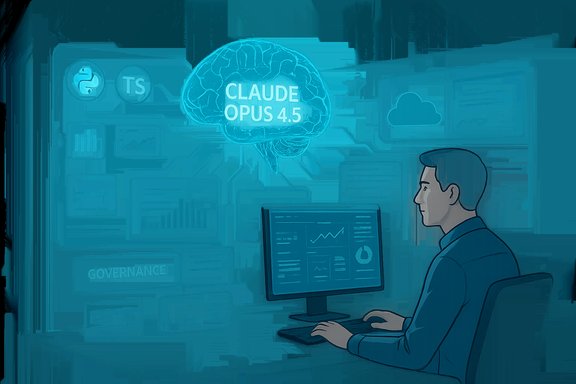 Background / Overview
Anthropic announced Claude Opus 4.5 on November 24, 2025, describing it as a hybrid reasoning model that advances coding, tool use, vision, and long-horizon agentic behavior. The company says Opus 4.5 delivers step-function improvements in developer productivity and agent reliability while reducing token consumption compared with prior Opus and Sonnet releases. Those claims are reflected across Anthropic’s product pages and the Microsoft messaging that surfaces Opus 4.5 inside Foundry and Copilot surfaces. Microsoft’s Azure Foundry integration makes Opus 4.5 available in public preview through Foundry’s serverless deployments and in GitHub Copilot paid plans and Copilot Studio. Foundry’s pitch is straightforward: give enterprises the widest selection of advanced and frontier models on a single platform, with unified governance, identity, observability, and billing inside an Azure tenancy. That integration is intended to reduce procurement friction and let IT teams route workloads to the model variant that best matches cost, latency, and capability requirements. This article examines the technical claims, practical implications, risks, and deployment considerations for Windows‑centric enterprises and engineering teams considering Claude Opus 4.5 on Microsoft Foundry. It cross-checks vendor claims against independent reporting, highlights where buyers should verify behavior in their own workloads, and outlines a practical path for pilot-to-production adoption.What Opus 4.5 claims to deliver
Claude Opus 4.5 is positioned as a model optimized for four linked areas:- Software engineering — long-horizon coding, multi-repo refactors, and test-driven code generation with improved multilingual coding performance and stronger test coverage. Anthropic reports new highs on internal engineering benchmarks (SWE-bench Verified: 80.9%).
- Agentic workflows — orchestrating multi-tool processes and long-running chains of reasoning, with programmatic tool calling and a focus on deterministic, reproducible executions.
- Computer use and office productivity — improved vision, spreadsheet and slide generation, and a better memory model for sustained projects across many files.
- Tool use at scale — searchable tool registries, better schema handling, and deterministic tool execution via Python callouts for agent orchestration.
How Microsoft Foundry packages Opus 4.5 for enterprises
Foundry’s value proposition
Microsoft Foundry is presented as an orchestration and delivery layer for multiple frontier models — not a single-source provider. Its core promises are:- Unified governance and observability across model choices.
- Serverless deployment of vendor-hosted models so teams can call endpoints without managing model runtime.
- Identity and billing integration, including eligibility for Microsoft Azure Consumption Commitment (MACC) mechanisms that simplify procurement for large organizations.
- SDK support for Python, TypeScript, and C#, enabling integration into existing CI/CD pipelines and agent frameworks.
Developer ergonomics and control knobs
Microsoft and Anthropic describe several engineering-oriented features aimed at operational predictability:- Effort Parameter (Beta) — tune how much computational “thinking” the model spends before answering to balance latency, cost, and quality.
- Compaction Control — SDK helpers that keep long-running agent contexts coherent and compact to avoid blowing context windows during extended sessions.
- Programmatic Tool Calling — deterministic tool execution reachable directly via Python, making agents less reliant on fragile textual tool invocation.
- Tool Search and schema-aware calling — dynamic discovery of tools so agents can find the right capability in large libraries without exhausting the context window.
Benchmark claims, verification, and what they mean in practice
Anthropic published internal benchmark numbers that position Opus 4.5 ahead of previous Opus and Sonnet models on a variety of tasks. Representative figures provided by Anthropic include:- SWE‑bench (agentic coding): 80.9% for Opus 4.5 vs 77.2% for Sonnet 4.5 and 74.5% for Opus 4.1.
- Terminal‑bench 2.0 (agentic terminal coding): 59.3% for Opus 4.5 vs 50.0% for Sonnet 4.5.
- Visual reasoning (MMMU): 80.7% for Opus 4.5.
- GPQA Diamond (graduate-level reasoning): 87.0% for Opus 4.5.
- Vendor benchmarks are valuable directional evidence — they indicate where the company has focused optimization.
- Benchmarks should be treated as vendor‑owned until reproduced in independent evaluations under representative workloads.
- For critical workloads (security, financial calculations, compliance sensitive code generation), in-house benchmarking with representative test suites is essential before trusting the model in production.
Reality check: what benchmarks don’t tell you
Benchmarks rarely capture the full production surface area: infrastructure latency, rate limits under burst load, tool‑integration edge cases, or how the model interacts with private data pipelines in an enterprise environment. They also do not automatically confer correctness guarantees for domain-specific business logic, regulatory compliance, or nondeterministic downstream systems. Put simply: benchmarks are a necessary signal, not a substitute for workload-specific validation.Pricing, availability, and procurement signals
Anthropic lists Opus 4.5 availability across its apps and APIs and in major cloud marketplaces, while Microsoft confirmed public preview access in Microsoft Foundry and in GitHub Copilot paid plans and Copilot Studio. Microsoft’s Foundry listing specifies serverless, pay‑as‑you‑go endpoints and regional availability options intended for enterprise deployments. Publicized price points announced with Opus 4.5 (vendor published) include a frontier-tier $5 per 1M tokens (input) and $25 per 1M tokens (output) for the Opus-level serverless offering. Pricing and region tables published at launch are vendor-declared and can change; procurement teams should confirm contractually with Azure Foundry marketplace listings and include cost‑control guardrails in billing alerts and monitoring. Key procurement notes for IT leaders:- If your organization has existing Azure Consumption Commitments (MACC), Opus usage through Foundry may be eligible to consume against those commitments, reducing procurement complexity.
- Pricing listed at launch is a reference point — careful cost modeling using your own token profiles (input vs output, average tokens per session, agent retries) is crucial to estimate TCO.
- Regions and data residency options vary; enterprises with strict data residency needs must check Foundry’s regional deployment map and any upcoming “US DataZone” options mentioned in vendor materials.
Practical enterprise use cases
Anthropic and Microsoft both highlight a set of enterprise use cases where Opus 4.5’s combination of agentic reasoning, tool use, and improved vision/memory is expected to have immediate value:- Software development: Autonomous agents that plan multi-repo refactors, write tests, and coordinate CI/CD changes with minimal human supervision.
- Financial analysis: Agents that synthesize SEC filings, internal datasets, and market research to produce predictive models and compliance-ready summaries.
- Cybersecurity: Systems that correlate logs, CVE feeds, and telemetry to automate incident response playbooks and orchestrate remediation across toolchains.
- Enterprise operations and knowledge work: Automated workflows that create and maintain spreadsheets, generate polished presentations, and manage long-running projects across teams.
Safety, governance, and security posture
Anthropic emphasizes advances in safety for Opus 4.5: reduced misaligned responses, stronger resistance to prompt injection, and more predictable behavior under complex instruction sets. Those internal safety improvements align with Microsoft’s requirement that Foundry-hosted models meet enterprise governance and compliance expectations. Important cautions for enterprise security teams:- Prompt injection remains a running risk: Vendor mitigations help, but any system that accepts arbitrary or user-supplied prompts must enforce robust input sanitation, rate limits, and policy enforcement layers.
- Tool-call isolation and least privilege: Agents that can execute tools must run under strict, auditable service principals and policy controls to prevent unauthorized actions.
- Data exfiltration and telemetry: Ensure telemetry and logging do not leak sensitive information into vendor-managed logs or cross-tenant telemetry — contractually validate data handling and retention policies with your cloud provider and Anthropic if using managed endpoints.
- Regulatory proof: For regulated industries, do not rely solely on vendor safety claims; validate through compliance tests that include adversarial prompts and realistic threat models.
Strengths and strategic upside
- Concrete enterprise integration: Having Opus 4.5 available inside Microsoft Foundry and GitHub Copilot reduces integration friction for organizations already committed to Azure, enabling faster experiments and more straightforward production routing.
- Agentic capability at scale: Programmatic tool calling and tool search features improve determinism and reduce brittle text-only tool invocation. That matters when agents must coordinate across hundreds of tools or services.
- Token efficiency and lower TCO potential: If Anthropic’s token-efficiency claims hold in representative workloads, the practical cost of agentic systems could fall materially, accelerating wider adoption.
- Developer productivity: Integration into GitHub Copilot and VS Code brings Opus-level capabilities directly into the IDE — a practical advantage for engineering velocity and adoption.
- Vendor momentum and capacity commitments: The broader Anthropic–Microsoft–NVIDIA alignments (reported compute purchase commitments and co‑engineering) signal long-term operational intent to scale these models on optimized hardware, which can translate to improved latency and TCO over time (subject to the normal caveats about staged investments).
Risks, limitations, and what to validate
- Vendor benchmarks vs. independent replication: Anthropic’s numbers are vendor-run evaluations. Independent benchmarking under your own workloads remains essential before trusting model outputs in mission-critical systems.
- Operational lock‑in: Running Opus via Foundry simplifies operations on Azure, but mixing model vendors and cloud providers creates architectural trade-offs. Plan BYOM (Bring Your Own Model) or multi-cloud fallbacks if vendor exclusivity is a concern.
- Contractual and financial complexity: Headlines about compute purchases and staged investments are strategic signals; the specific commercial terms, tranches, regions, and SLAs matter. Treat “up to” dollar figures and GW‑scale capacity statements as directional and verify contractually.
- Energy and infrastructure exposure: Large-scale model hosting ties into facility, power, and supply chains. Enterprises should watch for systemic dependencies that may affect availability or procurement in the future.
- Safety gaps for high-stakes domains: Even models with improved alignment can fail, hallucinate, or misapply regulatory constraints. For legal, clinical, or safety-critical workflows, combine model outputs with human review and deterministic checks.
Practical rollout checklist for IT and engineering teams
- Start with a bounded pilot:
- Define a narrow, high-value workflow (e.g., automated code refactor across a small subset of repos or spreadsheet generation for a specific finance process).
- Implement strict identity and permission boundaries for agent tool execution.
- Build a reproducible benchmark:
- Create a workload-specific test harness that measures correctness, latency, token usage, and tool-call determinism.
- Run comparisons across Opus 4.5, Sonnet 4.5, and your existing GPT-family baselines where appropriate.
- Validate safety and adversarial resilience:
- Run prompt‑injection tests, data‑exfiltration scenarios, and abuse-case simulations.
- Ensure logging, redaction, and policy triggers are active and audited.
- Model‑aware cost controls:
- Estimate tokens-per-session and set automated billing alerts; enable quotas and circuit breakers in production.
- Governance and audit:
- Bake agent decisions into traceable artifacts (plan.md, commit diffs, incident tickets).
- Maintain human-in-the-loop approval patterns for legally or financially consequential actions.
- Operational runbook:
- Define fallback modes (retries, human escalation, model switch).
- Instrument end-to-end tracing that links agent actions back to the originating user or service principal.
Where to be skeptical — and where to be opportunistic
Be skeptical of single-number headlines. Token-efficiency, benchmark wins, and pricing improvements are promising, but the real question is whether Opus 4.5 reduces cycle time, error rates, and operational toil for your specific workloads after accounting for governance, testing, and integration overhead.At the same time, be opportunistic about where Opus 4.5’s strengths map cleanly to automation value:
- Repetitive engineering tasks that are currently manual and rule-based (e.g., adding consistent logging wrappers, updating CI configs) are good early targets.
- Finance and reporting tasks where a model can synthesize across documents and spreadsheets and produce auditable outputs can unlock immediate productivity wins — provided outputs are validated against deterministic checks.
- Security playbooks that can be codified into agent workflows with strong isolation and logging can compress mean time to detect and mean time to remediate.
Conclusion
Claude Opus 4.5 arriving in Microsoft Foundry represents a practical step toward agentic AI systems that are easier for enterprises to deploy and govern. The technical advances Anthropic claims — stronger long-horizon reasoning, programmatic tool use, and token efficiency — combined with Foundry’s operational primitives (governance, billing, identity) create a realistic runway for production-grade agents.However, vendor benchmarks and grand infrastructure headlines require careful validation. Organizations that treat Opus 4.5 as a powerful new tool — but subject it to rigorous, workload-specific evaluation, safety testing, and cost modeling — will be best positioned to capture the productivity upside while keeping operational risk in check.
Source: Microsoft Azure Introducing Claude Opus 4.5 in Microsoft Foundry | Microsoft Azure Blog
