
Anthropic’s Claude chatbot suffered a widespread outage on Tuesday, June 23, 2026, affecting Claude.ai, Claude Code, mobile access, and multiple model endpoints as users reported failed chats, missing conversations, and elevated error rates across social platforms and outage trackers. The immediate story is not that one AI assistant had a bad day. It is that a growing class of workers now experiences an AI outage less like a website hiccup and more like a power cut. Claude’s failure exposed the new fragility of software work, where the assistant has become part search engine, part pair programmer, part memory system, and part build pipeline.
The language around AI outages still lags behind how people use these systems. A few years ago, a chatbot going down meant a consumer toy was unavailable. In 2026, when Claude stops responding, developers lose coding copilots, analysts lose drafting workflows, founders lose their ad hoc research assistant, and support teams lose a tool they may have quietly folded into daily operations.
That is why the social media reaction looked disproportionate only if Claude is treated as a normal website. Users posting “conversation not found” errors were not merely complaining that a web app failed to load. Many were staring at project context, prompts, notes, debugging trails, and partially completed work that had been trapped inside a remote service they do not control.
Claude Code made the outage feel sharper. Anthropic’s coding tool is no longer a novelty for people asking an assistant to explain a Python error; it has become a working layer for developers who delegate refactoring, test generation, documentation, and scaffolding. When that layer disappears mid-task, the developer still has the repository, but not necessarily the reasoning trail they had built with the assistant.
The most revealing jokes were the ones about “manual coding.” They were funny because they contained a little professional embarrassment. AI coding tools promised leverage, but outages remind users that leverage often comes with dependency, and dependency comes with operational risk.
The company’s incident history also suggests that June was not an isolated rough patch. Recent entries included elevated errors across multiple models, model-specific Opus 4.8 problems, and service disruption affecting Claude services. Some incidents were short. Others lasted longer. But to paying customers, especially those building workflows around Claude, frequency can matter as much as duration.
A five-minute outage is tolerable if it happens rarely and affects only a noncritical surface. A series of small failures across days becomes a different proposition when the service is being sold, adopted, and emotionally internalized as infrastructure. That is where AI vendors now find themselves: they are judged not only by model intelligence, but by the boring discipline of uptime.
The user-reported figures circulating around Downdetector sharpened that perception. Reports reportedly surged into the thousands, far above normal baseline levels. Downdetector is not a measurement of total affected users, and social media is not a controlled telemetry system, but both are useful signals of felt impact. When the spike is large and complaints cluster around the same symptoms, the incident has escaped the realm of isolated annoyance.
That proximity changes the risk model. A general-purpose chatbot outage interrupts a conversation. A coding-agent outage can interrupt a chain of work: issue triage, local debugging, CI failure analysis, documentation generation, and code review preparation. For teams that have started to treat AI assistance as a standard development accelerator, downtime becomes a capacity problem.
The obvious answer is “developers should still know how to code.” They should, and most do. But that misses the operational issue. If a team plans velocity around a tool, trains new habits around that tool, and embeds that tool into its development rituals, then the tool’s availability becomes part of the team’s effective throughput.
This is the same pattern enterprise IT has seen before. Email was once optional until it became the nervous system of the office. SaaS project trackers were once convenience layers until entire release processes depended on them. AI assistants are now moving through the same adoption curve, except faster and with fewer mature controls.
For individual users, the risk is simple: if Claude is where the context lives, Claude is where the bottleneck lives. A conversation history can feel like memory, but it is not the same as a local notebook, a checked-in design document, or a reproducible task log. When the service fails, the user learns which parts of their workflow were portable and which parts were merely rented.
For organizations, the problem is more complex. Many teams now use several AI systems informally, but informal redundancy is not the same as resilience. If employees improvise by jumping from Claude to ChatGPT to Gemini to Copilot, the organization may regain productivity while losing governance. Sensitive prompts may spread across vendors, access controls may vary, and auditability may vanish precisely when the pressure is highest.
The healthiest response is neither panic nor vendor lock-in. It is architectural realism. AI assistants should be treated like cloud dependencies: useful, powerful, monitored, and replaceable where possible. That means designing workflows where the model helps move work forward but does not become the only place where the work exists.
Anthropic had not, at the time of the reported outage coverage, offered a comprehensive public root-cause explanation for the June 23 disruption. That is not unusual. Vendors often wait until they have enough confidence before publishing a post-incident review. But the absence of detail leaves customers to infer patterns from symptoms, and inference tends to be unkind during a month with repeated incidents.
AI companies face a particular challenge here because their products are opaque by design. Users already struggle to distinguish model behavior from system behavior. Did Claude refuse a task because of policy? Did it slow down because of load? Did a conversation disappear because of an application bug, a routing error, or a backend outage? In a normal SaaS app, error boundaries are annoying. In an AI tool, they can feel uncanny.
Better incident communication will become a competitive feature. The winning AI providers will not merely say that systems are recovering; they will tell customers what degraded, what remained isolated, and what should be done differently next time. That is not just public relations. It is part of making AI acceptable as enterprise infrastructure.
That creates a familiar enterprise split. Consumer and small-team users get best-effort cloud access. Large customers get negotiated service terms, private deployments, priority capacity, and sharper escalation paths. The AI industry may talk about democratizing intelligence, but reliability usually follows money, regulation, and procurement power.
There is nothing inherently wrong with that. Critical users often need stronger guarantees. A public-sector deployment handling sensitive tasks should not necessarily share every failure domain with a consumer chatbot. But the optics are tricky when independent developers and startups are also building serious work on the public service tier.
If Anthropic wants Claude Code to be trusted as a professional tool, it has to make the reliability story legible beyond the top of the market. Developers do not need perfect uptime; no serious person expects that. They need predictable degradation, transparent failure modes, local escape hatches, and confidence that a bad morning will not strand their work.
Models are not interchangeable in practice. Teams tune prompts around a provider’s strengths. Developers learn how one assistant handles large codebases, long context, test failures, and shell commands. Writers learn its tone. Analysts learn its blind spots. Switching tools during an outage is possible, but it carries friction that does not show up in a status dashboard.
There is also the governance issue. Microsoft Copilot may be the preferred fallback inside a Microsoft 365-heavy enterprise because identity, compliance, and data boundaries are already negotiated. A startup may prefer API-level abstraction across multiple providers. A solo developer may simply paste a failing prompt into whichever service is online. Each approach solves one problem while creating another.
The right lesson is not that every organization should maintain five AI subscriptions and let employees choose in the moment. The right lesson is that AI continuity planning needs to exist before the outage. If the first fallback conversation happens on social media while the service is already down, the organization is improvising.
AI assistants are joining that web, but they are entering through side doors. They are adopted by developers before procurement notices, by analysts before compliance has a policy, and by executives before IT has telemetry. The result is a shadow productivity layer that can be critical without being formally managed.
That matters for Windows environments because Copilot, Visual Studio Code extensions, GitHub tooling, browser-based AI, and third-party agents increasingly live on the same desktops and developer workstations. If an AI tool becomes part of the workflow, endpoint management alone is not enough. Admins need to know which tools are approved, which data can be pasted into them, and what happens when they fail.
The outage also intersects with security. Users under deadline pressure will look for alternatives. They may install unvetted extensions, paste proprietary code into unmanaged chatbots, or route work through personal accounts. A provider outage can therefore become a data-governance incident, not because the provider leaked anything, but because the organization never defined safe fallback behavior.
Reliability in AI is harder than reliability in many older SaaS categories. Model serving is compute-intensive. Demand is bursty. New model releases can change traffic patterns overnight. Features like agents, code execution, file analysis, memory, and tool use add more moving parts than a simple chat endpoint.
That complexity does not excuse poor availability. It explains why the industry’s reliability posture is still maturing. The cloud giants took years to build the operational muscle customers now expect; AI labs are being asked to do the same while simultaneously shipping frontier models, safety systems, enterprise products, coding agents, and consumer apps at breakneck speed.
The vendors that win enterprise trust will be the ones that treat uptime, transparency, and graceful degradation as product features. If an AI assistant cannot answer, can it still show prior conversations? If the top model is impaired, can the service route to a lower-tier model with clear disclosure? If a coding agent cannot complete a task, can it export its plan and state so work can continue elsewhere? These are not luxuries. They are the difference between a clever assistant and dependable infrastructure.
But productivity debt is real too. If users stop writing durable notes because the chat history feels durable enough, they are borrowing against the provider’s uptime. If developers rely on the assistant to remember why a change was made, they are moving institutional memory into a private transcript. If managers assume AI acceleration in their planning but do not account for downtime, they are building schedules on an unpriced dependency.
The solution is not to abandon AI. That would be as unrealistic as abandoning cloud storage after a sync outage. The solution is to decide which parts of the workflow deserve local persistence, which tasks can tolerate interruption, and which ones need vendor diversity or contractual guarantees.
For developers, that may mean committing AI-generated plans into issue trackers, keeping architectural decisions in repositories, and using assistants as accelerators rather than sole custodians of context. For admins, it means treating AI access as part of business continuity planning. For vendors, it means accepting that customers now judge them by operational maturity as much as model brilliance.
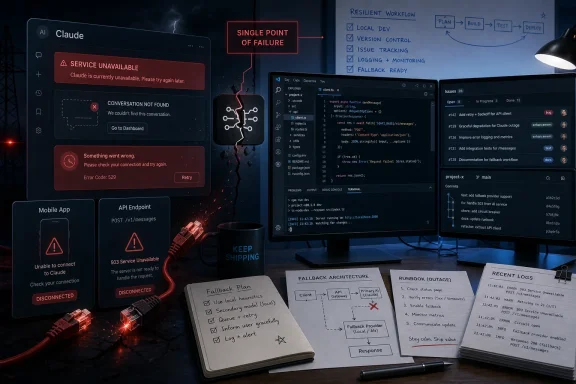 Claude’s Outage Was a Productivity Incident, Not Just a Chatbot Glitch
The language around AI outages still lags behind how people use these systems. A few years ago, a chatbot going down meant a consumer toy was unavailable. In 2026, when Claude stops responding, developers lose coding copilots, analysts lose drafting workflows, founders lose their ad hoc research assistant, and support teams lose a tool they may have quietly folded into daily operations.That is why the social media reaction looked disproportionate only if Claude is treated as a normal website. Users posting “conversation not found” errors were not merely complaining that a web app failed to load. Many were staring at project context, prompts, notes, debugging trails, and partially completed work that had been trapped inside a remote service they do not control.
Claude Code made the outage feel sharper. Anthropic’s coding tool is no longer a novelty for people asking an assistant to explain a Python error; it has become a working layer for developers who delegate refactoring, test generation, documentation, and scaffolding. When that layer disappears mid-task, the developer still has the repository, but not necessarily the reasoning trail they had built with the assistant.
The most revealing jokes were the ones about “manual coding.” They were funny because they contained a little professional embarrassment. AI coding tools promised leverage, but outages remind users that leverage often comes with dependency, and dependency comes with operational risk.
Anthropic’s Status Page Told a Narrower Story Than Users Did
Official status pages are designed to classify incidents, not narrate disruption. Anthropic’s public tracker showed elevated errors across models and components during a period when users were reporting broader access trouble. That distinction matters: a vendor can accurately describe an incident in terms of error rates while users experience the same incident as a hard stop.The company’s incident history also suggests that June was not an isolated rough patch. Recent entries included elevated errors across multiple models, model-specific Opus 4.8 problems, and service disruption affecting Claude services. Some incidents were short. Others lasted longer. But to paying customers, especially those building workflows around Claude, frequency can matter as much as duration.
A five-minute outage is tolerable if it happens rarely and affects only a noncritical surface. A series of small failures across days becomes a different proposition when the service is being sold, adopted, and emotionally internalized as infrastructure. That is where AI vendors now find themselves: they are judged not only by model intelligence, but by the boring discipline of uptime.
The user-reported figures circulating around Downdetector sharpened that perception. Reports reportedly surged into the thousands, far above normal baseline levels. Downdetector is not a measurement of total affected users, and social media is not a controlled telemetry system, but both are useful signals of felt impact. When the spike is large and complaints cluster around the same symptoms, the incident has escaped the realm of isolated annoyance.
Claude Code Turned the Outage Into a Developer Story
Claude’s consumer interface may generate the most visible frustration, but Claude Code is why this outage belongs on the radar of sysadmins and engineering managers. Coding agents sit closer to production work than general chatbots do. They operate in repositories, reason across files, suggest command-line actions, and sometimes become part of how teams move tickets from idea to pull request.That proximity changes the risk model. A general-purpose chatbot outage interrupts a conversation. A coding-agent outage can interrupt a chain of work: issue triage, local debugging, CI failure analysis, documentation generation, and code review preparation. For teams that have started to treat AI assistance as a standard development accelerator, downtime becomes a capacity problem.
The obvious answer is “developers should still know how to code.” They should, and most do. But that misses the operational issue. If a team plans velocity around a tool, trains new habits around that tool, and embeds that tool into its development rituals, then the tool’s availability becomes part of the team’s effective throughput.
This is the same pattern enterprise IT has seen before. Email was once optional until it became the nervous system of the office. SaaS project trackers were once convenience layers until entire release processes depended on them. AI assistants are now moving through the same adoption curve, except faster and with fewer mature controls.
The “Single Point of Failure” Critique Is Finally Landing
Acurast’s opportunistic post about decentralized compute was marketing, but the underlying argument is not silly. If a knowledge worker’s day can be derailed by one AI provider’s availability, that provider has become a single point of failure. The industry should be honest about that, even if “decentralized AI” is not a magic cure.For individual users, the risk is simple: if Claude is where the context lives, Claude is where the bottleneck lives. A conversation history can feel like memory, but it is not the same as a local notebook, a checked-in design document, or a reproducible task log. When the service fails, the user learns which parts of their workflow were portable and which parts were merely rented.
For organizations, the problem is more complex. Many teams now use several AI systems informally, but informal redundancy is not the same as resilience. If employees improvise by jumping from Claude to ChatGPT to Gemini to Copilot, the organization may regain productivity while losing governance. Sensitive prompts may spread across vendors, access controls may vary, and auditability may vanish precisely when the pressure is highest.
The healthiest response is neither panic nor vendor lock-in. It is architectural realism. AI assistants should be treated like cloud dependencies: useful, powerful, monitored, and replaceable where possible. That means designing workflows where the model helps move work forward but does not become the only place where the work exists.
Status Pages Are Not Postmortems
One of the subtle frustrations in AI outages is the gap between incident updates and explanations. “Investigating,” “identified,” “monitoring,” and “resolved” are useful operational states, but they rarely answer the questions enterprise customers care about. What failed? Which products were affected? Was data at risk? Was the incident caused by model serving capacity, deployment regression, authentication, routing, storage, or upstream infrastructure?Anthropic had not, at the time of the reported outage coverage, offered a comprehensive public root-cause explanation for the June 23 disruption. That is not unusual. Vendors often wait until they have enough confidence before publishing a post-incident review. But the absence of detail leaves customers to infer patterns from symptoms, and inference tends to be unkind during a month with repeated incidents.
AI companies face a particular challenge here because their products are opaque by design. Users already struggle to distinguish model behavior from system behavior. Did Claude refuse a task because of policy? Did it slow down because of load? Did a conversation disappear because of an application bug, a routing error, or a backend outage? In a normal SaaS app, error boundaries are annoying. In an AI tool, they can feel uncanny.
Better incident communication will become a competitive feature. The winning AI providers will not merely say that systems are recovering; they will tell customers what degraded, what remained isolated, and what should be done differently next time. That is not just public relations. It is part of making AI acceptable as enterprise infrastructure.
Government Isolation Hints at the Shape of Premium Resilience
Reports that Claude for Government or government-oriented infrastructure remained functional while other users struggled should be treated carefully unless Anthropic confirms the exact architecture and scope. Still, the claim points toward an important future: not all AI availability will be equal. Segmented environments, dedicated capacity, contractual uptime, and government-grade isolation are likely to become selling points.That creates a familiar enterprise split. Consumer and small-team users get best-effort cloud access. Large customers get negotiated service terms, private deployments, priority capacity, and sharper escalation paths. The AI industry may talk about democratizing intelligence, but reliability usually follows money, regulation, and procurement power.
There is nothing inherently wrong with that. Critical users often need stronger guarantees. A public-sector deployment handling sensitive tasks should not necessarily share every failure domain with a consumer chatbot. But the optics are tricky when independent developers and startups are also building serious work on the public service tier.
If Anthropic wants Claude Code to be trusted as a professional tool, it has to make the reliability story legible beyond the top of the market. Developers do not need perfect uptime; no serious person expects that. They need predictable degradation, transparent failure modes, local escape hatches, and confidence that a bad morning will not strand their work.
The Alternative Stack Is Not as Simple as “Use ChatGPT Instead”
During the outage, users predictably shifted to ChatGPT, Gemini, Microsoft Copilot, Perplexity, and other tools. That is sensible for ad hoc drafting or general research. It is less simple for deep work that depends on accumulated context, model-specific habits, tool integrations, and enterprise policy.Models are not interchangeable in practice. Teams tune prompts around a provider’s strengths. Developers learn how one assistant handles large codebases, long context, test failures, and shell commands. Writers learn its tone. Analysts learn its blind spots. Switching tools during an outage is possible, but it carries friction that does not show up in a status dashboard.
There is also the governance issue. Microsoft Copilot may be the preferred fallback inside a Microsoft 365-heavy enterprise because identity, compliance, and data boundaries are already negotiated. A startup may prefer API-level abstraction across multiple providers. A solo developer may simply paste a failing prompt into whichever service is online. Each approach solves one problem while creating another.
The right lesson is not that every organization should maintain five AI subscriptions and let employees choose in the moment. The right lesson is that AI continuity planning needs to exist before the outage. If the first fallback conversation happens on social media while the service is already down, the organization is improvising.
Windows Shops Should Recognize This Movie
For WindowsForum readers, the Claude outage should feel familiar. The modern Windows estate is already a web of cloud identity, endpoint security, update channels, device management, collaboration tools, and SaaS dependencies. Admins have spent years learning that productivity now depends on services well outside the local machine.AI assistants are joining that web, but they are entering through side doors. They are adopted by developers before procurement notices, by analysts before compliance has a policy, and by executives before IT has telemetry. The result is a shadow productivity layer that can be critical without being formally managed.
That matters for Windows environments because Copilot, Visual Studio Code extensions, GitHub tooling, browser-based AI, and third-party agents increasingly live on the same desktops and developer workstations. If an AI tool becomes part of the workflow, endpoint management alone is not enough. Admins need to know which tools are approved, which data can be pasted into them, and what happens when they fail.
The outage also intersects with security. Users under deadline pressure will look for alternatives. They may install unvetted extensions, paste proprietary code into unmanaged chatbots, or route work through personal accounts. A provider outage can therefore become a data-governance incident, not because the provider leaked anything, but because the organization never defined safe fallback behavior.
Reliability Is the New Model Benchmark
AI discourse still obsesses over leaderboard performance, context windows, coding scores, and whether one model beats another on a carefully chosen benchmark. Those measures matter, but outages reveal a harsher truth. The best model is not the best tool if it is unavailable when the work is due.Reliability in AI is harder than reliability in many older SaaS categories. Model serving is compute-intensive. Demand is bursty. New model releases can change traffic patterns overnight. Features like agents, code execution, file analysis, memory, and tool use add more moving parts than a simple chat endpoint.
That complexity does not excuse poor availability. It explains why the industry’s reliability posture is still maturing. The cloud giants took years to build the operational muscle customers now expect; AI labs are being asked to do the same while simultaneously shipping frontier models, safety systems, enterprise products, coding agents, and consumer apps at breakneck speed.
The vendors that win enterprise trust will be the ones that treat uptime, transparency, and graceful degradation as product features. If an AI assistant cannot answer, can it still show prior conversations? If the top model is impaired, can the service route to a lower-tier model with clear disclosure? If a coding agent cannot complete a task, can it export its plan and state so work can continue elsewhere? These are not luxuries. They are the difference between a clever assistant and dependable infrastructure.
The Real Risk Is Invisible Until the Assistant Vanishes
The most dangerous dependencies are the ones that feel like convenience until they fail. Claude’s outage made visible how much cognitive work users had shifted into a remote system. Some of that shift is rational. AI tools really can accelerate routine coding, summarize noisy documents, and turn half-formed ideas into usable drafts. The productivity gains are not imaginary.But productivity debt is real too. If users stop writing durable notes because the chat history feels durable enough, they are borrowing against the provider’s uptime. If developers rely on the assistant to remember why a change was made, they are moving institutional memory into a private transcript. If managers assume AI acceleration in their planning but do not account for downtime, they are building schedules on an unpriced dependency.
The solution is not to abandon AI. That would be as unrealistic as abandoning cloud storage after a sync outage. The solution is to decide which parts of the workflow deserve local persistence, which tasks can tolerate interruption, and which ones need vendor diversity or contractual guarantees.
For developers, that may mean committing AI-generated plans into issue trackers, keeping architectural decisions in repositories, and using assistants as accelerators rather than sole custodians of context. For admins, it means treating AI access as part of business continuity planning. For vendors, it means accepting that customers now judge them by operational maturity as much as model brilliance.
The June 23 Claude Failure Leaves a Practical Checklist Behind
The useful response to this outage is not outrage; it is inventory. Teams should use the incident to map where AI has become load-bearing, where context is trapped, and where fallback behavior is undefined. That exercise will matter more as coding agents, autonomous workflows, and enterprise copilots move from optional assistants to default interfaces.- Organizations should identify which AI services employees are using for production work and decide which ones are approved for sensitive data.
- Teams should keep important project context in durable systems such as repositories, ticket trackers, documentation platforms, or local notes rather than only in chatbot histories.
- Developers who rely on Claude Code or similar tools should define a fallback path for coding assistance, including what can safely move to another provider.
- IT departments should treat AI outages as business-continuity events when the tools are embedded in daily workflows.
- Vendors should publish clearer post-incident explanations that distinguish model degradation, application failures, authentication trouble, and data-access problems.
- Buyers should evaluate AI tools not only by benchmark performance, but by uptime history, exportability, administrative controls, and incident transparency.
References
- Primary source: LatestLY
Published: 2026-06-23T16:40:28.532566
Claude Down: Anthropic’s Chatbot Experiences Global Outage; Frustrated Users Report Errors on Social Media | 👍 LatestLY
Anthropic’s Claude AI experienced a significant service outage on 23 June, with Downdetector recording over 6,700 user reports. The disruption impacted the chat interface, mobile app, and coding tools, though government-dedicated infrastructure remained operational. Anthropic has not yet...www.latestly.com
- Official source: status.claude.com

Claude Status
Welcome to Claude's home for real-time and historical data on system performance.
status.claude.com
- Related coverage: moneycontrol.com
Claude AI down: Thousands of users are facing issues with Anthropic's AI chatbot
Anthropic's Claude AI platform experienced a significant outage on June 16, 2026, with over 1,200 user reports flooding in within minutes. Claude Code and Claude Chat were the most affected services.www.moneycontrol.com - Related coverage: serisec.com
- Related coverage: techradar.com
Claude is down for many — here's what we know about the outage | TechRadar
Anthropic has confirmed the "partial outage"www.techradar.com - Related coverage: techtimes.com
Claude Outage: Tenth Disruption in 12 Days Exposes Anthropic Infrastructure Strain
Claude outage on June 16, 2026 marks the tenth significant service disruption since June 5, with Opus 4.8 and Haiku 4.5 errors persisting despite a fix attempt at 2:00 PM ET. Anthropic haswww.techtimes.com
- Related coverage: techcrunch.com
Anthropic's Claude reports widespread outage | TechCrunch
Anthropic's AI chatbot Claude experienced widespread service disruptions on Monday morning, with thousands of users reporting issues accessing the bot.techcrunch.com - Related coverage: statusgator.com
Anthropic Status. Check if Anthropic is down or having an outage. | StatusGator
Anthropic down? Check the current Anthropic status right now, learn about outages, downtime, incidents, and issues.statusgator.com - Related coverage: status.c3.la
C3 Systems & Security - Service Monitoring - Anthropic
Get the latest status updates - Check the latest Anthropic incidents and outage.status.c3.la
- Related coverage: androidauthority.com
Claude AI is back following service outage (Update)
Claude AI was 'experiencing elevated error rates' this morning, with many users unable to access the chatbot.www.androidauthority.com - Related coverage: tomsguide.com
Claude was down — Live updates on the outage that hit Anthropic AI services | Tom's Guide
Looks like the popular AI tool was having issueswww.tomsguide.com - Related coverage: itpro.com
Anthropic’s Claude AI chatbot is down as company confirms ‘elevated error rates’ for Opus 4.5 and Sonnet 4.5 | IT Pro
Users of Anthropic's Claude Sonnet 4.5 and Opus 4.5 models are being met with "elevated error rates".www.itpro.com - Related coverage: issuewire.com
- Related coverage: caloes.ca.gov