

Microsoft made Anthropic’s Claude Sonnet 5 generally available in Microsoft Foundry on July 1, 2026, giving Azure enterprise customers access to Anthropic’s newest Sonnet-class model for production AI applications across coding, agents, document work, analysis, and workflow automation. The move is less about adding another shiny model tile than about tightening Azure’s claim to be the control plane for enterprise AI. Microsoft is telling customers they can shop across frontier labs without leaving its governance, identity, billing, and network perimeter. That is the real product.
The headline says Claude Sonnet 5 has arrived in Foundry, but the strategic story is that Microsoft wants the model layer to feel interchangeable. For years, Azure’s enterprise pitch has been control: identity through Entra, permissions through Azure role-based access control, network isolation, policy, logging, compliance, and procurement. Foundry now applies that same pattern to the most volatile layer of modern software: the AI model itself.
That matters because enterprise AI buyers are no longer evaluating models as isolated demos. They are asking whether a model can be deployed into a governed application stack, whether usage can be audited, whether spend can be forecast, whether data routing is understandable, and whether developers can swap models without rebuilding the entire system. In that world, Microsoft does not need every customer to use a Microsoft-made model. It needs every customer to use Azure as the place where model decisions happen.
Claude Sonnet 5 fits neatly into that argument. Anthropic’s Sonnet line has long occupied the practical middle of its portfolio: more capable than lightweight models, less expensive and generally less scarce than the highest-end flagship class. By bringing the newest Sonnet into Foundry immediately, Microsoft is positioning Azure not as a lagging catalog but as a first-class distribution channel for models enterprises actually want to test.
The timing also reveals how quickly the AI platform business has changed. Model announcements once looked like standalone events, with labs showing benchmark charts and developers rushing to API consoles. Now the important question is where the model lands on day one. Availability inside Foundry, Bedrock, Vertex, GitHub tools, coding environments, and enterprise automation platforms can matter almost as much as the model card.
For developers, the pitch is straightforward. Sonnet 5 is meant to handle larger codebases, multi-file changes, debugging sessions, refactoring projects, and implementation work with fewer correction cycles. That is the kind of workload where a model’s quality is not measured only by whether it can write a clever function. It is measured by whether it can keep a plan in its head, inspect surrounding context, avoid breaking adjacent code, and recover when a tool call fails.
For IT departments, that difference is enormous. A chatbot that produces a useful answer is a productivity tool. An agent that edits repositories, updates tickets, calls internal APIs, and writes production-adjacent artifacts is infrastructure. The more autonomy the model gets, the more enterprises care about access control, observability, quota management, and failure boundaries.
This is why Foundry is the more important half of the announcement. Microsoft is not merely saying, “Here is Claude.” It is saying, “Here is Claude inside the same enterprise machinery you already use to govern cloud workloads.” That is a stronger proposition than raw benchmark bragging because most companies do not fail at AI adoption because they cannot find a powerful model. They fail because they cannot operationalize one safely.
Microsoft’s documentation now distinguishes Claude models hosted on Azure from Claude models hosted on Anthropic infrastructure, and that distinction is not cosmetic. For regulated customers, the physical and contractual path of data matters. A model being available in Foundry does not automatically mean every deployment option has the same residency, compliance, or operational profile.
That nuance is important for WindowsForum’s core audience because sysadmins and cloud architects often inherit the consequences of enthusiastic AI pilots. A developer may see one endpoint and one SDK. The platform team sees identity boundaries, private networking, data retention questions, logging requirements, cost allocation, incident response, and whether the model is available in the regions the business is allowed to use.
Claude Sonnet 5 arriving as generally available on Azure-hosted infrastructure is therefore more than a checkbox. It gives enterprises a path to use Anthropic’s model while keeping more of the operational surface inside Azure’s standard governance envelope. That does not eliminate risk, but it makes the risk legible to the teams responsible for managing it.
That matters because token pricing is one of the few AI costs that can still surprise otherwise mature cloud teams. A proof of concept that looks cheap at small volume can become expensive when connected to document processing, code review, customer support, or agentic workflows that call tools repeatedly. Output tokens are especially important because agents often produce traces, intermediate reasoning artifacts, summaries, reports, and code patches that inflate consumption.
The promotional window gives teams a chance to benchmark Sonnet 5 against Sonnet 4.6, Claude Opus-class models, OpenAI models, Gemini models, and open-weight alternatives under realistic conditions. The smart buyers will not ask only which model gives the best answer in a demo. They will ask which model produces the lowest total cost per successful task.
That distinction is subtle but crucial. A cheaper model that needs three retries may cost more than a pricier model that gets the job done once. An agent that maintains context and recovers from tool failures may save money even if its per-token price is not the lowest. Conversely, a capable model can become financially unattractive if teams let it run without budget controls, caching discipline, and output limits.
But enterprise adoption will turn on less glamorous details. If Sonnet 5 is used inside build systems, developer portals, internal automation agents, or security review workflows, administrators will need to decide who can deploy it, who can call it, what data can be sent to it, and how failures are handled. The same model that helps one team refactor a service could accidentally become a shadow integration layer for another team’s sensitive data.
Microsoft’s advantage is that Azure customers already have a vocabulary for these controls. They know how to think about subscriptions, resource groups, managed identities, private endpoints, logging, quota requests, and marketplace procurement. Foundry does not make AI simple, but it makes it resemble the rest of enterprise cloud management.
That resemblance is valuable. The worst version of enterprise AI is a sprawling set of unmanaged API keys scattered across developer laptops, CI pipelines, SaaS tools, and departmental pilots. Foundry offers a more centralized path: models as governed cloud resources rather than secrets pasted into scripts.
Foundry’s model catalog is Microsoft’s answer to that uncertainty. If customers believe they can access OpenAI, Anthropic, Meta, Mistral, Cohere, and other models through a common enterprise platform, they are less likely to leave Azure to chase whichever lab is winning this quarter. Microsoft can let model competition happen above the platform while still capturing the platform relationship.
This is a classic cloud move. Azure does not need to own every database engine, Linux distribution, observability tool, or AI framework to make money from them. It needs to make Azure the default place enterprises run them. Foundry extends that logic to AI models.
For Anthropic, the arrangement is equally pragmatic. Enterprise distribution is hard, especially for customers with compliance requirements and existing Microsoft commitments. Being inside Foundry puts Claude in front of buyers who may not want to establish a separate vendor relationship or route sensitive workloads through a standalone platform before legal and security teams are comfortable.
That is not a contradiction. It is an insurance policy. Enterprises increasingly expect model optionality, and Microsoft would rather provide that optionality than watch customers build it elsewhere. If a CIO wants to compare GPT, Claude, Gemini, and open models for a regulated workflow, Microsoft wants that comparison to happen in Foundry, not in a rival cloud console or a patchwork of direct APIs.
This also changes the meaning of Microsoft’s AI platform. Azure AI is no longer merely the cloud wrapper around Microsoft’s preferred model partnerships. It is becoming a broker, marketplace, governance layer, and deployment fabric for a fragmented AI supply chain. The more fragmented the model market becomes, the more valuable that broker role can be.
There is a catch, of course. A broad catalog can become confusing. If Microsoft wants Foundry to be more than a model supermarket, it needs to help customers understand tradeoffs: hosted-on-Azure versus hosted-on-partner infrastructure, preview versus general availability, regional constraints, rate limits, supported APIs, safety behavior, and cost structures. Choice is powerful only when buyers can reason about it.
The enterprise AI market will not be won only by spectacular demos of autonomous agents booking trips or solving puzzle benchmarks. It will be won by models that can reliably reduce friction in mundane work. The spreadsheet that needs cleanup, the report that needs synthesis, the pull request that needs review, the support ticket that needs triage, the policy document that needs summarizing — these are the places where AI either becomes infrastructure or remains a novelty.
Sonnet 5’s stated emphasis on incremental reasoning and self-verification speaks directly to this reality. In business workflows, a plausible answer is often worse than no answer. A model that drafts a financial review, updates a spreadsheet, or summarizes compliance material must be able to check its own work and expose uncertainty, not just produce confident prose.
Still, enterprises should be careful with the phrase self-verification. It does not mean the model has become a trustworthy auditor of itself. It means the model may be better at breaking work into steps, checking intermediate outputs, and correcting obvious errors. Human review, deterministic validation, logging, and business-rule enforcement remain essential.
A coding assistant that suggests a patch is one thing. An agent that creates branches, modifies files, opens pull requests, updates tickets, and posts status messages is another. A finance assistant that summarizes spreadsheets is one thing. An agent that pulls data from systems, transforms it, drafts analysis, and routes it to executives is a very different governance problem.
This is where Microsoft’s enterprise plumbing matters more than model personality. The real question is not whether Claude can call tools. It is whether organizations can constrain which tools it calls, under whose identity, with what permissions, and with what observable record. If the answer is vague, the organization is not ready to treat agents as production systems.
Foundry’s role is to make these patterns more manageable, but it cannot supply judgment. Administrators still need to design boundaries. Developers still need to write safe tool interfaces. Security teams still need to threat-model prompt injection, data exfiltration, unauthorized actions, and model-driven automation errors. The model may be new, but the discipline is old.
If Sonnet 5 proves useful for document creation, presentations, spreadsheet analysis, and research tasks, customers will naturally ask where it belongs relative to Microsoft’s own Copilot stack. Microsoft will have to balance two instincts: protecting the value of its first-party Copilot experiences while letting Azure remain an open platform for model choice.
That tension may become more visible over time. A customer might want Claude for code review, GPT for Teams summarization, a small open model for internal classification, and a domain-specific model for legal documents. The platform that makes those choices manageable has leverage. The product suite that hides those choices has convenience.
For Windows administrators, the practical takeaway is to stop thinking of AI as one application rollout. It is becoming a cross-cutting dependency. Identity policy, endpoint security, data governance, developer tooling, SaaS integrations, and cloud cost management will all touch it.
Some customers will care most about whether Sonnet 5 is hosted on Azure infrastructure end to end. Others will care about whether Anthropic-hosted options are available in their region or under their procurement model. Still others will discover that their subscription type, billing setup, or marketplace permissions are the first obstacle, not model performance.
Rate limits deserve particular attention. Early pilots often run comfortably within default quotas, but production agents can generate bursts of requests and large input-token loads. Long-context coding and document workflows can be especially hungry because they send large repositories, file sets, or document collections into the model. If a team does not understand the quota model before launch, the first real user wave can look like a mysterious reliability problem.
This is where IT pros should be skeptical of smooth launch language. “Available immediately” does not mean “deployable everywhere, for everyone, at any scale, under every compliance requirement.” It means the service is generally available under specified conditions. The gap between those two meanings is where many enterprise rollouts either succeed quietly or stall in a ticket queue.
Prompt injection is the clearest example. If an agent reads untrusted content — a web page, document, email, ticket, issue comment, or repository file — that content can attempt to manipulate the agent’s instructions. A model that can merely summarize may produce a bad summary. A model that can use tools may take an unauthorized action.
Sonnet 5’s stronger tool use and multi-step reliability are therefore double-edged. The same improvements that help it complete useful workflows can help it follow maliciously planted instructions unless developers isolate tools, validate actions, and separate trusted instructions from untrusted data. The industry has not solved this problem by making models smarter.
Enterprises should treat model deployment as part of application security, not as a procurement decision. The controls around the model — identity, tool design, input filtering, output validation, human approval gates, logging, and rollback — are the difference between a helpful assistant and an unbounded automation layer.
Claude Sonnet 5 may be impressive, but the reason it matters inside Foundry is that it becomes part of a familiar enterprise motion. A team can request access, deploy a model, assign permissions, monitor usage, route billing, and integrate it into an Azure-based application. The work is still complex, but it fits into known organizational machinery.
That is how new technologies become normal. Virtual machines, containers, serverless functions, and managed databases all passed through a similar phase. The excitement lived in the capability; the adoption lived in the control plane. AI is following the same path, only faster and with higher stakes.
Microsoft understands this better than almost anyone. Its customers do not merely want the best model. They want a defensible way to use whichever model is best enough for the job, inside the governance structures they already trust. Foundry is Microsoft’s attempt to own that defensible layer.
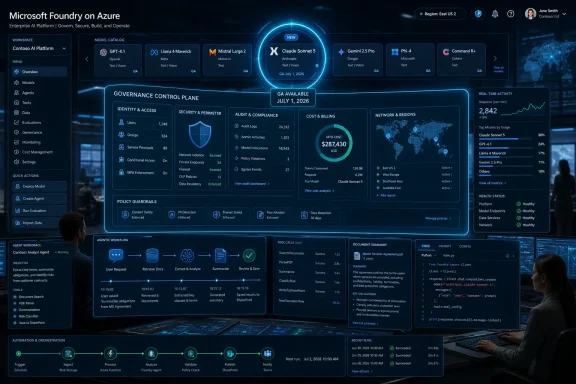 Microsoft Turns Model Choice Into an Azure Feature
The headline says Claude Sonnet 5 has arrived in Foundry, but the strategic story is that Microsoft wants the model layer to feel interchangeable. For years, Azure’s enterprise pitch has been control: identity through Entra, permissions through Azure role-based access control, network isolation, policy, logging, compliance, and procurement. Foundry now applies that same pattern to the most volatile layer of modern software: the AI model itself.That matters because enterprise AI buyers are no longer evaluating models as isolated demos. They are asking whether a model can be deployed into a governed application stack, whether usage can be audited, whether spend can be forecast, whether data routing is understandable, and whether developers can swap models without rebuilding the entire system. In that world, Microsoft does not need every customer to use a Microsoft-made model. It needs every customer to use Azure as the place where model decisions happen.
Claude Sonnet 5 fits neatly into that argument. Anthropic’s Sonnet line has long occupied the practical middle of its portfolio: more capable than lightweight models, less expensive and generally less scarce than the highest-end flagship class. By bringing the newest Sonnet into Foundry immediately, Microsoft is positioning Azure not as a lagging catalog but as a first-class distribution channel for models enterprises actually want to test.
The timing also reveals how quickly the AI platform business has changed. Model announcements once looked like standalone events, with labs showing benchmark charts and developers rushing to API consoles. Now the important question is where the model lands on day one. Availability inside Foundry, Bedrock, Vertex, GitHub tools, coding environments, and enterprise automation platforms can matter almost as much as the model card.
The Sonnet Upgrade Is Really an Agent Bet
Microsoft and Anthropic are both framing Claude Sonnet 5 around agentic work: coding, tool use, multi-step execution, workflow automation, and long-running enterprise tasks. That language can sound like marketing fog, but it points to a real shift in how companies are trying to use AI. The target is no longer just better chat. It is delegated work.For developers, the pitch is straightforward. Sonnet 5 is meant to handle larger codebases, multi-file changes, debugging sessions, refactoring projects, and implementation work with fewer correction cycles. That is the kind of workload where a model’s quality is not measured only by whether it can write a clever function. It is measured by whether it can keep a plan in its head, inspect surrounding context, avoid breaking adjacent code, and recover when a tool call fails.
For IT departments, that difference is enormous. A chatbot that produces a useful answer is a productivity tool. An agent that edits repositories, updates tickets, calls internal APIs, and writes production-adjacent artifacts is infrastructure. The more autonomy the model gets, the more enterprises care about access control, observability, quota management, and failure boundaries.
This is why Foundry is the more important half of the announcement. Microsoft is not merely saying, “Here is Claude.” It is saying, “Here is Claude inside the same enterprise machinery you already use to govern cloud workloads.” That is a stronger proposition than raw benchmark bragging because most companies do not fail at AI adoption because they cannot find a powerful model. They fail because they cannot operationalize one safely.
Foundry Becomes the Place Where AI Risk Is Contained
Enterprise buyers like model choice until choice becomes another governance problem. Every new model brings new terms, new data-handling questions, new billing mechanics, new regional constraints, and new operational failure modes. Foundry’s value is that it tries to compress those differences into a familiar Azure deployment pattern.Microsoft’s documentation now distinguishes Claude models hosted on Azure from Claude models hosted on Anthropic infrastructure, and that distinction is not cosmetic. For regulated customers, the physical and contractual path of data matters. A model being available in Foundry does not automatically mean every deployment option has the same residency, compliance, or operational profile.
That nuance is important for WindowsForum’s core audience because sysadmins and cloud architects often inherit the consequences of enthusiastic AI pilots. A developer may see one endpoint and one SDK. The platform team sees identity boundaries, private networking, data retention questions, logging requirements, cost allocation, incident response, and whether the model is available in the regions the business is allowed to use.
Claude Sonnet 5 arriving as generally available on Azure-hosted infrastructure is therefore more than a checkbox. It gives enterprises a path to use Anthropic’s model while keeping more of the operational surface inside Azure’s standard governance envelope. That does not eliminate risk, but it makes the risk legible to the teams responsible for managing it.
The Pricing Window Is a Migration Nudge
Anthropic’s promotional pricing for Claude Sonnet 5 — $2 per million input tokens and $10 per million output tokens through August 31, 2026, before moving to $3 and $15 — is not just a discount. It is an adoption tactic. The company is inviting developers and enterprise teams to run real workloads now, while the marginal cost of experimentation is lower.That matters because token pricing is one of the few AI costs that can still surprise otherwise mature cloud teams. A proof of concept that looks cheap at small volume can become expensive when connected to document processing, code review, customer support, or agentic workflows that call tools repeatedly. Output tokens are especially important because agents often produce traces, intermediate reasoning artifacts, summaries, reports, and code patches that inflate consumption.
The promotional window gives teams a chance to benchmark Sonnet 5 against Sonnet 4.6, Claude Opus-class models, OpenAI models, Gemini models, and open-weight alternatives under realistic conditions. The smart buyers will not ask only which model gives the best answer in a demo. They will ask which model produces the lowest total cost per successful task.
That distinction is subtle but crucial. A cheaper model that needs three retries may cost more than a pricier model that gets the job done once. An agent that maintains context and recovers from tool failures may save money even if its per-token price is not the lowest. Conversely, a capable model can become financially unattractive if teams let it run without budget controls, caching discipline, and output limits.
Developers Get the Sizzle, Administrators Get the Blast Radius
The coding story will attract the most attention because Claude has built a strong reputation among developers. Sonnet 5’s promised strengths — large codebase comprehension, multi-file editing, debugging, and refactoring — map directly onto the pain points of modern software teams. Nobody needs another assistant that can write a toy function. Developers want help navigating the messy, interdependent systems they actually maintain.But enterprise adoption will turn on less glamorous details. If Sonnet 5 is used inside build systems, developer portals, internal automation agents, or security review workflows, administrators will need to decide who can deploy it, who can call it, what data can be sent to it, and how failures are handled. The same model that helps one team refactor a service could accidentally become a shadow integration layer for another team’s sensitive data.
Microsoft’s advantage is that Azure customers already have a vocabulary for these controls. They know how to think about subscriptions, resource groups, managed identities, private endpoints, logging, quota requests, and marketplace procurement. Foundry does not make AI simple, but it makes it resemble the rest of enterprise cloud management.
That resemblance is valuable. The worst version of enterprise AI is a sprawling set of unmanaged API keys scattered across developer laptops, CI pipelines, SaaS tools, and departmental pilots. Foundry offers a more centralized path: models as governed cloud resources rather than secrets pasted into scripts.
The Model Catalog Is Becoming a Procurement Battlefield
Microsoft’s move also reflects a broader market reality: no single vendor can credibly claim permanent model supremacy. The frontier shifts too quickly. One month a model leads on coding, the next another model pulls ahead on long-context reasoning, document extraction, multimodal analysis, tool use, or price-performance. Enterprises know this, even if procurement cycles move more slowly than model releases.Foundry’s model catalog is Microsoft’s answer to that uncertainty. If customers believe they can access OpenAI, Anthropic, Meta, Mistral, Cohere, and other models through a common enterprise platform, they are less likely to leave Azure to chase whichever lab is winning this quarter. Microsoft can let model competition happen above the platform while still capturing the platform relationship.
This is a classic cloud move. Azure does not need to own every database engine, Linux distribution, observability tool, or AI framework to make money from them. It needs to make Azure the default place enterprises run them. Foundry extends that logic to AI models.
For Anthropic, the arrangement is equally pragmatic. Enterprise distribution is hard, especially for customers with compliance requirements and existing Microsoft commitments. Being inside Foundry puts Claude in front of buyers who may not want to establish a separate vendor relationship or route sensitive workloads through a standalone platform before legal and security teams are comfortable.
The OpenAI Relationship Now Looks Less Exclusive Than Strategic
Microsoft’s close relationship with OpenAI once defined its AI strategy. It still matters enormously, but Foundry’s Anthropic expansion shows that Microsoft does not want Azure’s AI future to depend on any single lab. The company can remain a major OpenAI partner while also selling access to rival models inside its own platform.That is not a contradiction. It is an insurance policy. Enterprises increasingly expect model optionality, and Microsoft would rather provide that optionality than watch customers build it elsewhere. If a CIO wants to compare GPT, Claude, Gemini, and open models for a regulated workflow, Microsoft wants that comparison to happen in Foundry, not in a rival cloud console or a patchwork of direct APIs.
This also changes the meaning of Microsoft’s AI platform. Azure AI is no longer merely the cloud wrapper around Microsoft’s preferred model partnerships. It is becoming a broker, marketplace, governance layer, and deployment fabric for a fragmented AI supply chain. The more fragmented the model market becomes, the more valuable that broker role can be.
There is a catch, of course. A broad catalog can become confusing. If Microsoft wants Foundry to be more than a model supermarket, it needs to help customers understand tradeoffs: hosted-on-Azure versus hosted-on-partner infrastructure, preview versus general availability, regional constraints, rate limits, supported APIs, safety behavior, and cost structures. Choice is powerful only when buyers can reason about it.
The Enterprise Workloads Are Boring, Which Is Why They Matter
The use cases Microsoft lists for Claude Sonnet 5 are not science fiction. Coding, spreadsheet analysis, report writing, document drafting, presentation creation, financial review, research support, and workflow automation are everyday office and IT tasks. That is precisely why they matter.The enterprise AI market will not be won only by spectacular demos of autonomous agents booking trips or solving puzzle benchmarks. It will be won by models that can reliably reduce friction in mundane work. The spreadsheet that needs cleanup, the report that needs synthesis, the pull request that needs review, the support ticket that needs triage, the policy document that needs summarizing — these are the places where AI either becomes infrastructure or remains a novelty.
Sonnet 5’s stated emphasis on incremental reasoning and self-verification speaks directly to this reality. In business workflows, a plausible answer is often worse than no answer. A model that drafts a financial review, updates a spreadsheet, or summarizes compliance material must be able to check its own work and expose uncertainty, not just produce confident prose.
Still, enterprises should be careful with the phrase self-verification. It does not mean the model has become a trustworthy auditor of itself. It means the model may be better at breaking work into steps, checking intermediate outputs, and correcting obvious errors. Human review, deterministic validation, logging, and business-rule enforcement remain essential.
Agents Make Old IT Problems New Again
Agentic AI has a way of rediscovering every hard problem in enterprise IT. Permissions, identity, least privilege, audit trails, error handling, rollback, change management, rate limiting, data classification, and incident response all become more urgent when software can decide which tool to call next. Sonnet 5’s stronger agent performance may make it more useful, but usefulness expands the blast radius.A coding assistant that suggests a patch is one thing. An agent that creates branches, modifies files, opens pull requests, updates tickets, and posts status messages is another. A finance assistant that summarizes spreadsheets is one thing. An agent that pulls data from systems, transforms it, drafts analysis, and routes it to executives is a very different governance problem.
This is where Microsoft’s enterprise plumbing matters more than model personality. The real question is not whether Claude can call tools. It is whether organizations can constrain which tools it calls, under whose identity, with what permissions, and with what observable record. If the answer is vague, the organization is not ready to treat agents as production systems.
Foundry’s role is to make these patterns more manageable, but it cannot supply judgment. Administrators still need to design boundaries. Developers still need to write safe tool interfaces. Security teams still need to threat-model prompt injection, data exfiltration, unauthorized actions, and model-driven automation errors. The model may be new, but the discipline is old.
Windows Shops Should Watch the Microsoft 365 Gravity Well
Although the announcement centers on Foundry and Azure, the longer-term gravitational pull is Microsoft 365. The same enterprises that experiment with Claude in Foundry are also dealing with Copilot, SharePoint, Teams, Power Platform, Purview, Defender, GitHub, and Azure DevOps. AI workloads rarely stay neatly confined to one product boundary.If Sonnet 5 proves useful for document creation, presentations, spreadsheet analysis, and research tasks, customers will naturally ask where it belongs relative to Microsoft’s own Copilot stack. Microsoft will have to balance two instincts: protecting the value of its first-party Copilot experiences while letting Azure remain an open platform for model choice.
That tension may become more visible over time. A customer might want Claude for code review, GPT for Teams summarization, a small open model for internal classification, and a domain-specific model for legal documents. The platform that makes those choices manageable has leverage. The product suite that hides those choices has convenience.
For Windows administrators, the practical takeaway is to stop thinking of AI as one application rollout. It is becoming a cross-cutting dependency. Identity policy, endpoint security, data governance, developer tooling, SaaS integrations, and cloud cost management will all touch it.
The Fine Print Will Decide the Real Deployment Story
General availability is a meaningful milestone, but it is not the end of due diligence. Microsoft’s own Foundry documentation shows that Claude models can differ by hosting version, lifecycle stage, region, quota, rate limit, and subscription eligibility. Those details decide whether a model is usable for a given enterprise workload.Some customers will care most about whether Sonnet 5 is hosted on Azure infrastructure end to end. Others will care about whether Anthropic-hosted options are available in their region or under their procurement model. Still others will discover that their subscription type, billing setup, or marketplace permissions are the first obstacle, not model performance.
Rate limits deserve particular attention. Early pilots often run comfortably within default quotas, but production agents can generate bursts of requests and large input-token loads. Long-context coding and document workflows can be especially hungry because they send large repositories, file sets, or document collections into the model. If a team does not understand the quota model before launch, the first real user wave can look like a mysterious reliability problem.
This is where IT pros should be skeptical of smooth launch language. “Available immediately” does not mean “deployable everywhere, for everyone, at any scale, under every compliance requirement.” It means the service is generally available under specified conditions. The gap between those two meanings is where many enterprise rollouts either succeed quietly or stall in a ticket queue.
The Security Conversation Is Bigger Than Data Privacy
Most AI security debates start with data privacy: where prompts go, whether data is retained, whether training uses customer inputs, and whether the provider can see the content. Those questions remain important. But agentic models add another dimension: what actions the model can trigger.Prompt injection is the clearest example. If an agent reads untrusted content — a web page, document, email, ticket, issue comment, or repository file — that content can attempt to manipulate the agent’s instructions. A model that can merely summarize may produce a bad summary. A model that can use tools may take an unauthorized action.
Sonnet 5’s stronger tool use and multi-step reliability are therefore double-edged. The same improvements that help it complete useful workflows can help it follow maliciously planted instructions unless developers isolate tools, validate actions, and separate trusted instructions from untrusted data. The industry has not solved this problem by making models smarter.
Enterprises should treat model deployment as part of application security, not as a procurement decision. The controls around the model — identity, tool design, input filtering, output validation, human approval gates, logging, and rollback — are the difference between a helpful assistant and an unbounded automation layer.
Microsoft’s Real Advantage Is Familiar Boredom
The paradox of Microsoft’s AI strategy is that its most important contribution may be making frontier AI boring. That is not an insult. Enterprises buy boring because boring can be budgeted, governed, audited, integrated, and supported.Claude Sonnet 5 may be impressive, but the reason it matters inside Foundry is that it becomes part of a familiar enterprise motion. A team can request access, deploy a model, assign permissions, monitor usage, route billing, and integrate it into an Azure-based application. The work is still complex, but it fits into known organizational machinery.
That is how new technologies become normal. Virtual machines, containers, serverless functions, and managed databases all passed through a similar phase. The excitement lived in the capability; the adoption lived in the control plane. AI is following the same path, only faster and with higher stakes.
Microsoft understands this better than almost anyone. Its customers do not merely want the best model. They want a defensible way to use whichever model is best enough for the job, inside the governance structures they already trust. Foundry is Microsoft’s attempt to own that defensible layer.
The Claude Sonnet 5 Launch Puts the Burden Back on Buyers
The most useful way to read this announcement is not as a declaration that Claude Sonnet 5 is the best enterprise model. It is a signal that the enterprise AI market has matured enough for buyers to make more precise decisions. The model is available. The platform controls are there. The remaining question is whether organizations can match workload, risk, and cost with discipline.- Claude Sonnet 5 is now a production option in Microsoft Foundry for enterprises building AI applications on Azure.
- The model’s most important pitch is not chat quality but stronger performance on coding, tool use, long workflows, and agent-style automation.
- The promotional pricing through August 31, 2026, gives teams a short window to benchmark real workloads before standard Sonnet pricing resumes.
- Azure-hosted availability matters because many enterprises need AI models to fit existing governance, networking, identity, and compliance patterns.
- Administrators should evaluate hosting mode, region support, quota limits, subscription eligibility, logging, and tool permissions before treating any agentic workload as production-ready.
- The strategic winner may be Microsoft even when the model winner varies, because Foundry turns model choice itself into an Azure-managed capability.
References
- Primary source: Windows Report
Published: 2026-07-01T10:30:25.006193
Loading…
windowsreport.com - Related coverage: axios.com
Anthropic's Sonnet 5 offer less cybersecurity risk than Mythos, Fable
It says the model can use browsers, plan, code and do knowledge work while posing fewer risks than Mythos and Fable.www.axios.com
- Official source: anthropic.com
Loading…
www.anthropic.com - Related coverage: blockchain-council.org
Loading…
www.blockchain-council.org - Related coverage: aws.amazon.com
Loading…
aws.amazon.com - Related coverage: aicost.tools
Loading…
aicost.tools
- Related coverage: codersera.com
Loading…
codersera.com - Related coverage: techmymoney.com
Loading…
techmymoney.com - Related coverage: aboutamazon.com
Loading…
www.aboutamazon.com - Related coverage: techtimes.com
Loading…
www.techtimes.com - Related coverage: modemguides.com
Loading…
www.modemguides.com - Related coverage: tomshardware.com
U.S. gov't orders Anthropic to disable its newest AI models worldwide due to security threats — ban on Claude Fable 5 and Mythos 5 bars access by any foreign national, even its own employees | Tom's Hardware
An alleged jailbreak triggered a national security directive that forced the model to be pulled.www.tomshardware.com - Related coverage: techradar.com
Anthropic's Claude Sonnet 4.5 is available now - ‘the best AI model in the world for real-world agents, coding, and computer use’ | TechRadar
The next generation of Claudewww.techradar.com - Related coverage: tomsguide.com
Anthropic once said this AI model was too powerful for the public — now it just released a safer version | Tom's Guide
Months after telling the world that its Mythos-class AI model was too dangerous to release to the public, it finally released it with stronger safety measures in placewww.tomsguide.com - Related coverage: itpro.com
Loading…
www.itpro.com - Official source: www-cdn.anthropic.com
- Related coverage: cirra.ai
Loading…
cirra.ai