

Claude Sonnet 5 became generally available in Microsoft Foundry on July 1, 2026, two days after Microsoft made Claude Opus 4.8 and Claude Haiku 4.5 production-ready on Azure with Azure billing, Entra ID governance, and Marketplace procurement. That is the plain enterprise story, and it matters more than another benchmark chart. Microsoft and Anthropic have not merely added another model tile to a console; they have moved Claude into the machinery enterprises already use to approve, meter, secure, and pay for software. The result is that one of the strongest alternatives to OpenAI’s models now clears the dull but decisive barrier that separates lab enthusiasm from production deployment.
Enterprise AI adoption has always had two clocks. One is the product clock, where model releases arrive in months, sometimes weeks, and every new benchmark resets the internal debate about which system is “best.” The other is the procurement clock, where legal review, data-processing terms, security questionnaires, budget approvals, and vendor onboarding move at the pace of institutional risk.
Claude in Microsoft Foundry is significant because it synchronizes those clocks. Before this launch, a developer inside a large company could call Anthropic’s API from an Azure-hosted application, but that did not make Anthropic part of the company’s Azure estate. It still meant a separate vendor relationship, a separate bill, a separate security review, and often a separate argument with finance about whether the spend belonged inside an already-approved cloud commitment.
The new arrangement changes the center of gravity. Claude usage can now be purchased through Azure Marketplace, billed through Azure, and governed through the identity and access systems many enterprises already operate. For customers with eligible Microsoft Azure Consumption Commitments, that distinction is not accounting trivia. It turns Claude from a new spending request into a way to consume committed cloud dollars that may already be sitting on the books.
That is why the phrase “generally available” carries unusual weight here. In consumer AI, GA can sound like marketing punctuation. In enterprise IT, it means the service has crossed into the category of something a platform team can plausibly bless, monitor, and scale without inventing a bespoke governance path for every use case.
That observation should sound familiar to anyone who has watched generative AI enter a large organization. Developers find a model that works. A business unit funds a proof of concept. A demo impresses a steering committee. Then the project hits the machinery of enterprise approval and slows to a crawl while security asks where the prompts go, legal asks who processes the data, finance asks why another AI vendor is needed, and architecture asks how access will be revoked when an employee leaves.
This is where Microsoft has an advantage no standalone AI lab can easily copy. Azure is not merely compute. It is a contractual, financial, and administrative environment. If Claude can be made to live inside that environment, Microsoft does not need every buyer to fall in love with Microsoft’s own models. It needs buyers to conclude that Foundry is the safest place to arbitrate model choice.
The practical effect is subtle but large. The enterprise buyer is no longer forced to decide between Claude’s capabilities and Azure’s governance. Microsoft is trying to make that trade-off disappear.
Shadow AI thrives in the gap between user demand and institutional approval. When a developer or analyst believes an external AI tool is materially better than the approved internal option, the path of least resistance is often a personal account, a browser tab, or a departmental expense card. The organization then gets the worst version of AI adoption: real usage, real data exposure, real cost, and little central visibility.
Azure-native Claude gives central IT a cleaner answer. Instead of saying no until a separate vendor process completes, platform teams can say yes inside the Azure control plane. Access can be tied to Microsoft Entra ID. Permissions can be shaped with Azure role-based access control. Billing can be attributed through the Azure invoice. Network and residency choices can be evaluated in the same language already used for other cloud services.
This does not eliminate risk. No LLM deployment becomes safe merely because it passes through a familiar portal. But it changes the risk conversation from “who approved this external AI vendor?” to “which users and applications are authorized to call this Azure-hosted model, under which policies, in which regions, and at what cost?” That is a much more governable problem.
The distinction matters most in regulated environments. Financial services, healthcare, public sector, energy, and defense-adjacent organizations tend not to reject AI outright. They reject ambiguity. A model available through an approved cloud platform with known identity and billing controls is easier to evaluate than a powerful external service that sits just outside the enterprise map.
That is a more durable strategic position. Individual models rise and fall quickly. A model that leads coding benchmarks in June may be merely competitive by September. A reasoning model that looks expensive one quarter may become a specialized tool the next. Enterprises know this, which is why many are reluctant to build their entire AI estate around one vendor’s model roadmap.
Foundry’s value proposition is that Microsoft can own the control plane even when it does not own the model. The company provides identity, networking, billing, monitoring, deployment patterns, agent orchestration, and policy controls. Anthropic provides Claude. OpenAI provides GPT-family systems. Other model providers may fill out the catalog. The buyer gets a place to compare and route workloads without turning every model decision into a new vendor-management exercise.
This is not pure altruistic openness. Microsoft would rather own the platform through which competing models are consumed than fight every model war directly. If Foundry becomes the default enterprise interface for frontier AI, Microsoft can benefit whether the next workload lands on a Claude model, an OpenAI model, a small specialized model, or a mixture of all three.
That matters because enterprise AI teams are increasingly allergic to stale model catalogs. A cloud provider can offer excellent governance, but if its managed model service lags the frontier by months, developers will route around it. The Foundry promise depends on Microsoft proving that governance does not mean delay.
Sonnet 5 is positioned as a stronger agentic model than Sonnet 4.6, with better tool use, more reliable multi-step execution, and improved coding and document workflows. Those are exactly the areas where enterprises are moving from chatbot experiments into process automation. A model that can call tools, maintain state across steps, read large context, and recover from intermediate errors is more valuable inside a business workflow than one that merely writes polished paragraphs.
The pricing detail is also worth reading carefully. Promotional pricing in Foundry makes Sonnet 5 look cheaper at launch, but the tokenizer change means customers should not assume a simple per-token discount translates into identical workload savings. If the same body of text encodes into more tokens, the effective economics depend on real prompt distributions, output lengths, cache behavior, and routing strategy. The only honest answer for IT teams is to benchmark their own workloads rather than extrapolate from list prices.
A separate Anthropic commercial contract may be perfectly reasonable for a startup or a digitally mature enterprise with a fast vendor process. For a multinational bank, a government contractor, or a healthcare network, it can be a quarter-long project. Vendor onboarding is not just a signature. It can involve data protection impact assessments, security documentation, financial risk review, tax setup, regional legal requirements, and internal mapping to cost centers.
Azure Marketplace collapses much of that friction because it gives enterprises a path they already recognize. A buyer can still evaluate Anthropic’s role as processor and service provider, but the commercial motion runs through Microsoft. The invoice arrives as part of an existing cloud relationship. Spend can be tracked against familiar budgets. For organizations with committed Azure spend, Claude usage can become a way to consume obligations that finance has already accepted.
This is why the announcement lands differently from a standard API integration. APIs are easy to call and hard to institutionalize. Marketplace-native, Azure-governed services are harder to ignore because they align with how large organizations actually buy.
For global enterprises, region availability is not a footnote. Data residency, latency, disaster recovery, and regulatory obligations can all turn a two-region launch into a planning constraint. A European organization may welcome Sweden Central. A U.S. organization may be comfortable with East US 2. A company with strict country-specific residency requirements may still need to wait, use a different deployment route, or fall back to Anthropic-hosted options where available.
Account eligibility is another practical boundary. Free trials, startup-sponsored accounts, and subscriptions without pay-as-you-go billing are excluded because this is an Azure Marketplace-backed commercial offering. That makes sense for production governance, but it means the smoothest path is aimed squarely at established Azure customers, not hobbyists or early-stage teams trying to experiment without a procurement footprint.
This is the classic enterprise cloud trade-off. The offering becomes more credible for production at the same time it becomes less casual to access. Microsoft is optimizing for the buyer who needs auditability, billing, and controls, not the developer who wants a frictionless weekend test.
Large models do not run cheaply just because a cloud provider has GPUs. They require high utilization, low-latency interconnects, memory bandwidth, scheduling sophistication, and enough capacity to absorb bursty demand. When enterprises start using agents at scale, the workload is not one prompt and one answer. It can be dozens of tool calls, document reads, intermediate reasoning steps, retries, and policy checks for a single user-visible task.
The GB300 NVL72 architecture is designed for that world. A rack-scale system with 72 GPUs connected through high-bandwidth NVLink can keep large inference workloads moving without constantly waiting on slower paths between devices. InfiniBand matters because distributed inference punishes latency. When many accelerators must coordinate, a slow network can turn expensive GPUs into idle metal.
This is where AI economics becomes less intuitive. A more expensive hardware platform can lower effective cost if it drives higher throughput, better utilization, and lower latency per completed task. For Microsoft, the goal is not merely to host Claude. It is to host Claude in a way that makes high-volume agent workloads economically tolerable.
That sounds obvious, but many enterprise deployments begin with exactly that mistake. A team picks a premium model because it works well in the demo, then sends every classification task, summary, extraction, rewrite, and complex reasoning request to the same endpoint. The result is a bill that makes AI look uneconomic even when a large share of the workload could have run on a smaller model.
A trained router changes the shape of the system. Simple requests can go to faster, cheaper models. Harder requests can be escalated to Sonnet, Opus, or another premium option. The user may experience better latency for common tasks, while the organization pays frontier-model prices only where frontier capability is actually needed.
This is also where Microsoft’s model-neutral platform strategy becomes practical. If Foundry can evaluate, route, observe, and govern across model families, then enterprises can build applications that are less brittle. A workflow does not have to be permanently married to one model name. It can become a policy-governed system in which models are interchangeable components selected by cost, capability, latency, and compliance requirements.
That is the moment governance stops being a compliance wrapper and becomes a product requirement. An agent that drafts an email is one thing. An agent that queries internal data, opens tickets, changes records, calls business systems, or writes code into a repository is another. The more useful the agent becomes, the more dangerous weak identity, logging, and policy controls become.
Claude’s strengths in tool use and multi-step workflows make it attractive for this next phase. But the same capabilities that make a model useful for agents also make it harder to treat as a harmless text generator. If a model can call tools, interpret instructions, and carry out long-running tasks, then enterprises need to know who invoked it, what data it accessed, which tools it used, what it attempted, and which outputs were blocked.
This is the real Foundry bet. Microsoft is not just selling model access; it is selling the administrative substrate for agents. That substrate includes identity, cost controls, content filtering, evaluation, routing, and observability. In a world of increasingly capable models, those layers may matter as much as the models themselves.
By appearing natively in Foundry, Anthropic gets access to customers who might have admired Claude but lacked a clean way to approve it. The relationship also positions Claude as a first-class alternative inside organizations that are already committed to Microsoft’s cloud and productivity stack. That is a far stronger posture than asking every enterprise to build a separate Anthropic relationship from scratch.
The arrangement still preserves an important distinction. Anthropic remains the model provider, and for Azure-hosted Claude it operates the inference and carries processor and service obligations under the described model. Microsoft supplies the Azure commercial and governance wrapper. That division lets each company play to its strengths, but it also means customers should read the service terms carefully rather than assuming “Azure-hosted” means identical treatment to a purely Microsoft-built service.
Over time, the open question is feature parity. Anthropic-hosted Claude may expose features, models, or beta capabilities before the Azure-native path does. Microsoft and Anthropic can narrow that gap, but enterprise buyers should expect some tension between the fastest possible access to Anthropic’s frontier experiments and the more governed Azure route. For many production workloads, the slower but approved path will win.
Claude in Foundry narrows that advantage. A platform team can now compare OpenAI and Anthropic models without one of them requiring a fundamentally different purchasing and governance model. That does not mean the models are interchangeable. It means the organizational friction around choosing between them is lower.
This should produce more pragmatic AI architecture. Some workloads will favor GPT-class models. Some will favor Claude. Some will use smaller models for cost reasons. Some will use routing or evaluation layers to choose dynamically. The important shift is that model selection can become an engineering and economics decision rather than a procurement destiny.
For Microsoft, that is ideal. The more enterprises treat Foundry as the neutral ground for model competition, the less Microsoft is exposed to the reputation cycle of any one frontier lab. If customers argue about whether Claude or GPT is better this month, but they do so inside Azure, Microsoft still wins.
Prompt migration deserves particular care. A prompt tuned for Sonnet 4.6, Opus 4.8, or an OpenAI model may not behave identically under Sonnet 5. Tokenization changes can alter cost estimates. Tool-use behavior can change control flow. Safety refusals and formatting tendencies can affect downstream parsers. Even when the new model is better overall, production systems often depend on predictable quirks.
Governance teams also need to define who can deploy which models and for what kinds of workloads. If every developer can spin up premium models without budget guardrails, the Azure invoice will eventually become the governance mechanism of last resort. That is not governance; it is surprise.
The better pattern is to treat Claude as part of a managed model portfolio. Platform teams should create approved deployment templates, logging requirements, evaluation criteria, cost budgets, and escalation paths. The point of Foundry is not to let every team improvise faster. It is to let the organization standardize the boring parts so teams can innovate where it matters.
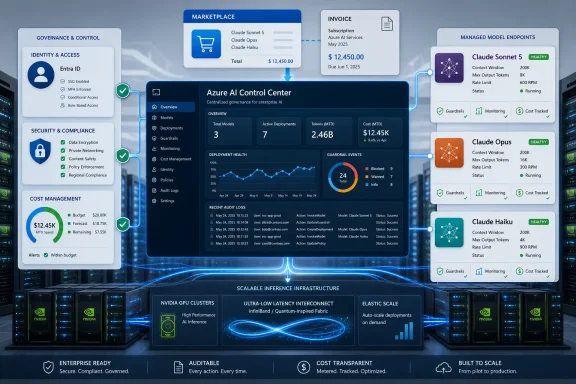 Microsoft Turns Claude From a Vendor Exception Into an Azure Workload
Enterprise AI adoption has always had two clocks. One is the product clock, where model releases arrive in months, sometimes weeks, and every new benchmark resets the internal debate about which system is “best.” The other is the procurement clock, where legal review, data-processing terms, security questionnaires, budget approvals, and vendor onboarding move at the pace of institutional risk.Claude in Microsoft Foundry is significant because it synchronizes those clocks. Before this launch, a developer inside a large company could call Anthropic’s API from an Azure-hosted application, but that did not make Anthropic part of the company’s Azure estate. It still meant a separate vendor relationship, a separate bill, a separate security review, and often a separate argument with finance about whether the spend belonged inside an already-approved cloud commitment.
The new arrangement changes the center of gravity. Claude usage can now be purchased through Azure Marketplace, billed through Azure, and governed through the identity and access systems many enterprises already operate. For customers with eligible Microsoft Azure Consumption Commitments, that distinction is not accounting trivia. It turns Claude from a new spending request into a way to consume committed cloud dollars that may already be sitting on the books.
That is why the phrase “generally available” carries unusual weight here. In consumer AI, GA can sound like marketing punctuation. In enterprise IT, it means the service has crossed into the category of something a platform team can plausibly bless, monitor, and scale without inventing a bespoke governance path for every use case.
The Model Was Never the Only Bottleneck
Microsoft’s framing of the announcement was unusually candid: enterprise AI projects often stall not because the model is inadequate, but because everything around the model is hard. Procurement, governance, networking, identity, data controls, and observability are not glamorous, but they are precisely the things that decide whether a pilot survives contact with production.That observation should sound familiar to anyone who has watched generative AI enter a large organization. Developers find a model that works. A business unit funds a proof of concept. A demo impresses a steering committee. Then the project hits the machinery of enterprise approval and slows to a crawl while security asks where the prompts go, legal asks who processes the data, finance asks why another AI vendor is needed, and architecture asks how access will be revoked when an employee leaves.
This is where Microsoft has an advantage no standalone AI lab can easily copy. Azure is not merely compute. It is a contractual, financial, and administrative environment. If Claude can be made to live inside that environment, Microsoft does not need every buyer to fall in love with Microsoft’s own models. It needs buyers to conclude that Foundry is the safest place to arbitrate model choice.
The practical effect is subtle but large. The enterprise buyer is no longer forced to decide between Claude’s capabilities and Azure’s governance. Microsoft is trying to make that trade-off disappear.
Shadow AI Loses One of Its Better Excuses
The most immediate governance win is not that every company will suddenly standardize on Claude. It is that unofficial Claude use becomes harder to justify.Shadow AI thrives in the gap between user demand and institutional approval. When a developer or analyst believes an external AI tool is materially better than the approved internal option, the path of least resistance is often a personal account, a browser tab, or a departmental expense card. The organization then gets the worst version of AI adoption: real usage, real data exposure, real cost, and little central visibility.
Azure-native Claude gives central IT a cleaner answer. Instead of saying no until a separate vendor process completes, platform teams can say yes inside the Azure control plane. Access can be tied to Microsoft Entra ID. Permissions can be shaped with Azure role-based access control. Billing can be attributed through the Azure invoice. Network and residency choices can be evaluated in the same language already used for other cloud services.
This does not eliminate risk. No LLM deployment becomes safe merely because it passes through a familiar portal. But it changes the risk conversation from “who approved this external AI vendor?” to “which users and applications are authorized to call this Azure-hosted model, under which policies, in which regions, and at what cost?” That is a much more governable problem.
The distinction matters most in regulated environments. Financial services, healthcare, public sector, energy, and defense-adjacent organizations tend not to reject AI outright. They reject ambiguity. A model available through an approved cloud platform with known identity and billing controls is easier to evaluate than a powerful external service that sits just outside the enterprise map.
Azure Foundry Becomes the Model Neutrality Layer Microsoft Wants
Microsoft has spent years benefiting from preferential access to OpenAI models through Azure OpenAI Service. That partnership gave Azure a major early lead in enterprise generative AI because buyers could access GPT-class systems through Microsoft’s cloud rather than stitching together their own relationship with OpenAI. Claude’s arrival in Foundry changes the message from “Azure has the OpenAI models” to “Azure is where frontier models become enterprise software.”That is a more durable strategic position. Individual models rise and fall quickly. A model that leads coding benchmarks in June may be merely competitive by September. A reasoning model that looks expensive one quarter may become a specialized tool the next. Enterprises know this, which is why many are reluctant to build their entire AI estate around one vendor’s model roadmap.
Foundry’s value proposition is that Microsoft can own the control plane even when it does not own the model. The company provides identity, networking, billing, monitoring, deployment patterns, agent orchestration, and policy controls. Anthropic provides Claude. OpenAI provides GPT-family systems. Other model providers may fill out the catalog. The buyer gets a place to compare and route workloads without turning every model decision into a new vendor-management exercise.
This is not pure altruistic openness. Microsoft would rather own the platform through which competing models are consumed than fight every model war directly. If Foundry becomes the default enterprise interface for frontier AI, Microsoft can benefit whether the next workload lands on a Claude model, an OpenAI model, a small specialized model, or a mixture of all three.
Sonnet 5 Makes the Timing Sharper
Claude Sonnet 5’s July 1 arrival gives the Azure announcement a sharper edge than a routine availability update would have had. Sonnet is Anthropic’s mainstream workhorse tier: more capable than Haiku, less costly than Opus, and often the model class enterprises look to for scaled document, coding, tool-use, and agentic workflows. Making the newest Sonnet model available in Foundry immediately after its Anthropic release reduces the sense that Azure is a second-class route for Claude access.That matters because enterprise AI teams are increasingly allergic to stale model catalogs. A cloud provider can offer excellent governance, but if its managed model service lags the frontier by months, developers will route around it. The Foundry promise depends on Microsoft proving that governance does not mean delay.
Sonnet 5 is positioned as a stronger agentic model than Sonnet 4.6, with better tool use, more reliable multi-step execution, and improved coding and document workflows. Those are exactly the areas where enterprises are moving from chatbot experiments into process automation. A model that can call tools, maintain state across steps, read large context, and recover from intermediate errors is more valuable inside a business workflow than one that merely writes polished paragraphs.
The pricing detail is also worth reading carefully. Promotional pricing in Foundry makes Sonnet 5 look cheaper at launch, but the tokenizer change means customers should not assume a simple per-token discount translates into identical workload savings. If the same body of text encodes into more tokens, the effective economics depend on real prompt distributions, output lengths, cache behavior, and routing strategy. The only honest answer for IT teams is to benchmark their own workloads rather than extrapolate from list prices.
Procurement Is the Feature Enterprises Actually Bought
It is tempting to treat the hardware, model versions, and agent tooling as the heart of the story. They are important, but procurement is the feature that makes the rest usable at scale.A separate Anthropic commercial contract may be perfectly reasonable for a startup or a digitally mature enterprise with a fast vendor process. For a multinational bank, a government contractor, or a healthcare network, it can be a quarter-long project. Vendor onboarding is not just a signature. It can involve data protection impact assessments, security documentation, financial risk review, tax setup, regional legal requirements, and internal mapping to cost centers.
Azure Marketplace collapses much of that friction because it gives enterprises a path they already recognize. A buyer can still evaluate Anthropic’s role as processor and service provider, but the commercial motion runs through Microsoft. The invoice arrives as part of an existing cloud relationship. Spend can be tracked against familiar budgets. For organizations with committed Azure spend, Claude usage can become a way to consume obligations that finance has already accepted.
This is why the announcement lands differently from a standard API integration. APIs are easy to call and hard to institutionalize. Marketplace-native, Azure-governed services are harder to ignore because they align with how large organizations actually buy.
The Regional Footprint Is a Reminder That “GA” Still Has Edges
The launch is not without boundaries. Azure-hosted Claude deployments are currently constrained to specific regions, including East US 2 and Sweden Central for the Azure-native path described in the announcement. That may be adequate for many customers, but it is not the same as universal Azure-region availability.For global enterprises, region availability is not a footnote. Data residency, latency, disaster recovery, and regulatory obligations can all turn a two-region launch into a planning constraint. A European organization may welcome Sweden Central. A U.S. organization may be comfortable with East US 2. A company with strict country-specific residency requirements may still need to wait, use a different deployment route, or fall back to Anthropic-hosted options where available.
Account eligibility is another practical boundary. Free trials, startup-sponsored accounts, and subscriptions without pay-as-you-go billing are excluded because this is an Azure Marketplace-backed commercial offering. That makes sense for production governance, but it means the smoothest path is aimed squarely at established Azure customers, not hobbyists or early-stage teams trying to experiment without a procurement footprint.
This is the classic enterprise cloud trade-off. The offering becomes more credible for production at the same time it becomes less casual to access. Microsoft is optimizing for the buyer who needs auditability, billing, and controls, not the developer who wants a frictionless weekend test.
The GB300 Story Is About Inference Economics, Not Silicon Theater
Microsoft’s Claude deployment is tied to NVIDIA GB300 NVL72 systems and Quantum-X800 InfiniBand networking, which gives the announcement the expected dose of accelerator spectacle. The numbers are enormous: rack-scale systems, dozens of Blackwell Ultra GPUs, Grace CPUs, liquid cooling, high-speed interconnects, and exaFLOPS-class low-precision compute. But the important point is not that the hardware sounds impressive. It is that modern LLM inference has become an infrastructure problem as much as a model problem.Large models do not run cheaply just because a cloud provider has GPUs. They require high utilization, low-latency interconnects, memory bandwidth, scheduling sophistication, and enough capacity to absorb bursty demand. When enterprises start using agents at scale, the workload is not one prompt and one answer. It can be dozens of tool calls, document reads, intermediate reasoning steps, retries, and policy checks for a single user-visible task.
The GB300 NVL72 architecture is designed for that world. A rack-scale system with 72 GPUs connected through high-bandwidth NVLink can keep large inference workloads moving without constantly waiting on slower paths between devices. InfiniBand matters because distributed inference punishes latency. When many accelerators must coordinate, a slow network can turn expensive GPUs into idle metal.
This is where AI economics becomes less intuitive. A more expensive hardware platform can lower effective cost if it drives higher throughput, better utilization, and lower latency per completed task. For Microsoft, the goal is not merely to host Claude. It is to host Claude in a way that makes high-volume agent workloads economically tolerable.
Model Routing Is the Quiet Counterweight to Frontier Model Inflation
The other major cost lever is not hardware but dispatch. Microsoft’s model router in Foundry is designed to route requests to different models based on the complexity of the prompt and the configured pool of available systems. In plain English, not every request deserves the most expensive model.That sounds obvious, but many enterprise deployments begin with exactly that mistake. A team picks a premium model because it works well in the demo, then sends every classification task, summary, extraction, rewrite, and complex reasoning request to the same endpoint. The result is a bill that makes AI look uneconomic even when a large share of the workload could have run on a smaller model.
A trained router changes the shape of the system. Simple requests can go to faster, cheaper models. Harder requests can be escalated to Sonnet, Opus, or another premium option. The user may experience better latency for common tasks, while the organization pays frontier-model prices only where frontier capability is actually needed.
This is also where Microsoft’s model-neutral platform strategy becomes practical. If Foundry can evaluate, route, observe, and govern across model families, then enterprises can build applications that are less brittle. A workflow does not have to be permanently married to one model name. It can become a policy-governed system in which models are interchangeable components selected by cost, capability, latency, and compliance requirements.
Agent Services Raise the Stakes for Governance
The Claude-in-Foundry launch is also part of a broader move toward agentic systems. Microsoft Foundry Agent Service, Microsoft IQ, prompt optimization, response evaluation, and control-plane policy enforcement all point toward a future in which AI is not merely answering questions but taking actions inside enterprise environments.That is the moment governance stops being a compliance wrapper and becomes a product requirement. An agent that drafts an email is one thing. An agent that queries internal data, opens tickets, changes records, calls business systems, or writes code into a repository is another. The more useful the agent becomes, the more dangerous weak identity, logging, and policy controls become.
Claude’s strengths in tool use and multi-step workflows make it attractive for this next phase. But the same capabilities that make a model useful for agents also make it harder to treat as a harmless text generator. If a model can call tools, interpret instructions, and carry out long-running tasks, then enterprises need to know who invoked it, what data it accessed, which tools it used, what it attempted, and which outputs were blocked.
This is the real Foundry bet. Microsoft is not just selling model access; it is selling the administrative substrate for agents. That substrate includes identity, cost controls, content filtering, evaluation, routing, and observability. In a world of increasingly capable models, those layers may matter as much as the models themselves.
Anthropic Gets Enterprise Distribution Without Becoming Microsoft
Anthropic also gains something substantial from the deal. Claude has enjoyed a strong reputation among developers, writers, and AI-heavy teams, particularly for coding, reasoning, and long-form work. But reputation does not automatically translate into enterprise standardization. Distribution matters, and Microsoft controls one of the most important enterprise distribution channels in the world.By appearing natively in Foundry, Anthropic gets access to customers who might have admired Claude but lacked a clean way to approve it. The relationship also positions Claude as a first-class alternative inside organizations that are already committed to Microsoft’s cloud and productivity stack. That is a far stronger posture than asking every enterprise to build a separate Anthropic relationship from scratch.
The arrangement still preserves an important distinction. Anthropic remains the model provider, and for Azure-hosted Claude it operates the inference and carries processor and service obligations under the described model. Microsoft supplies the Azure commercial and governance wrapper. That division lets each company play to its strengths, but it also means customers should read the service terms carefully rather than assuming “Azure-hosted” means identical treatment to a purely Microsoft-built service.
Over time, the open question is feature parity. Anthropic-hosted Claude may expose features, models, or beta capabilities before the Azure-native path does. Microsoft and Anthropic can narrow that gap, but enterprise buyers should expect some tension between the fastest possible access to Anthropic’s frontier experiments and the more governed Azure route. For many production workloads, the slower but approved path will win.
OpenAI Now Has a Real Governance Peer Inside Azure
The competitive significance is straightforward: OpenAI no longer has the Azure governance field to itself. For years, Azure OpenAI Service gave Microsoft customers a uniquely enterprise-friendly way to access GPT-family models. That did not eliminate competition, but it gave OpenAI a procurement and identity advantage inside the Microsoft estate.Claude in Foundry narrows that advantage. A platform team can now compare OpenAI and Anthropic models without one of them requiring a fundamentally different purchasing and governance model. That does not mean the models are interchangeable. It means the organizational friction around choosing between them is lower.
This should produce more pragmatic AI architecture. Some workloads will favor GPT-class models. Some will favor Claude. Some will use smaller models for cost reasons. Some will use routing or evaluation layers to choose dynamically. The important shift is that model selection can become an engineering and economics decision rather than a procurement destiny.
For Microsoft, that is ideal. The more enterprises treat Foundry as the neutral ground for model competition, the less Microsoft is exposed to the reputation cycle of any one frontier lab. If customers argue about whether Claude or GPT is better this month, but they do so inside Azure, Microsoft still wins.
The Real Migration Work Starts After the Press Release
The hard work for enterprise teams begins now. Turning on access is not the same as migrating workloads. Teams evaluating Claude Sonnet 5 in Foundry need to test latency, cost, output quality, safety behavior, tool-call reliability, and integration differences against their actual applications.Prompt migration deserves particular care. A prompt tuned for Sonnet 4.6, Opus 4.8, or an OpenAI model may not behave identically under Sonnet 5. Tokenization changes can alter cost estimates. Tool-use behavior can change control flow. Safety refusals and formatting tendencies can affect downstream parsers. Even when the new model is better overall, production systems often depend on predictable quirks.
Governance teams also need to define who can deploy which models and for what kinds of workloads. If every developer can spin up premium models without budget guardrails, the Azure invoice will eventually become the governance mechanism of last resort. That is not governance; it is surprise.
The better pattern is to treat Claude as part of a managed model portfolio. Platform teams should create approved deployment templates, logging requirements, evaluation criteria, cost budgets, and escalation paths. The point of Foundry is not to let every team improvise faster. It is to let the organization standardize the boring parts so teams can innovate where it matters.
The Fine Print Is Where Production Readiness Lives
The practical readout for WindowsForum’s audience is less about brand rivalry and more about operational consequence.- Enterprises can now consume Claude through Azure Marketplace billing instead of treating Anthropic as a wholly separate procurement path.
- Microsoft Entra ID, Azure role-based access control, and familiar Azure governance patterns make Claude easier to approve for sanctioned internal use.
- Claude Sonnet 5’s Foundry availability gives Azure customers access to Anthropic’s newest mainstream model without waiting through a long managed-service lag.
- Regional and account restrictions still matter, especially for organizations with strict residency requirements or nonstandard Azure subscription arrangements.
- Real cost will depend on workload benchmarking, tokenizer effects, model routing, output length, and whether teams reserve premium models for tasks that actually need them.
- The strategic winner is not only Anthropic or Microsoft, but the platform model in which enterprises choose among frontier systems without rebuilding governance each time.
References
- Primary source: Tech Times
Published: Thu, 02 Jul 2026 15:15:03 GMT
Loading…
www.techtimes.com - Related coverage: techradar.com
Loading…
www.techradar.com - Related coverage: tomshardware.com
Anthropic restores Claude Fable 5 as US lifts export controls — single filter now blocks prompt that could identify software vulnerabilities and write code to exploit them | Tom's Hardware
Commerce withdrew the controls after testing confirmed weaker models could do the same thing.www.tomshardware.com - Related coverage: axios.com
Anthropic's Sonnet 5 offer less cybersecurity risk than Mythos, Fable
It says the model can use browsers, plan, code and do knowledge work while posing fewer risks than Mythos and Fable.www.axios.com
- Official source: techcommunity.microsoft.com
Loading…
techcommunity.microsoft.com - Official source: azure.microsoft.com
Loading…
azure.microsoft.com
- Official source: support.claude.com
Use Claude in Microsoft Foundry | Claude Help Center
support.claude.com
- Official source: learn.microsoft.com
Claude models in Microsoft Foundry - Microsoft Foundry | Microsoft Learn
Discover Claude models in Microsoft Foundry. Compare available models, capabilities, quotas, and supported regions to choose the right one for your AI use case.learn.microsoft.com - Related coverage: windowsreport.com
Microsoft Brings Anthropic Claude Sonnet 5 to Foundry for Enterprise AI Workloads
Microsoft has launched Claude Sonnet 5 in Foundry, bringing Anthropic's latest AI model to Azure for enterprise coding and agents. windowsreport.com
- Related coverage: tech-noisy.com
Microsoft Foundry - Claude が GA、Azure 上で Opus 4.8 提供開始
Microsoft Foundry で Claude が 2026 年 6 月 29 日に一般提供を開始。Messages API 経由で Claude Opus 4.8 と Haiku 4.5 が使え、Azure でホストと Anthropic でホストの 2 方式から選べます。tech-noisy.com - Related coverage: windowscentral.com
NVIDIA joins Microsoft’s push on Claude — piling billions into Anthropic’s future | Windows Central
Claude’s arrival on Azure signals a major shift in the competitive AI cloud landscape.www.windowscentral.com