

I fed the same detailed family prompt to five popular AI chatbots and, after comparing itineraries, packing lists, booking advice and line‑item budgets, one clear runner-up emerged: Claude—not because it booked my Finnair Avios seat for me, but because it stitched together the most practical, verifiable, and family‑friendly plan from a short free session.
Artificial intelligence is no longer a curiosity for travel planning; it's a practical drafting tool for millions of travelers who want ideas, checklists, and side‑by‑side options. The hands‑on test that produced these findings used the same carefully built prompt across five free chatbots—ChatGPT, Google Gemini, Anthropic Claude, Deepseek, and Microsoft Copilot—and asked each to plan a 7–10 day family trip to Finnish Lapland in December (four adults plus an infant), including a night in Helsinki and a visit to Santa Claus Village in Rovaniemi. The comparison deliberately avoided asking the models to find mileage award seats or real‑time vacation rental availability—two areas where chatbots still fail to deliver.
That structure mirrors how testers are evaluating assistants in 2025: across practical outputs (itineraries, citations, integration features), safety and hallucination checks, and ecosystem integrations. Reviewers consistently emphasize the same tradeoffs: speed and inspiration vs. provenance and booking accuracy.
The Thrifty Traveler hands‑on test demonstrates this hybrid reality clearly: while each assistant produced usable itineraries, Claude stood out for operational depth and budgeting clarity—qualities that matter for family travel and for planners who must hit both experiential and budgetary targets. These findings echo broader comparative testing across the ecosystem: different assistants win different jobs, and adopting a best‑tool‑for‑the‑job approach gives the strongest results.
Source: Thrifty Traveler I Asked 5 AI Chatbots to Plan My Upcoming Trip; 1 Was Better Than the Rest
 Background
Artificial intelligence is no longer a curiosity for travel planning; it's a practical drafting tool for millions of travelers who want ideas, checklists, and side‑by‑side options. The hands‑on test that produced these findings used the same carefully built prompt across five free chatbots—ChatGPT, Google Gemini, Anthropic Claude, Deepseek, and Microsoft Copilot—and asked each to plan a 7–10 day family trip to Finnish Lapland in December (four adults plus an infant), including a night in Helsinki and a visit to Santa Claus Village in Rovaniemi. The comparison deliberately avoided asking the models to find mileage award seats or real‑time vacation rental availability—two areas where chatbots still fail to deliver.That structure mirrors how testers are evaluating assistants in 2025: across practical outputs (itineraries, citations, integration features), safety and hallucination checks, and ecosystem integrations. Reviewers consistently emphasize the same tradeoffs: speed and inspiration vs. provenance and booking accuracy.
How the experiment was run (quick recap)
- One single prompt, delivered to each chatbot, specified travelers (four adults + infant), travel window (7–10 days, before Christmas), must‑visits (Rovaniemi + at least one night in Helsinki), preferred activities (snowshoeing, sauna), and pacing constraints (sufficient downtime for an infant).
- Only the free tiers were used to keep the comparison even.
- Outputs were evaluated for: practical day‑by‑day planning, restaurant and activity recommendations, booking advice (what needs reservations and when), packing and baby equipment guidance, and an overall usefulness score for a hands‑on traveler.
- Not tested: live award availability, dynamic airfare shopping, or real‑time vacation‑rental inventory.
Quick summary of each assistant’s performance
ChatGPT — the reliable generalist
- Strengths: clear day‑by‑day itinerary, attention to daylight planning (crucial in December near the Arctic Circle), good restaurant suggestions, and practical nap‑time-aware pacing for an infant.
- Weaknesses: no live flight or rental availability; moderate specificity on tour operators; tended to be less price‑driven than some rivals.
- Bottom line: an excellent starting point and well‑sourced in its UI, useful for drafting a trip and identifying what to verify next.
Google Gemini — clean UX, Sheets export, needs prodding
- Strengths: polished, chart‑style itineraries and a handy “Export to Sheets” convenience for spreadsheet planners; one‑click access to Google Flights and Hotels when asked to look for fares.
- Weaknesses: initial drafts can be skeletal; often requires follow‑up prompts to produce operator names or booking links.
- Bottom line: great for planners who want a tidy starting grid and to own the spreadsheet; less useful if you expect a fully filled‑out concierge‑style itinerary.
Claude (the winner) — budget‑aware, detail‑forward
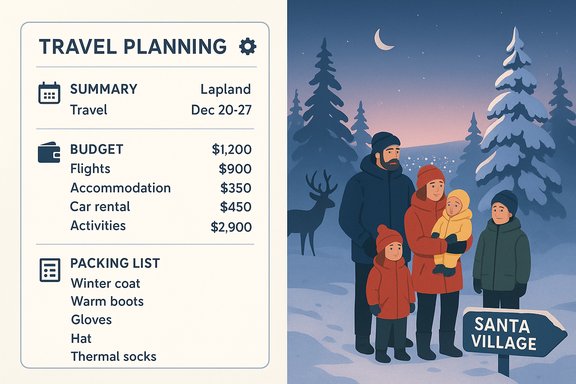
- Strengths: two‑column UI with summary + deep detail; outstanding line‑item cost estimates and a grand total; packing lists including infant items; pragmatic booking urgency notes.
- Weaknesses: like all chatbots tested, it cannot verify award seats or real‑time rental inventory in a single free session.
- Bottom line: the strongest all‑around travel drafter for a family that needs budgeting, logistics and booking prioritization.
Deepseek — specific and operator‑oriented
- Strengths: pragmatic pre‑trip essentials, baby‑equipment rental suggestions, and named tour operators/grocery options—details other bots sometimes omitted.
- Weaknesses: less polished UI and fewer alternative options; readability suffers compared with Gemini or Claude.
- Bottom line: slightly better at sourcing on‑the‑ground service providers, which can be useful for independent travelers who want to DIY logistics.
Microsoft Copilot — strong on logistics and options
- Strengths: excellent “travel logistics and timing” primers and multiple options per activity or meal; good at pacing advice for infant travelers; explicit citations.
- Weaknesses: still limited on live booking tasks in the free session; best value is inside the Microsoft ecosystem where calendar and email integrations become available.
- Bottom line: one of the strongest assistants for productivity‑savvy planners—especially those already using Microsoft 365.
Why Claude won (a closer look)
Claude’s decisive edge came from three practical areas:- Budget transparency: every itinerary line item was assigned a price estimate and summed into a final cost. For family travel—where taxes, stroller fees and infant seat rules can balloon budgets—this is immensely useful.
- Operational triage: Claude annotated which reservations were urgent (e.g., saunas, specialty dinners), which could wait, and typical lead times for booking—making it actionable, not just inspirational.
- Family planning sensitivity: it supplied a packing list tailored to Arctic winter weather and a separate infant packing checklist, plus advice on baby gear rentals and transport options.
What chatbots do well for travel today
- Rapid ideation: generate destination themes, route options and “day themes” in seconds.
- Packing lists and seasonal advice: climate‑specific gear and infant considerations are commonly handled well.
- Restaurant and localized recommendations: close to on‑par with mid‑tier travel blogs; they frequently flag when reservations are required.
- Checklists and booking priority: bots can flag “book now” items versus flexible ones, which helps triage limited planning time.
- Budget ballparks: some assistants now estimate costs per item and provide totals—helpful for immediate feasibility checks.
Where chatbots still fall short
- Live fares and award availability: AI chatbots rarely (if ever) access or verify specific award‑seat inventories or dynamically changing airline availability in free sessions.
- Real‑time vacation‑rental inventory: listings change fast and require direct OTA or host checks.
- Hallucinations: models can invent plausible‑sounding but false details (e.g., non‑existent tour operators or incorrect opening hours). Treat any single listing as a lead that must be verified.
- Safety and logistics for remote or risky activities: don't rely solely on an assistant for mountain routes, avalanche conditions, or medical/evacuation arrangements.
- Data privacy and PII risk: avoid pasting passports, booking references or payment card numbers into public chat interfaces.
Practical, step‑by‑step workflow: How to use chatbots to plan a trip (and avoid pitfalls)
- Seed the idea: use a generalist like ChatGPT or Gemini to sketch high‑level routes and a day‑by‑day skeleton.
- Deepen and budget: run Claude (or its equivalent) to produce packing lists, line‑item budgets, and booking urgency notes.
- Verify logistics: use Perplexity, Google Flights, or the OTA apps to confirm live fares, award seats and rental listings.
- Reserve critical items: book high‑demand dinners, saunas, excursions and any pre‑booked transport directly with operators or major OTAs.
- Cross‑check safety info: for winter adventures, confirm trail conditions and guide credentials through official websites or local tourist offices.
- Protect personal data: never paste passport or payment details into free chat sessions; use secure, private booking portals.
- Keep a human in the loop: treat AI as co‑pilot, not the pilot—especially for children, remote areas, or special medical needs.
UX and ecosystem considerations (Windows users in particular)
- Microsoft Copilot shines if you want itinerary items to integrate directly with Outlook calendar, Teams, or Windows reminders—useful for coordinating with co‑travelers and syncing reservations. For Windows‑heavy households, Copilot's native ties to Microsoft 365 can make it the natural hub.
- Google Gemini is handy if you plan to export itineraries into Google Sheets, Google Travel or Gmail, and appreciate a polished, visual layout. Export to Sheets is a small but meaningful convenience for spreadsheet planners.
- If privacy and enterprise controls matter (for business travel or shared corporate cards), evaluate each provider’s data retention and non‑training guarantees before feeding sensitive itineraries into a public chatbot. Industry tests emphasize governance as a major differentiator as the ecosystem matures.
Safety, verification, and the hallucination problem
Chatbots can invent specifics because they synthesize based on patterns, not live verification. The practical result is that an itinerary can look authoritative while including one or two inaccurate items—often the most consequential ones.- Always verify operator names and phone numbers against official websites or national tourism boards.
- For adventure activities (snowmobiling, guided snowshoeing, ice fishing), confirm guide certification and cancellation policies directly.
- Use citation‑forward tools or request sources from the assistant, then check those references. Prefer answers with visible provenance when you need operational certainty.
Policy, privacy and environmental notes (caveats and red flags)
- Privacy: Many consumer chatbots retain prompts for model improvement unless the user is on a paid or enterprise tier with explicit non‑training clauses. For sensitive itinerary details, use tools that provide contractual guarantees. This is an especially important consideration for corporate travel managers.
- Regulatory and provider risk: Some emerging vendors carry geopolitical or data‑handling concerns that have led public agencies to restrict use in sensitive environments—an important factor for enterprise planners evaluating lower‑cost alternatives. Deepseek, for instance, has attracted scrutiny in some jurisdictions. Treat vendor claims about cost or capability cautiously and verify them with corporate legal/IT if in doubt.
- Energy and environmental footprint: public discussions have highlighted that large AI models consume energy during training and inference. While it's true AI has a footprint, exact figures for any provider vary widely and are often proprietary; therefore specific numerical claims about water or electricity use should be treated as estimates unless backed by an official emissions report from the provider. Flag such claims and seek provider disclosures before drawing firm conclusions. This is a domain where cautionary language is warranted because concrete, comparable metrics are rarely published.
Recommendations for different traveler profiles
- For the time‑poor parent coordinating a family trip: use Claude for budgeting and packing lists, then verify top bookings manually. Claude’s operable checklist approach is tailored for quick, practical planning.
- For a Microsoft‑centric business traveler who wants calendar and mail integration: use Copilot to synchronize itineraries with Outlook and Teams; then confirm bookings in the travel portal.
- For spreadsheet lovers and those who plan every detail: use Gemini to export to Sheets and build a shared itinerary tracker; then cross‑check vendors.
- For bargain hunters managing cash flow: run Claude for a budget baseline and Deepseek to find local vendors or grocery options to reduce dining costs.
Final assessment: where AI fits in travel planning in 2025
AI chatbots are now a meaningful accelerant for travel planning: they compress ideation, surface booking priorities, and generate family‑friendly checklists in minutes rather than hours. But they are not yet a safe, single‑source transactional agent for the entire trip lifecycle. Use them for inspiration, budgeting, pace planning, and local recommendations—but verify fares, award availability, and host‑level rental details through established booking channels.The Thrifty Traveler hands‑on test demonstrates this hybrid reality clearly: while each assistant produced usable itineraries, Claude stood out for operational depth and budgeting clarity—qualities that matter for family travel and for planners who must hit both experiential and budgetary targets. These findings echo broader comparative testing across the ecosystem: different assistants win different jobs, and adopting a best‑tool‑for‑the‑job approach gives the strongest results.
Closing thoughts
Travel remains a deeply human endeavor—preferences, tolerances, and serendipitous discoveries shape a trip in ways no AI can fully anticipate. For now, the smartest workflow is AI-assisted, human‑verified: use chatbots to collapse the boring parts of planning, then apply human judgement and trusted sources before you click “book.” The tools are already powerful helpers; used sensibly, they make planning faster, more organized, and often less expensive. The winner in this test—Claude—earned that title by being the most practically useful assistant for the full life of a family trip draft, not by replacing the traveler’s judgment.Source: Thrifty Traveler I Asked 5 AI Chatbots to Plan My Upcoming Trip; 1 Was Better Than the Rest
