

Cloud infrastructure has become the single most powerful accelerator for modern AI — not because of abstract synergy, but because the cloud solves the specific operational problems that AI demands: instant access to massive GPU fleets, distributed training fabrics, integrated MLOps toolchains, and production-grade deployment primitives that teams can use without building a datacenter from scratch.
Cloud providers have reshaped AI from a slow, capex‑intensive process into an iterative, product‑centric practice. Where training a frontier language model once required months of hardware procurement and complex lab engineering, cloud platforms now let teams spin up GPU/accelerator fleets, run distributed training jobs, track experiments, and push models to production in measurably shorter cycles. This shift underpins the current wave of generative AI products and enterprise copilot services, and it is a major reason why startups and researchers can compete with established labs.
That transformation rests on four concrete capabilities the cloud provides:
Typical cloud orchestrated training workflow:
Enterprises and Windows‑centric development teams should embrace cloud capabilities while building the operational muscle to manage cost, security, and portability. Practical measures — IaC for consistent provisioning, centralized experiment tracking, customer‑managed keys, and cost gates — will turn the cloud’s raw power into sustainable advantage. The cloud does not make AI safe or affordable by itself; it supplies the infrastructure, and the onus is on engineering and leadership teams to design resilient, governed, and responsible workflows that realize AI’s promise without inheriting unchecked risk.
Source: OfficeChai The Role of Cloud in Accelerating AI Innovation
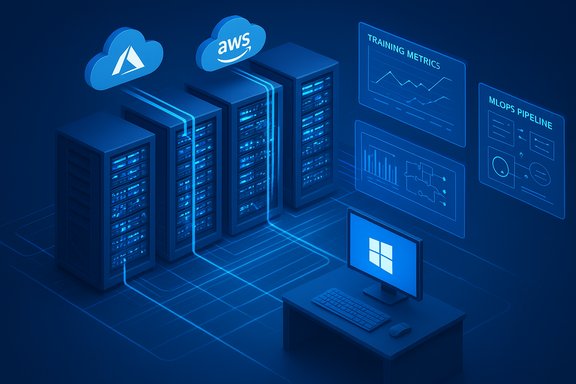 Background / Overview
Cloud providers have reshaped AI from a slow, capex‑intensive process into an iterative, product‑centric practice. Where training a frontier language model once required months of hardware procurement and complex lab engineering, cloud platforms now let teams spin up GPU/accelerator fleets, run distributed training jobs, track experiments, and push models to production in measurably shorter cycles. This shift underpins the current wave of generative AI products and enterprise copilot services, and it is a major reason why startups and researchers can compete with established labs.That transformation rests on four concrete capabilities the cloud provides:
- On‑demand, high‑density compute (GPUs/TPUs/accelerators) with global scale.
- Distributed networking and storage tuned for high‑throughput ML workflows.
- Integrated MLOps toolchains for experiment tracking, versioning, and CI/CD.
- Managed deployment and security controls that meet enterprise and regulatory needs.
Scalable compute provisioning: from minutes to hyperscale
The essential problem: hardware time vs. iteration time
AI research and productization run on iteration speed. A slow procurement cycle for specialized accelerators (weeks or months) kills exploratory work. Cloud instances flip that model: teams can provision GPU‑accelerated VMs or rack‑scale clusters on demand, reducing time‑to‑first‑experiment from months to minutes.What hyperscale looks like in practice
Hyperscalers have moved beyond single‑GPU instances to co‑engineered, rack‑scale systems. Microsoft and NVIDIA’s recent rollouts illustrate this evolution: Azure now offers rack‑scale clusters built around NVIDIA’s Blackwell family (GB200/GB300 NVL72 systems), and Microsoft reports production deployments exceeding 4,600 GB300 GPUs in a single supercluster — a scale intended to support multitrillion‑parameter models and drastically shorten training timelines. Those systems are not just “more GPUs”; they’re engineered stacks where:- NVLink/NVSwitch fabrics provide high intra‑rack memory bandwidth.
- InfiniBand or Quantum‑class fabrics scale cross‑rack communication with low latency.
- Co‑designed software (drivers, RDMA, orchestration) keeps synchronization overheads manageable.
Operational patterns that become possible
- Define infrastructure as code (IaC) for consistent, repeatable clusters.
- Provision high‑bandwidth training fabrics on demand for peak jobs.
- Use spot/preemptible instances for low‑priority workloads to reduce cost.
- Tape out runbooks for power, cooling, and failure modes when running dense GPU racks.
Distributed model training: software and systems at scale
How distributed training is orchestrated
Training large models uses multiple parallelization strategies (data, model, tensor, pipeline). Cloud ML services embed distributed frameworks — Horovod, distributed TensorFlow, PyTorch DDP — into managed services so teams can focus on model design rather than cluster plumbing.Typical cloud orchestrated training workflow:
- Data sharding: split datasets and persist balanced shards in cloud object stores (e.g., Azure Blob Storage).
- Cluster launch: create a training cluster with GPU‑accelerated VMs and an RDMA fabric for fast all‑reduce operations.
- Synchronized updates: use Horovod or native DDP to coordinate gradient updates across nodes.
- Checkpointing and fault tolerance: write frequent checkpoints to durable cloud storage so jobs can resume after node failures.
- Live metrics aggregation: stream training metrics to central dashboards for monitoring and early stopping.
Scale realities: “tens of thousands” is a realistic working figure
Public commentary from cloud and systems engineers indicates modern frontiers often use GPU counts that scale into the tens of thousands for long pre‑training runs and hundreds or thousands for production fine‑tuning and inference farms. Microsoft’s own descriptions of operating “tens of thousands of co‑located GPUs” reflect that reality, and independent coverage corroborates the rapid growth of rack‑scale clusters across hyperscalers. Because vendors rarely disclose exact private training runs for proprietary models, precise numbers should be treated as estimates derived from public cluster specs and vendor disclosures.Experiment tracking and model version control: provenance as infrastructure
Why centralized experiment tracking matters
As model complexity grows, reproducibility and traceability become operational requirements — particularly for regulated industries. Cloud MLOps offerings (Azure Machine Learning, Google Vertex AI, AWS SageMaker, MLflow integrations) provide:- Run metadata (hyperparameters, commit hashes, dataset IDs).
- Artifacts (model binaries, tokenizer state, evaluation artifacts).
- Model registries for lifecycle states (development → staging → production).
Practical practices
- Store raw datasets with immutable identifiers and access controls.
- Record each training run with a unique experiment ID and attach environment metadata.
- Use a model registry that supports controlled promotions and automated validation gates.
Production deployment patterns: inference at variable scale
Common deployment options in the cloud
Cloud providers support multiple deployment patterns tailored to application needs:- RESTful API endpoints on managed inference services.
- Autoscaled Kubernetes clusters hosting optimized inference containers.
- Batch processing pipelines for offline scoring.
- Streaming inference for low‑latency pipelines (e.g., voice agents).
Engineering considerations for inference at scale
- Latency vs. throughput tradeoffs (batching strategies, model quantization).
- Multi‑tenant routing and throttling to prevent noisy neighbor effects.
- Model ensemble management and rollout (canary, blue/green) for safe updates.
Cost optimization practices: squeeze more work from every dollar
Operational AI in the cloud is powerful but expensive. Practical ways teams control spend include:- Using spot or preemptible instances for fault‑tolerant training.
- Applying mixed‑precision training (FP16/bfloat16) and quantization to reduce memory and compute needs.
- Scheduling dev environments to auto‑terminate when idle.
- Setting budget alerts and using cost dashboards to detect runaway experiments.
Governance, compliance and security: building trust into AI operations
Regulatory controls are now table stakes
AI projects often touch regulated data — health records, financial transactions, identity data. The cloud provides pre‑built compliance and encryption features: platform‑provided encryption at rest and in transit, customer‑managed keys (Key Vault / KMS), role‑based access control (RBAC), and audit logging. Azure’s compliance artifacts explicitly document HIPAA controls for services like Databricks and Key Vault, making it feasible to construct HIPAA‑eligible training and inference pipelines without designing low‑level cryptographic infrastructure from scratch. Nevertheless, customer responsibility remains central: cloud providers make the controls available, but correct configuration and legal contracts (BAAs) are required.Security automation and CI/CD checks
Shift‑left security practices — automated container scanning, policy as code, and runtime vulnerability alerts — are critical. Integrating vulnerability scanning and policy checks into CI/CD pipelines prevents unsafe images from reaching production and helps demonstrate due diligence in audits.Critical analysis: strengths, risks, and where the cloud changes the calculus
Strengths — why cloud + AI is transformative
- Speed: On‑demand access to massive compute reduces iteration time and time‑to‑market.
- Accessibility: GPUaaS democratizes capabilities previously restricted to top labs.
- Integration: Managed ML services and model registries compress the stack and reduce integration work.
- Operational maturity: Hyperscalers invest in power, cooling, and networking so customers don’t have to.
Material risks and tradeoffs
- Compute concentration and vendor lock‑in: The largest cloud providers now operate the largest AI supercomputers. That concentration carries strategic risk — vendors control pricing, capacity allocation, and feature roadmaps. Public reporting shows Microsoft’s and NVIDIA’s co‑engineered clusters alongside OpenAI’s heavy Azure usage; OpenAI itself has moved to diversify cloud partners, reflecting the competitive and supply constraints in play. Treat statements about exclusive provider relationships cautiously; many partnerships are pragmatic rather than exclusive.
- Geopolitical and supply risk: GPUs are subject to global supply constraints and export rules. Building resilient pipelines means planning for supply shocks and multi‑cloud strategies where appropriate.
- Energy and sustainability: Dense GPU clusters demand large power and cooling budgets. Large scale deployments require sophisticated datacenter engineering to avoid power instability and to meet sustainability goals. Vendor engineering notes on liquid cooling and power stabilization show the real operational engineering overhead behind “just more GPUs.”
- Opaque training provenance: Many model authors do not publicly disclose dataset composition or exact training infrastructure. That opacity complicates reproducibility, risk assessment (e.g., for data leakage), and regulatory review. Industry reporting and academic work repeatedly caution that scale amplifies both capability and systemic risk.
- Security surface area: More automation and managed services lowers friction but expands the attack surface if IAM, KMS, and private networking are not configured correctly. Misconfigurations remain a leading cause of cloud breaches.
Unverifiable claims and necessary caution
Where readers encounter numerical claims — “GPT‑4 trained on tens of thousands of GPUs in 2023” or “OpenAI uses X GPUs for training” — treat those numbers as estimates unless confirmed by the model owner or cloud provider. Vendors typically disclose cluster capabilities (e.g., rack counts, VM families) but rarely publish per‑model training runs for proprietary models. This article flags those points and cites vendor and independent reporting where possible, but precise GPU counts for specific model runs should be considered approximate.Operational recommendations for Windows and enterprise teams
Short list: what to do today
- Use IaC (Terraform/ARM/Bicep) to provision repeatable training and inference clusters.
- Centralize experiment tracking and a model registry to ensure reproducibility and controlled promotions.
- Build cost controls: automated shutdowns, usage quotas, and scheduled spot runs for low‑priority work.
- Harden deployments: enforce RBAC, customer‑managed keys, and automated image scanning before production.
- Design for multi‑cloud or at least multi‑region failover if the business impact of capacity loss is high.
Architecture checklist (practical)
- Data governance: tag datasets, enforce retention policies, and store immutable dataset hashes.
- Security: enable customer‑managed keys (Key Vault/KMS) and tighten RBAC for all ML artifacts.
- Observability: collect training/inference metrics, cost metrics, and guardrails for drift and anomalies.
- Scalability: benchmark your model on smaller clusters and validate linearity before moving to superclusters.
- Exit strategy: keep model artifacts and training pipelines cloud‑portable (container images, reproducible scripts).
Policy and industry implications
The cloud‑driven consolidation of compute raises policy questions that matter for national competitiveness, antitrust, and national security. The ability for a handful of providers to field the racks required by frontier projects shifts strategic leverage and creates an operational single point of failure for some workflows. At the same time, public‑private initiatives and sovereign cloud efforts are emerging in parallel (for instance, regionally focused GPU programs and national AI missions) that aim to broaden access while addressing data residency concerns. These trends will continue to shape enterprise planning and regulatory scrutiny.The future: edge, hybrid, and the next generation of AI infrastructure
Two clear trajectories will shape the next five years:- Hybrid models: training and heavy pre‑training remain centralized, but inference and latency‑sensitive components will push to edge or hybrid topologies, improving responsiveness and privacy.
- Rack‑scale specialization: co‑engineered racks (NVLink+Grace+liquid cooling) will become the unit of competition; software that optimizes cross‑rack scale will be a differentiator.
Conclusion
The cloud has turned AI into a product engineering discipline rather than a lab experiment. By offering instant access to high‑density compute, integrated distributed training stacks, centralized experiment and model governance, and managed deployment scaffolding, cloud providers have shortened iteration cycles and enabled teams to focus on data, models, and application logic. That acceleration comes with clear trade‑offs: concentration of compute resources, supply and energy challenges, and governance responsibilities that fall squarely on both providers and customers.Enterprises and Windows‑centric development teams should embrace cloud capabilities while building the operational muscle to manage cost, security, and portability. Practical measures — IaC for consistent provisioning, centralized experiment tracking, customer‑managed keys, and cost gates — will turn the cloud’s raw power into sustainable advantage. The cloud does not make AI safe or affordable by itself; it supplies the infrastructure, and the onus is on engineering and leadership teams to design resilient, governed, and responsible workflows that realize AI’s promise without inheriting unchecked risk.
Source: OfficeChai The Role of Cloud in Accelerating AI Innovation
