

For many organisations the move to the cloud has already happened — workloads have been migrated, virtual machines spun up, and SaaS rolled out — yet the expected payoff in agility, scalability and faster innovation often remains elusive. The distinction Luke Bainbridge draws in ITWeb — that cloud adoption is not the same as cloud maturity — is the blunt truth behind stalled cloud projects and an opportunity for partners to move from transactional suppliers to strategic enablers.
Cloud migration used to be the headline — lift-and-shift projects, first-line SaaS wins, server decommissions. Today, the conversation has shifted from “are we in the cloud?” to “are we getting meaningful business outcomes from the cloud?” That shift exposes a recurring pattern: organisations have consumed cloud services, but many stop short of re-architecting systems, building governance, and integrating cloud-native capabilities that unlock lasting value. The Microsoft Cloud Adoption Framework (CAF) explicitly models this: successful cloud programs progress from strategy and planning into ongoing governance, security and management that run in parallel throughout the lifecycle. Independent industry maturity models mirror the same diagnosis. Cloud maturity frameworks from vendors and consultancies break progress into stages (ad hoc experimentation → repeatable practices → defined governance → managed optimisation → optimized, automated operations) and warn that organisations can get stuck for months or years in the early stages if they treat migration as a single project rather than an ongoing transformation.
Source: ITWeb The cloud is not the destination. It’s how you grow once you get there
 Background: the maturity gap that matters
Cloud migration used to be the headline — lift-and-shift projects, first-line SaaS wins, server decommissions. Today, the conversation has shifted from “are we in the cloud?” to “are we getting meaningful business outcomes from the cloud?” That shift exposes a recurring pattern: organisations have consumed cloud services, but many stop short of re-architecting systems, building governance, and integrating cloud-native capabilities that unlock lasting value. The Microsoft Cloud Adoption Framework (CAF) explicitly models this: successful cloud programs progress from strategy and planning into ongoing governance, security and management that run in parallel throughout the lifecycle. Independent industry maturity models mirror the same diagnosis. Cloud maturity frameworks from vendors and consultancies break progress into stages (ad hoc experimentation → repeatable practices → defined governance → managed optimisation → optimized, automated operations) and warn that organisations can get stuck for months or years in the early stages if they treat migration as a single project rather than an ongoing transformation. What the ITWeb piece argued — and why it matters
The ITWeb essay, framed around Westcon‑Comstor’s channel perspective, makes three tightly linked points:- Cloud is a platform, not an end state — moving workloads to Azure is only the first step.
- Governance, cost control and architecture discipline drive scale — without them, resource sprawl, unpredictable costs and security gaps appear.
- Partners must evolve — the real partner role is to help customers modernise, optimise and turn cloud consumption into recurring business outcomes rather than one‑off migrations.
Why adoption ≠ maturity: five concrete differences
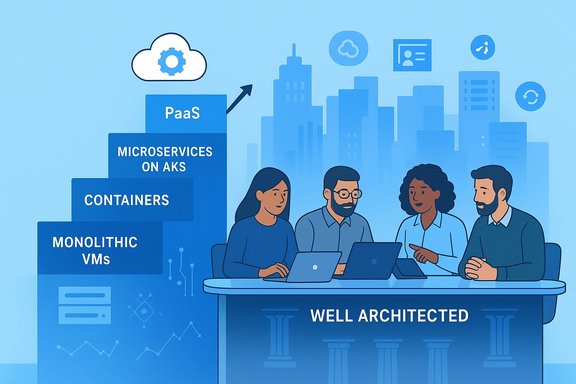
Organisations commonly confuse having cloud resources with operating a mature cloud platform. The differences are visible, measurable and actionable:- Architecture style — Adoption: many workloads remain monolithic VMs (IaaS). Maturity: apps are refactored to microservices and containers, or rebuilt on PaaS, allowing elasticity and faster deployment. Azure’s managed Kubernetes (AKS) and platform services are explicitly designed to enable those patterns.
- Governance & policy — Adoption: ad‑hoc team provisioning and inconsistent tagging. Maturity: centralized guardrails, automated policy enforcement and identity modelling that reduce risk and enable accountable automation. The CAF and Well‑Architected Framework make governance and identity first‑class concerns.
- Cost control — Adoption: opaque, surprise bills and idle resources. Maturity: cost visibility, allocation, budgets, and automated remediation through tools like Microsoft Cost Management and Advisor recommendations.
- Operational model — Adoption: runbooks and manual change processes. Maturity: GitOps/CI‑CD pipelines, platform engineering, automated observability and SRE practices that enable resilience and faster iteration. Azure’s developer and platform tooling is built to accelerate this transition.
- Product alignment — Adoption: technology decisions driven by short‑term convenience. Maturity: cloud decisions driven by business outcomes — data latency, time‑to‑market for features, AI workflows — and measured against business KPIs. Microsoft aligns CAF guidance to business outcomes for this reason.
What high‑maturity customers actually do (and the Azure services they use)
When you examine enterprises that extract real value from Azure, certain patterns recur. These are not checklist items; they are operating practices and investments.Modernise apps: containers, microservices, and platform engineering
High‑maturity teams use container orchestration and platform engineering to accelerate development while retaining operational control. Azure Kubernetes Service (AKS) provides a managed control plane and integration into Azure’s security, monitoring and networking constructs — a common choice for refactoring monoliths into scalable microservices. AKS also supports running AI workloads and integrating with CI/CD pipelines to deliver developer velocity at scale.Embed AI and analytics into workflows
Rather than experimenting with point AI projects, mature organisations integrate AI into business processes. Azure’s AI portfolio — from Cognitive Services to Azure OpenAI and Azure Machine Learning — is designed to be consumed as platform services that combine pre‑built APIs and model orchestration, enabling use cases such as document processing, recommendation engines and conversational assistants. The critical point: AI becomes a capability embedded into products and processes, not an isolated R&D lab.Continuous cost governance and optimisation
Mature teams treat cost as a first‑class operational metric. They use Azure Cost Management, budgets, tagging policies and Advisor recommendations to detect idle resources, shape procurement decisions (reserved instances, savings plans) and automate shutdowns for dev/test environments. Those practices materially reduce surprise charges and improve forecast accuracy.Security posture built into the lifecycle
Security is woven into design, not bolted on after the fact. Identity governance (Entra), network segmentation, automated compliance controls and continuous posture assessment are standard practices. The Well‑Architected Framework’s security pillar and CAF governance guidance provide clearly documented patterns to adopt.Governance: the secret lever for scaling securely
One of the essay’s strongest and most actionable claims is that governance — not just tooling — is the real gatekeeper of maturity. That’s correct and can be unpacked:- Visibility is the prerequisite: you cannot control what you cannot see. Cost, inventory and identity visibility must be established early with a centrally governed landing zone. Microsoft’s CAF “Ready” and “Govern” phases describe the structural work to establish landing zones and policies.
- Guardrails, not gates: effective governance provides automated guardrails — policies that prevent risky or non‑compliant deployments — while preserving developer self‑service. Azure Policy, resource tagging standards and predefined role assignments are the mechanisms that translate governance into daily operations. Governance should reduce friction for valid work and raise the cost of risky behaviour.
- Automate enforcement and remediation: governance programs that rely solely on human reviews fail to scale. Automation — policy-as-code, policy assignments at management group levels, and automated remediation actions — makes governance enforceable at cloud scale. The Well‑Architected Framework encourages automated enforcement to maintain consistent posture across workloads.
- Measure and iterate: governance is itself a product. Teams should track policy compliance, cost variance, and security posture as metrics and iterate on policy as teams evolve. This is the operational discipline separating one‑off migrations from sustained cloud maturity.
The partner opportunity: how distributors and resellers level up customers
Bainbridge’s central business point is that partners can — and should — be more strategic. The industry evidence shows distributors like Westcon‑Comstor are explicitly building those capabilities: landing‑zone enablement, marketplace onboarding, managed support and training programs that help partners offer differentiated, recurring services. Westcon‑Comstor’s CloudPlace programme and its expanded Microsoft distribution footprint in Africa are concrete examples of a distributor moving beyond SKU distribution toward enablement and marketplace orchestration. What does that mean in practice for partners who want to capture the high‑value part of the cloud lifecycle?- Move from transactional migrations to recurring managed services:
- Landing zone design and management
- Cost governance and FinOps services
- Application refactoring and platform engineering
- Continuous optimisation and SRE/DevOps managed offerings
- Build packaged, measurable outcomes:
- Offer time‑boxed “cloud foundation” engagements that deliver a repeatable landing zone and governance baseline.
- Follow with outcome‑oriented managed services (cost targets, SLOs, security posture objectives) rather than hourly break/fix.
- Use marketplace and subscription models:
- Help ISVs and consultancies onboard to marketplaces and use reseller/distributor programs to accelerate procurement and trials. Westcon‑Comstor’s CloudPlace illustrates how distributors can smooth the Azure Marketplace route for partners.
- Invest in enablement and 24/7 support:
- Strategic partners increasingly need advanced technical support offerings and partner enablement — Westcon‑Comstor has launched advanced Microsoft support and partner enablement services targeted at this need. Those capabilities reduce partner risk and shorten time to production for complex Azure solutions.
Practical steps partners should offer (a prescriptive playbook)
Partners who want to move up the value chain can start with a clear, repeatable service catalogue. A compact playbook:- Assess (2–4 weeks)
- Inventory workloads, data flows, and regulatory constraints.
- Produce a cloud‑maturity snapshot and measurable target state.
- Build landing zone (4–8 weeks)
- Implement management groups, subscription boundaries, identity model, networking and baseline security policies using CAF patterns.
- Platformise (6–12 weeks)
- Introduce a platform team and developer self‑service (AKS/containers, PaaS services, CI/CD pipelines).
- Govern & optimise (ongoing)
- Enable Cost Management, policy enforcement, and automated remediation; run FinOps cadence.
- Innovate (quarterly+)
- Inject AI/analytics pilots and refactor high‑value workloads into cloud‑native services.
Strengths and risks: a critical assessment
Strengths of Bainbridge’s argument and Westcon‑Comstor’s approach
- Practical orientation: The essay avoids platitudes and highlights governance and architectural discipline as the actual enablers of scale — a view backed by Microsoft’s CAF and many enterprise maturity models.
- Channel realism: The role of distributors in enabling partner growth (marketplace onboarding, enablement, 24/7 support) is an under‑appreciated lever for scaling partner businesses; Westcon‑Comstor’s investments demonstrate that distributors can materially change partner economics.
- Business outcome focus: Advising partners to tie cloud usage to business priorities rather than raw consumption reduces waste and aligns incentives across supplier, partner and customer.
Risks, blind spots and things to watch
- Operational complexity and skills gap: Re‑architecting for containers and running AKS (or platform engineering) requires sustained skills investment. Certification counts don’t always equate to run‑time competence; organisations must prove SRE and platform engineering capability, not just headcount or training numbers. This is a common maturity risk flagged by independent analyses.
- Vendor lock‑in vs. pragmatic optimisation: Pushing customers toward managed PaaS and platform services accelerates value but can increase dependency on platform APIs. Partners must balance measured refactoring with portability and contractual clarity, especially for regulated or long‑lifecycle workloads. Microsoft guidance and CAF encourage planning hybrid and migration paths for that reason.
- Cost promises that outpace operational reality: Claims of large cost reductions without a disciplined FinOps practice are fragile. Cloud savings are real but require continuous optimisation and governance to sustain; partners must avoid selling “instant savings” narratives without measurable controls. Azure Cost Management and Advisor can help, but they are tooling complements to disciplined practice.
- Security and compliance complexity: Embedding AI and global analytics raises data residency and compliance concerns. Solutions that work in one geography or industry may not be directly portable to another; partners must bake regulatory controls into landing zones and platform services from the start. CAF and Well‑Architected guidance emphasize this.
How Windows‑focused IT teams should read this
For Windows administrators and enterprise IT architects, the implications are clear and practical:- Treat Azure as a long‑term platform: invest in identity, single sign‑on, hybrid networking and secure landing zones early.
- Demand measurable outcomes from partners: SLOs for cost, availability and security should be contractual.
- Prioritise workloads for modernization: not every application needs to be refactored; target high‑value customer facing or data‑heavy apps first.
- Make FinOps routine: budgets, tagging standards, and automation remove the “bill shock” problem and free up funds for innovation.
- Embrace platform engineering: orchestrated developer experiences and CI/CD pipelines speed delivery and reduce production incidents.
Conclusion — from movement to momentum
Moving to Azure was the easy, visible part of many organisations’ cloud stories. The harder, more important work is transforming cloud consumption into sustained business capability. That requires disciplined governance, modern architecture, continuous optimisation and partner relationships that go beyond transactions into recurring, measurable services. Microsoft’s Cloud Adoption Framework and Well‑Architected Framework codify the technical and organisational practices that underpin that transition; distributors and partners such as Westcon‑Comstor are signalling they will play a bigger role in enabling partners to deliver those practices at scale. The business takeaway is straightforward: the cloud is not a destination — it’s the platform you must cultivate to grow. Partners who help customers plant the right foundations, automate the guardrails and align cloud consumption to outcomes will capture the margin and strategic relevance that one‑off migrations never deliver. The alternative is a perpetual cycle of migration projects, cloud sprawl and missed expectations — and that is a pattern no enterprise wants to repeat.Source: ITWeb The cloud is not the destination. It’s how you grow once you get there
