

The Cloud Wars Minute’s blunt verdict — that the company who invented modern cloud computing is losing ground to its hyperscaler rivals — landed like a splash of cold water: AWS’s growth is real, but context matters, and the context now favors Microsoft, Google Cloud and a resurgent Oracle.
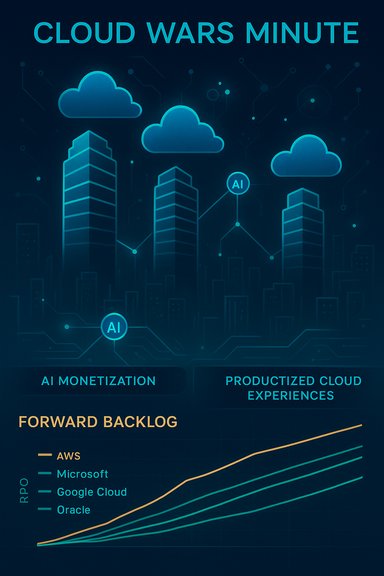
The Cloud Wars Minute episode summarized a seismic shift in how enterprises and investors judge cloud leadership: raw scale is still essential, but the market now prizes AI monetization, convertible backlog (RPO), and productized AI experiences that reduce time‑to‑value. That framing is the lens through which recent quarterly results must be read.
Across the most recent earnings cycle, the four public hyperscalers reported the following headline patterns: AWS delivered a substantial quarter but slower percentage growth than its peers; Microsoft reported large dollar additions and strong Azure percentage gains; Google Cloud posted the fastest percentage growth among the big three and materially expanded its backlog; Oracle disclosed an eye‑catching backlog / RPO number that dramatically increased its forward visibility. These are the numbers that have shifted the market narrative.
But the narrative needs important nuance:
Yet AWS remains the largest single cloud revenue engine, with deep engineering moats, unmatched global footprint, and the financial firepower to deploy AI capacity at scale. The decisive factor over the next several quarters will not be a single quarterly print but whether AWS can translate its infrastructure scale and silicon investments into easily consumable, enterprise‑grade AI offerings that match or beat the time‑to‑value and commercial packaging of Microsoft and Google. If AWS succeeds, the “momentum gap” narrative will be reversed. If it does not, the next several quarters of RPO conversion and adoption metrics will entrench the perception that the hyperscaler order is realigning.
Either way, the cloud market is expanding rapidly and the real winner for enterprise IT is competition itself: more choice, more innovation, and more pressure to deliver AI outcomes at scale.
Source: Cloud Wars 'King of the Cloud' AWS Falling Farther Behind Google, Microsoft, + Oracle
 Background / Overview
The Cloud Wars Minute episode summarized a seismic shift in how enterprises and investors judge cloud leadership: raw scale is still essential, but the market now prizes AI monetization, convertible backlog (RPO), and productized AI experiences that reduce time‑to‑value. That framing is the lens through which recent quarterly results must be read.Across the most recent earnings cycle, the four public hyperscalers reported the following headline patterns: AWS delivered a substantial quarter but slower percentage growth than its peers; Microsoft reported large dollar additions and strong Azure percentage gains; Google Cloud posted the fastest percentage growth among the big three and materially expanded its backlog; Oracle disclosed an eye‑catching backlog / RPO number that dramatically increased its forward visibility. These are the numbers that have shifted the market narrative.
The quarter in numbers: who grew, by how much, and why it matters
Headline revenue and growth comparisons
- AWS: reported roughly $33.0 billion in quarterly revenue for the quarter and ~20% year‑over‑year growth — an acceleration versus prior quarters and an operational signal that AI demand is contributing to top‑line momentum. AWS’s quarterly operating income remains a major profit engine for Amazon.
- Google Cloud: reported about $15.2 billion for the quarter with ~34% year‑over‑year growth; the business also disclosed a rapidly expanding backlog driven by enterprise AI commitments. Google Cloud’s margin profile improved as scale rose.
- Microsoft (Azure & Microsoft Cloud): disclosed very large cloud dollar adds and Azure growth in the high‑30s percent range in the comparable period, with Microsoft Cloud revenues and commercial bookings that point to robust enterprise conversion of AI projects. Microsoft tied part of that momentum to seat‑based monetization (Copilot and Microsoft 365 integrations) and large commercial commitments.
- Oracle: reported cloud revenue growing strongly and an RPO/backlog spike that drew headlines — management described a large forward backlog of multi‑year AI and infrastructure contracts. While the headline RPO figure is unusually large and requires careful interpretation, it nonetheless signals heavy reserved capacity commitments in Oracle’s pipeline.
Backlog / RPO: the forward view that matters more than ever
Quarterly revenue is backward‑looking; Remaining Performance Obligations (RPO) and backlog show contracted future business and therefore decide where future revenue will come from. The most important forward indicators from recent reports were:- Oracle’s RPO surge to a very large headline number that magnified investor attention and implied multi‑billion‑dollar multi‑year commitments. Treat the number as a major signal, but also as concentrated and dependent on contract duration and customer concentration.
- Microsoft’s huge commercial backlog and bookings, which reflect enterprise commitments anchored to seat‑based products and long‑term Azure consumption. Microsoft’s commercial RPO and bookings provide strong revenue visibility.
- Google Cloud’s backlog increase to the low‑hundreds of billions (relative to its base), a very high sequential increase that gives disproportionate future leverage to a smaller revenue base.
- AWS’s backlog — large in absolute terms (reported near the $190–200 billion range depending on disclosure reconciliation) but not increasing as fast in percentage terms as Microsoft or Oracle’s RPO, which is the core of the “momentum gap” narrative.
Product and go‑to‑market differences: why momentum diverged
AWS: modular depth, slower productization
AWS’s historic advantage is breadth. Its service catalog is unmatched, spanning IaaS, PaaS, managed databases, edge services, developer tooling, and custom silicon (Graviton, Trainium, Inferentia). That depth creates high switching costs and makes AWS the natural home for large, regulated workloads. Yet in the current environment:- AWS’s approach has been largely building blocks first — powerful primitives, deep capabilities, but a heavier lift for enterprise teams that want fast time‑to‑value.
- Competitors are packaging AI into turnkey experiences (Copilot integrations, managed model hosting, vertical‑specific solutions) that reduce engineering burden and accelerate adoption.
Microsoft: integration + monetization
Microsoft’s competitive advantage is enterprise distribution: billions of seats inside Office, Dynamics, GitHub and Windows make it uniquely positioned to embed AI features and monetize them by seat or workflow.- Microsoft’s Copilot integrations, Azure OpenAI services, and Fabric/analytics stack convert AI into measurable, seat‑based revenue.
- That integration translates into higher‑value contracts and larger commercial RPOs because customers buy outcomes (productivity gains) rather than only raw compute.
Google Cloud: ML‑first tooling and developer traction
Google Cloud’s momentum stems from developer and ML tooling — Vertex AI, BigQuery, TPUs, and a model ecosystem (Gemini) that appeals to data‑centric engineering organizations.- Google’s product stack is engineered to make model building and deployment faster for ML teams. That has translated into large enterprise AI deals and a fast‑growing backlog.
- From a market narrative perspective, Google is the poster child for “ML‑native” cloud: smaller base, faster percentage growth, and improving profitability as AI workloads scale.
Oracle: opportunistic and focused on reserved capacity
Oracle’s surge in RPO / backlog came from several large, multi‑billion‑dollar reserved capacity agreements and vertical deals. Oracle’s pitch is heavily centered on enterprise databases + AI infrastructure, and its RPO jump underscores that some customers are signing very large, long‑dated reserved purchases for capacity and services. The scale of the reported RPO is notable; however, its long recognition schedules and concentration risk mean the figure must be read with caution.Critical analysis — strengths, weaknesses, and risks
Strengths that remain indisputable
- AWS’s scale and profitability: AWS is still the largest cloud business in absolute dollars and drives a substantial portion of Amazon’s operating income. That scale translates into engineering maturity, global footprint, and the ability to fund aggressive capex for AI infrastructure.
- Microsoft’s enterprise funnel: Microsoft converts seat relationships into cloud revenue via Copilot and 365 integrations, yielding sticky revenue and high commercial bookings. That distribution is a durable moat.
- Google’s ML product leadership: Vertex AI, TPUs and Gemini give Google a technical advantage for ML teams that want turnkey model tooling and optimized accelerators. That technical leadership can translate into durable customer wins.
- Oracle’s large contract pipeline: Oracle’s RPO spike signals a meaningful reserved capacity play which, if converted, will materially accelerate Oracle’s cloud revenue profile.
Where the Cloud Wars Minute was right — and where it needs nuance
The Cloud Wars Minute correctly identified AWS’s relative slowdown in percentage terms and the growing momentum of Azure, Google Cloud and Oracle. The data backing that is verifiable: AWS grew ~20% in the quarter while rivals posted mid‑30s percentage gains and very large forward commitments.But the narrative needs important nuance:
- Base effect: faster percentage growth on a smaller revenue base (Google) is not the same as larger absolute dollar additions. AWS still adds big dollars each quarter; that matters for absolute market share and profit generation.
- RPO comparability: RPO definitions differ by company. Microsoft’s RPO may include a large mix of software seat‑related commitments; Oracle’s huge RPO may be concentrated in a handful of deals with long recognition schedules. Comparing RPO across firms is informative directionally but not perfectly apples‑to‑apples.
- Execution risk: all hyperscalers face the same operational constraints — power, chips, data center construction timelines and regional permitting. A backlog without timely capacity to execute is a backlog that delays revenue conversion.
Risks and downside scenarios
- Margin squeeze at AWS: if AWS continues to defend market share through discounts while capex and depreciation rise for AI capacity, margins could compress materially, limiting reinvestment ability.
- Concentration / convertibility risk for Oracle: a very large RPO concentrated in a few counterparties slows diversification and increases execution risk if those large contracts do not convert on expected timelines.
- Capacity bottlenecks for Azure and Google: both Microsoft and Google have signaled capacity constraints in certain regions; if those persist, large customers may face delays that slow revenue recognition.
- Narrative entrenchment: investors and enterprises sometimes prefer a simple narrative (e.g., “Microsoft = AI in Office”) — if Microsoft and Google continue to be perceived as better at productizing AI, AWS must work harder to shift that perception.
Practical implications for IT buyers and CIOs
Architects and procurement teams need to understand that the hyperscaler race now tilts on productized outcomes and contract structure. Tactical takeaways:- Treat multicloud as strategic optionality: design portability where it matters and optimize for vendor strengths where it doesn’t.
- Prioritize time‑to‑value: compare providers not just on $/GPU‑hour but on how quickly a managed solution (Copilot, Bedrock, Vertex AI) can drive measurable business outcomes.
- Insist on adoption‑based milestones: when negotiating reserved capacity, require milestone‑linked terms tied to production adoption and performance.
- Plan for reserved capacity: AI projects often need reserved, multi‑year capacity to avoid spot shortages; budget accordingly and diversify reserved capacity across providers when possible.
- Instrument model economics: measure cost per inference, time‑to‑value, and model observability from day one to avoid runaway spend.
What to watch next: indicators that will decide the narrative
- RPO conversion rates: how quickly large RPO/backlog figures translate into recognized revenue. This will show which vendors are actually converting pipeline into dollars.
- AI product adoption metrics: bedrock/managed model hosting bookings, Copilot seat growth, and Gemini / Vertex AI customer counts. Adoption trumps announcements.
- CapEx and capacity timelines: how fast GPUs/TPUs and power capacity come online to meet booked demand.
- Margin trends: whether cloud gross margins stabilize as AI services scale; persistent margin pressure will test the economics of AI monetization.
- Large enterprise churn / expansion behaviors: net dollar retention signals and account expansions reveal whether productized AI actually increases spend per customer.
Final assessment
The Cloud Wars Minute’s diagnosis — that AWS is “no longer anywhere close to the leader” — is emotionally resonant but analytically overstated if read as an immediate dethroning. The reality is more surgical: AWS’s growth rate lags its biggest rivals in percentage terms, and Microsoft, Google and Oracle are winning the headlines by converting AI interest into large reserved commitments, productized experiences, and seat‑driven monetization. That combination drives investor and buyer momentum, which is why the market reaction has favored the competitors in recent quarters.Yet AWS remains the largest single cloud revenue engine, with deep engineering moats, unmatched global footprint, and the financial firepower to deploy AI capacity at scale. The decisive factor over the next several quarters will not be a single quarterly print but whether AWS can translate its infrastructure scale and silicon investments into easily consumable, enterprise‑grade AI offerings that match or beat the time‑to‑value and commercial packaging of Microsoft and Google. If AWS succeeds, the “momentum gap” narrative will be reversed. If it does not, the next several quarters of RPO conversion and adoption metrics will entrench the perception that the hyperscaler order is realigning.
Either way, the cloud market is expanding rapidly and the real winner for enterprise IT is competition itself: more choice, more innovation, and more pressure to deliver AI outcomes at scale.
Source: Cloud Wars 'King of the Cloud' AWS Falling Farther Behind Google, Microsoft, + Oracle
