

CloudEdge users and administrators should treat a freshly publicized vulnerability affecting the CloudEdge mobile app and CloudEdge‑managed cameras as an urgent operational risk: the flaw permits remote attackers to harvest credentials and camera connection keys by abusing MQTT topic handling and message routing, potentially exposing live video feeds and remote control functions. This advisory — tied to the CloudEdge App version 4.4.23.2 and assigned CVE‑2025‑11757 in the disclosure — carries high severity under both CVSS v3.1 and v4 scoring frameworks and demands immediate network hardening, access controls, and a realistic replacement/segmentation plan where patching is unavailable or vendor coordination is incomplete.
CloudEdge is a consumer- and small-business–oriented camera platform used by many inexpensive IP/IoT cameras that connect through a vendor cloud and a companion mobile application. The architecture typically relies on MQTT (a lightweight publish/subscribe messaging protocol popular in IoT) to broker device status, pairing, and provisioning messages between cameras, mobile clients, and the CloudEdge cloud.
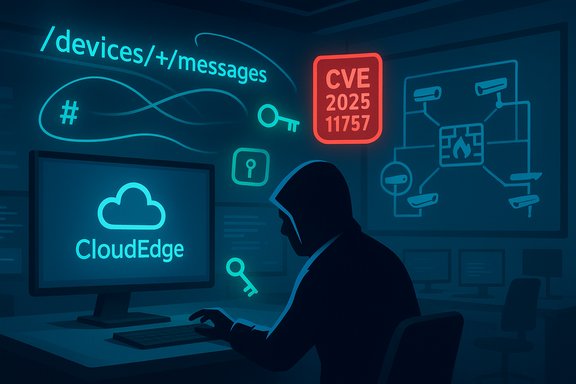
The newly disclosed vulnerability centers on how the CloudEdge cloud and app process MQTT topic strings and provisioning messages. By leveraging MQTT wildcard subscriptions (for example, subscribing to “#” or other broad topic expressions) or insufficient topic filtering, an unauthenticated remote actor can receive messages intended for other users. Those messages may contain credentials, session tokens, or peer‑to‑peer connection keys that enable direct connectivity to cameras — effectively sidestepping device‑level authentication and allowing access to live video and controls. The vulnerability was reported to federal incident response authorities and is described in the advisory material — CloudEdge App version 4.4.23.2 is explicitly cited as affected.
This is not an isolated pattern: camera and IoT vendors repeatedly face credential‑exposure and hard‑coded secret problems, and CISA advisories for other camera vendors show the same operational consequences — remote exploitability, low attack complexity, and high confidentiality impact — that make these classes of flaws particularly dangerous for commercial facilities and critical infrastructure environments.
Those messages can carry:
Conclusion
The CloudEdge advisory is a timely reminder that IoT convenience often carries hidden operational risk. When cloud message routing and broker authorization are weak, the consequences are not theoretical: live feeds, administrative control, and the security posture of connected facilities are on the line. The immediate priority for defenders is not theory but action — inventory, isolate, and harden — and for procurement teams to demand devices and vendors capable of delivering secure, maintainable surveillance infrastructure over the long term.
Source: CISA CloudEdge Online Cameras and App | CISA
 Background / Overview
CloudEdge is a consumer- and small-business–oriented camera platform used by many inexpensive IP/IoT cameras that connect through a vendor cloud and a companion mobile application. The architecture typically relies on MQTT (a lightweight publish/subscribe messaging protocol popular in IoT) to broker device status, pairing, and provisioning messages between cameras, mobile clients, and the CloudEdge cloud.The newly disclosed vulnerability centers on how the CloudEdge cloud and app process MQTT topic strings and provisioning messages. By leveraging MQTT wildcard subscriptions (for example, subscribing to “#” or other broad topic expressions) or insufficient topic filtering, an unauthenticated remote actor can receive messages intended for other users. Those messages may contain credentials, session tokens, or peer‑to‑peer connection keys that enable direct connectivity to cameras — effectively sidestepping device‑level authentication and allowing access to live video and controls. The vulnerability was reported to federal incident response authorities and is described in the advisory material — CloudEdge App version 4.4.23.2 is explicitly cited as affected.
This is not an isolated pattern: camera and IoT vendors repeatedly face credential‑exposure and hard‑coded secret problems, and CISA advisories for other camera vendors show the same operational consequences — remote exploitability, low attack complexity, and high confidentiality impact — that make these classes of flaws particularly dangerous for commercial facilities and critical infrastructure environments.
Why this matters: practical risk to camera users and facilities
- Live feed exposure. If an attacker retrieves session keys or direct‑connect credentials, they can view camera streams in real time. This threatens privacy and operational surveillance integrity.
- Camera control and manipulation. Beyond viewing, attackers may pan/tilt/zoom (PTZ), disable recording, or alter motion detection and alerting — undermining incident detection and response.
- Credential harvesting & lateral movement. Leaked camera credentials frequently reuse passwords or reveal network paths that attackers can use to pivot into management networks or obtain admin interfaces.
- Persistent backdoors & supply‑chain effects. Compromised cameras can be made persistent with firmware changes (where possible) or be used as stealthy persistence and reconnaissance nodes.
- No vendor response / EoL risk. Where vendor coordination is absent or devices are end‑of‑life, the only durable mitigation may be removal or network isolation; many facilities cannot patch or replace devices quickly, raising long‑term residual risk.
Technical details (what happened and how it works)
MQTT topic handling and the wildcard attack surface
MQTT lets clients subscribe to a topic hierarchy and receive messages published to matching topics. The vulnerability arises when the cloud-side broker or the app fails to restrict which topics a subscribing client can see. If an attacker can subscribe to a broad topic wildcard (for example, “/devices/+/messages” or “#”) due to insufficient topic sanitization or authorization checks, they will receive messages intended for other clients.Those messages can carry:
- Provisioning tokens and ephemeral session keys
- Encrypted or unencrypted credentials used for peer‑to‑peer connection setup
- Camera metadata that facilitates direct connections (IP/port/relay info)
- Configuration blobs that include account identifiers or shared secrets
CVE and scoring (what’s been assigned and how bad it is)
- The disclosure includes an assigned identifier (CVE‑2025‑11757) and high impact scoring: a CVSS v3.1 base score in the high‑severity range (reported at 7.5 in the advisory text) and a recalculated CVSS v4 base score of 8.7, which emphasizes high confidentiality impact and the ability for remote unauthenticated exploitation with low complexity. These numbers reflect real operational impact: confidentiality of video feeds and credential material is the primary loss.
Exploitation profile
- Vector: Remote (network accessible).
- Complexity: Low — requires only subscription to the broker topic space and the broker failing to enforce topic restrictions.
- Privileges / Interaction: None required; no user interaction needed.
- Impact: Confidentiality (exposure of keys/credentials) with potential follow‑on integrity impacts (camera control). The advisory warns that an attacker could obtain live feed access and camera control.
What operators must do now — immediate defensive checklist
The threat profile is typical of cloud‑mediated camera ecosystems: when the vendor cloud or app mismanages message routing or embeds secrets in transit, controls must shift to the network and operational level. Follow this prioritized checklist immediately.- Inventory and identify.
- Map all CloudEdge‑managed cameras and related apps (device lists, IPs, firmware/app versions, physical locations).
- Flag any devices that use CloudEdge App version 4.4.23.2 or are paired to unknown/third‑party accounts.
- Remove Internet exposure.
- Block inbound management ports from the Internet for camera subnets.
- Disable any port forwarding/NAT rules that expose camera management or service ports to the public Internet.
- Isolate and segment.
- Place cameras on an isolated VLAN with strict firewall rules limiting outbound connections to only required vendor endpoints.
- Deny camera VLAN access to general business networks and sensitive servers.
- Harden remote access.
- If remote access is required, enforce access through a central jump host or a corporate VPN with MFA and endpoint posture checks.
- Consider zero‑trust access brokers to mediate remote vendor connections.
- Rotate credentials and revoke sessions.
- Where possible, reset any credentials or keys exposed in camera configuration and rotate associated cloud account passwords and API keys.
- Invalidate/all current sessions in the CloudEdge app if an account compromise is suspected.
- Monitor and detect anomalies.
- Enable logging for camera management endpoints. Create IDS/IPS rules to detect unusual MQTT subscriptions, wildcard topic subscriptions, or unexpected outbound traffic patterns to unknown broker endpoints.
- Increase logging retention for camera admin events and broker traffic for forensic analysis.
- Apply vendor updates and follow vendor guidance.
- Check CloudEdge / Meari Technologies support channels for official patches or mitigations. If the vendor fails to respond, escalate to procurement and consider replacement strategies.
- Replace as necessary.
- For devices that cannot be patched or where the vendor refuses coordination, plan expedited replacement — especially if they sit on flat networks or bridge OT/IT segments.
Detection, monitoring, and forensic readiness
- Capture broker logs (MQTT broker audit trails) and examine for broad/wildcard subscription patterns or unexpected clients joining large topic namespaces.
- Deploy flow logging for camera subnets and watch for new outbound peers, sudden P2P connections, or unusual patterns to external relay IPs.
- Add SPI/IDS rules to look for published messages containing base64 blobs or JSON objects with recognizable key patterns (token, sessionKey, authKey, passwd).
- If compromise is suspected, preserve full network captures, broker logs, and camera config exports for post‑incident analysis and engagement with law enforcement as needed.
Windows and enterprise admin perspective — specific steps for corporate networks
Many Windows‑centric environments integrate IP cameras into building‑management and security systems. Administrators should:- Treat camera subnets as untrusted and strictly firewall traffic between camera VLANs and domain controllers, file servers, or sensitive Windows hosts.
- If cameras are integrated with Windows NVR servers or video management systems, isolate those servers with host-based controls and apply application allow‑listing.
- Use Windows event forwarding & SIEM ingestion to correlate camera control events with other network events to spot lateral movement from camera subnets into enterprise hosts.
- Enforce least privilege for any Windows admin accounts that manage camera NVRs or cloud integrations; require MFA and monitored jump hosts for camera management tasks.
- Where vendor cloud clients run on Windows hosts, ensure those hosts are hardened, fully patched, and run endpoint detection tools capable of flagging unusual network behavior.
Vendor coordination, disclosure, and trust: what went wrong and what to watch for
- The advisory notes that CloudEdge and its parent company, Meari Technologies, did not respond to CISA’s attempts at coordination. That lack of vendor engagement complicates patch timelines and forces defenders to adopt network compensations. When vendors do not coordinate, expect:
- No timely firmware or cloud-side fixes.
- Incomplete mitigation notes or absent security bulletins.
- Increased reliance on device replacement or network isolation.
- This pattern repeats across camera vendor advisories: vendors that ship low‑cost devices often have shorter support horizons and fewer secure‑by‑design features (secure boot, signed updates, robust authentication). Organizations must treat such devices as disposable security risks unless proven otherwise.
Risk analysis: who’s most at risk?
- Commercial facilities that use CloudEdge cameras in security-sensitive roles (lobbies, loading docks, server rooms) are at high risk if those camera management interfaces are reachable from corporate or Internet routes.
- Small businesses that rely on vendor cloud access without strong network segmentation often expose devices inadvertently.
- Facilities that combine building automation, access control, and surveillance on flat networks create high-value pivot potential for attackers.
- Organizations with limited IT staffing or long refresh cycles may be forced to operate vulnerable devices for extended periods, increasing exposure to reconnaissance and exploitation.
Long-term remediation and procurement guidance
- Do not assume low-cost camera vendors will provide sustained security. Procurement policy must include:
- Minimum security requirements: signed firmware updates, secure OTA mechanisms, secure default configurations, unique device credentials out of the box.
- Vulnerability disclosure policies: vendors must accept and respond to coordinated disclosures within reasonable timeframes.
- Support lifecycle minimums: require warranty/security‑support windows and clarity on end‑of‑life processes.
- Consider architecture changes:
- Centralize video ingestion through hardened NVRs that present a controlled management surface to operators and reduce direct camera cloud exposure.
- Use network proxies/mediators that enforce application‑layer authentication and encrypt traffic over known channels.
- Budget for refresh cycles and include security maintenance in TCO calculations — cameras are not disposable from a security lifecycle perspective.
Practical remediation playbook (30/90/180 day milestones)
- Immediate (0–7 days)
- Inventory affected devices and block Internet access to camera management ports.
- Isolate cameras on dedicated VLANs and apply deny‑by‑default firewall rules.
- Rotate credentials and revoke sessions where possible.
- Short term (7–30 days)
- Implement stricter remote access controls (jump hosts, VPN with MFA).
- Configure IDS/IPS rules and raise logging retention for camera management events.
- Begin replacement procurement for high‑risk cameras that remain unpatchable.
- Medium term (30–180 days)
- Replace end‑of‑life or unsupported cameras with devices meeting procurement security criteria.
- Re‑architect video ingestion to central NVRs or mediators to reduce device exposure.
- Reassess vendor relationships and contractual security SLAs.
Attack mitigation caveats and what cannot be guaranteed
- Network controls reduce exposure but may not stop an attacker already inside a segmented management network or one that has legitimate cloud access via compromised credentials.
- VPNs and jump hosts are useful but only as secure as the endpoints and the vendor cloud; compromised operator machines or cloud accounts can still enable exploitation.
- If the vulnerability is exploited to obtain long‑term secrets, recovering from compromise may require full device replacement and credential rotation across related systems.
Why this is a broader industry problem
Hard‑coded secrets, insufficient broker/topic authorization, and cloud‑mediated device ecosystems have repeatedly produced high‑impact vulnerabilities in camera and IoT product lines. Past advisories for multiple camera vendors have shown analogous patterns — when device vendors ship low-cost, widely deployed hardware without secure lifecycle support, defenders must adopt compensating architectural controls to limit the blast radius. The CloudEdge advisory fits this recurring template and should push organizations to re-evaluate reliance on vendor cloud features for security‑critical surveillance functions.Final assessment and recommendations
- The CloudEdge vulnerability is materially serious: remote, low‑complexity access that exposes credentials and keys elevates the risk of unauthorized live feed access, manipulation, and lateral movement.
- Immediate, practical steps are clear: inventory, isolate, remove Internet exposure, rotate credentials, and monitor. These are defensive essentials that organizations can implement even if vendor coordination is absent.
- Where vendor patching or clear remediation timelines are not forthcoming, organizations must assume persistent compromise risk and prioritize removal or replacement of affected devices.
- Long term, procurement policies and architecture must change: insist on secure device lifecycle features, signed updates, documented vulnerability response procedures, and minimum support windows.
Conclusion
The CloudEdge advisory is a timely reminder that IoT convenience often carries hidden operational risk. When cloud message routing and broker authorization are weak, the consequences are not theoretical: live feeds, administrative control, and the security posture of connected facilities are on the line. The immediate priority for defenders is not theory but action — inventory, isolate, and harden — and for procurement teams to demand devices and vendors capable of delivering secure, maintainable surveillance infrastructure over the long term.
Source: CISA CloudEdge Online Cameras and App | CISA
