

YoSmart’s YoLink ecosystem has been the subject of a coordinated security disclosure: multiple vulnerabilities affecting the YoSmart cloud server, YoLink Smart Hub firmware, and the YoLink mobile application were reported and—per the vendor and independent researchers—have been addressed through a combination of server-side patches, app updates, and hub firmware updates, but the issues expose important operational and design weaknesses that demand immediate attention from home‑automation users, integrators, and IT teams.
YoSmart’s YoLink line is a consumer‑focused LoRa‑based smart home ecosystem that uses hubs (YoLink Smart Hub models such as YS1603), cloud services, and mobile apps to connect locks, sensors, switches, and other devices. The coordinated disclosure assigned four CVE identifiers covering three distinct problem areas: insecure/unencrypted MQTT traffic used by older components, session-management weaknesses that can allow long‑lived session tokens to be reused, and insufficient authorization in the hub API that exposed broker/device credentials or allowed unauthorized commands. Vendor advisories and public write‑ups indicate the vendor released server patches and firmware/app updates to remediate the issues. Why this matters: smart‑home hubs and their companion apps are a bridge between low‑power wireless field devices (LoRa, sensors) and internet services. Weaknesses in the hub, cloud, or mobile application can lead to remote control of door locks, cameras, or other safety‑critical devices and may expose sensitive credentials or session tokens that enable longer‑term compromise. The public disclosure shows both classic design flaws (cleartext transmission, insufficient authorization) and implementation problems (session invalidation), problems that can scale rapidly when devices or cloud services are widely deployed.
Appendix — Quick reference (actionable checklist)
Source: CISA YoSmart YoLink Smart Hub | CISA
 Background / Overview
YoSmart’s YoLink line is a consumer‑focused LoRa‑based smart home ecosystem that uses hubs (YoLink Smart Hub models such as YS1603), cloud services, and mobile apps to connect locks, sensors, switches, and other devices. The coordinated disclosure assigned four CVE identifiers covering three distinct problem areas: insecure/unencrypted MQTT traffic used by older components, session-management weaknesses that can allow long‑lived session tokens to be reused, and insufficient authorization in the hub API that exposed broker/device credentials or allowed unauthorized commands. Vendor advisories and public write‑ups indicate the vendor released server patches and firmware/app updates to remediate the issues. Why this matters: smart‑home hubs and their companion apps are a bridge between low‑power wireless field devices (LoRa, sensors) and internet services. Weaknesses in the hub, cloud, or mobile application can lead to remote control of door locks, cameras, or other safety‑critical devices and may expose sensitive credentials or session tokens that enable longer‑term compromise. The public disclosure shows both classic design flaws (cleartext transmission, insufficient authorization) and implementation problems (session invalidation), problems that can scale rapidly when devices or cloud services are widely deployed. What was reported (concise technical summary)
The CVEs and their high‑level descriptions
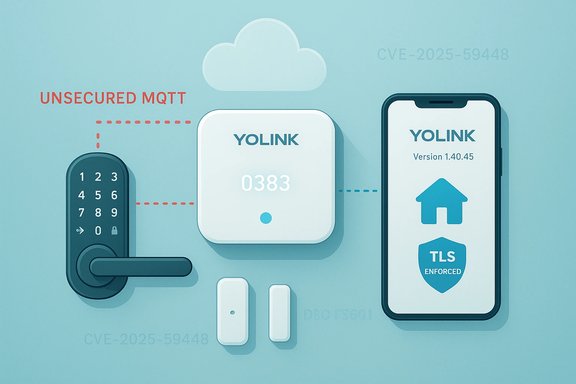
- CVE‑2025‑59448 — Insecure transmission (unencrypted MQTT): Older YoLink mobile app logic and early hub broker configurations used unencrypted MQTT (plaintext) for some communications, allowing an on‑path observer to read or tamper with MQTT messages including credentials and command payloads. Vendor statements and public trackers describe this as affecting legacy mobile application logic and components prior to vendor fixes.
- CVE‑2025‑59449 & CVE‑2025‑59451 — YoSmart server / session and authentication issues: Weaknesses in the YoSmart server infrastructure and session handling (including long‑lived tokens and session invalidation problems) could enable session hijacking or misuse of MQTT access if an attacker could obtain or replay old session tokens or credentials. The vendor reported server‑side fixes were deployed.
- CVE‑2025‑59452 — YoLink Smart Hub API authorization: Researchers identified an authorization flaw in the YoLink Hub profile API and a legacy authentication algorithm that could be abused to obtain MQTT broker credentials or perform actions on behalf of a hub/device if an attacker supplied predictable identifiers or MD5‑style hashes. YoSmart released a firmware update (Hub firmware
0383and later staged OTA updates) to move hubs to a dynamic authentication algorithm.
Vendor response and public verification
What the vendor did
YoSmart published a security advisory (YOSMART‑SA‑2025‑001) that describes the four issues, lists the affected components and versions, and summarises the mitigations: server‑side patches for the YoSmart cloud, app update (YoLink App v1.40.45) to enforce SSL, and hub firmware0383 to replace the legacy static authentication slot with a dynamic algorithm. The vendor indicates automatic staggered OTA delivery for hubs and recommends users update mobile apps and confirm firmware versions in the YoLink app. Independent confirmation
Bishop Fox independently analyzed the YoLink Hub version 0382 and published technical details that align with the vendor’s advisory: cleartext MQTT on legacy paths, session invalidation failures, and an API path enabling access to MQTT credentials via device IDs and MD5 hashes. Public CVE repositories (NVD, CVE aggregators) have registered CVE‑2025‑59448 and provided initial enrichment notes, although some CVE entries were listed as awaiting analysis or disputed while vendors and researchers coordinate canonical scoring and technical descriptions. Cross‑checking the vendor advisory and independent research is a critical verification step: both the vendor and an established security firm documented the same functional issues, which strengthens confidence in the indicators and recommended mitigations.Caveat — what remains unverifiable
Some public CVE entries are still marked as awaiting analysis or flagged as disputed in national registries at the time of this article. That timing gap between coordinated disclosure, vendor advisories, and public CVE enrichment frequently occurs in complex coordinated disclosures. Where public databases have not yet finalized vector strings or scores, treat vendor advisories and independent technical write‑ups as the working truth for immediate defensive action, but re‑verify CVE metadata before using it for compliance reporting.Technical analysis — how the weaknesses work and attack chains
Insecure MQTT (CVE‑2025‑59448)
- Root cause: legacy client/server logic transmitted MQTT messages without TLS (MQTTS), making broker‑bound traffic readable and modifiable by anyone able to observe the network path (local Wi‑Fi snooping, compromised gateway, ISP level, or malicious hotspot).
- Practical exploit: an attacker sniffing traffic can harvest MQTT credentials, device IDs, and session tokens, then publish authenticated MQTT commands to unlock locks, toggle switches, or inject false telemetry. Bishop Fox reproduced these flows with packet captures and MQTT publish commands that triggered device actions.
- Risk properties: this is an information‑disclosure + integrity risk (CWE‑319). It’s context dependent—exploitable only when the attacker can observe or intercept the path—but legacy app/hub combos that operated outside modern TLS assumptions increase the exposure surface considerably.
Session management / token reuse (CVE‑2025‑59451)
- Root cause: the platform allowed session cookies or MQTT credentials to remain valid for extended periods (examples show tokens valid for days after apparent logout) and did not reliably revoke broker credentials on logout or device reprovisioning.
- Practical exploit: an attacker who steals or reuses a session token can issue device commands until the token expires or is invalidated. Because IoT devices are frequently managed from mobile apps and cloud services, token theft can happen via device compromise, backups, malware on mobile devices, or Wi‑Fi compromises.
- Risk properties: this is a session management and improper invalidation issue (CWE‑613). The exploitability is high if tokens are obtainable; otherwise it is an enabling step that amplifies other failures (unencrypted transport or stolen credentials).
Hub API authorization (CVE‑2025‑59452)
- Root cause: an API path allowed the derivation or retrieval of MQTT credentials using predictable identifiers or weak/legacy hash algorithms, enabling credential harvest or impersonation of a device.
- Practical exploit: by supplying a device ID and a derived hash, an attacker could obtain or misuse MQTT broker credentials and publish commands as if they were the hub or app.
- Fix deployed: YoSmart updated the hub API and released firmware
0383that migrates hubs to a new dynamic authentication algorithm; hubs running the new firmware reject legacy algorithm attempts and the vendor rolled out OTA updates in stages.
Attack scenarios that practical defenders should prioritize
- Local Wi‑Fi adversary: A malicious hotspot or local network eavesdropper captures MQTT traffic and replays unlock commands against residential smart locks. (High real‑world severity; demonstrated by Bishop Fox.
- Compromised mobile device: A user’s phone running legacy YoLink app or infected with credential‑stealing malware leaks long‑lived session tokens that permit remote control of home devices. (Session reuse + token lifetime amplifies risk.
- Cloud account compromise: If a cloud account or service token is stolen, an attacker with valid cloud/MQTT access could target many users at scale by issuing broker publishes to topics for many hubs/devices. (This is the systemic failure orthogonal to a single hub.
Strengths in the vendor response — what YoSmart did well
- Rapid coordinated disclosure and fixes: YoSmart published an advisory and delivered server‑side patches, an app update enforcing TLS, and a hub firmware update with an improved authentication algorithm. That mix addresses the three layers (cloud, app, hub) where the weaknesses resided.
- OTA firmware rollout for hubs: Automatic OTA for the hub firmware reduces reliance on end‑user technical action and accelerates remediation of field devices—important for consumer deployments where manual updates have low completion rates.
- Clear app upgrade guidance: Requiring users to run YoLink App v1.40.45 or newer to enforce SSL is a straightforward mitigation for the largest population of mobile users.
Risks, shortfalls and outstanding concerns
- Legacy exposure persists: Older hubs or users who do not update mobile apps remain vulnerable. OTA rollouts can be staged and slow; some devices may never receive updates if decommissioned or offline. The presence of legacy unencrypted paths in deployed devices is a persistent risk until confirmed fully remediated.
- Session lifetime and credential leakage: Even with server fixes, the fact that tokens remained valid for days highlights design choices that increase the attack window and reliance on endpoint hygiene. Robust session‑invalidations and shorter lifetimes are core security hygiene that must be enforced.
- Incomplete public CVE metadata at publication time: Official registry entries (e.g., NVD) were still completing enrichment for at least some CVEs, which complicates compliance reporting and automated patch‑tracking systems. Defenders should not wait for public CVE normalization before taking action.
- Trust model and cloud centralization: Cloud‑centric smart home platforms centralize risk: a defect in cloud validation or broker logic can affect many homes simultaneously. While cloud patches are fast to apply, they also centralize attack value—attackers who gain cloud access can target fleets.
Practical, prioritized defensive checklist (for consumers, integrators, and IT)
- Update the YoLink mobile app to the latest version (YoLink App v1.40.45 or newer). Confirm the Play Store/App Store shows the update and check the app’s security notes.
- Verify YoLink Hub firmware: open the YoLink App and confirm the hub firmware is at least
0383(or the vendor‑stated fixed build). If the dashboard shows a pending update, ensure the hub stays online until the OTA completes. - Rotate credentials and review account security: change cloud account passwords, enable strong unique passwords and use multi‑factor authentication where the service supports it. Treat exposed credentials as high priority to rotate.
- Minimize local network exposure to adversaries: connect home hubs and management devices to a segregated Wi‑Fi SSID, enforce WPA3 if available, and avoid using open or untrusted hotspots for device management.
- Block or monitor MQTT endpoints in local networks: firewall rules on home routers or gateway devices can block outbound connections to non‑TLS MQTT ports (for instance, block TCP 1883 if not required); monitor for unexpected MQTT traffic.
- Check mobile backup settings: ensure app credentials and session tokens are not inadvertently included in unprotected backups or logs on mobile devices that could be exfiltrated.
- If you operate YoLink hubs at scale (integrators, service providers), implement logging and SIEM alerts for unusual MQTT publishes, unexpected session reuse, or device commands issued outside maintenance windows.
Step‑by‑step incident response (1–6)
- Detect: Look for anomalous MQTT publishes, unexpected device state changes (unexplained unlock events), or cloud account logins from new geographies/devices. Enable verbose logging if available.
- Contain: If suspicious activity is observed, disable cloud‑to‑device connectivity from the YoSmart dashboard (if supported), or temporarily disconnect affected hubs from the network to prevent further remote commands.
- Eradicate: Ensure hubs are running the fixed firmware and mobile apps updated; rotate all affected credentials (cloud, MQTT, local hub credentials) and force session invalidation where possible.
- Recover: Reconnect devices to the network only after verifying firmware and cloud configurations are corrected. Monitor for recurrence and validate that command logs show only authorized actions.
- Notify: For large‑scale incidents or evidence of compromise, inform the vendor’s security contact and, if relevant, national incident response authorities. Keep forensic evidence (logs, packet captures) for triage.
- Post‑mortem and hardening: Shorten session lifetimes, require app updates, strengthen credential rules, and, for integrators, design networks to isolate hubs and management interfaces from broader client networks.
Detection and monitoring guidance (for Windows and enterprise defenders)
- Add IDS/ET rules to flag MQTT traffic on TCP/1883 and other non‑TLS ports. Correlate with EDR logs on Windows workstations used for management to detect suspicious command issuance or credential reuse.
- Monitor Windows event logs and EDR alerts for unexpected network connections from mobile‑management devices or jump hosts to external MQTT brokers. Unexpected patterns or long‑lived connections warrant inspection.
- Create SIEM rules for anomalous device state changes (e.g., door unlocks at unusual times) and pair those rules with authentication events. For integrators, maintain a whitelist of permitted management IPs and flag any control messages originating outside those ranges.
- For corporate or managed smart‑home solutions, enforce device and app inventory baselines and patch policy controls through mobile device management (MDM) and asset management systems to ensure apps and firmware stay current.
Longer‑term recommendations and policy implications
- Vendors must enforce TLS for all broker and API communications and avoid shipping legacy unencrypted logic in production releases. TLS should be mandatory by design, not optional, and mobile apps must refuse cleartext connections. The YoSmart fixes show this pattern, but the presence of legacy modes underscores why secure defaults are essential.
- Session‑management best practices should be enforced: short token lifetimes, per‑session keys tied to device state, and robust revocation paths. Long‑lived tokens increase risk in low‑hygiene environments (consumer devices, mobile phones).
- Independent security auditing and public disclosure programs (bug‑bounty/PSIRT engagement) help discover design flaws earlier. The coordinated disclosure with researchers indicates a functioning security process; device vendors should institutionalize and publicize remediation timelines and telemetry for patch uptake.
- For regulators and consumer protection bodies, these incidents reinforce the need for minimum IoT security standards (TLS by default, enforceable patch windows, documented PSIRTs) to reduce systemic risk from cloud‑centric device ecosystems.
Final assessment — balancing impact vs. remediation
The disclosed YoSmart YoLink vulnerabilities combined classic design mistakes (cleartext transport, weak/legacy hashing, insufficient session invalidation) with implementation gaps. The vendor responded by deploying cloud patches, app updates, and hub firmware with OTA support—actions that materially reduce the immediate risk for patched users. However, the real world rarely reaches 100% patch uptake for consumer IoT, and legacy devices or users who fail to update remain exposed. Independent analysis from established researchers corroborates the technical details and demonstrates practical exploitability in real scenarios; public CVE registries were still completing enrichment at publication time, but the vendor confirmation and third‑party write‑ups provide sufficient actionable intelligence for defenders to act now. Treat this advisory as a reminder that cloud‑connected smart home ecosystems require layered security: secure transport and authentication, short session lifetimes, robust API authorization, and rapid update mechanisms. For users and administrators, the immediate actions are clear—update apps and hub firmware, rotate credentials, monitor MQTT and account activity, and segment management networks—while security teams should audit fleets for non‑updated devices and plan replacement or isolation strategies for units that cannot be patched.Appendix — Quick reference (actionable checklist)
- Update YoLink App to v1.40.45 or later.
- Confirm YoLink Hub firmware is >=
0383(verify in app); allow OTA updates to complete. - Rotate cloud and broker credentials; enable MFA for cloud accounts where available.
- Block unencrypted MQTT (TCP 1883) at gateway/home router if not required; enforce MQTTS/TLS.
- Monitor for anomalous MQTT publishes and session reuse; collect packet captures for forensic analysis if compromise suspected.
Source: CISA YoSmart YoLink Smart Hub | CISA
