

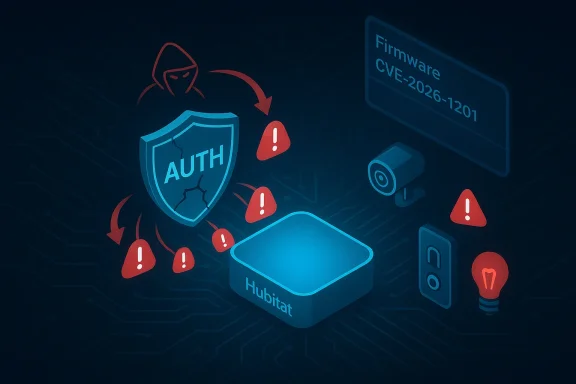
A high-severity asuthorization bypass affecting Hubitat Elevation hubs — tracked as CVE-2026-1201 — was published in a CISA coordination notice on January 22, 2026; the issue allows a remote, authenticated user to escalate control beyond their authorized scope by manipulating client-side request data, and Hubitat has pushed a firmware mitigation (2.4.2.157) that owners should install immediately. c
Hubitat Elevation hubs (models C3, C4, C5, C7, C8 and C8 Pro) serve as local controllers for consumer and prosumer smart-home devices. The recently disclosed vulnerability is an Authorization Bypass Through User‑Controlled Key (CWE‑639) that affects hub firmware prior to 2.4.2.157. According to the coordinating notice, exploitation requires the attacker to be authenticated to the hub or app, but it permits manipulation of client-side request tokens or keys so an attacker can issue device commands outside their normal authorization boundaries — effectively letting a mid‑privilege account act as if it were higher‑privilege for some device operations. The advisory assigns a CVSS v3.1 base score of 9.1 (Critical), reflecting networking impact to confidentiality, integrity and availability.
Hubitat’s public community channels confirm the vulnerability and the vendor-supplied remediation: engineers pushed a fix and published firmware 2.4.2.157 to correct dashboard / request‑handling logic that allowed the escalation. The community announcement also credits researcher Aaron “theHastyOne” Hasty of Ostrich Lab for responsible disclosure.
Recommendations distilled:
This advisory-level coverage synthesizes the coordinating notice and the vendor’s public mitigation while highlighting practical detection, containment, and verification steps practitioners need to implement today.
Source: CISA Hubitat Elevation Hubs | CISA
 Background / overview
Hubitat Elevation hubs (models C3, C4, C5, C7, C8 and C8 Pro) serve as local controllers for consumer and prosumer smart-home devices. The recently disclosed vulnerability is an Authorization Bypass Through User‑Controlled Key (CWE‑639) that affects hub firmware prior to 2.4.2.157. According to the coordinating notice, exploitation requires the attacker to be authenticated to the hub or app, but it permits manipulation of client-side request tokens or keys so an attacker can issue device commands outside their normal authorization boundaries — effectively letting a mid‑privilege account act as if it were higher‑privilege for some device operations. The advisory assigns a CVSS v3.1 base score of 9.1 (Critical), reflecting networking impact to confidentiality, integrity and availability.Hubitat’s public community channels confirm the vulnerability and the vendor-supplied remediation: engineers pushed a fix and published firmware 2.4.2.157 to correct dashboard / request‑handling logic that allowed the escalation. The community announcement also credits researcher Aaron “theHastyOne” Hasty of Ostrich Lab for responsible disclosure.
What the flaw actually is (technical summary)
Authorization‑bypass via client‑controlled key (CWE‑639)
At a high level, the hub’s API and dashboard components accepted a key or token value that was treated by the server as a scope or authorization indicator, but the service relied on client-provided values without adequate server‑side enforcement of scope. This pattern enables a simple but powerful abuse:- A valid low‑privilege user or an attacker who can authenticate to the hub or app crafts requests with modified key fields or request parameters.
- The hub’s backend code fails to validate that the supplied key is authoritative for the scope being requested (for example, commands for devices outside the submitting user’s permissions).
- The server honors the manipulated request, executing commands or revealing device state that should have been blocked.
Preconditions, complexity and likely attack scenarios
- Authenticated access is required. The attacker needs a valid account or session tied to the hub (local account, cloud account that authenticates to the hub, or a stolen session token).
- The vulnerability is exploitable via normal network interfaces (mobile app → cloud → hub, or hub dashboard via local web UI), not requiring phyphysical access.
- Attack complexity is low once authentication is obtained: crafting a modified request to alter the client‑controlled key is straightforward for an attacker with access to the API traffic or developer tools.
- A compromised or malicious secondary user account on a shared hub.
- A malicious mobile app or compromised phone that still has authenticated access.
- Credential theft (phishing, device backup leakage) leading to an authenticated session that is then abused.
What Hubitat and others have done so far
- Hubitat released firmware 2.4.2.157 addressing the dashboard / request‑handling path and closed the client‑side key abuse vector; users are urged to update their hubs to that version.
- The coordinating government notice (CISA-style CSAF) published mitigation guidance and flagged the issue as critical, recommending immediate patching and standard network isolation practices for control systems.
- Public disclosures attribute initial reporting to a third‑party researcher and recognize responsible disclosure processes — a positive signal for coordinated remediation.
Immediate actions for administrators and power users (prioritized checklist)
Applying the vendor fix is the single most important action — install firmware 2.4.2.157 on all affected hubs as soon as possible. After that, perform the following steps in order:- Patch first
- Upgrade every affected Hubitat Elevation hub (C3, C4, C5, C7, C8, C8 Pro) to firmware 2.4.2.157 and confirm device reboots complete normally.
- Contain and reduce exposure
- Ensure hubs are not reachable from the public Internet. Remove NAT/port‑forwarding rules and disable UPnP that could open management paths.
- Place hubs on a segmented VLAN or isolated Wi‑Fi SSID dedicated to smart‑home/IoT devices.
- Invalidate sessions and rotate credentials
- Log out all remote sessions if possible (cloud dashboard sessions), rotate cloud and hub admin credentials, and require strong unique passwords.
- If the service supports it, force session invalidation and short token lifetimes to reduce window for stolen tokens.
- Review access control and accounts
- Audit local user accounts and remove or demote any accounts that are not strictly necessary. Disable or remove shared accounts where possible.
- Monitor and hunt
- Enable verbose device logging and collect recent command logs. Look for unexpected device commands, repeated API calls with unusual parameters, or unknown session tokens.
- Configure SIEM or EDR rules to alert on anomalous hub‑related traffic and unusual MQTT/HTTP publishes from management hosts.
- If suspicious activity is observed
- Temporarily disconnect the hub from the network and preserve logs and packet captures for forensic analysis.
- Notify Hubitat support and, for enterprise/professional deployments, follow incident response escalation procedures.
- Apply additional hardening
- Use a hardened jump host (with MFA and endpoint security) for any remote vendor or integrator access.
- For critical devices (locks, alarms), sical controls until confidence in the environment is restored.
Deeper technical recommendations and detection guidance
Why patching alone is necessary but not sufficient
Patching closes the specific logic bug, but operational realities mean many hubs may remain unpatched for days, weeks or longer. OTA uptake lags, some hubs are offline, and end users may delay updates. Attackers only need a single unpatched hub in a network to create compromise paths.Detection signals to prioritize
- Unexpected device actuation outside normal schedules (door unlocks, camera arm/disarm, alarm toggles).
- API calls with malformed or unusual token/key fields emitted by endpoints that previously used stable formats.
- Session activity from unusual IPs or mobile device IDs that do not match known users.
- Outbound connections to unknown or new cloud endpoints from hub or management hosts.
- Export and snapshot current hub logs.
- Correlate device events with user login/session logs.
- Search for failed and successful POST/PUT operations to hub API endpoints in a compressed time window.
- If available, collect a PCAP of hub traffic and search for client-side request fields being sent to the hub — look for inconsistencies across sessions.
Compensating controls if patching is delayed
- Place the hub behind a firewall that whitelists only known management IPs.
- Use network ACLs to block non‑essential outbound services from the hub.
- Disable cloud‑to‑hub connectivity temporarily if the deployment model allows local‑only operation, while considering loss of remote app features.
Risk analysis: why this matters beyond a “home automation bug”
- High-impact device control: Hubs bridge user interfaces to actuators with physical effects (locks, garages, alarms). Authorization bypasses can translate directly into physical security compromises.
- Privileged chaining: Once an attacker issues commands to highly privileged devices (alarm bypass, door unlock), that can enable subsequent attacks on the local network or on people (social engineering, physical access).
- Scale and centralization: Cloud‑connected ecosystems allow a single logic flaw in hub handling code to affect many hubs if shared infrastructure or similar client code is used across models.
- Token/session fragility: The attack model (client‑side control of keys) often intersects with weak session management; stolen or long‑lived tokens significantly enlarge attack windows.
- Visibility gap: Many consumer deployments lack centralized logging or incident response; malicious activity can go unods.
Strengths in the vendor response — what Hubitat did right
- Hubitat issued a rapid firmware update addressing the issue and posted clear community guidance urging updates to 2.4.2.157.
- The vendor acknowledged the researcher and credited responsible disclosure, indicating coordinated triage and a working PSIRT process — important signals for supply‑chain confidence.
- Pushing a firmware release that targets the dashboard/request flow addresses the root server‑side logic rather than merely adding client mitigations, which is the correct remediation model.
Outstanding concerns and residual risks
- Patch uptake: Home users and some integrators delay firmware updates; OTA rollouts can be staged or interrupted. Devices offline during updates stay vulnerable.
- Incomplete public registry enrichment: Public CVE registries and NVD/MITlag or have incomplete metadata after coordinated disclosures; defenders should not wait for final CVE entries to act. Use vendor advisories and the coordinating government notice as operational authority until canonical database enrichment completes.
- Potential for secondary vulnerabilities: Authorization logic errors often coexist with other session, API or cloud‑side weaknesses; defenders should search for related issues like token reuse, predictable identifiers, and insufficient session invalidation.
- Supply‑chain and integration risk: Managed deployments or third‑party automation scripts that rely on hub APIs could mask or reintroduce vulnerable flows; integrators must validate their automation post‑patch.
For enterprise integrators and managed service providers (MSPs)
- Inventory and verification
- Produce a complete inventory of all Hubitat hubs (model, serial, firmware) and confirm firmware is 2.4.2.157 or later.
- Mass mitigation plan
- Coordinate update windows, test a pilot hub first, then deploy in controlled stages with monitoring.
- Policy and access hygiene
- Enforce MFA on cloud accounts, centralize device credential management, and remove shared accounts where feasible.
- Incident playbook adjustments
- Ensure customers’ incident response plans include IoT hubs as critical assets, with logging, forensics and evidence preservation steps.
- Communication
- Notify end customers of the update, outline rollback procedures, and publish observable indicators (IOCs) for local defenders.
How to validate your hub is fixed (quick checklist)
- Confirm hub firmware version in the hub web UI or the Hubitat mobile app reads 2.4.2.157 or later.
- After upgrade, force a session rotation: log out all mobile apps and cloud sessions and reauthenticate.
- Perform a sample command audit: check recent device command logs for unexpected device control during the patch window.
- Validate that dashboards and mobile apps operate normally post‑upgrade and that no unexpected errors appear in the hub logs.
Final assessment — measured urgency and recommended posture
CVE‑2026‑1201 is a critical authorization flaw that materially increases attacker capability in affected Hubitat environments. Although exploitation requires authenticated access, the low complexity of the misuse, the high impact to device control, and the ubiquity of shared or sub‑privileged accounts in consumer/prosumer deplorgent remediation priority.Recommendations distilled:
- Patch all affected hubs to 2.4.2.157 immediately.
- Treat CISA‑style mitigations (isolate hubs, avoid Internet exposure, use hardened jump hosts and VPNs where remote access is necessary) as mandatory baseline controls until all hubs are confirmed patched.
- Rotate credentials and invalidate sessions after patching.
- Monitor logs and implement SIEM/IDS rules for anomalous hub traffic and device commands.
- For integrators, prioritize patch rollouts in managed fleets and communicate clearly with customers about the steps taken and expected impact.
Short operational checklist (one page)
- Upgrade Hubitat hubs to firmware 2.4.2.157.
- Immediately rotate hub/cloud credentials and force session logouts.
- Isolate hubs from public Internet and move to segme and remove unnecessary user accounts; enforce MFA on cloud logins.
- Enable/collect hub logs and search for anomalous device commands.
- If compromise is suspected: disconnect hub, preserve logs/pcap, notify vendor and escalate to incident response.
This advisory-level coverage synthesizes the coordinating notice and the vendor’s public mitigation while highlighting practical detection, containment, and verification steps practitioners need to implement today.
Source: CISA Hubitat Elevation Hubs | CISA
