

Siemens has disclosed a critical authorization‑bypass flaw in its Industrial Edge product family (tracked as CVE‑2025‑40805) that allows unauthenticated remote actors to circumvent authentication on specific API endpoints and impersonate legitimate users; Siemens has issued updated releases for many affected SKUs, is preparing additional fixes, and urges customers to apply vendor patches or compensating network controls immediately.
Siemens’ ProductCERT and downstream advisories republished by national agencies describe CVE‑2025‑40805 as an authorization bypass through a user‑controlled key (CWE‑639) that affects a broad range of Industrial Edge variants, SCALANCE LPE devices, SIMATIC HMI panels, SIMATIC IPC/Industrial Edge devices, SIMATIC IOT devices and many related SKUs. The vendor and national advisories assign the vulnerability a top severity rating (CVSS v3.1/v4.0 = 10.0), reflecting full confidentiality, integrity and availability impact in scenarios where the flaw can be exploited. This advisory package is substantial: Siemens has published both a general Industrial Edge advisory and a device‑kit advisory, listing exact part numbers and per‑SKU remediation guidance. For several device families the vendor has released fixed versions; for others fixes are forthcoming or not planned, and Siemens recommends mitigations such as strict network access controls. National CERTs and security trackers have already mirrored the disclosure and urged immediate action for exposed systems.
Operators must treat this as both a software‑update problem and a systems‑engineering exercise: accurate inventory, disciplined change control, rigorous segmentation, and elevated monitoring are all required to close the window of exposure. In the absence of immediate patches for some SKUs, assume that any reachable management API is high risk and take aggressive network controls and monitoring steps accordingly. Siemens’ ProductCERT advisory and government republished notices supply the authoritative remediation table; map your assets, apply fixes, and verify enforcement as a matter of priority.
For operational follow‑up, refer to your internal asset inventory and Siemens ProductCERT advisory pages to fetch the exact per‑SKU remediation versions and installation notes before performing any firmware updates.
Source: CISA Siemens Industrial Edge Devices | CISA
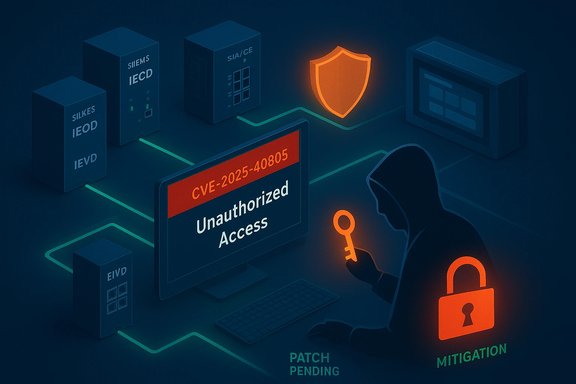 Background / Overview
Siemens’ ProductCERT and downstream advisories republished by national agencies describe CVE‑2025‑40805 as an authorization bypass through a user‑controlled key (CWE‑639) that affects a broad range of Industrial Edge variants, SCALANCE LPE devices, SIMATIC HMI panels, SIMATIC IPC/Industrial Edge devices, SIMATIC IOT devices and many related SKUs. The vendor and national advisories assign the vulnerability a top severity rating (CVSS v3.1/v4.0 = 10.0), reflecting full confidentiality, integrity and availability impact in scenarios where the flaw can be exploited. This advisory package is substantial: Siemens has published both a general Industrial Edge advisory and a device‑kit advisory, listing exact part numbers and per‑SKU remediation guidance. For several device families the vendor has released fixed versions; for others fixes are forthcoming or not planned, and Siemens recommends mitigations such as strict network access controls. National CERTs and security trackers have already mirrored the disclosure and urged immediate action for exposed systems. What the vulnerability actually is
Technical summary
- Affected implementations do not properly enforce user authentication on certain REST/API endpoints.
- The weakness allows an unauthenticated remote actor who knows a legitimate user identity to interact with endpoints in a way that bypasses authentication checks, effectively impersonating that user.
- The root classification is Authorization Bypass Through User‑Controlled Key (CWE‑639) — an attacker supplies a parameter or key that the product incorrectly trusts as proof of identity.
- Siemens and echoing advisories rate the vulnerability as exploitable over the network with no required privileges or user interaction; the vendor assigns the maximum CVSS severity.
Preconditions for exploitation
- The attack is remote and network‑based: the attacker must be able to reach the affected API endpoint over a network path.
- The attacker must have learned (or enumerated) a valid username or user identity on the target system.
- No additional credentials, local privileges, or user interaction are required once the identity is known. This makes the issue particularly dangerous for exposed or poorly segmented management interfaces.
Affected product families (summary)
Siemens published an exhaustive SKU table; summarised at a product‑family level the affected items include (non‑exhaustive):- Industrial Edge Device families:
- Industrial Edge Cloud Device (IECD), Industrial Edge Own Device (IEOD), Industrial Edge Virtual Device (IEVD).
- SCALANCE LPE series:
- SCALANCE LPE9413, LPE9433.
- SIMATIC HMI panels:
- MTP700 / MTP1000 / MTP1200 / MTP1500 / MTP1900 / MTP2200 Unified/Comfort variants, including SIPLUS variants and hygienic designs.
- SIMATIC IPC/Industrial Edge devices and SIMATIC IOT2050.
- SIMATIC Automation Workstations (19", 24").
- Many models across SIMATIC IPC BX‑39A/BX‑59A, IPC127E/227E/227G/427E/847E, and SIPLUS siblings.
Vendor remediation status and available fixes
Siemens has published updated firmware/software for a subset of affected devices and has published per‑SKU remediation thresholds; examples called out in the advisory(s) include:- Industrial Edge Own Device (IEOD) / Industrial Edge Cloud Device (IECD) / IEVD — updates to V1.24.2 or later where available.
- SIMATIC IOT2050 — update to V1.25.1 or later.
- SCALANCE LPE9413 / LPE9433 — update to V2.2 or later.
- Multiple SIMATIC HMI Unified/Comfort panels and SIMATIC IPC devices — vendor lists V21 or V3.1 minimums for specific SKUs.
Why this matters to industrial operators
Industrial edge devices sit at the boundary between OT (operational technology) and the enterprise network, frequently aggregating telemetry, hosting applications, exposing management APIs and providing remote maintenance interfaces. A successful authorization bypass in such a device can allow adversaries to:- Access operational dashboards and control channels with the privileges of a legitimate user.
- Reconfigure device behaviour, change process data, or push malicious application images to edge nodes.
- Use compromised edge devices as footholds to traverse into supervisory or engineering networks, or to poison data flows consumed by cloud and enterprise systems.
- Cause availability and integrity impacts to automation loops, monitoring, alarm handling and safety interlocks.
Attack scenarios and practicality
- Targeted maintenance‑tunnel compromise: Many operators use VPNs, remote‑access jump hosts or managed maintenance tunnels to allow vendor support. If an attacker can compromise the tunnel or a maintenance host, they may reach the vulnerable API and exploit the bypass without additional credentials.
- Local network pivot: An adversary who gains foothold on a corporate workstation or contractor laptop that can reach the OT management VLAN can exploit exposed endpoints.
- Reconnaissance + impersonation: Because exploitation requires knowledge of a valid username, attackers will typically use user‑enumeration techniques (if available) or social engineering to obtain or guess operator identities and then use the bypass to impersonate them. The vendor’s characterization confirms that the identity is the missing piece, not a password.
Recommended mitigations (vendor + independent best practice)
Siemens’ immediate guidance and the standard ICS/OT security playbook converge on the following actions:- Apply vendor updates where available: cross‑check the exact SKU and firmware against Siemens’ ProductCERT advisory and install the remediations the vendor lists (for example, IEOD/IECD/IEVD updates to V1.24.2; SCALANCE LPE to V2.2; SIMATIC IOT2050 to V1.25.1).
- If a vendor fix is not yet available for a specific SKU:
- Restrict network access to the management interfaces to trusted administration networks only.
- Place devices behind OT firewalls, deny internet access to management ports, and enforce ACLs that allow only explicit operator/jump‑host IPs.
- Require multifactor authentication and use bastion/jump hosts for all administrative sessions; do not rely on direct RDP/SSH from uncontrolled endpoints.
- Monitor device logs and authentication events for suspicious impersonation attempts or previously unseen API activity.
- Inventory and prioritize:
- Map all Industrial Edge devices by SKU and firmware; prioritize exposed or internet‑facing devices, devices reachable from cross‑domain jump hosts, and devices on flat networks.
- Maintain a list of devices that cannot be patched and apply additional compensating controls and monitoring for those units.
- Defensive posture:
- Block or rate‑limit access to the affected API endpoints at perimeter and internal firewall layers if feasible.
- Enforce least privilege and segregate monitoring/telemetry networks from device management planes.
- Incident readiness:
- Prepare rollback plans for firmware updates, capture baselines before patching and snapshot configurations as part of the change window.
Patch verification and operational guidance
- Inventory: produce an authoritative list containing each device’s model number (SKU), serial number, current firmware build string and its network address.
- Vendor mapping: match each SKU + build string to Siemens’ per‑SKU remediation tables on ProductCERT to determine whether a patch is available and which target version is required.
- Test: validate the vendor patch in a non‑production testbed replicating your network segmentation and operations; confirm that HMI/SCADA integrations, telemetry and edge apps behave as expected.
- Rollout: deploy fixes during controlled maintenance windows with staged verification and fall‑back steps.
- Post‑deployment checks: verify authentication enforcement on the previously vulnerable API endpoints, monitor for anomalous sessions, and perform focused scans for lingering exploitable versions.
Detection and incident response
- Look for anomalous API activity: unusual calls to management or configuration APIs, especially requests associated with valid usernames that did not come from known admin hosts.
- Audit logs: ensure device logging is enabled and aggregated to a central collector for analysis; keep historical logs long enough to investigate potential pre‑patch compromises.
- Network telemetry: check firewall logs and jump‑host sessions for any unexpected connections to devices, especially from external IPs or compromised maintenance addresses.
- Hunt for persistence: if an exploitation is suspected, search for new user accounts, changed configuration artifacts, unexpected application packages, or scheduled tasks that could indicate long‑term footholds.
- Coordinate with vendor and national CERTs: if compromise is suspected, follow Siemens ProductCERT and local CSIRT escalation channels for coordinated response.
Critical analysis — strengths, gaps, and residual risk
Strengths and positives
- Rapid vendor disclosure: Siemens published a consolidated advisory and followed with device‑kit specifics and remediation guidance; multiple vendor updates were available at initial publication for high‑priority SKUs. This indicates active vulnerability management and coordination with national authorities.
- Clear mitigations provided: Siemens has supplied explicit temporary mitigations for unpatched SKUs (network restrictions, segmentation, etc., which are practical and aligned with ICS‑centric best practices.
Gaps and risks
- Breadth of affected SKUs: the advisory spans a very large and diverse product set, from compact IoT gateways to large HMI panels and industrial PCs. This increases operator burden: precise SKU + firmware mapping is required and mistakes are likely during triage.
- Some SKUs lacking immediate fixes: where no vendor patch is yet available, the organization must rely on compensating controls that are operationally costly and sometimes insufficient if remote access tunnels are compromised.
- Attack surface realities: many Industrial Edge devices are used as management or data aggregation points and may be reachable via maintenance connections or poorly segmented enterprise networks — the real‑world exposure is often greater than inventories suggest.
Residual concerns
- CVSS 10 rating and authentication bypass semantics imply that a successful exploit could produce full admin‑level control or serious operational sabotage; until all exposed endpoints are patched or isolated, risk remains materially high.
- The requirement that an attacker knows a valid username reduces the attack surface marginally, but user enumeration and social engineering make that requirement less protective in practice.
- Long OT lifecycles and complex change control processes mean full remediation at scale will take weeks to months in many industrial environments; adversaries often target precisely this patch window.
Prioritized action checklist (quick reference)
- Immediately identify and isolate all devices with management interfaces reachable from untrusted networks.
- Cross‑reference each device with Siemens ProductCERT SKU tables and apply vendor updates where available.
- For unpatchable devices, restrict access to trusted management subnets and enforce jump‑host access with MFA.
- Increase logging and network monitoring for affected IPs and API endpoints; enable alerting for anomalous admin activity.
- Conduct targeted vulnerability scans and an asset‑level risk assessment to prioritize remediation by exposure and criticality.
- Plan and schedule firmware rollouts with rollback plans and verification steps; coordinate with operations to minimize production impact.
- If signs of compromise are detected, engage incident response and follow vendor/national CSIRT guidance.
Closing assessment
CVE‑2025‑40805 is a high‑urgency event for industrial operators that use Siemens Industrial Edge, SCALANCE LPE, SIMATIC HMI/IPC and related devices. The vulnerability’s authorization‑bypass nature and maximum CVSS rating make it one of the more consequential OT disclosures in recent months. Siemens’ published patches and per‑SKU remediation guidance are the immediate path to risk reduction, but real world risk will persist until all exposed endpoints are patched and network architectures are hardened.Operators must treat this as both a software‑update problem and a systems‑engineering exercise: accurate inventory, disciplined change control, rigorous segmentation, and elevated monitoring are all required to close the window of exposure. In the absence of immediate patches for some SKUs, assume that any reachable management API is high risk and take aggressive network controls and monitoring steps accordingly. Siemens’ ProductCERT advisory and government republished notices supply the authoritative remediation table; map your assets, apply fixes, and verify enforcement as a matter of priority.
For operational follow‑up, refer to your internal asset inventory and Siemens ProductCERT advisory pages to fetch the exact per‑SKU remediation versions and installation notes before performing any firmware updates.
Source: CISA Siemens Industrial Edge Devices | CISA
