

Cloudflare’s edge network suffered yet another high‑visibility disruption this week, leaving major websites and cloud services intermittently unreachable and dragging a spate of dependent platforms — including conversational AI front ends and Microsoft Copilot users in Europe — into a cascade of 500‑level errors and challenge interstitials that confused and frustrated millions of users.
Cloudflare operates one of the most widely used global edge platforms, combining CDN caching, DNS, TLS termination, a Web Application Firewall (WAF), bot management and user challenge flows (Turnstile) into a single front‑door for millions of websites and APIs. That architectural consolidation accelerates development and improves security, but it also concentrates critical functionality in a single control plane — a trade‑off that turns a localized configuration or software fault into a user‑visible outage for many otherwise healthy services.
The incidents in the last month form a cluster: a major disruption in mid‑November that produced hours of instability, a brief but widely felt outage on December 5 that lasted roughly 25–35 minutes, and a further event in early December that again routed significant user traffic through error states. Cloudflare’s own status updates and post‑incident notes place the most recent visible impact windows firmly in those short but disruptive intervals, and independent reporting corroborates the timelines.
Cross‑checking the timelines shows Copilot complaints spiking in the same windows when Cloudflare’s edge disruptions were visible, suggesting a shared dependency or a coincident surge that overwhelmed Microsoft’s front doors for Copilot. However, Microsoft’s official initial statement cited increased traffic rather than naming Cloudflare explicitly, and public confirmation of a direct dependency or root cause linkage was not present in every post‑incident message — treat a direct causal claim as probable but not fully verified until vendors publish coordinated post‑incident analyses.
Customers and downstream vendors reacted in kind: some services issued public status updates indicating third‑party dependency issues, developers switched traffic to alternate routes, and many incident response teams executed runbooks to switch DNS or bypass edge protections where safe and feasible. For many organizations this incident triggered immediate discussions about contractual SLAs, change‑management practices, and whether to pursue multi‑provider edge strategies.
For Windows administrators, enterprise IT teams and site reliability engineers the practical takeaway is clear: continue to use edge services for their performance and security benefits, but design production systems under the assumption that any single external dependency can fail. Plan for origin fallbacks, practice incident drills, and demand stronger propagation safeguards from edge vendors. When vendors publish post‑incident technical analyses, treat those as the authoritative narrative, but cross‑check with independent telemetry and incident trackers to piece together the full operational picture.
Cloudflare’s public commitments to review propagation controls and legacy proxy deprecation are the correct immediate steps, but architectural resilience will ultimately come from a mix of vendor engineering discipline and customer‑side contingency planning. Until that balance is demonstrably restored, occasional short but visible outages will remain an unavoidable risk for the internet’s increasingly centralized edge.
Despite the frustration and the very public errors, these incidents are also an opportunity: they crystallize the operational trade‑offs of modern web architecture and give enterprises a clear checklist for improving resilience. The internet’s edge delivers immense value — but like any critical utility, it requires both robust supplier governance and diligent consumer contingency planning to keep services reliably online.
Source: The Irish Sun Microsoft Copilot DOWN as AI is crippled by outage affecting users across UK
 Background
Cloudflare operates one of the most widely used global edge platforms, combining CDN caching, DNS, TLS termination, a Web Application Firewall (WAF), bot management and user challenge flows (Turnstile) into a single front‑door for millions of websites and APIs. That architectural consolidation accelerates development and improves security, but it also concentrates critical functionality in a single control plane — a trade‑off that turns a localized configuration or software fault into a user‑visible outage for many otherwise healthy services.The incidents in the last month form a cluster: a major disruption in mid‑November that produced hours of instability, a brief but widely felt outage on December 5 that lasted roughly 25–35 minutes, and a further event in early December that again routed significant user traffic through error states. Cloudflare’s own status updates and post‑incident notes place the most recent visible impact windows firmly in those short but disruptive intervals, and independent reporting corroborates the timelines.
What happened (concise timeline and symptoms)
The visible symptoms
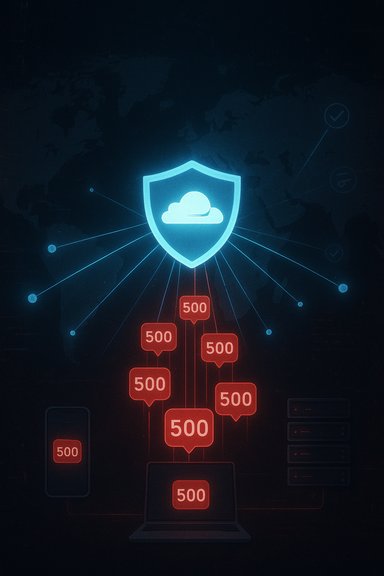
End users encountered two recurring outcomes when attempting to reach affected sites:- HTTP 500 Internal Server Error pages served from Cloudflare’s edge, which made origin servers appear down even when they were healthy.
- Challenge interstitials instructing browsers to “please unblock challenges.cloudflare.com to proceed,” a symptom of Turnstile/bot‑mitigation checks failing in a fail‑closed posture.
The proximate triggers reported publicly
Cloudflare’s publicly disclosed explanations for the December incidents highlight internal configuration and software interactions rather than an external attack. Two patterns recur in its incident notes:- A configuration change to WAF/request‑body buffering intended to mitigate a disclosed vulnerability (reported as increasing buffer limits to better support modern Next.js/React workloads) interacted badly with older proxy software, producing runtime exceptions on some edge nodes. Engineers reverted the change and restored service within roughly 25–35 minutes.
- Earlier outages were attributed to sudden spikes of unusual traffic or control‑plane degradations that impaired challenge validation systems, producing the now‑familiar challenge interstitials and elevated 5xx errors across large swathes of proxied traffic.
Technical anatomy: why an edge failure cascades so widely
The edge is the new choke point
Modern edge platforms perform multiple critical functions in the request path: TLS termination, caching, routing, WAF inspection, bot scoring and human verification. When the edge fails to proxy or validate a request, the origin server never receives it — from the client’s perspective the website is simply down. That architectural position is why even a short‑lived Cloudflare disruption looks like a full application outage across dozens of unrelated services.Fail‑closed security posture
Components designed to protect services (WAFs, bot mitigations, Turnstile) typically default to a conservative fail‑closed stance: if validation cannot be completed, requests are blocked or challenged to avoid exposing the origin to automated abuse. That conservative safety posture is logically sound for security, but operationally it magnifies availability risk when the validation systems themselves are unstable. Multiple incident reports show the interplay of fail‑closed behavior and global configuration propagation as a key amplifier.Rapid global propagation and legacy code paths
The incidents surfaced a second operational issue: certain global configuration toggles or propagation paths did not enforce staged canary rollouts in the way other operational channels do. When a global toggle propagates instantly, legacy proxy instances that contain untested or incompatible code paths (Cloudflare internally references an older FL1 proxy in its notes) can be pushed into error states at scale. The combination of instantaneous propagation and legacy code produced the Lua runtime exceptions reported in the company’s public post‑mortem for one December incident.Services and sectors impacted
The blast radius extended across consumer platforms, enterprise productivity tools, gaming backends, and even payment/booking flows. Representative categories impacted during the incidents include:- Conversational AI front ends and AI UIs (intermittent access or challenge blocks).
- Social media feeds and posting endpoints, producing 500 errors and stalled timelines.
- Collaboration and videoconferencing platforms (login and session issues reported for some users).
- E‑commerce storefronts and payment gateways that rely on Cloudflare for TLS and bot mitigation, causing checkout failures or degraded payment flows.
- Gaming matchmaking and CDN asset delivery, where front‑end edge failures produced timeouts and broken match flows.
Microsoft Copilot — the outage intersection
A noteworthy downstream impact was reported for Microsoft Copilot, the AI assistant integrated with Office 365 applications. Users across the UK and parts of Europe reported degraded functionality and intermittent access problems; Microsoft’s initial messaging attributed the interruption to an “unexpected increase in traffic” for the service and said it was investigating telemetry that pointed to the UK and Europe. Public outage trackers logged over a thousand reports from users experiencing error messages such as “Well, that wasn’t supposed to happen” and “Sorry, I wasn’t able to respond to that,” and the assistant indicated it could not connect to the server powering the AI.Cross‑checking the timelines shows Copilot complaints spiking in the same windows when Cloudflare’s edge disruptions were visible, suggesting a shared dependency or a coincident surge that overwhelmed Microsoft’s front doors for Copilot. However, Microsoft’s official initial statement cited increased traffic rather than naming Cloudflare explicitly, and public confirmation of a direct dependency or root cause linkage was not present in every post‑incident message — treat a direct causal claim as probable but not fully verified until vendors publish coordinated post‑incident analyses.
How Cloudflare and major customers responded
Cloudflare followed an incident lifecycle of detection, triage, rollback and staged recovery. In the December 5 case the company reverted the problematic WAF buffer configuration within roughly 25 minutes and moved the incident into monitoring and validation phases. Cloudflare also acknowledged that the global configuration propagation channel used for the change did not enforce a gradual canary rollout and said that propagation controls were under review. Independent outlets echoed the broad contours of the repair actions and noted that multiple services recovered as engineers restored older configurations and restarted proxies.Customers and downstream vendors reacted in kind: some services issued public status updates indicating third‑party dependency issues, developers switched traffic to alternate routes, and many incident response teams executed runbooks to switch DNS or bypass edge protections where safe and feasible. For many organizations this incident triggered immediate discussions about contractual SLAs, change‑management practices, and whether to pursue multi‑provider edge strategies.
Strengths exposed by the response
- Speed of rollback: Engineers identified the problematic change and reverted it within a compact window in the December 5 incident, limiting total user downtime to under an hour in most regions. That rapid remediation reduced aggregate business impact relative to longer outages.
- Public incident transparency: Cloudflare posted incident updates and a technical post‑incident note detailing the immediate mechanics (buffer changes, FL1 proxy interaction, Lua exception). Public-facing explanations help customers triage and restore services faster.
- Broad monitoring: The outages demonstrated how multi‑vector monitoring (status pages, telemetry, public outage trackers) can correlate cross‑vendor symptoms and accelerate root‑cause identification for dependent service operators.
Risks and unresolved issues
- Single‑provider concentration: The core risk — concentration of critical edge functions in a small number of providers — remains unresolved. The incidents are a practical reminder that convenience and scale bring systemic exposure when changes are propagated globally.
- Propagation controls and legacy paths: Global toggles that bypass staged canaries create a single blast radius. Legacy proxies (e.g., FL1) containing dormant code paths present latent failure modes when new configurations are applied universally. Cloudflare acknowledged reviewing these propagation channels, but full mitigation requires code upgrades, staged rollout enforcement and rigorous compatibility testing.
- Incomplete causal linkage for downstream outages: While several downstream outages (including Microsoft Copilot blips) coincided with Cloudflare’s edge failures, direct causal linkage is not always fully verified in public statements. Some vendor notices emphasize increased internal traffic or telemetry signals without naming the third party explicitly. Where direct cause is not confirmed, treat attribution as probable but not fully corroborated.
- Operational visibility during incidents: Incident monitoring and incident response dashboards often sit behind the same edge protections; when those protections are impacted, operator visibility and remediation tooling can be degraded. This second‑order effect compounds recovery time and hamstrings coordinated responses.
Practical resilience steps for IT teams and Windows administrators
For organizations that depend on edge providers for public ingress, the following hard‑won operational patterns reduce business risk without sacrificing the benefits of modern CDN/WAF services.- Implement origin‑direct fallback routes:
- Configure DNS failover or alternate hostnames that can be activated to route traffic directly to origin servers when edge proxies fail.
- Use multi‑provider edge strategies for critical endpoints:
- Where SLA and business continuity demand it, front critical APIs with multiple CDNs or multi‑CDN DNS patterns to avoid a single‑vendor outage.
- Harden authentication fallback:
- Ensure SSO and identity providers have backup login paths or out‑of‑band access so employees can still reach admin consoles during an edge outage.
- Canary and staged rollouts for internal operators:
- Avoid global toggles for safety‑critical configuration changes; require at least a small percentage canary cohort and automated rollback triggers.
- Maintain alternate telemetry channels:
- Host monitoring consoles and incident runbooks outside of the primary edge fabric so they remain reachable if the edge fails.
- Practice incident drills:
- Regularly run tabletop exercises simulating edge provider outages to test DNS failover, deprovisioning of bot checks, and manual steps for emergency routing.
- Negotiate stronger contractual protections:
- Seek explicit SLAs, credits for multi‑minute outages that hit multiple services, and commitments for change‑management transparency from critical vendors.
What vendors should do next
- Cloudflare and similar providers should institutionalize strict canarying for any control‑plane toggle that can affect request parsing or challenge flows, and they should accelerate replacing or deprecating legacy proxy versions that contain untested code paths. A formal, independently audited change‑management framework for emergency security mitigations would also help reconcile the tension between rapid security fixes and availability risk.
- Large cloud and SaaS vendors that rely on third‑party edge providers must map and publish dependency diagrams that identify which public endpoints will fail closed if an edge provider returns 5xx responses. Those dependency maps enable faster incident routing, clearer status messaging to users, and shorter remediation loops.
- For users of integrated AI assistants (Copilot, ChatGPT front ends, etc., vendors must publish explicit guidance about fallback experiences and offline modes — clarifying what functionality is preserved when the assistant cannot reach its core service due to upstream edge failures. Microsoft’s message that the Copilot disruption may have been related to increased traffic is plausible, but operators should still document dependencies and contingency behaviors to reduce user confusion during incidents.
Final analysis: strengths, risks and outlook
Cloudflare’s network remains a powerful enabler for speed, security and global scale. The company’s ability to detect, diagnose and roll back problematic configurations rapidly is an operational strength that limited the duration of visible outages in recent incidents. At the same time, the clustering of high‑profile disruptions within a short window has heightened attention on the systemic risks of centralized edge control — the very convenience that makes a provider invaluable also makes it a single point of failure for many applications.For Windows administrators, enterprise IT teams and site reliability engineers the practical takeaway is clear: continue to use edge services for their performance and security benefits, but design production systems under the assumption that any single external dependency can fail. Plan for origin fallbacks, practice incident drills, and demand stronger propagation safeguards from edge vendors. When vendors publish post‑incident technical analyses, treat those as the authoritative narrative, but cross‑check with independent telemetry and incident trackers to piece together the full operational picture.
Cloudflare’s public commitments to review propagation controls and legacy proxy deprecation are the correct immediate steps, but architectural resilience will ultimately come from a mix of vendor engineering discipline and customer‑side contingency planning. Until that balance is demonstrably restored, occasional short but visible outages will remain an unavoidable risk for the internet’s increasingly centralized edge.
Despite the frustration and the very public errors, these incidents are also an opportunity: they crystallize the operational trade‑offs of modern web architecture and give enterprises a clear checklist for improving resilience. The internet’s edge delivers immense value — but like any critical utility, it requires both robust supplier governance and diligent consumer contingency planning to keep services reliably online.
Source: The Irish Sun Microsoft Copilot DOWN as AI is crippled by outage affecting users across UK
