

The internet hiccup that briefly left millions asking “why is ChatGPT down?” is now a two‑part cautionary tale about how centralizing the web’s “front door” can magnify brief technical errors into wide, real‑time disruption — and how workers can keep projects moving by having reliable alternative AI tools at hand.
Cloudflare — one of the world’s largest edge and security platforms — experienced two high‑visibility edge disruptions in late 2025 that produced user‑visible outages across dozens of major sites and conversational AI front ends. The first, on November 18, produced widespread HTTP 5xx responses and challenge interstitials that blocked access to web apps including ChatGPT. The second, on December 5, triggered a similar but technically distinct failure during a security‑hardening change; Cloudflare’s post‑mortem shows the incident lasted about 25 minutes and impacted roughly 28% of the HTTP traffic it serves. These interruptions were short in absolute time but wide in impact. For millions of knowledge workers, developers, students, and content teams the immediate operational question was simple and urgent: how do I keep working now that ChatGPT and other web‑fronted assistants are down? This article explains what happened at a technical level, why ChatGPT appeared to be “down” even when backend models were healthy, and which practical AI alternatives and operational steps teams should rely on during similar global edge disruptions.
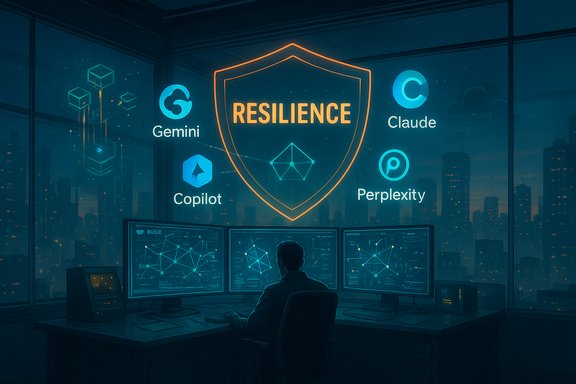
For knowledge workers and IT teams the lessons are immediate and actionable: adopt a tested multi‑AI toolbox, map and diversify edge dependencies, segregate admin access, and rehearse failure scenarios. Practically, that means knowing which assistant you reach for when the web front end of your primary tool fails (Perplexity for citations, Copilot for tenant‑bound drafting, Gemini for web‑grounded multimodal work, Claude for deep reasoning), having credentials and prompts ready, and ensuring your SRE playbooks include DNS and multi‑CDN failovers where business impact justifies the cost.
Short outages will continue to happen. The smarter reaction is not panic, but preparation: build redundancy into the productivity stack so a 25‑minute edge failure becomes an operational nuisance instead of a career‑defining downtime.
Source: MSN https://www.msn.com/en-in/money/new...vertelemetry=1&renderwebcomponents=1&wcseo=1]
 Background / Overview
Cloudflare — one of the world’s largest edge and security platforms — experienced two high‑visibility edge disruptions in late 2025 that produced user‑visible outages across dozens of major sites and conversational AI front ends. The first, on November 18, produced widespread HTTP 5xx responses and challenge interstitials that blocked access to web apps including ChatGPT. The second, on December 5, triggered a similar but technically distinct failure during a security‑hardening change; Cloudflare’s post‑mortem shows the incident lasted about 25 minutes and impacted roughly 28% of the HTTP traffic it serves. These interruptions were short in absolute time but wide in impact. For millions of knowledge workers, developers, students, and content teams the immediate operational question was simple and urgent: how do I keep working now that ChatGPT and other web‑fronted assistants are down? This article explains what happened at a technical level, why ChatGPT appeared to be “down” even when backend models were healthy, and which practical AI alternatives and operational steps teams should rely on during similar global edge disruptions.What happened — two incidents, shared lessons
November 18: malformed configuration files and intermittent recovery
On November 18 a configuration generation process produced a malformed “feature” file that propagated across parts of Cloudflare’s fleet. That bad file caused proxies to return 5xx errors intermittently — a pattern that looked like recovery and relapse because the invalid file was being regenerated periodically from an updating data cluster. The observable symptoms included Turnstile and other challenge systems failing to load and dashboards or login pages showing the now‑familiar “Please unblock challenges.cloudflare.com” interstitial. The result: many front ends that rely on Cloudflare’s validation and routing logic were unreachable to end users. This incident made it clear that an edge validation system designed to protect sites can, when internal logic goes wrong, block legitimate traffic at scale — a classic fail‑closed safety tradeoff.December 5: a security hardening change and a 25‑minute outage
Less than three weeks later Cloudflare rolled a change intended to harden Web Application Firewall (WAF) parsing in response to a security issue related to server component payloads. During that rollout an internal testing/tooling configuration was disabled globally; in a subset of older proxies (the FL1 proxy family) the change triggered a longstanding Lua runtime error in the rules module and produced HTTP 500 responses for affected customers. Cloudflare reverted the change and resolved the incident in roughly 25 minutes. The company reported about 28% of its HTTP traffic was affected during the window. Cloudflare explicitly stated the outage was not the result of a cyberattack. Multiple independent outlets and technical summaries confirm the high‑level sequence: a widespread vendor‑side change, a runtime exception on specific proxy versions, a rapid rollback, and broad but regionally uneven user impact. Journalistic coverage emphasizes the same systemic point raised after the November incident: the internet’s edge is now a high‑leverage failure surface.Why ChatGPT and other AI front ends looked “down”
Edge dependency, not model collapse
It’s important to separate two different layers of modern AI services:- The model and compute layer — the large language models (LLMs) running on clusters inside cloud providers.
- The public ingress/edge layer — CDNs, bot mitigation, WAF, TLS termination and session validation that sit between users and those backend servers.
Turnstile and “fail‑closed” mitigation
Cloudflare’s bot‑mitigation and challenge systems (Turnstile and related managed challenge stacks) are designed to prevent abuse. They operate as gatekeepers: when a session cannot be validated, the system defaults to blocking the request. That mitigative fail‑closed posture is sensible from a security standpoint but increases blast radius if the verification system itself becomes impaired. During the incidents many users saw error pages that specifically referenced challenge validation problems — clear evidence the failure happened at the edge validation layer.The measurable impact: who and what were affected
The outage lists changed by region, but the common patterns were consistent:- Conversational AI front ends (ChatGPT, some third‑party assistants that use Cloudflare for ingress).
- Social and content platforms (X, LinkedIn), creative SaaS (Canva), and streaming/music services (Spotify).
- Fintech and trading front ends in some regions, where payment or trading portals used Cloudflare proxies.
- Thousands of smaller websites that rely on Cloudflare’s DNS, TLS, WAF, or bot mitigation.
Immediate triage: what individuals and teams should do when the edge fails
When an edge provider is the choke point, end‑user actions are limited. Still, several practical steps can preserve short‑term productivity.Quick user triage (what to try immediately)
- Try a different network path: switch from Wi‑Fi to mobile data, or vice versa. Different routing sometimes reaches alternate PoPs that aren’t experiencing the same fault. This is a diagnostic workaround, not a cure.
- Try official mobile apps: mobile apps sometimes use alternate client endpoints that recovered earlier in pockets of the outage. Several users reported the ChatGPT mobile app functioning when the web front end did not.
- Check vendor status pages: always verify the vendor’s public status dashboard (OpenAI, Cloudflare, Microsoft) before making infrastructure changes. Status feeds are the authoritative source while incident updates are rolling.
Operator triage (for SREs, admins, and site owners)
- Consult the vendor incident feed and your own telemetry first — don’t trigger a rollback unless you can prove a local change caused the problem.
- If you have multi‑CDN or direct origin routes, consider enabling them. Programmatic DNS failover can be decisive if preconfigured and tested.
- Maintain an out‑of‑band admin path. If your admin console is fronted by the same problematic edge, you may lose the ability to roll back changes; segregate management paths where possible.
Short‑term productivity fix: three practical AI alternatives to use for work
If ChatGPT’s web access is down, you need dependable, task‑matched substitutes that keep teams productive. The following three tools are practical fallbacks for common work needs — each chosen because it covers the typical triage categories: research/citations, tenant‑grounded document work, and long‑form reasoning or code assistance.1) Google Gemini — best for live web grounding and multimodal tasks
Why pick it: Gemini is tightly integrated with Google Search and Workspace, offering strong real‑time web grounding and native access to Drive and Gmail for in‑document drafting and summarization. Gemini also supports multimodal inputs (images, audio, and increasingly video) and has developer APIs for programmatic use. For fact checks, current events, and multimedia tasks — especially when you already use Google Workspace — Gemini is an excellent fallback. Strengths:- Live web grounding via Google Search.
- Deep integration with Drive, Gmail, Docs for tenant‑aware drafting.
- Multimodal features for images, voice and screen/camera interactions.
- Ecosystem lock‑in for heavy Google Workspace users.
- Enterprise governance and data residency policies should be reviewed before sending sensitive data.
2) Microsoft 365 Copilot — best when you need tenant grounding inside Office apps
Why pick it: Microsoft Copilot excels at tenant‑grounded workflows inside Word, Excel, PowerPoint, Outlook and Teams. If your work depends on summarizing mailboxes, generating slides from internal documents, or producing Excel analyses with Python helpers, Copilot’s native Graph integration and enterprise controls make it the fastest path to continuity during a ChatGPT timeout. It also provides robust admin controls and contractual options for enterprise governance. Strengths:- Deep integration with Microsoft Graph for contextual responses based on your tenant data.
- Enterprise governance features and contractual non‑training options at higher tiers.
- Desktop and app integration for Windows users, reducing friction.
- Licensing complexity across tiers and SKU boundaries.
- Copilot capabilities vary by platform surface; check which entry points are available under your tenant plan.
3) Claude (Anthropic) and Perplexity — best for long‑form reasoning and source‑backed research
Why pick them: Claude (Anthropic) shines for long‑form reasoning, large context windows, advanced code assistance and enterprise‑grade controls; it’s a good choice for complex drafting, legal or regulatory work and technical analysis. Perplexity is a research‑first assistant that emphasizes citation transparency and real‑time web access — ideal when you need verifiable, source‑backed answers. Use Claude for depth and controlled reasoning tasks; use Perplexity when you need quick research with linked sources to back claims. Strengths:- Claude: very large context windows (200K tokens in Claude 3 family), strong steerability and agent toolchains.
- Perplexity: citation‑backed answers and real‑time web retrieval for up‑to‑the‑minute research.
- Pricing and rate limits for heavy workloads (check API tiers).
- Perplexity’s citation parsing occasionally struggles with bulk URL verification; always spot‑check critical references before publishing.
How to choose the right fallback under pressure
When ChatGPT is inaccessible, match the task to the tool quickly:- For quick factual lookups with links and citations: Perplexity.
- For tenant‑grounded drafting and document edits inside Office: Microsoft Copilot.
- For long context, deep reasoning, code debugging, or enterprise‑grade controls: Anthropic Claude.
- For multimodal, image/video tasks and broad web queries tied to Google services: Gemini.
- Confirm the alternative supports your required input format (file uploads, web grounding, code).
- Validate vendor data‑use and training policies if you’re sending regulated or sensitive content.
- Run a short verification prompt and spot‑check outputs for hallucination, especially where accuracy matters.
Critical analysis — strengths revealed and risks exposed
Notable strengths exposed by the incidents
- Rapid detection and transparent status updates reduced uncertainty. Cloudflare and downstream vendors provided real‑time incident feeds that helped engineers prioritize failovers.
- The outage validated the practical utility of a multi‑AI toolbox; teams that had pre‑identified fallbacks were far less disrupted. This is a low‑cost resilience pattern that every knowledge team can adopt immediately.
Structural risks that demand action
- Single‑vendor edge concentration is a real operational risk. Centralizing DNS, WAF, bot mitigation, and admin portals behind a single edge fabric creates a single external choke point. When that provider’s control plane or rollout logic misbehaves, it can propagate outages across industries.
- Operational coupling of admin and public surfaces is dangerous. If your admin consoles, SSO issuer, and public endpoints share the same ingress fabric, an outage can remove both access and the ability to remediate. Segregated admin paths and out‑of‑band recovery options are practical mitigations.
- Change‑control and rollout gating need stronger engineering guardrails. Both incidents involved configuration or code changes that propagated broadly; the fix is not exotic — it’s better validation, staged rollouts, and more robust rollback automation. Cloudflare’s own remediation roadmap emphasizes improved gating and propagation safeguards.
Communication and contractual gaps
Many organizations discover after an outage that SLAs and contractual remedies do not map cleanly to the real business impact of a partial internet outage (lost transactions, missed deadlines, reputational harm). Procurement teams should demand playbooks and joint runbooks that clarify escalation, remediation priorities, and comms expectations for outage events.Practical resilience playbook for Windows admins and teams
- Maintain an AI redundancy plan: keep credentials and 2–3 alternate assistants ready and tested (Copilot, Gemini, Claude/Perplexity). Store common prompts and templates in an accessible place.
- Map edge dependencies: inventory which services (DNS, CDN, WAF, Access) are fronted by each provider and mark the critical flows that require multi‑path ingress.
- Implement DNS failover and multi‑CDN where cost‑effective: test these failovers regularly and practice cutovers in low‑risk windows.
- Segregate admin/control plane access from public ingress: ensure CLI or out‑of‑band consoles exist to roll back changes if your GUI is unavailable.
- Practice tabletop drills for edge loss scenarios and rehearse incident comms with prewritten customer templates.
What to expect next and how to read vendor claims
Cloudflare and downstream vendors will publish formal post‑incident analyses that fill in technical timelines, logs and root causes. Early reporting described different proximate triggers for the two incidents (a malformed feature file in November and a WAF parsing change in December) — both accounts are consistent with internal configuration or software limits being exceeded rather than external attack. Treat early or third‑party speculation about precise causal chains as provisional until the vendor’s formal post‑mortem is published. If you are a Cloudflare customer, expect product‑level changes focused on:- tighter rollout gating,
- more conservative propagation of global configuration,
- additional validation on auto‑generated files,
- expanded telemetry and break‑glass procedures for critical subsystems.
Conclusion — operational resilience beats optimism
The short outages that left many users asking “why is ChatGPT down?” are a useful wake‑up call. They did not reveal a fundamental inability to run LLMs at scale; rather they exposed edge concentration risk and brittle change‑management guardrails in a small set of widely used ingress services.For knowledge workers and IT teams the lessons are immediate and actionable: adopt a tested multi‑AI toolbox, map and diversify edge dependencies, segregate admin access, and rehearse failure scenarios. Practically, that means knowing which assistant you reach for when the web front end of your primary tool fails (Perplexity for citations, Copilot for tenant‑bound drafting, Gemini for web‑grounded multimodal work, Claude for deep reasoning), having credentials and prompts ready, and ensuring your SRE playbooks include DNS and multi‑CDN failovers where business impact justifies the cost.
Short outages will continue to happen. The smarter reaction is not panic, but preparation: build redundancy into the productivity stack so a 25‑minute edge failure becomes an operational nuisance instead of a career‑defining downtime.
Source: MSN https://www.msn.com/en-in/money/new...vertelemetry=1&renderwebcomponents=1&wcseo=1]
