

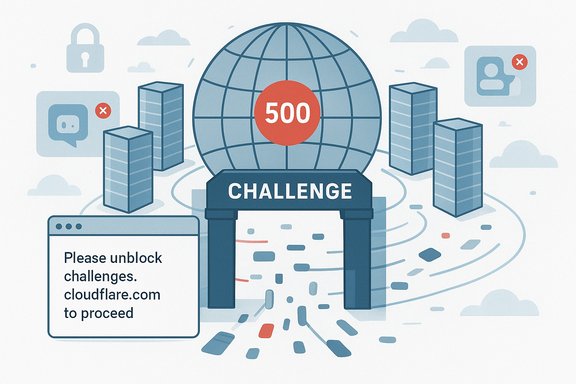
ChatGPT, X, Canva and a raft of other services intermittently failed for many users today after a major Cloudflare outage that left front‑end security checks returning 500 errors and the now‑notorious browser prompt — “Please unblock challenges.cloudflare.com to proceed.” The interruption illustrated, in stark terms, how much of the modern web sits behind a single edge provider: when Cloudflare’s challenge and edge systems degraded, many downstream applications immediately looked — to end users — like they were offline.
Cloudflare is one of the internet’s largest edge providers, offering a mix of services that include a global content delivery network (CDN), DDoS mitigation, DNS, web application firewalling (WAF), bot mitigation and lightweight challenge pages designed to separate human visitors from automated traffic. Those challenge systems — part of Cloudflare’s Managed Challenge and Turnstile stack — are intended to be mostly invisible to users, but when they fail they can block legitimate traffic at the edge. OpenAI and many other companies rely on Cloudflare to terminate TLS, run bot checks and cache or accelerate content for global users. When the edge fabric fails in ways that prevent successful challenge validation or token exchanges, the result for users is immediate: web clients get blocked or receive 500‑level responses even when the origin services (the application servers) are healthy. OpenAI’s status reporting page explicitly states that intermittent access issues for ChatGPT and related services were caused by “an issue with one of our third‑party service providers.” That language points squarely at an edge provider problem in this incident.
Recommended resilience measures for organizations that cannot tolerate short interruptions:
From a user perspective, the outage was painfully visible and produced the now‑familiar “Please unblock challenges.cloudflare.com” message — a sign that the gatekeepers at the edge were unable to do their job. From an operator view, the incident is a fresh signal to re‑examine failover plans, diversify critical dependencies, and insist on stronger transparency and post‑incident reporting from vendors who occupy the edge.
Cloudflare and affected customers have begun remediation and recovery steps, and the company’s status updates indicate progressive restoration for several services while engineers investigate and implement fixes. The full technical narrative will only be clear once Cloudflare publishes its post‑incident report; until then, the public facts are best summarized as: a Cloudflare internal degradation of challenge/edge services caused widespread user‑visible failures across multiple major services, including ChatGPT, X and others, and vendors are responding with triage and communications. For users impacted by today’s outage: patience and checking the official status feeds are the most practical immediate measures. For architects and enterprises: treat this as a timely reminder that edge convenience must be paired with real resilience engineering and contractual safeguards.
Source: Windows Central https://www.windowscentral.com/arti...one-major-cloudflare-outage-affecting-openai/
 Background
Cloudflare is one of the internet’s largest edge providers, offering a mix of services that include a global content delivery network (CDN), DDoS mitigation, DNS, web application firewalling (WAF), bot mitigation and lightweight challenge pages designed to separate human visitors from automated traffic. Those challenge systems — part of Cloudflare’s Managed Challenge and Turnstile stack — are intended to be mostly invisible to users, but when they fail they can block legitimate traffic at the edge. OpenAI and many other companies rely on Cloudflare to terminate TLS, run bot checks and cache or accelerate content for global users. When the edge fabric fails in ways that prevent successful challenge validation or token exchanges, the result for users is immediate: web clients get blocked or receive 500‑level responses even when the origin services (the application servers) are healthy. OpenAI’s status reporting page explicitly states that intermittent access issues for ChatGPT and related services were caused by “an issue with one of our third‑party service providers.” That language points squarely at an edge provider problem in this incident. What happened (timeline and public signals)
- Early reports and user telemetry began surfacing just after 06:00–07:00 ET, with outage trackers and social posts flagging simultaneous failures across multiple major sites. Community reports quickly converged on Cloudflare as the shared link.
- Cloudflare’s official status page moved from Investigating to Identified over the morning, with a series of updates showing progressive recovery for some subsystems (notably Access and WARP) while other application services continued to show elevated error rates. The status timeline includes Investigating at Nov 18, 2025 — 11:48 UTC and Identified / Fix in progress updates in the 12:00–14:00 UTC window.
- The Verge reported that Cloudflare engineers observed a “spike in unusual traffic” to one of its services and that the spike coincided with the error rates that blocked legitimate sessions; Cloudflare said it was “all hands on deck” to remediate and later restricted or re‑enabled some subsystems as recovery progressed. That account provides a contemporaneous investigator’s log from the company’s public spokespeople.
- OpenAI’s status page confirmed intermittent access issues affecting APIs, ChatGPT and Sora and identified a third‑party provider as the cause; OpenAI continued to post incremental updates while engineers and Cloudflare took steps to restore normal traffic flow.
Why “Please unblock challenges.cloudflare.com” appeared
Cloudflare’s “challenge” system is a gatekeeper: it evaluates whether a connecting client appears legitimate and issues a short, automated check (or a light interactive step) before letting the session proceed. These checks are a last line of defense against automated scraping, DDoS and abuse. Under normal conditions the challenge validation completes invisibly; during this outage the challenge endpoints themselves returned errors or failed to respond reliably, so browsers were shown the “unblock challenges.cloudflare.com” guidance (or were presented with challenge pages that could not be completed). The practical result is a fail‑closed effect: instead of letting traffic pass, the edge blocks it until it can verify the client. This behavior is an intentional safety posture for most edge filters — better to block questionable traffic than to let an attack or a bot flood through — but when the protective checks are the component that fails, the protection becomes the problem.Services hit and user impact
The outage affected a broad cross‑section of the consumer web and enterprise services. Reported and observed impacts included:- ChatGPT and other OpenAI surfaces: intermittent failures and challenge pages preventing access. OpenAI acknowledged the issue and linked it to a third‑party provider.
- X (Twitter): feeds and client apps failed to load for many users.
- Downdetector: the outage tracker itself was briefly impaired because it also uses Cloudflare protections.
- Productivity and creative tools such as Canva, plus gaming matchmaking and asset delivery for titles that rely on Cloudflare, showed intermittent errors. Users also reported errors while interacting with payment portals and bank web forms where a Cloudflare edge sat in front of critical endpoints.
Technical hypotheses and what we do — and don’t — know
Publicly available signals allow us to sketch plausible failure modes, but they do not constitute a definitive root‑cause analysis. The firmest public facts are:- Cloudflare acknowledged an internal service degradation and published status updates as engineers worked to restore normal operations.
- Observers (and Cloudflare statements reported by news outlets) described an unusual spike in traffic to one of Cloudflare’s services around the outage start, which the company said it was investigating.
- OpenAI confirmed its own symptoms were caused by a third‑party provider and listed intermittent access impacts.
- A software/logic bug in Cloudflare’s challenge or bot‑management subsystem that caused valid sessions to be incorrectly classified and blocked at scale.
- A cascading telemetry/configuration failure where a related third‑party (for example, a support or telemetry provider) became unavailable and affected Cloudflare’s ability to manage challenge workflows.
- A spike of malformed or automated traffic that triggered aggressive mitigation rules and caused legitimate client validations to fail (or caused internal control systems to behave in a mitigation posture that blocked normal traffic).
- Regional routing or PoP (point of presence) failures where maintenance or an unexpected routing condition left some PoPs unable to complete challenge validations — the Cloudflare status page does report scheduled maintenance in SCL (Santiago) that overlapped the event window and could have changed traffic patterns.
Short‑term advice for users and admins
If you encountered the challenge error, there are a few practical, short‑term steps and clarifications to keep in mind:- For most users: there is nothing you can reliably do to “fix” a global Cloudflare challenge outage. Clearing cookies, switching browsers or toggling DNS rarely helps because the edge check itself is failing for many PoPs. Patience is usually the only option while Cloudflare remediates.
- Try alternative clients or networks: sometimes mobile apps or alternate regions route traffic differently and may evade a problematic PoP; switching to mobile data or trying a different device may temporarily restore access.
- Use known fallback services: if you rely on AI assistants operationally, Microsoft Copilot and other vendor alternatives (Gemini, Claude, Perplexity) can provide short‑term continuity if they are not affected by the same edge provider. Some services already advertise they use different CDNs or architectures and remained reachable. Note that vendor architectures vary and some providers may also be impacted.
- For operators: check vendor dashboards first. If you are running critical services through Cloudflare, consult your Cloudflare dashboard and incident subscriptions, and prepare runbooks for fallback actions (development mode, origin direct routes, or alternate CDNs if you have them). Communicate clearly with customers and provide cached landing pages if possible.
- Confirm the outage via official status pages (Cloudflare, OpenAI) rather than changing network settings immediately.
- Try a hard refresh or a different network (mobile data) to check for partial recovery.
- If the problem persists, wait for vendor updates — most users regain access as PoPs recover and caches flush.
Long‑term lessons for architects and enterprises
This incident is another case study in the systemic risk of edge concentration. Cloud providers and edge networks deliver enormous scale and security benefits, but they also act as high‑leverage choke points when a control‑plane or challenge system fails.Recommended resilience measures for organizations that cannot tolerate short interruptions:
- Multi‑CDN and multi‑edge strategies: avoid placing all critical ingress and WAF/bot checks behind a single provider. Modern multi‑CDN solutions can fail over origin or offload static content if one provider degrades.
- Architect for graceful degradation: critical authentication and payment flows should be decoupled from synchronous edge checks when possible. Cache verification tokens, allow cached content where acceptable, and design retry/backoff logic to tolerate transient 5xx responses.
- Non‑portal admin paths: maintain out‑of‑band management and emergency consoles that do not depend on the public edge fabric used for customer traffic (for example, ensure your critical admin ops do not live solely behind the same CDN‑fronted control plane).
- Contract and SLA hygiene: insist on clear incident reporting, runbook access and post‑incident root‑cause analysis commitments from edge providers. These documents are essential for operational and legal preparedness.
- Exercise vendor failover regularly: run simulations of edge provider loss and validate incident communications, alternate DNS, and customer notification flows.
Regulatory and market implications
High‑visibility outages at major cloud or edge providers often spur two predictable responses: customer re‑evaluation of vendor lock‑in, and increased regulatory scrutiny about the concentration of critical internet infrastructure. Today’s outage joins a string of incidents at hyperscalers and edge providers that have raised systemic resilience questions for governments and enterprises. Expect renewed vendor risk reviews, contract renegotiations, and possibly heightened attention from procurement and regulatory bodies about meaningful multi‑provider strategies.What to watch next
- Cloudflare’s post‑incident report: the company typically produces a public analysis after a major disruption; that report will be the authoritative source for root cause, corrective actions and any follow‑on mitigations. Until that PIR is published, definitive technical statements should be treated as provisional.
- OpenAI’s incident timeline and downstream customer impact disclosures: OpenAI has already flagged third‑party provider issues on its status page; any expanded customer guidance or mitigation steps will be posted there.
- Vendor response and architecture shifts: expect customers that were disrupted to publicly discuss multi‑CDN or regional failover plans, and for some large tenants to accelerate contractual talks about resiliency and operational guarantees.
Final assessment
Today’s event was a high‑impact demonstration of an architectural trade‑off that has been obvious to systems engineers for years: centralizing edge security and delivery simplifies operations and improves performance, but it raises the systemic stakes when that edge fabric experiences a control‑plane or challenge‑validation failure.From a user perspective, the outage was painfully visible and produced the now‑familiar “Please unblock challenges.cloudflare.com” message — a sign that the gatekeepers at the edge were unable to do their job. From an operator view, the incident is a fresh signal to re‑examine failover plans, diversify critical dependencies, and insist on stronger transparency and post‑incident reporting from vendors who occupy the edge.
Cloudflare and affected customers have begun remediation and recovery steps, and the company’s status updates indicate progressive restoration for several services while engineers investigate and implement fixes. The full technical narrative will only be clear once Cloudflare publishes its post‑incident report; until then, the public facts are best summarized as: a Cloudflare internal degradation of challenge/edge services caused widespread user‑visible failures across multiple major services, including ChatGPT, X and others, and vendors are responding with triage and communications. For users impacted by today’s outage: patience and checking the official status feeds are the most practical immediate measures. For architects and enterprises: treat this as a timely reminder that edge convenience must be paired with real resilience engineering and contractual safeguards.
Source: Windows Central https://www.windowscentral.com/arti...one-major-cloudflare-outage-affecting-openai/
