

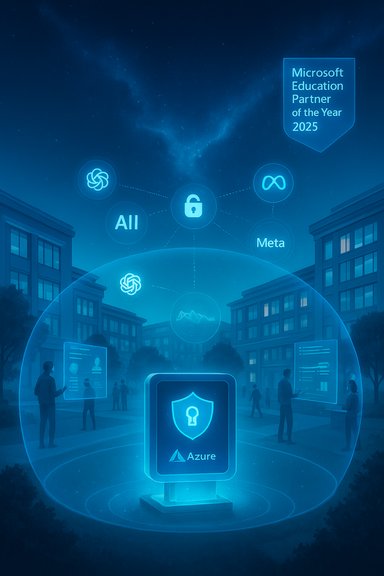
Cloudforce’s nebulaONE® platform has just been handed one of the most consequential industry seals of approval in education technology: Microsoft named Cloudforce its 2025 Education Partner of the Year, recognizing a secure AI delivery model that Cloudforce says is already in production at leading campuses around the world.
Microsoft’s annual Partner of the Year Awards spotlight partners whose solutions move Microsoft’s cloud and AI strategy into real, customer-facing outcomes. The 2025 awards emphasize partners delivering on large-scale AI and cloud transformations, and Microsoft singled out partners across categories and regions as part of the lead-up to Microsoft Ignite. Cloudforce’s recognition in the Education category places its nebulaONE® secure AI platform squarely in the spotlight for colleges, universities, and academic medical centers seeking private, compliant access to generative AI. Cloudforce and its nebulaONE® product have been public-facing priorities for the company throughout 2025. The platform launch in April was framed as a higher-education–focused “AI gateway” that runs inside a customer’s own Microsoft Azure tenancy, with case studies presented from institutions such as UCLA Anderson and London Business School. Those case studies have been used to demonstrate how nebulaONE can deliver rapid pilot-to-production timelines for classroom and administrative AI use cases.
Cloudforce’s 2025 Education Partner of the Year recognition is a strong indicator that its nebulaONE® platform has traction and industry visibility, especially for institutions seeking Azure-native, tenant-scoped alternatives to public LLM services. The award validates engineering and go-to-market execution; it does not, however, obviate the need for careful institutional evaluation of governance, compliance, costs and pedagogy. For campus IT leaders, the sensible path forward is to treat this recognition as a prompt to dig deeper—validate the vendor’s claims, run tightly scoped pilots, and build the organizational controls that convert platform capability into durable, responsible educational value.
Source: StreetInsider Cloudforce Named Microsoft Partner of the Year: Global Recognition Validates Transformative Impact of nebulaONE®, Cloudforce's Secure AI Platform
 Background / Overview
Microsoft’s annual Partner of the Year Awards spotlight partners whose solutions move Microsoft’s cloud and AI strategy into real, customer-facing outcomes. The 2025 awards emphasize partners delivering on large-scale AI and cloud transformations, and Microsoft singled out partners across categories and regions as part of the lead-up to Microsoft Ignite. Cloudforce’s recognition in the Education category places its nebulaONE® secure AI platform squarely in the spotlight for colleges, universities, and academic medical centers seeking private, compliant access to generative AI. Cloudforce and its nebulaONE® product have been public-facing priorities for the company throughout 2025. The platform launch in April was framed as a higher-education–focused “AI gateway” that runs inside a customer’s own Microsoft Azure tenancy, with case studies presented from institutions such as UCLA Anderson and London Business School. Those case studies have been used to demonstrate how nebulaONE can deliver rapid pilot-to-production timelines for classroom and administrative AI use cases. What is nebulaONE®? A concise technical profile
nebulaONE® is positioned as a secure generative AI gateway that aggregates model access, data connectors, governance controls, and user-facing interfaces inside an educational institution’s Azure environment. In marketing materials and case studies Cloudforce frames the core technical differentiators as:- Full deployment within a customer’s Microsoft Azure tenancy (private environment).
- Brokered access to multiple LLMs and multimodal models (OpenAI, Anthropic, Meta, Mistral, and others are listed in Cloudforce materials).
- Data governance and privacy controls intended to prevent institutional data from being used to train external models.
- Role-based access, per-user usage limits and cost/consumption controls.
- Integration support and implementation services delivered by Cloudforce engineers and Forward Deployed Engineers (FDEs).
Adoption, case studies and scale claims
Cloudforce’s announcement with the Microsoft award reiterates that nebulaONE has seen traction with “Oxford and London Business School to the University of Maryland and UCLA” and states that “over 85 universities, school systems, and academic medical centers use nebulaONE on Microsoft Azure,” reaching “millions of students, educators, and healthcare professionals.” Those figures appear in Cloudforce’s official press materials. The most detailed independent, public case material available today comes from university-specific writeups and the April product/eBook launch that highlighted UCLA Anderson’s 45-business-day deployment and London Business School’s rapid pilot-to-production timeline. Caveat on scale: Cloudforce’s “over 85” customer figure is presented in its press release. Independent, third-party verification of that exact number is not publicly available at the time of writing beyond Cloudforce’s own statements and related PR coverage, so this specific metric should be treated as a company-declared figure until corroborated by external procurement records or Microsoft’s official winners page detailing award rationale.Why Microsoft’s award matters
Being named Microsoft’s Education Partner of the Year carries three practical implications for Cloudforce and its customers:- Validation of technical integration with Azure AI stack. Microsoft’s partner awards are heavily weighted toward demonstrable deployments that run on and extend Microsoft cloud technologies; Cloudforce’s emphasis on private Azure tenancy deployments fits that expectation.
- Easier procurement and co-sell opportunity for universities. Award recognition raises a partner’s profile within Microsoft’s sales and partner ecosystem, which can accelerate introductions and co-sell motions into enterprise and public sector accounts.
- Signal to the market on governance-first AI delivery. Institutions wary of public model services—particularly healthcare units and research labs handling sensitive data—may view a Microsoft-validated partner as lower risk for initial AI rollouts.
Strengths and notable capabilities
These are the most defensible strengths that emerge from Cloudforce’s public materials and the reported use cases:- Private, tenant-scoped deployment model. For institutions that require strict data controls or must meet HIPAA/FERPA/GDPR obligations, running inference and orchestration inside an Azure subscription—rather than sending institutional data to a multi-tenant public service—can materially reduce legal and compliance friction when combined with proper contractual and technical controls. Case studies from UCLA explicitly cite the platform’s Azure deployment as a deciding factor.
- Multi-model access for use-case fit. nebulaONE’s ability to present a curated set of models (OpenAI, Anthropic, Meta, Mistral, DeepSeek among them in Cloudforce literature) lets institutions select model families tuned for cost, latency, or safety trade-offs. That flexibility is valuable for researchers, teaching assistants and digital services that require different behaviors from models.
- Rapid pilot-to-production cadence. Reported deployments—UCLA’s 45-business-day capstone chatbot, London Business School’s two-week pilot-to-platform narrative—suggest Cloudforce emphasizes rapid proof-of-value programs supported by hands-on engineering. That speed-to-solution is attractive for academic units under semester-driven deadlines.
- Operational controls for cost and governance. Cloudforce promotes per-user usage limits, consumption-based budgeting, and identity-integrated access (Canvas, Copilot, Microsoft Fabric integrations claimed), which help central IT reconcile AI spending and governance with campus identity and LMS systems. Institutional identity integration is repeatedly cited as a standout differentiator.
- Professional services / FDE engagement. Cloudforce’s Forward Deployed Engineers and subject-matter experts provide implementation, organizational change management, and integration services—an important capability that distinguishes product vendors from platform integrators. That human layer is a frequent reason academic IT shops pick vendors when timeline and compliance are critical.
Risks, gaps, and cautionary considerations
No platform is risk-free. The following are realistic concerns university IT and procurement leaders should weigh before a broad nebulaONE roll-out:- Vendor claim verification and transparency. The statement that “over 85 universities” are active nebulaONE customers originates from Cloudforce PR. Independent confirmation of that count (which institutions, contract scopes, and live production vs pilot status) is not publicly available. Institutions should require customer references and contract-level proof of similar deployments when evaluating Cloudforce.
- Regulatory compliance is contextual, not automatic. Running a platform inside Azure does not automatically make an institution HIPAA-, FERPA-, or GDPR-compliant. Compliance depends on data classification, encryption scope, logging, configuration management, contractual commitments (Data Processing Agreements), and institutional policies. Public claims that nebulaONE “enables compliance” are meaningful only when backed by detailed controls, SOC/ISO audit reports, and contract terms that align with an institution’s legal counsel. Treat such compliance statements as enablers, not substitutes, for legal review.
- Model governance and hallucination risk. Multi-model access is useful, but it also increases the surface area for unpredictable model behavior. Institutions using generative AI for research support, clinical decision aids or grading assistance must implement model validation, red-team testing, and explicit guardrails to manage hallucination, bias, and inappropriate content. Technical routing of sensitive queries to non-deterministic models without human review can create reputational and legal exposure.
- Academic integrity and pedagogy disruption. Rapid student access to powerful generative AI can alter assessment validity. Academic leaders must define acceptable use, redesign assessments, and create honor-code enforcement mechanisms where necessary. IT deployment should be paired with instructional design support, training, and transparency about AI-enabled tools in curricula.
- Lock-in, upgrade and lifecycle risk. While tenant-scoped deployment reduces data egress concerns, it can increase operational responsibilities and entrenchment around vendor-specific connectors and workflows. Institutions should document escape clauses, data export formats, model reproducibility, and service-level guarantees in procurement contracts.
- Costs at scale and consumption unpredictability. Consumption-based AI can be cost-effective for pilots but hard to forecast in campus-wide rollouts. Institutions need robust quota policies, automated throttles, and alerting to avoid large unexpected cloud bills. Cloudforce promotes per-user limits; buyers must validate that these controls are enforceable at account and billing levels.
- Supply-chain and third-party risk. Using multiple external models—each with its own vendor terms and security posture—creates a composite supply chain. Legal teams should review each model provider’s terms, data retention policies, and incident response commitments. Ensure that contractual flows are consistent with institutional risk tolerance.
How university IT leaders should evaluate nebulaONE and similar platforms: a practical checklist
- Confirm deployment topology and tenancy boundary. Request an architecture diagram that shows where inference happens, how keys are stored, and the flow of PII/PHI. Verify that the platform can be deployed inside the institution’s own Azure subscription and that all compute and logs remain within the institution’s control.
- Demand audited controls and compliance artifacts. Ask for SOC 2 / ISO 27001 reports, Azure Marketplace attestations, or third-party assessments. If claims include HIPAA/FERPA compliance, require a Data Processing Agreement and proof points (technical and contractual) that map to those regulations.
- Test model governance and safety controls. Run a red-team exercise to probe hallucination, bias, and data leakage. Confirm that administrators can restrict model choices, apply content filters, and log all queries at scale.
- Verify identity, audit and integration points. Ensure integrations with your LMS (Canvas, Blackboard), identity provider (Azure AD), and SIEM/log collection for retention/forensics are available and demonstrably working.
- Request total-cost-of-ownership scenarios. Insist on modeled cost examples for per-student monthly usage at small, medium and large scale. Confirm whether Cloudforce manages the Azure billing account or if the institution receives direct billing.
- Ask for real campus references and detailed case studies. A named reference who uses the platform for a comparable use case (and who is willing to speak about implementation, costs, and governance) is more valuable than a claim of broad adoption. Cloudforce’s UCLA and London Business School case studies are examples; ask for additional references in your region or sector.
- Include academic stakeholders in procurement. Faculty, registrars, ethics boards, and legal counsel should be part of the evaluation to identify pedagogical and compliance impacts early.
Competitive landscape and market context
Cloudforce is entering an education AI market that includes established EdTech vendors, systems integrators, and major platform partners. Competitors—both specialist education platform providers and large SIs—are also pursuing Azure-based or multi-cloud approaches to campus AI. Recent award winners and finalists in Microsoft’s ecosystem (multiple regional winners across categories) demonstrate both opportunity and competition; other education-focused vendors have been recognized in prior years and continue to invest in classroom AI features and governance tooling. In short, being a Microsoft Partner of the Year is influential, but not exclusive leverage: institution choice will be decided by feature fit, total cost and risk profile.Recommendations for responsible roll-out
- Start with low-risk, high-value pilots (admissions chatbots, administrative automation, library search assistants) and measure impact on time-savings, student satisfaction, and error rates.
- Pair every deployment with a documented risk assessment and an incident response plan that defines model misuse, data misuse, and breach scenarios.
- Invest in faculty development and clear academic policies that define acceptable uses, disclosure, and assessment redesign.
- Implement continuous monitoring—query logs, content moderation flags, model drift detection—and schedule periodic independent audits.
- Negotiate procurement terms that cover data ownership, exportability, model behavior change notices, and post-contract data deletion.
Final assessment: why the award matters — and where scrutiny is still due
Cloudforce’s Microsoft Education Partner of the Year award is a meaningful market signal: it acknowledges that Cloudforce has executed real campus deployments and aligned nebulaONE® with Microsoft’s Azure-first vision for responsible, partner-enabled AI. Public case studies from UCLA Anderson and London Business School demonstrate plausible, rapid impact scenarios and highlight the value of private-tenancy deployments for institutions with heightened privacy needs. At the same time, the most consequential claims—customer counts, exact compliance status across regulated institutions, and long-term total cost behavior—remain company-declared and require institutional due diligence. Compliance and risk management for generative AI are not off-the-shelf guarantees; they are programmatic outcomes that depend on configuration, contractual commitments, and disciplined governance by the institution. Institutions considering nebulaONE or any other campus-grade AI gateway should treat Cloudforce’s award as an important validation checkpoint, not the final procurement decision.Practical next steps for IT teams and decision-makers
- Request an architecture workshop and an Azure tenancy proof-of-concept to validate the claimed deployment model and data flows.
- Ask Cloudforce for at least three named higher-education references with live deployments and gather written statements on governance, billing, and operations.
- Run a parallel pilot with governance controls engaged: red-team tests, cost-limited workload, and faculty-led evaluation of pedagogical impacts.
- Secure contractual protections: DPA, indemnities for data misuse, termination export clauses, and a clear runbook for incident response.
- Develop campus-wide AI policy and instructional guidance before campus-wide rollouts, and create a phased adoption plan tied to measurable outcomes.
Cloudforce’s 2025 Education Partner of the Year recognition is a strong indicator that its nebulaONE® platform has traction and industry visibility, especially for institutions seeking Azure-native, tenant-scoped alternatives to public LLM services. The award validates engineering and go-to-market execution; it does not, however, obviate the need for careful institutional evaluation of governance, compliance, costs and pedagogy. For campus IT leaders, the sensible path forward is to treat this recognition as a prompt to dig deeper—validate the vendor’s claims, run tightly scoped pilots, and build the organizational controls that convert platform capability into durable, responsible educational value.
Source: StreetInsider Cloudforce Named Microsoft Partner of the Year: Global Recognition Validates Transformative Impact of nebulaONE®, Cloudforce's Secure AI Platform
