

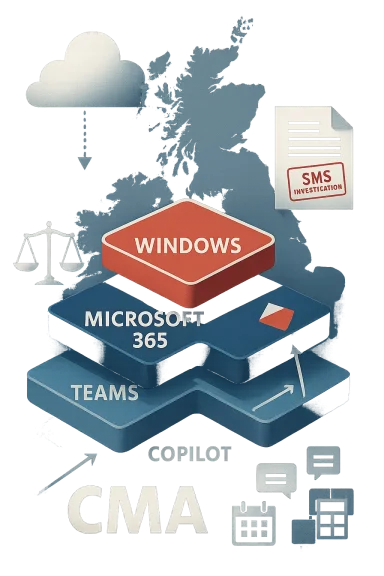
The UK’s Competition and Markets Authority has moved from cloud infrastructure into the broader Microsoft productivity stack, opening a strategic market status investigation that could reshape how Windows, Microsoft 365, Teams, and Copilot are packaged, licensed, and interoperable in Britain. The timing matters: the CMA is acting after its cloud market inquiry found that Microsoft’s licensing practices could reduce competition, while AI is now being woven into the very software categories that millions of UK workers use every day. For businesses and public bodies, this is no longer just about switching cloud providers; it is about whether the dominant workplace platform can be regulated before AI cements its position inside the default office software layer.
The CMA’s latest move is best understood as the next step in a longer campaign to interrogate power in digital markets rather than a standalone Microsoft case. In 2025, the regulator’s cloud services market investigation found that competition in the UK cloud market was not working as well as it should, and it recommended that the CMA consider strategic market status investigations for Microsoft and AWS under the new digital markets regime. That recommendation was not merely symbolic. It was an explicit invitation to use a new toolbox designed for conduct requirements and pro-competition interventions, not just retrospective findings. (gov.uk)
The new investigation broadens the lens from infrastructure to the software layers that sit on top of it. Microsoft’s business software ecosystem includes Windows, Word, Excel, Teams, and increasingly Copilot, which means the CMA is now examining a set of products that shapes office productivity, collaboration, and AI adoption across public and private sectors. That matters because platform power in productivity software is often subtler than in consumer apps: the issue is not always outright exclusion, but the ability to set defaults, bundle services, and make switching feel expensive, risky, or technically awkward. That kind of leverage is exactly what digital markets rules are meant to test.
The CMA has already shown, in its mobile platform decisions, that it intends to use the new regime aggressively but pragmatically. In October 2025, it designated Apple and Google with strategic market status in their mobile platforms, explaining that the designation itself is not a finding of wrongdoing, but a gateway to targeted interventions. The agency has also signalled that it wants to act quickly where it can deliver practical benefits, while leaving room for more formal obligations if voluntary changes do not hold up. That pattern is now being repeated in Microsoft’s case. (gov.uk)
What makes this investigation especially significant is that it sits at the intersection of three overlapping policy concerns: cloud switching costs, software licensing, and AI competition. The CMA has already said that the cloud inquiry raised concerns around egress fees, technical barriers, and licensing terms, while current market dynamics suggest AI assistants like Copilot are becoming embedded in the same products that benefit from those existing switching frictions. In other words, the regulator is not just asking whether Microsoft is strong today; it is asking whether the company is using old advantages in cloud and software distribution to lock in the next generation of workplace AI. (gov.uk)
The more strategic answer is that the regulator believes the problem has evolved. In cloud, the concern was that Microsoft’s licensing could distort competition by making it less attractive to run Microsoft software on rival clouds. In productivity software, the concern becomes broader: if that same licensing power extends into AI-enabled workplace tools, then the company may be able to shape not just where customers host workloads, but how they work. That is a more durable form of market power.
There is also a political economy element here. The CMA repeatedly frames its work as supporting growth, innovation, and choice, which is not accidental. UK policymakers want digital markets to stay open while avoiding blunt interventions that might chill investment. That balancing act is why the regulator has been so insistent that SMS designation is not punishment; it is a mechanism for calibrated oversight.
Microsoft’s licensing practices became a focal point because they allegedly made it harder for customers to use Microsoft software in rival clouds on fair terms. That allegation has broad implications. If a customer pays for the software but faces worse economics when deploying it off-platform, the cloud choice may be technically open but commercially constrained. The CMA’s concern was therefore not simply about price, but about whether licensing policy itself can function as a competitive barrier. (gov.uk)
The CMA’s cloud findings suggest it viewed these dynamics as structural, not incidental. That distinction is important because structural problems call for structural oversight. A customer can negotiate around a one-off price increase, but it is far harder to negotiate away a platform-level rule that affects thousands of workloads. That is why regulators care about defaults, bundles, and discriminatory terms.
The move also reflects the pace of AI integration. In 2025, Copilot was already important; by 2026, it is becoming part of the sales pitch for productivity software across enterprises. If AI features are bundled into the same licenses and user environments that already dominate workplace software, the market may tip further before rivals can catch up. The CMA appears to be trying to get ahead of that lock-in effect.
That is a classic platform-regulation problem, but it has a modern AI twist. Historically, the issue might have been bundling or default placement. Today, the question is whether the AI assistant becomes the interface through which work gets done, making whichever vendor controls the assistant a gatekeeper for data, workflows, and user attention. The market power is no longer just in the file format; it is in the workflow layer.
The regulator is also looking at a market that is central to public-sector efficiency. Hundreds of thousands of UK businesses and public bodies rely on Microsoft products, which means any conduct remedy could have wide spillover effects. The upside is obvious: better interoperability and fairer licensing could lower costs and widen choice. The downside is that even small adjustments may have large operational consequences if they are not carefully designed.
This is why the CMA’s timing is notable. AI competition is still fluid, but it is also increasingly concentrated around incumbent distribution channels. If the first mass-market AI assistants are embedded in dominant office suites, then the competition question shifts from model quality alone to ecosystem control. That is a much harder market to enter.
This is a meaningful shift because AI competition often looks open at the model layer and closed at the distribution layer. Many companies can build models, but far fewer control the operating systems, office suites, collaboration tools, and admin permissions through which AI reaches workers. Microsoft has one of the strongest positions in that distribution stack, which is why Copilot is not being assessed in isolation.
That is also why enterprise buyers tend to overestimate substitutability. They may compare AI features in a spreadsheet, but the real cost of adopting a competing assistant includes change management, compliance review, user retraining, and integration with line-of-business systems. The CMA appears to understand that friction. The issue is not whether alternatives exist; it is whether they can be used at scale on fair terms.
For public-sector users, the implications are even sharper. Governments often standardise around a small number of vendors for security and procurement simplicity, which can unintentionally strengthen incumbent control. The CMA’s action suggests it is worried that public bodies could end up paying for convenience with reduced bargaining power and less innovation.
It will also likely argue that AI integration is still early and that competition remains intense. Rivals in cloud, productivity, and AI are all active, and customers can increasingly mix and match services. From Microsoft’s perspective, the CMA risks intervening before the market settles, potentially freezing a competitive landscape that is still being defined. That argument may resonate with firms that fear regulatory overreach.
That defence, however, only goes so far. Integration becomes a competition problem if rivals are unable to match it because access to the necessary interfaces, data, or defaults is blocked. So the real question is not whether Microsoft’s stack is useful, but whether the terms of access are fair and contestable.
Still, the regulator’s response is likely to be that targeted conduct rules are not the same as structural break-ups. The whole point of the SMS regime is to allow proportionate interventions that preserve investment while addressing market power. In theory, that should make the case less ideological and more surgical.
From a policy standpoint, that matters because a Microsoft-only intervention may improve conditions at the margin while leaving the market structure intact. On the other hand, trying to regulate every dominant player at once could overwhelm the regulator and create uncertainty for legitimate business models. The CMA seems to be choosing a phased approach, beginning where the evidence is strongest and where the public impact is broadest.
At the same time, some industry observers warn against assuming that regulatory action alone can solve cloud or AI portability. Data migration is difficult, governance is complex, and workloads are often customised around proprietary tools. That means even the most ambitious remedy may improve competition without eliminating friction altogether. In this market, perfection is not a realistic policy goal.
For public-sector organisations, the stakes are arguably higher. Government departments and agencies often depend on large standardised software estates, which can magnify the impact of any licensing change or platform constraint. If the CMA can reduce hidden switching costs or improve data mobility, public bodies may gain both financial savings and operational resilience.
That does not mean wholesale decoupling is practical. But it does mean that Microsoft’s ecosystem may no longer be treated as the default answer without negotiation. The bargaining table just got a little wider.
The challenge is implementation. Government IT estates are complex, and any regulatory remedy that ignores that complexity could produce more paperwork than competition. The best outcome would be targeted relief that improves choice without forcing disruptive migrations.
Another concern is selectivity. If the CMA applies pressure to Microsoft while leaving structurally similar firms outside the scope of scrutiny, it risks accusations of inconsistency. A credible digital markets regime must be principled, not just forceful.
The most important question is whether the regulator can translate cloud-era concerns into business-software remedies that actually change customer behaviour. If it can reduce licensing friction, improve interoperability, and preserve room for rival AI tools, this will be a meaningful test case for the UK’s digital markets regime. If not, Microsoft may remain the dominant organising layer for enterprise productivity while regulators continue to chase the market one layer at a time.
The most likely outcome is not a dramatic rupture but a series of careful pressure points: narrower licensing terms, better interoperability, clearer switching rights, and more scrutiny of bundled AI. Those changes would not remove Microsoft’s advantage, but they could make that advantage contestable. And in digital markets, contestability is often the difference between a dominant platform and a genuinely competitive one.
Source: businesscloud.co.uk UK watchdog to investigate Microsoft’s business software ecosystem
 Overview
The CMA’s latest move is best understood as the next step in a longer campaign to interrogate power in digital markets rather than a standalone Microsoft case. In 2025, the regulator’s cloud services market investigation found that competition in the UK cloud market was not working as well as it should, and it recommended that the CMA consider strategic market status investigations for Microsoft and AWS under the new digital markets regime. That recommendation was not merely symbolic. It was an explicit invitation to use a new toolbox designed for conduct requirements and pro-competition interventions, not just retrospective findings. (gov.uk)The new investigation broadens the lens from infrastructure to the software layers that sit on top of it. Microsoft’s business software ecosystem includes Windows, Word, Excel, Teams, and increasingly Copilot, which means the CMA is now examining a set of products that shapes office productivity, collaboration, and AI adoption across public and private sectors. That matters because platform power in productivity software is often subtler than in consumer apps: the issue is not always outright exclusion, but the ability to set defaults, bundle services, and make switching feel expensive, risky, or technically awkward. That kind of leverage is exactly what digital markets rules are meant to test.
The CMA has already shown, in its mobile platform decisions, that it intends to use the new regime aggressively but pragmatically. In October 2025, it designated Apple and Google with strategic market status in their mobile platforms, explaining that the designation itself is not a finding of wrongdoing, but a gateway to targeted interventions. The agency has also signalled that it wants to act quickly where it can deliver practical benefits, while leaving room for more formal obligations if voluntary changes do not hold up. That pattern is now being repeated in Microsoft’s case. (gov.uk)
What makes this investigation especially significant is that it sits at the intersection of three overlapping policy concerns: cloud switching costs, software licensing, and AI competition. The CMA has already said that the cloud inquiry raised concerns around egress fees, technical barriers, and licensing terms, while current market dynamics suggest AI assistants like Copilot are becoming embedded in the same products that benefit from those existing switching frictions. In other words, the regulator is not just asking whether Microsoft is strong today; it is asking whether the company is using old advantages in cloud and software distribution to lock in the next generation of workplace AI. (gov.uk)
Why the CMA is moving now
The simplest answer is that the new regime gives the CMA more flexibility. Under the Digital Markets, Competition and Consumers Act, an SMS designation allows the regulator to impose legally binding conduct requirements or pro-competition interventions on the specific digital activity it has designated. That is a much more focused approach than a traditional market investigation, and it gives the CMA a way to address licensing, interoperability, and technical standards without waiting for a broad competition case to wind its way through the system. (gov.uk)The more strategic answer is that the regulator believes the problem has evolved. In cloud, the concern was that Microsoft’s licensing could distort competition by making it less attractive to run Microsoft software on rival clouds. In productivity software, the concern becomes broader: if that same licensing power extends into AI-enabled workplace tools, then the company may be able to shape not just where customers host workloads, but how they work. That is a more durable form of market power.
The regulatory backdrop
The CMA’s digital markets regime only came into force on 1 January 2025, so this is still a relatively new enforcement architecture. Yet the agency has already built a clear pattern: identify a gatekeeper, designate where legal tests are met, then consult on proportionate interventions. That sequence has been visible in mobile platforms, and it now appears to be carrying over to business software. The result is a regulatory environment where big tech firms cannot assume that a single market study will close the book on conduct concerns. (gov.uk)There is also a political economy element here. The CMA repeatedly frames its work as supporting growth, innovation, and choice, which is not accidental. UK policymakers want digital markets to stay open while avoiding blunt interventions that might chill investment. That balancing act is why the regulator has been so insistent that SMS designation is not punishment; it is a mechanism for calibrated oversight.
What the cloud inquiry changed
The cloud services inquiry is the foundation stone for everything that follows. The CMA’s final decision in 2025 closed one chapter but opened another by recommending that the agency prioritise SMS investigations into Microsoft and AWS. It also found that egress fees and technical barriers were harmful features in the market, while committed spend discounts did not currently harm competition in the same way. That distinction matters, because it suggests the CMA is trying to isolate the most distortionary practices rather than condemn cloud pricing wholesale. (gov.uk)Microsoft’s licensing practices became a focal point because they allegedly made it harder for customers to use Microsoft software in rival clouds on fair terms. That allegation has broad implications. If a customer pays for the software but faces worse economics when deploying it off-platform, the cloud choice may be technically open but commercially constrained. The CMA’s concern was therefore not simply about price, but about whether licensing policy itself can function as a competitive barrier. (gov.uk)
Licensing as a competitive lever
Licensing is one of Microsoft’s most powerful strategic tools because it sits between software demand and infrastructure choice. If the pricing or terms differ depending on where software runs, customers may remain on the incumbent platform even when alternatives are technically viable. This kind of pressure is especially strong in large enterprises, where procurement teams calculate not only unit cost but also operational risk, migration complexity, and support implications.The CMA’s cloud findings suggest it viewed these dynamics as structural, not incidental. That distinction is important because structural problems call for structural oversight. A customer can negotiate around a one-off price increase, but it is far harder to negotiate away a platform-level rule that affects thousands of workloads. That is why regulators care about defaults, bundles, and discriminatory terms.
What changed between 2025 and 2026
The new Microsoft probe implies the CMA believes the cloud findings were not enough on their own. If Microsoft still retains the power to influence cloud competition through software licensing, then the regulator may want to address the issue closer to the source: the software ecosystem itself. That is a sharper, more ambitious approach. It also suggests the CMA does not want to rely solely on cloud-specific remedies when the root causes may sit in the office software stack.The move also reflects the pace of AI integration. In 2025, Copilot was already important; by 2026, it is becoming part of the sales pitch for productivity software across enterprises. If AI features are bundled into the same licenses and user environments that already dominate workplace software, the market may tip further before rivals can catch up. The CMA appears to be trying to get ahead of that lock-in effect.
Key cloud-market lessons
- Egress fees can deter switching even when the cloud market appears competitive on paper.
- Licensing terms can influence cloud choice as much as infrastructure quality.
- Technical barriers often combine with commercial barriers to raise real-world migration costs.
- Multi-cloud strategies depend on interoperability that is both contractual and practical.
- Proactive remedies are now the CMA’s preferred answer when markets look sticky.
Why Microsoft’s office stack is now under the microscope
Microsoft’s business software ecosystem is not a single product; it is a distribution system for daily work. Windows controls the desktop environment, Microsoft 365 anchors productivity, Teams owns a huge share of enterprise collaboration, and Copilot is increasingly the AI layer that links them together. The CMA’s concern is that this stack could enable Microsoft to translate dominance in one layer into leverage in the next.That is a classic platform-regulation problem, but it has a modern AI twist. Historically, the issue might have been bundling or default placement. Today, the question is whether the AI assistant becomes the interface through which work gets done, making whichever vendor controls the assistant a gatekeeper for data, workflows, and user attention. The market power is no longer just in the file format; it is in the workflow layer.
The importance of the productivity layer
Productivity software is sticky because entire organisations standardise around it. Training, templates, document formats, meeting habits, and admin processes all reinforce the status quo. In consumer tech, switching can be annoying; in enterprise tech, switching can be expensive, disruptive, and politically fraught. That is why the CMA’s decision to investigate Microsoft’s office stack is so consequential.The regulator is also looking at a market that is central to public-sector efficiency. Hundreds of thousands of UK businesses and public bodies rely on Microsoft products, which means any conduct remedy could have wide spillover effects. The upside is obvious: better interoperability and fairer licensing could lower costs and widen choice. The downside is that even small adjustments may have large operational consequences if they are not carefully designed.
Copilot changes the competitive equation
Copilot is not just another feature. It is an AI layer that sits inside familiar applications, using access to documents, calendars, meetings, and emails to offer productivity gains. That creates a powerful adoption loop: the more integrated the assistant is with existing Microsoft software, the more likely customers are to prefer it, and the harder it becomes for rivals to offer a comparable experience without the same data access.This is why the CMA’s timing is notable. AI competition is still fluid, but it is also increasingly concentrated around incumbent distribution channels. If the first mass-market AI assistants are embedded in dominant office suites, then the competition question shifts from model quality alone to ecosystem control. That is a much harder market to enter.
Practical questions the probe will likely ask
- Does Microsoft’s licensing make rival clouds less attractive for its own software?
- Are Copilot features tied too tightly to Microsoft 365 or Windows?
- Can businesses move data and workflows easily between Microsoft and non-Microsoft environments?
- Do interoperability rules adequately support third-party innovation?
- Are enterprise customers getting meaningful choice, or just a menu of Microsoft-branded options?
The AI angle: competition moves from software to workflow
The CMA’s framing of the Microsoft investigation shows just how much AI has changed the competition agenda. The agency is not simply protecting legacy software rivals; it is trying to ensure that AI-driven innovation does not harden into a new kind of monopoly architecture. In practice, that means looking at whether productivity AI is entering the market through open interfaces or through closed ecosystems that lock customers into one vendor’s stack.This is a meaningful shift because AI competition often looks open at the model layer and closed at the distribution layer. Many companies can build models, but far fewer control the operating systems, office suites, collaboration tools, and admin permissions through which AI reaches workers. Microsoft has one of the strongest positions in that distribution stack, which is why Copilot is not being assessed in isolation.
Ecosystem power versus model power
A useful way to think about the market is to separate model capability from ecosystem control. A rival AI model may be good, cheaper, or faster, but still lose if it cannot integrate into the user’s daily workflow with the same depth. That is especially true in regulated sectors and government, where identity management, audit controls, and document retention matter as much as chatbot performance.That is also why enterprise buyers tend to overestimate substitutability. They may compare AI features in a spreadsheet, but the real cost of adopting a competing assistant includes change management, compliance review, user retraining, and integration with line-of-business systems. The CMA appears to understand that friction. The issue is not whether alternatives exist; it is whether they can be used at scale on fair terms.
The enterprise versus consumer split
In consumer markets, AI assistant competition is often about convenience and novelty. In enterprise markets, it is about reliability, governance, and integration. Microsoft’s advantage is especially pronounced in enterprise because the company already sits inside the document, meeting, and identity layers that matter most to organisations. That gives it a distribution edge that is very difficult for smaller rivals to replicate.For public-sector users, the implications are even sharper. Governments often standardise around a small number of vendors for security and procurement simplicity, which can unintentionally strengthen incumbent control. The CMA’s action suggests it is worried that public bodies could end up paying for convenience with reduced bargaining power and less innovation.
AI market consequences the CMA may be tracking
- Integrated assistants may deepen lock-in if they require proprietary data access.
- Enterprise procurement may favour incumbents unless interoperability is mandated.
- Governance requirements can raise the bar for new entrants.
- Default placement can shape user habits before competition has time to mature.
- AI bundling may blur the line between software pricing and market access.
Microsoft’s likely defence
Microsoft will almost certainly argue that its ecosystem benefits customers through integration, security, and lower administrative burden. That is a credible defence because many businesses genuinely prefer one vendor across identity, collaboration, productivity, and device management. A unified stack can reduce complexity, speed deployment, and improve support outcomes. The company can therefore present itself as a provider of efficiency, not exclusion.It will also likely argue that AI integration is still early and that competition remains intense. Rivals in cloud, productivity, and AI are all active, and customers can increasingly mix and match services. From Microsoft’s perspective, the CMA risks intervening before the market settles, potentially freezing a competitive landscape that is still being defined. That argument may resonate with firms that fear regulatory overreach.
The integration argument
Microsoft’s strongest defence is that product integration creates genuine value. Windows, Microsoft 365, Teams, and Copilot work better together because they share identity, policy, and data connections. For many customers, that is not a trap; it is the reason they buy the platform in the first place. The company will likely say that regulators should not mistake customer preference for coercion.That defence, however, only goes so far. Integration becomes a competition problem if rivals are unable to match it because access to the necessary interfaces, data, or defaults is blocked. So the real question is not whether Microsoft’s stack is useful, but whether the terms of access are fair and contestable.
The innovation argument
Microsoft will also stress that broad intervention could slow product development or reduce incentives to invest in AI. If the CMA pushes too hard on licensing or bundling, Microsoft may say it could make it harder to launch new features quickly or to maintain the security posture that enterprise buyers expect. That concern is especially relevant in AI, where trust and safe deployment remain central concerns for enterprise adoption.Still, the regulator’s response is likely to be that targeted conduct rules are not the same as structural break-ups. The whole point of the SMS regime is to allow proportionate interventions that preserve investment while addressing market power. In theory, that should make the case less ideological and more surgical.
What Microsoft may try to demonstrate
- Its licensing is commercially justified and not exclusionary.
- Customers retain real alternatives across cloud and productivity markets.
- Copilot competes in a broader AI landscape rather than controlling it.
- Security and compliance benefits explain much of the ecosystem preference.
- Any intervention should be narrowly tailored and evidence-based.
What the industry response tells us
The CMA’s announcement has already drawn mixed reactions from the market, which is telling in itself. Critics of hyperscaler dominance see the probe as overdue, while some cloud and data vendors worry that focusing on Microsoft alone could miss broader structural issues. That split reflects a deeper debate: is the problem one company’s conduct, or the power of the entire hyperscaler model?From a policy standpoint, that matters because a Microsoft-only intervention may improve conditions at the margin while leaving the market structure intact. On the other hand, trying to regulate every dominant player at once could overwhelm the regulator and create uncertainty for legitimate business models. The CMA seems to be choosing a phased approach, beginning where the evidence is strongest and where the public impact is broadest.
Voices from adjacent markets
Cloud competitors and hybrid data providers tend to support tougher oversight because they face the brunt of ecosystem leverage. They argue that customers want flexibility but encounter hidden or deferred switching costs. Their criticism is not just about pricing; it is about the cumulative effect of commercial terms, technical dependencies, and integration bias.At the same time, some industry observers warn against assuming that regulatory action alone can solve cloud or AI portability. Data migration is difficult, governance is complex, and workloads are often customised around proprietary tools. That means even the most ambitious remedy may improve competition without eliminating friction altogether. In this market, perfection is not a realistic policy goal.
Why the CMA may care about third-party reactions
The regulator has learned that credible remedies require understanding operational reality. If firms say switching is easy but customers disagree, the agency will pay attention to the customers. If rivals say they are blocked, the CMA will ask whether the block is technical, contractual, or economic. Those distinctions will shape what comes next, and they are likely to matter more than the headlines.Industry themes worth watching
- Some vendors want the CMA to address structural lock-in, not just licensing.
- Others fear overcorrection that could create compliance burdens without real competition gains.
- Hybrid-cloud firms see an opportunity to push for interoperability standards.
- Enterprise users want cost relief but do not want migration chaos.
- AI vendors are watching to see whether office software becomes the next regulatory frontier.
How this affects UK businesses and public bodies
For most organisations, the most immediate impact of the probe is not a legal change but a strategic one. If the CMA succeeds, Microsoft customers may eventually gain more leverage in contract negotiations, more clarity on interoperability, and less friction in multi-cloud or hybrid deployments. That could lower long-term costs and make diversification less painful. It could also give procurement teams stronger grounds to demand portability and transparency.For public-sector organisations, the stakes are arguably higher. Government departments and agencies often depend on large standardised software estates, which can magnify the impact of any licensing change or platform constraint. If the CMA can reduce hidden switching costs or improve data mobility, public bodies may gain both financial savings and operational resilience.
Enterprise procurement implications
Enterprise buyers should view the investigation as a signal to re-examine vendor dependency. Contracts that once seemed standard may now deserve closer scrutiny around data access, cloud portability, and AI integration rights. Procurement teams will likely want to ask harder questions about where Copilot data flows, what happens when licences lapse, and how multi-cloud support is actually implemented.That does not mean wholesale decoupling is practical. But it does mean that Microsoft’s ecosystem may no longer be treated as the default answer without negotiation. The bargaining table just got a little wider.
Public-sector implications
Public bodies tend to value continuity, security, and auditability. Those preferences often make Microsoft an attractive choice, but they also create long-term dependency if competitive pressure is weak. The CMA’s probe may therefore benefit public-sector buyers indirectly by increasing market transparency and improving their leverage over renewal terms.The challenge is implementation. Government IT estates are complex, and any regulatory remedy that ignores that complexity could produce more paperwork than competition. The best outcome would be targeted relief that improves choice without forcing disruptive migrations.
Practical outcomes organisations may want
- Contract reviews focused on licensing symmetry across clouds.
- Data portability planning for AI-augmented workflows.
- Interoperability audits for collaboration and identity tools.
- Procurement language that protects switching options.
- Governance controls for Copilot and other embedded AI features.
Strengths and Opportunities
The CMA’s approach has several strengths if it can stay disciplined and evidence-based. It is moving early, before AI lock-in becomes harder to unwind, and it is using a legal framework designed for targeted action rather than blanket prohibition. It is also aligning competition policy with real-world procurement concerns, which should make any remedy more relevant to actual UK customers.- Early intervention may prevent deeper lock-in.
- Targeted powers reduce the need for broad, blunt remedies.
- Interoperability goals could lower switching friction.
- Fair licensing could improve cloud competition.
- AI oversight may stop productivity software from becoming a closed gatekeeper.
- Public-sector benefits could include stronger bargaining power and lower costs.
- Market clarity may encourage investment by smaller rivals who know the rules.
Opportunity for a more open ecosystem
A successful intervention could create room for a healthier mix of vendors. That would not mean weakening Microsoft across the board; it would mean ensuring customers can use Microsoft products without being penalised for choosing a rival cloud or a competing AI tool. For businesses, that sort of openness is often the difference between theoretical choice and usable choice.Risks and Concerns
There are also real risks. The most obvious is overreach: if the CMA intervenes too broadly, it could create compliance burdens that hit smaller customers hardest or slow legitimate innovation. Another risk is underreach, where the regulator focuses on narrow symptoms while leaving the broader ecosystem advantages intact. In a market this complex, both mistakes are plausible.- Overly narrow remedies may fail to change market structure.
- Overly broad rules could increase compliance costs.
- Technical complexity may make enforcement hard to monitor.
- Voluntary commitments can be useful but may lack durability.
- Interoperability claims may outpace real engineering feasibility.
- Regulatory imbalance could emerge if similar firms are treated differently.
- AI uncertainty makes it difficult to define the right boundary for intervention.
The risk of treating remedies as simple fixes
One concern raised by industry observers is that cloud and AI portability is inherently messy. Data formats, access controls, application dependencies, and identity systems do not move cleanly from one environment to another. If regulators promise easy switching, they may set expectations that the market cannot meet. That would damage credibility as much as it would help competition.Another concern is selectivity. If the CMA applies pressure to Microsoft while leaving structurally similar firms outside the scope of scrutiny, it risks accusations of inconsistency. A credible digital markets regime must be principled, not just forceful.
Enforcement and measurement problems
Even good remedies can be hard to measure. If licensing terms improve but prices rise elsewhere, is competition actually better? If AI assistants become more interoperable but adoption remains concentrated, has the market truly opened? These are not easy questions, and they underline why the CMA’s monitoring role will matter as much as the initial designation.Looking Ahead
The next phase will determine whether this becomes a landmark case or simply another important but partial regulatory step. The CMA has already shown, through its mobile platform work, that it is prepared to use the new regime to secure voluntary commitments first and formal requirements later if needed. That suggests the Microsoft investigation may evolve in stages, with consultation, evidence gathering, and possible conduct requirements following if the legal tests are met. (gov.uk)The most important question is whether the regulator can translate cloud-era concerns into business-software remedies that actually change customer behaviour. If it can reduce licensing friction, improve interoperability, and preserve room for rival AI tools, this will be a meaningful test case for the UK’s digital markets regime. If not, Microsoft may remain the dominant organising layer for enterprise productivity while regulators continue to chase the market one layer at a time.
What to watch next
- Whether the CMA opens the SMS investigation in the timeframe it has indicated.
- Whether Microsoft responds with voluntary commitments before formal action.
- Whether the probe focuses narrowly on licensing or broadens to Copilot and interoperability.
- Whether other regulators, including overseas agencies, move in parallel.
- Whether enterprise customers start pressing vendors for more portability clauses.
- Whether the CMA’s eventual remedy targets cloud, software, or both.
The most likely outcome is not a dramatic rupture but a series of careful pressure points: narrower licensing terms, better interoperability, clearer switching rights, and more scrutiny of bundled AI. Those changes would not remove Microsoft’s advantage, but they could make that advantage contestable. And in digital markets, contestability is often the difference between a dominant platform and a genuinely competitive one.
Source: businesscloud.co.uk UK watchdog to investigate Microsoft’s business software ecosystem
