

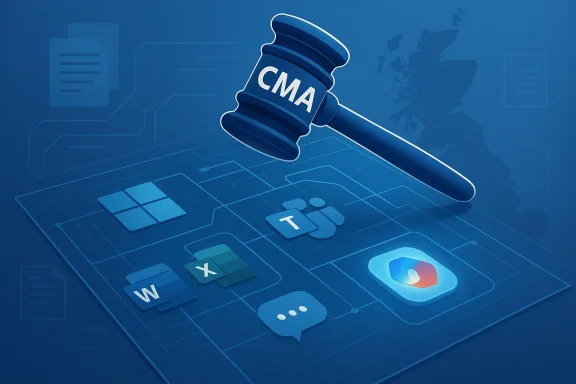
Microsoft’s latest move in the United Kingdom is a reminder that its AI strategy is no longer being judged only as product design. It is now being tested as a competition and market-structure question, with the Competition and Markets Authority preparing a fresh probe into the company’s broader business software stack, including Windows, Word, Excel, Teams, and Copilot. That follows the regulator’s cloud work, which has already concluded that Microsoft and AWS do not need dominant-status designation in cloud, even as the CMA continues to flag licensing and interoperability concerns across the market oft has spent the last two years turning Copilot into more than a chatbot name. It has become a distribution strategy, a branding layer, and a way to bind Windows, Microsoft 365, Azure, and partner ecosystems into a single AI narrative. That strategy has been commercially rational, but it has also made Microsoft easier for regulators to read. When one company controls the operating system, the productivity suite, the collaboration layer, and the AI assistant people increasingly use to bridge them, competition authorities tend to look for leverage points.
The CMA’s new scrutiny reflects that reality. The watchdog has already spent years examining cloud infrastructure and the licensing practices that influence where workloads run, how customers switch providers, and how Microsoft’s own software can affect rivals’ economics. The next step is a broader assessment of the corporate software stack itself, and that matters because the software stack is where modern work actually happens. If cloud is the engine room, Windows, Office, Teams, and Copilot are the dashboard.
This is not the first time the UK regulator has taken an interest in Microsoft’s ecosystem power. The CMA has repeatedly looked at the company’s AI partnerships and cloud arrangements, often deciding that specific deals did not meet the legal threshold for an in-depth merger review. But the current push is different. It is not centered on a single transaction. It is about whether Microsoft’s platform reach and distribution advantages warrant an ongoing regulatory framework under the Digital Markets, Competition and Consumers Act.
That distinction matters. A merger probe is a one-off event. A Strategic Market Status designation can create a much longer supervisory relationship. If the CMA eventually designates Microsoft in business software, the company could face ongoing behavioral obligations rather than a narrow, deal-specific set of questions. For Microsoft, that is a more serious challenge because it touches the way the company monetizes software, integrates AI, and shapes default user behavior across the enterprise stack.
Microsoft’s own response has been measured. The company has said it is working to address the CMA’s concerns quickly and constructively, while Brad Smith has signaled that the business software market is already under review. That language is notable because it suggests Microsoft understands the CMA is not just policing price or bundling. It is also asking whether AI is becoming embedded in a way that narrows choice before customers have a chance to evaluate alternatives.
The current regulatory moment is about more than Microsoft’s market share. It is about timing. AI is moving from optional add-on to embedded interface, and regulators are trying to decide whether the rules that govern software distribution still make sense when AI is built into everyday tools.
The cloud probe also connected the dots between Microsoft’s software licensing and its cloud business. The CMA has been looking at whether licensing practices can make it more expensive or more complicated for customers to use rival clouds, which is a subtle but powerful kind of competition issue. If a vendor can make one infrastructure choice cheaper than another because of software terms, the market may look open on paper while still being tilted in practice.
That background helps explain why the latest investigation is so broad. Windows, Office, Teams, and Copilot are not merely products. They are control points. They shape identity, document formats, communication habits, and the AI layer that increasingly mediates work. In the enterprise world, those layers are often purchased together, administered together, and defended together. That is efficient for customers, but it also gives the supplier enormous strategic leverage.
Microsoft’s AI ambitions have only sharpened the concern. The company has spent heavily to turn Copilot into the default AI interface across consumer and business workflows. That includes adding AI features to core applications, integrating assistance into productivity suites, and linking the desktop to cloud-backed intelligence. From a product perspective, this is coherent. From a competition perspective, it creates a question: when does integration become entrenchment?
The UK is not alone in asking that question, but it may be moving faster and more openly than some other jurisdictions. The CMA’s new digital markets regime gives it the ability to act more like an ongoing referee than a post-hoc prosecutor. That means the regulator can focus on the structure of markets before a problem becomes irreversible. In AI, that may be exactly what governments want, because the most consequential lock-in often happens before the technology settles into mature use patterns.
That is why a regulator can say, in effect, “not dominant in this specific legal sense” while still believing the market has serious structural issues. The CMA’s own cloud findings pointed to higher costs, less choice, and weaker innovation than a healthy market should produce. It also recommended that the authority use its digital markets powers to investigate the biggest players more closely. So the non-designation is not a clean bill of health; it is more accurately a decision about one legal test.
Microsoft’s cloud strategy is inseparable from its software strategy. Azure is not just a separate line of business. It benefits from the company’s installed base of Windows and Microsoft 365 customers, and it is shaped by the licensing rules around Microsoft software running on rival clouds. That means the regulator’s cloud concerns naturally spill into the productivity suite and the AI assistant sitting on top of it.
Microsoft has argued the cloud market remains dynamic and that rivalry is intense. That is not implausible. AWS, Azure, Google Cloud, and a range of specialized providers all compete vigorously. But the CMA’s point is subtler: dynamic markets can still be distorted if one firm’s software terms shape the cost of switching. That is the sort of distortion regulators increasingly care about.
The cloud case also exposes a broader truth about Microsoft’s business model. The company does not win through a single product alone. It wins through interoperability between products, usage inertia, and the convenience of buying from one vendor. Those same strengths become competition issues when they reduce the practical ability of customers to mix and match.
The CMA appears to be worried about exactly that. Its recent language suggests AI could transform business software, but also that the market could close if Microsoft does not open its ecosystem to third-party AI developers. That is a crucial point. The regulator is not rejecting AI. It is asking whether AI should be distributed in a way that preserves access, competition, and interoperability for competing toolmakers.
This is where the tension becomes structural. Microsoft wants Copilot to feel like an always-available layer across Office, Windows, and Teams. The CMA wants to ensure that AI layers do not become gatekeepers. In one view, embedding AI everywhere improves productivity. In the other, it can create a new default behavior that crowd-outs rivals before users can compare options.
Microsoft’s challenge is that its own business incentives favor deep integration. If Copilot is tightly woven into Windows and Microsoft 365, it is easier to sell, easier to support, and harder to displace. But that same integration can look like foreclosure to regulators, especially if it makes independent AI vendors feel like guests in someone else’s house.
This creates a delicate balance. The more useful Copilot becomes, the more suspicious regulators may become of the path that made it useful. That is the paradox of platform AI: usefulness often scales with access, but access often scales with control.
Defaults matter in this environment. If Teams is the default collaboration layer, Word and Excel the default file formats, and Windows the default desktop, then Microsoft does not need to force adoption in obvious ways. It can simply make its own services the path of least resistance. That is exactly why competition authorities pay close attention to bundling, integration, and licensing terms.
The AI angle makes this more important, not less. AI works best when it is close to the context of work: the file you are editing, the meeting you are joining, the chat you are reading, the spreadsheet you are analyzing. Microsoft’s suite is well-positioned for that future because it already owns the context. Competitors must either integrate through Microsoft or hope users switch ecosystems entirely, which is a much harder proposition.
For consumers, the effect may be less visible but still important. A cleaner, more competitive market can mean more choice in productivity tools, more innovation in AI assistants, and less pressure to accept one vendor’s ecosystem as inevitable. Yet consumer adoption often follows enterprise standardization, so if Microsoft remains the default in business, the consumer effect may lag behind.
The CMA’s challenge is therefore to intervene where market power is most concentrated without creating chaos for users who depend on the existing stack. That is a hard balance, but it is the whole point of the new SMS framework.
The regime also reflects a broader policy shift in Britain. Regulators are being asked not just to punish misconduct after the fact, but to shape markets so they remain contestable. That is especially relevant in AI, where fast-moving product cycles can lock in habits before the market has time to correct itself. The CMA’s earlier designation work on mobile platforms shows how serious it is about using the SMS tool to influence conduct early.
Microsoft may become one of the regime’s clearest tests. If the CMA can show that a company can dominate business software interfaces without any single outright monopoly needing to be proven in the traditional sense, that will strengthen the case for proactive regulation. If not, the new powers risk looking more symbolic than transformative.
The regulator will also be aware of political optics. The UK wants to attract technology investment, support growth, and avoid looking hostile to large US companies. At the same time, it wants to prove that digital markets can be both open and fair. That makes this probe a test of regulatory maturity as much as legal power.
If the CMA is too aggressive, it risks pushing firms into defensive product behavior. If it is too passive, it risks leaving the same concentration problems untouched while AI accelerates them. That balance is difficult, and the stakes are high because other regulators are watching.
For Google, the implications are obvious. A more open Microsoft stack could make it easier for Google Workspace and Gemini-based workflows to compete where organizations want cross-platform flexibility. For Amazon, the issue is cloud more than business software, but any loosening of Microsoft licensing pressure could also improve the economics of running mixed workloads across multiple clouds. For smaller AI vendors, the upside is even clearer: easier access to Microsoft’s ecosystem means a chance to reach enterprise users without being boxed out by defaults.
Microsoft, however, still has several advantages that regulation cannot erase overnight. It has trust relationships with CIOs, deep enterprise procurement channels, and a familiar administration model. Even if the CMA pushes the market toward more openness, Microsoft could still win because many businesses prefer a single vendor with clear support and predictable integration.
Microsoft will counter that integrated platforms create value and reduce complexity. That is also true. Most enterprises do not want a dozen disconnected AI tools. They want coherent workflows, centralized identity, and predictable support. The regulatory question is not whether integration is useful. It is whether integration has become so powerful that alternatives are no longer commercially viable.
That is the broader market issue here. If regulators can preserve enough openness, then AI in business software becomes a contest among models, interfaces, and workflows. If they cannot, the market may tip toward whichever vendor already owns the productivity layer. Microsoft understands that better than most companies because it has spent decades building exactly that kind of leverage.
Consumers will notice the effect more indirectly. They may benefit from a healthier competitive environment, but most home users do not negotiate licenses or manage deployment policies. What they do notice is whether products feel forced, cluttered, or hard to escape. In that sense, the regulator’s work can still matter to consumer experience because it shapes the products businesses standardize on first.
Microsoft’s own AI rollout already reflects this tension. On the consumer side, Copilot has sometimes felt like a branding push. On the enterprise side, it is increasingly a governance question. The same feature can look innovative in a demo and intrusive in an admin console. That split is one reason regulators are focusing on the distribution mechanisms, not just the feature list.
For enterprises, the key issue is control. They want to know whether they can disable features, audit data flows, and avoid being nudged toward a particular cloud or assistant. For consumers, the key issue is trust. They want to know that their operating system and productivity suite remain tools, not sales funnels.
That distinction may sound subtle, but it is the difference between a product that feels empowering and one that feels manipulative. Microsoft has to live on both sides of that line at once.
Microsoft also has the opportunity to separate good AI from noisy AI. Not every feature needs to be visible everywhere to be valuable. If the company can make Copilot feel context-aware rather than omnipresent, it may actually improve adoption quality. That would be a meaningful product win, not just a legal compromise.
The regulator may also force Microsoft to sharpen the business case for its AI ambitions. If Copilot wins because it saves time, not because it is bundled into everything, then the platform becomes more credible. That is a better outcome for the company’s brand, even if it is less convenient for its distribution strategy.
A second risk is regulatory drift. If the CMA keeps adding layers of scrutiny without clear endpoints, businesses could end up in a long period of uncertainty. That is bad for investment and bad for product planning. Microsoft wants clarity, even if that clarity includes obligations.
Finally, there is the risk that AI competition moves faster than the rules. By the time regulators settle on remedies, Microsoft, Google, Apple, and a wave of smaller AI vendors may have shifted the battleground again. That would not make the CMA irrelevant, but it would make agility essential. Static remedies in a dynamic market can miss the real problem.
The broader context to watch is AI integration inside ordinary productivity tools. If regulators conclude that embedded assistants should remain open to third-party competition, that could shape not just Microsoft’s roadmap but how the entire industry designs workplace AI. That would be a meaningful precedent. It would tell vendors that the AI layer cannot simply be welded onto incumbency.
Microsoft’s long game is still intact, but the rules around how it plays are becoming stricter. The company can either adapt to a more open definition of AI competition or keep testing the limits of platform leverage until regulators force the issue. In the end, the outcome will shape more than one company’s product strategy. It will help define whether AI in business software becomes a competitive marketplace or simply the next layer of default dominance.
Source: Windows Central Microsoft’s AI ambitions face fresh CMA scrutiny in the United Kingdom
The CMA’s new scrutiny reflects that reality. The watchdog has already spent years examining cloud infrastructure and the licensing practices that influence where workloads run, how customers switch providers, and how Microsoft’s own software can affect rivals’ economics. The next step is a broader assessment of the corporate software stack itself, and that matters because the software stack is where modern work actually happens. If cloud is the engine room, Windows, Office, Teams, and Copilot are the dashboard.
This is not the first time the UK regulator has taken an interest in Microsoft’s ecosystem power. The CMA has repeatedly looked at the company’s AI partnerships and cloud arrangements, often deciding that specific deals did not meet the legal threshold for an in-depth merger review. But the current push is different. It is not centered on a single transaction. It is about whether Microsoft’s platform reach and distribution advantages warrant an ongoing regulatory framework under the Digital Markets, Competition and Consumers Act.
That distinction matters. A merger probe is a one-off event. A Strategic Market Status designation can create a much longer supervisory relationship. If the CMA eventually designates Microsoft in business software, the company could face ongoing behavioral obligations rather than a narrow, deal-specific set of questions. For Microsoft, that is a more serious challenge because it touches the way the company monetizes software, integrates AI, and shapes default user behavior across the enterprise stack.
Microsoft’s own response has been measured. The company has said it is working to address the CMA’s concerns quickly and constructively, while Brad Smith has signaled that the business software market is already under review. That language is notable because it suggests Microsoft understands the CMA is not just policing price or bundling. It is also asking whether AI is becoming embedded in a way that narrows choice before customers have a chance to evaluate alternatives.
 Why this matters now
The current regulatory moment is about more than Microsoft’s market share. It is about timing. AI is moving from optional add-on to embedded interface, and regulators are trying to decide whether the rules that govern software distribution still make sense when AI is built into everyday tools.- Microsoft is trying to make Copilot feel native, not separate.
- The CMA is asking whether that native layer reduces competitive space.
- Enterprises care about control, interoperability, and licensing clarity.
- Rivals care about whether Microsoft can use defaults to foreclose choice.
Background
The CMA’s cloud investigation laid the groundwork for the current inquiry. In January 2025, the authority’s independent inquiry group published provisional findings that competition in UK cloud infrastructure was not working as well as it could, and it recommended that the CMA consider Strategic Market Status investigations into the two biggest providers, Microsoft and AWS. That recommendation is important because it shows the regulator had already become concerned about market structure, not just specific complaints. The final cloud market report later reinforced that direction and said the CMA should prioritize SMS investigations into Microsoft and AWS in relation to cloud servicesThe cloud probe also connected the dots between Microsoft’s software licensing and its cloud business. The CMA has been looking at whether licensing practices can make it more expensive or more complicated for customers to use rival clouds, which is a subtle but powerful kind of competition issue. If a vendor can make one infrastructure choice cheaper than another because of software terms, the market may look open on paper while still being tilted in practice.
That background helps explain why the latest investigation is so broad. Windows, Office, Teams, and Copilot are not merely products. They are control points. They shape identity, document formats, communication habits, and the AI layer that increasingly mediates work. In the enterprise world, those layers are often purchased together, administered together, and defended together. That is efficient for customers, but it also gives the supplier enormous strategic leverage.
Microsoft’s AI ambitions have only sharpened the concern. The company has spent heavily to turn Copilot into the default AI interface across consumer and business workflows. That includes adding AI features to core applications, integrating assistance into productivity suites, and linking the desktop to cloud-backed intelligence. From a product perspective, this is coherent. From a competition perspective, it creates a question: when does integration become entrenchment?
The UK is not alone in asking that question, but it may be moving faster and more openly than some other jurisdictions. The CMA’s new digital markets regime gives it the ability to act more like an ongoing referee than a post-hoc prosecutor. That means the regulator can focus on the structure of markets before a problem becomes irreversible. In AI, that may be exactly what governments want, because the most consequential lock-in often happens before the technology settles into mature use patterns.
The regulatory shift in plain terms
The CMA is moving from one-off merger scrutiny toward market-power supervision. That is a very different style of oversight.- Identify where a firm has meaningful strategic influence.
- Decide whether the legal SMS threshold is met.
- If so, impose targeted, proportionate conduct rules.
- Use those rules to preserve competition and interoperability.
The Cloud Legacy
The cloud case matters because it provides the legal and economic context for Microsoft’s business software scrutiny. The CMA recently concluded that neither Microsoft Azure nor AWS should be designated as dominant in the cloud market under the DMCC framework, but that decision did not end the conversation. Instead, it kept open the wider question of how large platforms can use software licensing and ecosystem power to influence cloud competition.That is why a regulator can say, in effect, “not dominant in this specific legal sense” while still believing the market has serious structural issues. The CMA’s own cloud findings pointed to higher costs, less choice, and weaker innovation than a healthy market should produce. It also recommended that the authority use its digital markets powers to investigate the biggest players more closely. So the non-designation is not a clean bill of health; it is more accurately a decision about one legal test.
Microsoft’s cloud strategy is inseparable from its software strategy. Azure is not just a separate line of business. It benefits from the company’s installed base of Windows and Microsoft 365 customers, and it is shaped by the licensing rules around Microsoft software running on rival clouds. That means the regulator’s cloud concerns naturally spill into the productivity suite and the AI assistant sitting on top of it.
Licensing as a competitive lever
Licensing may not sound glamorous, but it is often the real battlefield in enterprise software. The issue is not whether Microsoft sells a good product. It is whether the structure of the license makes alternative deployment models artificially expensive or operationally awkward.- Customers may face higher costs on rival clouds.
- Migrating workloads can become more complex.
- Procurement teams may choose the path of least resistance.
- Competitors can lose not because they are worse, but because they are constrained.
Microsoft has argued the cloud market remains dynamic and that rivalry is intense. That is not implausible. AWS, Azure, Google Cloud, and a range of specialized providers all compete vigorously. But the CMA’s point is subtler: dynamic markets can still be distorted if one firm’s software terms shape the cost of switching. That is the sort of distortion regulators increasingly care about.
The cloud case also exposes a broader truth about Microsoft’s business model. The company does not win through a single product alone. It wins through interoperability between products, usage inertia, and the convenience of buying from one vendor. Those same strengths become competition issues when they reduce the practical ability of customers to mix and match.
Copilot as a Regulatory Symbol
Copilot is the public face of Microsoft’s AI ambitions, which makes it the obvious symbol for this new probe. It is also the most politically sensitive because it sits at the intersection of user experience, data access, licensing, and product bundling. If Copilot is powerful because it can reach across documents, chats, and enterprise contexts, then regulators will ask whether that power depends on advantages rivals cannot match.The CMA appears to be worried about exactly that. Its recent language suggests AI could transform business software, but also that the market could close if Microsoft does not open its ecosystem to third-party AI developers. That is a crucial point. The regulator is not rejecting AI. It is asking whether AI should be distributed in a way that preserves access, competition, and interoperability for competing toolmakers.
This is where the tension becomes structural. Microsoft wants Copilot to feel like an always-available layer across Office, Windows, and Teams. The CMA wants to ensure that AI layers do not become gatekeepers. In one view, embedding AI everywhere improves productivity. In the other, it can create a new default behavior that crowd-outs rivals before users can compare options.
The interoperability question
Interoperability is the hinge on which this debate turns. If third-party AI tools can plug into Microsoft’s ecosystem with meaningful access, then the market stays more open. If they cannot, Copilot becomes not just a product but a toll booth.- Open access supports competition and innovation.
- Closed integration strengthens the incumbent’s platform power.
- Customers get more choice when tools can interoperate.
- Enterprises get more flexibility when AI is modular.
Microsoft’s challenge is that its own business incentives favor deep integration. If Copilot is tightly woven into Windows and Microsoft 365, it is easier to sell, easier to support, and harder to displace. But that same integration can look like foreclosure to regulators, especially if it makes independent AI vendors feel like guests in someone else’s house.
This creates a delicate balance. The more useful Copilot becomes, the more suspicious regulators may become of the path that made it useful. That is the paradox of platform AI: usefulness often scales with access, but access often scales with control.
Windows, Office, Teams, and the Power of Defaults
The CMA’s decision to widen the lens beyond cloud infrastructure is significant because Windows, Word, Excel, and Teams sit at the center of daily business life. They are not fringe tools. They are the surface area of modern office work. If Microsoft has leverage anywhere, it is here.Defaults matter in this environment. If Teams is the default collaboration layer, Word and Excel the default file formats, and Windows the default desktop, then Microsoft does not need to force adoption in obvious ways. It can simply make its own services the path of least resistance. That is exactly why competition authorities pay close attention to bundling, integration, and licensing terms.
The AI angle makes this more important, not less. AI works best when it is close to the context of work: the file you are editing, the meeting you are joining, the chat you are reading, the spreadsheet you are analyzing. Microsoft’s suite is well-positioned for that future because it already owns the context. Competitors must either integrate through Microsoft or hope users switch ecosystems entirely, which is a much harder proposition.
Why enterprise customers feel the impact first
Enterprise customers will feel any regulatory remedy before consumers do. That is because business software is where licensing, compliance, and admin policy are most explicit.- Procurement teams negotiate licenses at scale.
- IT administrators must manage rollout and access controls.
- Compliance officers need auditability and data governance.
- Employees just want the tools to work without friction.
For consumers, the effect may be less visible but still important. A cleaner, more competitive market can mean more choice in productivity tools, more innovation in AI assistants, and less pressure to accept one vendor’s ecosystem as inevitable. Yet consumer adoption often follows enterprise standardization, so if Microsoft remains the default in business, the consumer effect may lag behind.
The CMA’s challenge is therefore to intervene where market power is most concentrated without creating chaos for users who depend on the existing stack. That is a hard balance, but it is the whole point of the new SMS framework.
The UK’s Digital Markets Playbook
The UK’s DMCC regime gives the CMA more flexibility than older competition tools. It is designed for cases where a firm’s position is not merely large, but strategically important to how a digital market functions. That makes it a better fit for modern platform businesses, where power comes from the interplay of software, data, distribution, and ecosystem control.The regime also reflects a broader policy shift in Britain. Regulators are being asked not just to punish misconduct after the fact, but to shape markets so they remain contestable. That is especially relevant in AI, where fast-moving product cycles can lock in habits before the market has time to correct itself. The CMA’s earlier designation work on mobile platforms shows how serious it is about using the SMS tool to influence conduct early.
Microsoft may become one of the regime’s clearest tests. If the CMA can show that a company can dominate business software interfaces without any single outright monopoly needing to be proven in the traditional sense, that will strengthen the case for proactive regulation. If not, the new powers risk looking more symbolic than transformative.
Why this is different from old antitrust
Traditional antitrust often moves slowly because it needs a high evidentiary bar and usually arrives after harm is entrenched. The DMCC model is intended to be more surgical.- It can focus on specific digital activities.
- It can impose tailored conduct requirements.
- It can react before markets fully tip.
- It can address interoperability and choice directly.
The regulator will also be aware of political optics. The UK wants to attract technology investment, support growth, and avoid looking hostile to large US companies. At the same time, it wants to prove that digital markets can be both open and fair. That makes this probe a test of regulatory maturity as much as legal power.
If the CMA is too aggressive, it risks pushing firms into defensive product behavior. If it is too passive, it risks leaving the same concentration problems untouched while AI accelerates them. That balance is difficult, and the stakes are high because other regulators are watching.
Competitive Implications for Microsoft, Rivals, and the Market
This investigation could reshape the competitive narrative around enterprise AI. Microsoft has spent years building an advantage through distribution. It owns the desktop, the productivity stack, and a major cloud platform. That gives it a unique ability to place AI exactly where work happens. If regulators limit how tightly those pieces can be bound together, rivals may have more room to compete on the merits of their own tools.For Google, the implications are obvious. A more open Microsoft stack could make it easier for Google Workspace and Gemini-based workflows to compete where organizations want cross-platform flexibility. For Amazon, the issue is cloud more than business software, but any loosening of Microsoft licensing pressure could also improve the economics of running mixed workloads across multiple clouds. For smaller AI vendors, the upside is even clearer: easier access to Microsoft’s ecosystem means a chance to reach enterprise users without being boxed out by defaults.
Microsoft, however, still has several advantages that regulation cannot erase overnight. It has trust relationships with CIOs, deep enterprise procurement channels, and a familiar administration model. Even if the CMA pushes the market toward more openness, Microsoft could still win because many businesses prefer a single vendor with clear support and predictable integration.
How rivals may respond
Rivals are unlikely to wait passively. They will likely push three arguments.- Microsoft’s stack is too closed.
- AI should be interoperable by default.
- Enterprises should not be forced into one ecosystem.
- Licensing should not penalize rival deployment choices.
Microsoft will counter that integrated platforms create value and reduce complexity. That is also true. Most enterprises do not want a dozen disconnected AI tools. They want coherent workflows, centralized identity, and predictable support. The regulatory question is not whether integration is useful. It is whether integration has become so powerful that alternatives are no longer commercially viable.
That is the broader market issue here. If regulators can preserve enough openness, then AI in business software becomes a contest among models, interfaces, and workflows. If they cannot, the market may tip toward whichever vendor already owns the productivity layer. Microsoft understands that better than most companies because it has spent decades building exactly that kind of leverage.
Enterprise vs Consumer Impact
The enterprise impact is immediate and concrete. If the CMA uses SMS powers to require changes in licensing or interoperability, IT departments may get more freedom to choose cloud, identity, or AI components independently. That could reduce dependence on a single vendor and improve bargaining power. It might also increase administrative complexity if Microsoft has to offer more modular product options.Consumers will notice the effect more indirectly. They may benefit from a healthier competitive environment, but most home users do not negotiate licenses or manage deployment policies. What they do notice is whether products feel forced, cluttered, or hard to escape. In that sense, the regulator’s work can still matter to consumer experience because it shapes the products businesses standardize on first.
Microsoft’s own AI rollout already reflects this tension. On the consumer side, Copilot has sometimes felt like a branding push. On the enterprise side, it is increasingly a governance question. The same feature can look innovative in a demo and intrusive in an admin console. That split is one reason regulators are focusing on the distribution mechanisms, not just the feature list.
Where the pressure is strongest
The pressure is strongest where Microsoft controls both the interface and the backend.- Windows can favor Microsoft services by default.
- Office can embed AI in core workflows.
- Teams can centralize collaboration and meeting data.
- Copilot can knit those surfaces together into one assistant layer.
For enterprises, the key issue is control. They want to know whether they can disable features, audit data flows, and avoid being nudged toward a particular cloud or assistant. For consumers, the key issue is trust. They want to know that their operating system and productivity suite remain tools, not sales funnels.
That distinction may sound subtle, but it is the difference between a product that feels empowering and one that feels manipulative. Microsoft has to live on both sides of that line at once.
Strengths and Opportunities
Microsoft is not entering this fight from a position of weakness. It still has one of the strongest software franchises in the world, deep enterprise loyalty, and an AI platform that already reaches into daily workflows. If it handles the scrutiny well, it may come out with a clearer, more defensible story about how AI should work inside modern business software.- Massive installed base across Windows and Microsoft 365.
- Deep enterprise trust built over decades of procurement relationships.
- Integrated AI distribution through Copilot and Microsoft 365.
- Strong cloud infrastructure that supports the AI layer.
- Potential for cleaner product design if it responds to regulator pressure constructively.
- Opportunity to improve interoperability in ways that expand adoption rather than shrink it.
- Chance to reposition Copilot as a utility rather than a headline feature.
Microsoft also has the opportunity to separate good AI from noisy AI. Not every feature needs to be visible everywhere to be valuable. If the company can make Copilot feel context-aware rather than omnipresent, it may actually improve adoption quality. That would be a meaningful product win, not just a legal compromise.
The regulator may also force Microsoft to sharpen the business case for its AI ambitions. If Copilot wins because it saves time, not because it is bundled into everything, then the platform becomes more credible. That is a better outcome for the company’s brand, even if it is less convenient for its distribution strategy.
Risks and Concerns
The biggest risk for Microsoft is that this probe becomes part of a larger narrative that its ecosystem power is being used to lock in AI adoption before rivals can compete fairly. That would be damaging not only because of possible remedies, but because it could reinforce the impression that Microsoft’s AI strategy depends too much on control and too little on product excellence.- Possible conduct restrictions on bundling and licensing.
- Pressure to open APIs or interoperability layers more than it wants.
- Enterprise uncertainty while customers wait for rule changes.
- Reputational risk if AI is seen as a lock-in mechanism.
- Fragmentation risk if Microsoft has to offer too many product configurations.
- Slower monetization if Copilot cannot be distributed as aggressively.
- Competitor advantage if rivals gain clearer access to Microsoft’s ecosystem.
A second risk is regulatory drift. If the CMA keeps adding layers of scrutiny without clear endpoints, businesses could end up in a long period of uncertainty. That is bad for investment and bad for product planning. Microsoft wants clarity, even if that clarity includes obligations.
Finally, there is the risk that AI competition moves faster than the rules. By the time regulators settle on remedies, Microsoft, Google, Apple, and a wave of smaller AI vendors may have shifted the battleground again. That would not make the CMA irrelevant, but it would make agility essential. Static remedies in a dynamic market can miss the real problem.
What to Watch Next
The next few months will show whether this investigation is mainly a warning shot or the opening phase of a much deeper intervention. The most important near-term question is how the CMA frames the SMS process and which parts of Microsoft’s software stack it treats as the real source of concern. The second question is whether Microsoft makes voluntary concessions before formal remedies are imposed.The broader context to watch is AI integration inside ordinary productivity tools. If regulators conclude that embedded assistants should remain open to third-party competition, that could shape not just Microsoft’s roadmap but how the entire industry designs workplace AI. That would be a meaningful precedent. It would tell vendors that the AI layer cannot simply be welded onto incumbency.
Key signals to monitor
- Whether the CMA formally opens the SMS investigation in May.
- Whether the scope focuses on licensing, interoperability, or AI defaults.
- Whether Microsoft offers voluntary changes before any designation.
- Whether rivals and enterprise customers publicly support the probe.
- Whether Copilot packaging or access rules change in response.
- Whether other regulators, especially in the EU or US, follow the UK’s framing.
Microsoft’s long game is still intact, but the rules around how it plays are becoming stricter. The company can either adapt to a more open definition of AI competition or keep testing the limits of platform leverage until regulators force the issue. In the end, the outcome will shape more than one company’s product strategy. It will help define whether AI in business software becomes a competitive marketplace or simply the next layer of default dominance.
Source: Windows Central Microsoft’s AI ambitions face fresh CMA scrutiny in the United Kingdom
