

The U.S. Coast Guard has chosen PRATUS® as its enterprise incident management platform, a move that replaces the legacy Incident Management Software System (IMSS) and positions a cloud-first, Microsoft 365–integrated solution at the center of the Service’s Force Design 2028 modernization effort.
The selection of PRATUS (developed by Disaster Tech/PRATUS) was announced publicly through a vendor release and reinforced by an internal Coast Guard ALCOAST notice detailing the decision and the implementation approach. PRATUS is described as a cloud-native incident command and coordination workspace built on Microsoft Azure Government, with deep integration into Microsoft 365 and Microsoft Teams, and with geospatial capability via Esri ArcGIS. The Coast Guard explicitly named PRATUS as the platform intended to support major national events in 2026—most notably FIFA World Cup 2026™—as part of an operator-informed, phased deployment that will move from Initial Operational Capability (IOC) toward Full Operating Capability (FOC).
This decision sits inside the larger Force Design 2028 (FD28) posture: a multi-year effort aimed at accelerating capability delivery, modernizing command-and-control, and increasing operational readiness across Coast Guard missions. The PRATUS procurement and fielding are framed as a practical expression of FD28’s emphasis on rapid, commercially enabled modernization.
For state, local, and tribal partners—many of whom use varied incident management tools—the Coast Guard’s move presents both opportunity and risk. If PRATUS can support controlled, cross-tenant collaboration and provide predictable partner access models, it could significantly reduce friction during multi-jurisdictional incidents. Conversely, if partner access requires separate licensing or bespoke integration work, the interoperability benefits may be diminished. The Coast Guard should therefore prioritize a partner engagement and licensing strategy that minimizes barriers to shared situational awareness.
Success will hinge on how the Service addresses several hard problems: ensuring data portability and procurement transparency, validating compliance and security baselines, guaranteeing operational resilience in low-connectivity maritime environments, and executing comprehensive training and partner-access strategies. If those areas receive sustained attention—backed by clear documentation, vendor accountability, and measurable field testing—PRATUS can deliver meaningful improvements in decision speed and interagency coordination. If not, the program risks becoming another well-intentioned capability that struggles at scale.
The announcement is an important signal: the Coast Guard is moving decisively toward commercially enabled, cloud-first command-and-control. The coming months—through IOC and the transition to FOC—will be the proving ground for whether this acquisition genuinely transforms maritime incident management or simply modernizes the toolset without altering the underlying operational and governance challenges that have historically constrained joint response.
Source: The Malaysian Reserve https://themalaysianreserve.com/202...agement-platform-for-the-u-s-coast-guard/amp/
 Background
The selection of PRATUS (developed by Disaster Tech/PRATUS) was announced publicly through a vendor release and reinforced by an internal Coast Guard ALCOAST notice detailing the decision and the implementation approach. PRATUS is described as a cloud-native incident command and coordination workspace built on Microsoft Azure Government, with deep integration into Microsoft 365 and Microsoft Teams, and with geospatial capability via Esri ArcGIS. The Coast Guard explicitly named PRATUS as the platform intended to support major national events in 2026—most notably FIFA World Cup 2026™—as part of an operator-informed, phased deployment that will move from Initial Operational Capability (IOC) toward Full Operating Capability (FOC).This decision sits inside the larger Force Design 2028 (FD28) posture: a multi-year effort aimed at accelerating capability delivery, modernizing command-and-control, and increasing operational readiness across Coast Guard missions. The PRATUS procurement and fielding are framed as a practical expression of FD28’s emphasis on rapid, commercially enabled modernization.
What PRATUS Brings to the Coast Guard
Core platform capabilities
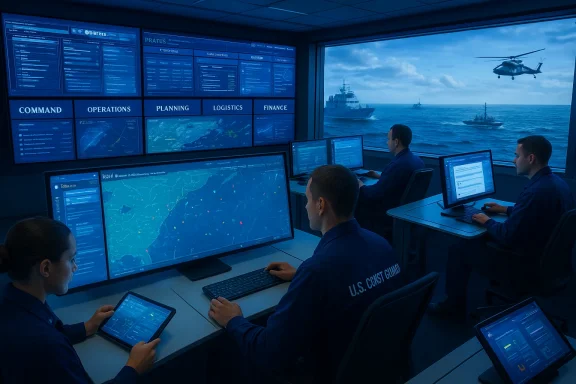
PRATUS is being marketed and fielded as a unified incident management workspace with a set of capabilities tailored to ICS/NIMS-centric workflows and large-scale maritime operations:- Role-based incident workspaces aligned to ICS functions (Command, Operations, Planning, Logistics, Finance/Admin).
- Rapid Incident Action Plan (IAP) development with templates and workflows consistent with NIMS/ICS standards.
- Integrated geospatial situational awareness, reported to leverage Esri ArcGIS for mapping and common operating pictures.
- Secure collaboration across jurisdictions through Microsoft Teams integration, tenant-sharing, and Azure Government hosting.
- Exercise and training management, linking drills, after-action reporting, and lessons learned into operational planning.
- AI-assisted analytics and decision support, including tools PRATUS markets as "PRATUS AI" and Copilot-like functionality within Teams.
Operational framing: IOC for 2026 national events
The Coast Guard’s ALCOAST indicates that PRATUS will be fielded through a phased, operator-informed approach, with an Initial Operational Capability timed to support the summer 2026 large-scale events (FIFA World Cup 2026™, Sail250®, America250). Until FOC is achieved, units may continue to use legacy IMSS and existing processes as needed. This staged approach underlines the dual pressures of rapidly fielding new capability for high-profile national events while preserving continuity of critical operations during hurricane season.Why this matters: Strategic and operational implications
Modernizing incident command across maritime operations
For a Service that executes search-and-rescue, maritime security, environmental response, and large-event public safety missions, a consolidated incident management environment promises measurable benefits: faster IAP cycles, a single source of truth for situational awareness, and streamlined interagency coordination. The Coast Guard’s explicit goal—improving “decision advantage” and scaling operations from routine to national-level responses—aligns with the capability set PRATUS advertises.Commercial cloud and rapid acquisition in FD28
The choice to deploy a commercial, cloud-native platform on Azure Government reflects FD28’s prioritization of commercial foundations and speed-to-field. Using Microsoft Azure Government and native Microsoft 365 integrations reduces the engineering surface for identity, collaboration, and platform-hardened services, which can accelerate fielding compared with bespoke on-prem solutions. The Microsoft corporate statement accompanying the vendor announcement stresses these ecosystem benefits.Interagency and public-safety integration at scale
Large events like the World Cup and America250 demand multi-jurisdictional orchestration—federal, state, local, and private partners operating on shared information. PRATUS’s tenant and Teams-based collaboration model is designed to permit controlled information exchange across those boundaries while maintaining role-based access. If implemented well, that architecture can improve interoperability during complex events that involve vessel movements, maritime safety zones, and mass public gatherings.Strengths: What PRATUS appears to offer
- Operator-centered design and iterative delivery. Public messaging emphasizes weekly feedback from operators and an approach that evolves based on real user workflows—important for adoption in mission-critical contexts.
- Cloud-native scale and resilience (when configured properly). Azure Government gives access to high-assurance cloud features, regional scalability, and hardened platform services that many agencies prefer for sensitive workloads.
- Built-in ICS/NIMS alignment. Pre-built templates and role-based workspaces that mirror Incident Command System constructs reduce training friction and accelerate IAP creation.
- Integrated geospatial common operating picture. Esri-powered mapping and situational displays can centralize maritime and land-based operational awareness—critical for search-and-rescue and maritime security.
- Potential to close the gap between exercises and operations. PRATUS’s exercise management features and after-action analytics could shorten the cycle from lessons-learned to doctrinal updates. Partnerships announced earlier with exercise-oriented organizations indicate this use-case is a focus.
Risks and limitations: What the Coast Guard and partners should watch
1. Vendor lock-in and platform dependency
Adopting a single commercial platform as the enterprise incident management system raises lock-in concerns: format portability for IAPs, data exportability, interoperability standards, and long-term vendor sustainment. The public materials confirm PRATUS as the selected platform but do not disclose contract vehicle, duration, or data ownership terms, leaving those questions open. Organizations moving to vendor-hosted SaaS must insist on exportable, standards-based data formats and exit strategies.2. Data sovereignty, compliance, and interagency access
Hosting on Azure Government suggests attention to federal compliance, but specifics (e.g., FedRAMP authorization level for the PRATUS service, control baselines, cross-domain solutions for classified/controlled unclassified information) are not detailed publicly. The Coast Guard will need to validate that the service’s compliance posture aligns with mission data categories and partner sharing requirements. Missing or ambiguous compliance details should be flagged as operational risk until clarified.3. Network dependence and operational resilience
A cloud-native incident management system offers many advantages, but maritime operations frequently operate in degraded-connectivity environments. The vendor materials and ALCOAST note the cloud-centric approach but do not publicly specify offline-capable features, edge-sync models, or hardened local gateways for disconnected operations. For coastal units, cutters, and small boat crews, the platform must be able to function under intermittent connectivity or provide reliable cache-and-sync mechanisms. The Coast Guard will need clear Service-Level Agreements (SLAs) and architecture designs that address low-bandwidth and contested-network scenarios.4. Integration with legacy systems and sensors
Legacy systems such as the Incident Management Software System (IMSS), disparate VHF/shipboard sensors, AIS feeds, and national-level data sources must interoperate for a full common operating picture. While vendor messaging highlights integration points (GIS, Teams), the complexity of connecting to operational sensors, legacy databases, and law-enforcement interfaces is non-trivial. The Coast Guard must budget and schedule system-of-systems integration work and define authoritative data sources to avoid fragmentation.5. Training, change management, and human factors
Operational adoption hinges on training and trust. Rapidly replacing a long-standing toolset like IMSS will require sustained training investments, playbooks, and operator buy-in. The ALCOAST notes a phased, operator-informed rollout—but real-world training, role practice, and institutionalization of new workflows are the long lead items that will determine whether PRATUS becomes an enabler rather than another tool that operators must work around.6. Cost and procurement transparency
Public announcements do not disclose contract value, procurement vehicle, or terms for partner access. These opaque details matter for long-term sustainment, scalability, and the ability of state/local partners to access platform capabilities without undue duplication. The lack of disclosed pricing or contracting details should be treated as an item to verify internally. Flagging these gaps is prudent: until procurement terms are public inside the Service, staff and partner budgets may face uncertainty.Recommendations: Mitigations and best practices for a resilient fielding
- Require documented data export standards and an exit plan. Ensure all Incident Action Plans, resource lists, and after-action reports are exportable in open, documented formats to prevent vendor lock-in.
- Validate the PRATUS FedRAMP/IL/DoD compliance posture and obtain system security documentation (Authorization to Operate, FedRAMP package, SSP) before broad data migration.
- Design and test low-bandwidth and offline modes. Require field trials that simulate cutter/shore/offshore conditions and measure synchronization and conflict-resolution behavior.
- Build an integration roadmap with prioritized legacy systems, AIS, USCG sensor feeds, and DOJ/DHS law-enforcement interfaces. Use API-first contracts and enforce rigorous interface specifications.
- Invest in a multi-tier training plan: tabletop exercises, focused hands-on workshops, and embedded “tech ambassadors” in operational units for the first 12 months after IOC.
- Publish procurement and cost-sharing frameworks for state/local/tribal partners to ensure interoperable access and predictable sustainment funding.
- Implement zero-trust identity and access models, integrating PIV/CAC authentication, conditional access policies, and least-privilege role definitions for cross-tenant collaboration.
- Establish continuous monitoring, logging, and incident response playbooks that include vendor responsibilities, SLAs for availability, and a joint escalation matrix for cyber events or service outages.
Technical verification and open questions
Public documentation from the vendor and the Coast Guard confirms key technical claims: PRATUS will operate on Microsoft Azure Government, integrates with Microsoft 365/Teams, provides role-based ICS-aligned workspaces, and leverages Esri for geospatial visualization. These elements are corroborated by the PR Newswire vendor announcement and the Coast Guard ALCOAST guidance. However, several operationally significant facts remain unverified in public sources:- Contract vehicle, duration, and total program cost (no public figure disclosed).
- Specific FedRAMP authorization level or Authority to Operate (ATO) package for the PRATUS deployment.
- Details on offline/edge operation, caching mechanisms, or on-prem gateway architectures for disconnected maritime environments.
- Exact integration mappings and APIs for legacy IMSS data migration and sensor/telemetry feeds.
Wider sector context: Industry and interagency perspective
The Coast Guard’s decision reflects a broader federal trend toward commercial cloud adoption for mission-critical applications. Agencies are increasingly favoring cloud-native, SaaS-driven solutions that can be rapidly fielded and iterated with operator feedback—especially when built on high-assurance government clouds such as Azure Government. At the same time, procurement transparency, cybersecurity posture, and offline resilience remain recurring challenges across agencies that adopt SaaS for operational command-and-control.For state, local, and tribal partners—many of whom use varied incident management tools—the Coast Guard’s move presents both opportunity and risk. If PRATUS can support controlled, cross-tenant collaboration and provide predictable partner access models, it could significantly reduce friction during multi-jurisdictional incidents. Conversely, if partner access requires separate licensing or bespoke integration work, the interoperability benefits may be diminished. The Coast Guard should therefore prioritize a partner engagement and licensing strategy that minimizes barriers to shared situational awareness.
Practical scenarios: How PRATUS could change operations
- During a multi-vessel search-and-rescue, PRATUS could give a unified map with AIS positions, task assignments by ICS role, and synchronized briefings via Teams, reducing handoffs and redundant radio traffic.
- For hurricane season, emergency planners could develop and share IAP templates, pre-stage resources, and run tabletop exercises with integrated after-action analytics to iterate plans faster.
- For World Cup maritime security operations, controllers could manage vessel exclusion zones, coordinate port-of-call security, and exchange time-stamped decisions across federal and local partners through role-scoped workspaces.
Conclusion
The Coast Guard’s selection of PRATUS as its enterprise incident management platform is a consequential step in Force Design 2028’s modernization arc. The platform’s cloud-native architecture, Microsoft 365 integration, ICS-friendly workflows, and geospatial features align with the operational needs of large-scale maritime events and complex incident response. Public documentation and the Coast Guard’s ALCOAST confirm the phased, operator-informed rollout with IOC planned to support 2026 national events.Success will hinge on how the Service addresses several hard problems: ensuring data portability and procurement transparency, validating compliance and security baselines, guaranteeing operational resilience in low-connectivity maritime environments, and executing comprehensive training and partner-access strategies. If those areas receive sustained attention—backed by clear documentation, vendor accountability, and measurable field testing—PRATUS can deliver meaningful improvements in decision speed and interagency coordination. If not, the program risks becoming another well-intentioned capability that struggles at scale.
The announcement is an important signal: the Coast Guard is moving decisively toward commercially enabled, cloud-first command-and-control. The coming months—through IOC and the transition to FOC—will be the proving ground for whether this acquisition genuinely transforms maritime incident management or simply modernizes the toolset without altering the underlying operational and governance challenges that have historically constrained joint response.
Source: The Malaysian Reserve https://themalaysianreserve.com/202...agement-platform-for-the-u-s-coast-guard/amp/
