

Cognizant’s announced agreement to acquire 3Cloud is a calculated, high-stakes play to bulk up Azure engineering capacity and accelerate enterprise AI delivery — a move that folds a pure‑play Azure specialist into one of the world’s largest systems integrators and positions the combined business as a dominant Microsoft partner in the Azure + AI era.
Cognizant on November 13, 2025 announced it has entered into a definitive agreement to acquire 3Cloud, a Chicago‑based firm focused exclusively on Microsoft Azure services and Azure‑dedicated AI enablement. The transaction is expected to close in the first quarter of 2026, subject to regulatory approvals, with financial terms not disclosed. 3Cloud was founded as an Azure‑first engineering house and has built a reputation for delivering modern data platforms, cloud‑native AI applications, advanced analytics and managed Azure operations to enterprise customers across banking, healthcare, technology and consumer verticals. The company has grown rapidly since 2016, including through bolt‑on acquisitions and organic growth, and was majority‑owned by Gryphon Investors prior to the sale. At announcement the parties framed several headline benefits:
Medium term (12–36 months): If integration preserves specialist velocity and successfully productizes vertical offerings, Cognizant could capture substantial new Azure‑centric pipeline, increase managed services revenue, and show margin improvement in higher‑value engineering engagements.
This acquisition is emblematic of the broader industry trend: as AI becomes the primary driver of cloud consumption, systems integrators are buying specialized engineering capability to close the gap between pilot enthusiasm and production reality. The market will now watch how Cognizant turns credentials and talent into scalable, accountable enterprise AI outcomes.
Source: The Fast Mode Cognizant to Acquire 3Cloud, Bolstering Enterprise AI and Azure Capabilities
 Background / Overview
Cognizant on November 13, 2025 announced it has entered into a definitive agreement to acquire 3Cloud, a Chicago‑based firm focused exclusively on Microsoft Azure services and Azure‑dedicated AI enablement. The transaction is expected to close in the first quarter of 2026, subject to regulatory approvals, with financial terms not disclosed. 3Cloud was founded as an Azure‑first engineering house and has built a reputation for delivering modern data platforms, cloud‑native AI applications, advanced analytics and managed Azure operations to enterprise customers across banking, healthcare, technology and consumer verticals. The company has grown rapidly since 2016, including through bolt‑on acquisitions and organic growth, and was majority‑owned by Gryphon Investors prior to the sale. At announcement the parties framed several headline benefits:- Addition of roughly 1,200 3Cloud employees (about 700 U.S.‑based).
- Contribution of 1,000+ Azure experts and engineers and 1,500+ Microsoft certifications to Cognizant’s capabilities.
- Creation of one of the most credentialed Microsoft Azure partners, with a combined pool of more than 20,000 Azure‑certified specialists cited by the companies.
Why this deal matters: strategic rationale
1) Immediate engineering depth for enterprise AI
Enterprises trying to move AI projects from pilot to production require integrated expertise across cloud infrastructure, modern data platforms, MLOps, inference operations, and app modernization. 3Cloud’s value proposition is specialization: concentrated Azure engineering teams, accelerators and delivery frameworks purpose‑built for Azure data and AI programs. Folding that bedrock into Cognizant reduces time‑to‑expertise and shortens the runway to production for regulated, scale‑sensitive clients.2) Scale inside the Microsoft partner ecosystem
Microsoft’s partner economics — co‑sell, consumption incentives, joint go‑to‑market programs — favor partners who can influence sustained Azure consumption. Cognizant’s stated aim is to increase both its technical bench and its ability to drive Azure consumption revenue through a larger, more credentialed partner. The acquisition therefore isn’t just a talent play; it’s also a channel and commercial play to capture a larger share of Azure‑driven enterprise spend.3) Faster productization of repeatable industry plays
3Cloud brings verticalized delivery patterns — for example, clinical data platforms for health systems or governed Copilot rollouts for financial services — and accelerators that are ripe for productization at scale when combined with Cognizant’s industry playbooks. That’s the value lever: packaging engineering IP into repeatable, higher‑margin offerings across Cognizant’s large global account book.What the numbers say — verified claims and where to be cautious
The public disclosures and filings provide headline numbers; these require cautious reading because some are company assertions rather than audited figures.- Announcement date and transaction status: Definitive agreement announced November 13, 2025; expected close in Q1 2026, subject to approvals. This is a concrete, verifiable timeline in corporate releases.
- Employee and credential counts: The buyer and seller say ~1,200 3Cloud employees (≈700 in the U.S., adding 1,000+ Azure experts and 1,500+ Microsoft certifications to Cognizant’s roster. These are company‑reported figures repeated across official releases. Treat them as accurate for headline purposes but watch for reconciliation during integration and in regulatory or investor filings.
- Azure growth context: Microsoft’s FY26 Q1 disclosure confirms Azure and other cloud services revenue grew ~40% year‑over‑year, the backdrop cited to justify the timing and urgency of the acquisition. That figure is independently verifiable in Microsoft’s investor materials and corroborated by market reporting.
- Financial terms: Purchase price and valuation multiples were not disclosed at announcement; that remains an unknown until further filings or reporting. Because price and expected accretion will materially affect shareholder and market reaction, the lack of financial detail is a significant open item.
Technical and delivery capabilities 3Cloud brings
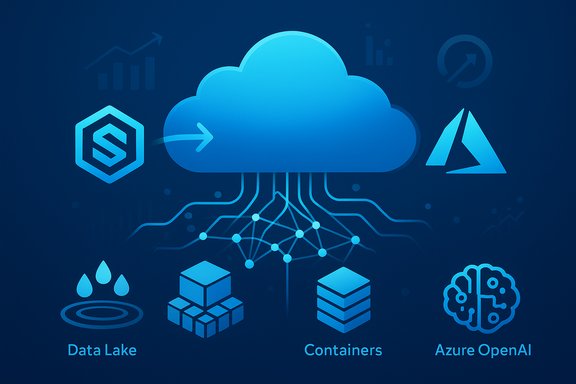
3Cloud’s positioning as an Azure‑native engineering firm centers on these capabilities:- Modern data engineering and lakehouse architectures that integrate Azure storage, Synapse, Fabric patterns and Databricks.
- Cloud‑native AI app development, including containerized inference services (AKS), microservices, and integration with Azure OpenAI and model hosting patterns.
- MLOps practices: CI/CD for models, monitoring and drift detection, and production rollout practices for LLMs and other models.
- Managed services and runbooks for enterprise governance, security, and FinOps for inference cost control.
Integration risks and execution challenges
M&A in the services business is rarely frictionless. The strategic rationale is sound, but realizing the promised value depends on execution across multiple fronts:- Talent retention and cultural integration: 3Cloud is a specialist, engineer‑led shop. Absorbing ~1,200 people into Cognizant’s larger, process‑oriented global delivery model risks brain drain if incentives, career paths and autonomy are not managed carefully. Preserving the speed and specialist culture that built 3Cloud’s reputation will be critical.
- Maintaining technical identity and velocity: Specialized engineering boutiques often win on speed, deep technical focus and reputation. Large SIs can standardize and scale services — but over‑standardization can dampen the specialist edge. Cognizant will need to retain autonomous delivery pods and ensure bench specialists can continue to operate on engineering‑heavy, niche problems without excessive bureaucracy.
- Integration complexity and hidden cost: Without disclosed financial terms, it’s hard to model purchase price, goodwill, retention payments, and integration investments. Integration projects often reveal hidden costs in systems consolidation, benefits harmonization, legal and compliance transitions, and service‑delivery retooling. Those costs can compress expected margins and extend payback periods.
- Client churn and contract transfer: 3Cloud serves enterprise clients in regulated sectors. Cognizant must ensure smooth contractual transitions, maintain service SLAs, and avoid client concerns about changes in delivery teams or escalation paths. Any perception of diluted attention to existing clients can trigger churn.
- Partner dynamics with Microsoft: While having a larger partner with more Azure‑certified staff can improve co‑sell leverage, it also increases scrutiny by Microsoft and raises expectations for measurable Azure consumption influence. Cognizant will need to translate added bench into demonstrable pipeline and consumption growth, or risk underperforming against partner incentive thresholds.
Commercial upside and timeframes
If executed well, the acquisition offers layered commercial benefits:- Faster go‑to‑market on Azure AI solutions: combining 3Cloud accelerators with Cognizant’s industry playbooks can compress pilot‑to‑production cycles.
- Deeper co‑sell and consumption economics: a larger, highly‑credentialed Azure practice increases the ability to capture Microsoft joint‑sales opportunities and influence customer cloud spend.
- Higher‑margin engineering services: engineering‑intensive Azure data & AI work typically commands higher rates than pure lift‑and‑shift migration projects; a successful productization of 3Cloud’s IP could drive margin improvement over time.
Medium term (12–36 months): If integration preserves specialist velocity and successfully productizes vertical offerings, Cognizant could capture substantial new Azure‑centric pipeline, increase managed services revenue, and show margin improvement in higher‑value engineering engagements.
What customers should watch for
Enterprise buyers considering Cognizant for Azure AI programs should evaluate the following in the coming quarters:- Proof points of integrated delivery: Look for jointly delivered case studies where Cognizant + 3Cloud teams move pilots into sustained production with measurable outcomes (latency, cost per inference, compliance posture, ROI).
- Continuity of 3Cloud teams: Confirm which delivery leads and architects remain on client accounts post‑close and whether teams are co‑located or centralized into Cognizant pods. Stability matters for production AI workloads.
- Governance, portability and vendor lock‑in: Enterprises should insist on architecture reviews that prioritize data portability, multi‑cloud strategies where appropriate, and clear FinOps controls for LLM hosting and inference costs. Even Azure‑centric programs benefit from well‑defined portability and exit plans.
- Managed services SLAs and security posture: Verify how runbooks, monitoring, incident response, and compliance certificates will be maintained under the combined organization. For regulated industries this is non‑negotiable.
Competitive implications in the SI market
This acquisition is part of a broader consolidation trend where large systems integrators acquire hyperscaler‑aligned specialists to secure engineering depth and influence cloud consumption. The Cognizant + 3Cloud combination raises the stakes for peers:- Other global SIs will likely pursue similar tuck‑ins to bulk up Azure benches or deepen specialty in Databricks, MLOps, or Azure OpenAI integrations.
- Microsoft’s partner ecosystem consolidates around a smaller set of large, highly credentialed partners capable of end‑to‑end delivery — a dynamic that benefits SIs who can demonstrate measurable consumption influence and disciplined delivery.
- Boutique Azure specialists will remain valuable acquisition targets and potential subcontract partners for large accounts seeking specialized engineering work. The arms race for Azure‑native talent and delivery IP will continue.
Assessment: strengths, realistic expectations, and risks
Strengths:- Immediate reinforcement of Cognizant’s Azure and Data & AI bench with specialist engineering talent and IP.
- A strong strategic fit with Cognizant’s stated “AI builder” strategy: tools, accelerators, and industry plays that speed enterprise AI adoption.
- Favorable timing: Azure’s rapid growth and enterprise appetite for production‑grade AI increases the addressable market for combined offerings.
- Integration will take time. Expect initial public wins to be selective and incremental rather than transformative overnight.
- Financial impact depends heavily on undisclosed purchase price and integration costs — watch for clarity in subsequent filings or investor calls.
- The strategic value is maximized if Cognizant preserves 3Cloud’s specialist culture and continues to invest in engineering autonomy.
- Talent attrition and dilution of specialist identity.
- Integration cost overruns and delayed realization of co‑sell benefits.
- Overreliance on Azure consumption metrics without a clear plan to convert certifications and awards into sustained revenue growth.
Practical takeaways for IT leaders and procurement
- Validate continuity: Require named resource commitments for the first 6–12 months on any migration or AI production work being transitioned between 3Cloud and Cognizant teams.
- Insist on architecture and portability reviews: Protect downstream flexibility and avoid brittle, vendor‑locked LLM deployments.
- Align commercial terms to outcomes: Negotiate SLAs and performance milestones tied to uplift metrics (e.g., inference cost targets, latency, availability) rather than time‑and‑material commitments during integration windows.
- Monitor proof points: Look for early joint case studies that demonstrate productionized AI with measured ROI and governance practices. Those will be the clearest sign the combined entity is delivering on its promise.
Conclusion
Cognizant’s agreement to acquire 3Cloud is a strategic, timely response to a market where Azure is central to enterprise AI rollouts and where engineering depth, repeatable data & AI IP, and partner influence over cloud consumption matter more than ever. The acquisition, if integrated thoughtfully, gives Cognizant a sharper execution edge for production‑grade AI and a stronger position inside Microsoft’s partner ecosystem. However, the real test lies in execution: preserving 3Cloud’s specialist culture, translating certifications into measurable Azure consumption and client outcomes, and managing integration costs and talent retention. Without disclosed financial terms, stakeholders must watch for post‑close disclosures and early client deliverables to judge whether the acquisition delivers durable value rather than short‑term headlines.This acquisition is emblematic of the broader industry trend: as AI becomes the primary driver of cloud consumption, systems integrators are buying specialized engineering capability to close the gap between pilot enthusiasm and production reality. The market will now watch how Cognizant turns credentials and talent into scalable, accountable enterprise AI outcomes.
Source: The Fast Mode Cognizant to Acquire 3Cloud, Bolstering Enterprise AI and Azure Capabilities
