

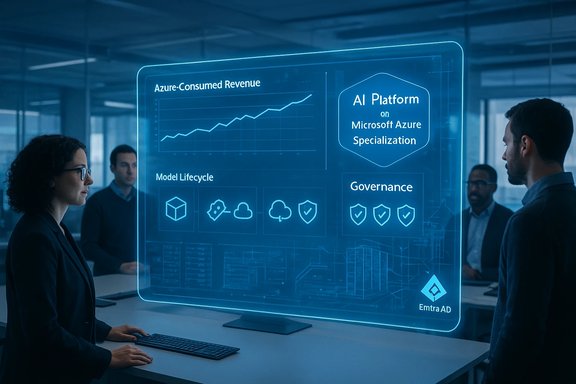
Columbus says it has earned the AI Platform on Microsoft Azure Specialization — a partner credential Microsoft reserves for organizations that can demonstrate repeatable, production-grade delivery of AI solutions on Azure — and that the award was achieved with “outstanding results,” according to the company’s press distribution. This recognition, if validated, places Columbus among a narrower set of partners that Microsoft treats as capable of moving enterprises from experimental AI proofs‑of‑concept to governed, auditable production deployments.
Microsoft’s partner ecosystem now layers its partner signals into tiered designations and workload specializations that are intended to give buyers an auditable procurement signal. At the top of that stack are specializations — focused, audit‑grade validations that require partners to meet measurable thresholds in three broad areas: performance (measured as Azure Consumed Revenue for eligible workloads), skilling (a bench of certified practitioners), and customer evidence or a third‑party audit demonstrating repeatable processes and outcomes. These gates are explicit in Microsoft’s public program documentation and industry analyses of partner specializations.
What a Microsoft specialization certifies is narrower and deeper than a generic Solutions Partner designation. Specializations aim to prove operational models — that the partner is not only skilled but has production consumption on specified Azure services, documented playbooks, and demonstrable customer outcomes. For enterprise procurement teams, this makes such badges useful starting points for shortlists — but not a substitute for procurement due diligence.
This kind of announcement typically includes executive commentary and customer success highlights; those elements are intended to show the business outcomes produced and to provide context for Microsoft’s selection criteria. That said, partner press releases vary in how much operational detail they disclose — and the specialized evidence Microsoft uses for the decision is often not fully reproduced in a public PR. For procurement purposes, the specialization itself is the starting signal rather than the complete dossier of proof.
The net effect for Windows‑centric enterprises is positive: more partners are being evaluated against measurable outcomes rather than pure marketing. That gives IT leaders a clearer shortlist when they need partners who can run AI workloads on Azure with governance and scale. But the specialization remains a procurement starting point, not the final judgement.
At the same time, the specialization is a time‑bound snapshot and a necessary but not sufficient condition for project success. Buyers should convert Columbus’ press claims into procurement artifacts (specialization letter, Partner Center exports, audit summaries and named references), insist on FinOps and portability controls, and use a realistic pilot to validate the partner’s runbooks before scaling deployments. These steps ensure that the promise of “outstanding results” in a press release translates to predictable, governed outcomes for production AI on Azure.
Source: Via Ritzau Columbus Earns AI Platform on Microsoft Azure Specialization with Outstanding Results | Columbus Global
Source: Via Ritzau Columbus Earns AI Platform on Microsoft Azure Specialization with Outstanding Results | Columbus Global
 Background
Microsoft’s partner ecosystem now layers its partner signals into tiered designations and workload specializations that are intended to give buyers an auditable procurement signal. At the top of that stack are specializations — focused, audit‑grade validations that require partners to meet measurable thresholds in three broad areas: performance (measured as Azure Consumed Revenue for eligible workloads), skilling (a bench of certified practitioners), and customer evidence or a third‑party audit demonstrating repeatable processes and outcomes. These gates are explicit in Microsoft’s public program documentation and industry analyses of partner specializations.What a Microsoft specialization certifies is narrower and deeper than a generic Solutions Partner designation. Specializations aim to prove operational models — that the partner is not only skilled but has production consumption on specified Azure services, documented playbooks, and demonstrable customer outcomes. For enterprise procurement teams, this makes such badges useful starting points for shortlists — but not a substitute for procurement due diligence.
What the Columbus announcement claims
According to the press materials distributed, Columbus achieved the AI Platform on Microsoft Azure Specialization and reported outstanding results in the associated evaluation. The release frames the award as validation of Columbus’ engineering capabilities, governance practices and customer deliveries on Azure AI services. The company positions the specialization as evidence that it can design, deploy and operate AI workloads — from model lifecycle processes to secure tenant configurations — that enterprises increasingly rely on.This kind of announcement typically includes executive commentary and customer success highlights; those elements are intended to show the business outcomes produced and to provide context for Microsoft’s selection criteria. That said, partner press releases vary in how much operational detail they disclose — and the specialized evidence Microsoft uses for the decision is often not fully reproduced in a public PR. For procurement purposes, the specialization itself is the starting signal rather than the complete dossier of proof.
Why Microsoft specializations matter — a technical overview
The three program gates: performance, skilling, audit
- Performance (Azure Consumed Revenue — ACR): Microsoft measures recent customer consumption tied to eligible workloads to ensure partners operate real, production traffic. Historically, specializations tied to analytics or AI workloads require measurable ACR across at least three customers in the trailing months, with published thresholds that have varied by specialization and over time.
- Skilling: Partners must show a bench of certified practitioners. For many specializations Microsoft requires multiple individuals with defined certifications (for example, Fabric Data Engineer, Azure Data Engineer, or specialized AI certifications), and often expects redundancy (each certification held by at least two people). This ensures depth beyond single experts.
- Third‑party audit or validated customer evidence: Many specializations demand an independent audit or validated references that confirm repeatable delivery processes, governance controls, and runbooks. The audit verifies the partner’s operational practices at the time of review.
What “AI Platform on Microsoft Azure” typically certifies
Earning the AI Platform specialization implies the partner can handle important elements of an enterprise AI lifecycle:- Design and operate model lifecycle tooling (registry, versioning, experiments) and observability.
- Build secure, tenant‑level AI deployments that integrate identity (Entra/Azure AD), network controls, and DLP.
- Implement retrieval‑augmented generation (RAG), vector indexing, and secure connectors to enterprise data sources.
- Provide governance, safety tooling, auditing and incident logging for model and agentic deployments.
- Demonstrate real customer outcomes and measurable consumption on eligible Azure AI services.
Critical analysis — strengths in Columbus’ claim
- Market signal for enterprise procurement. A formal Microsoft specialization reduces the effort for shortlists because Microsoft itself vets candidates against measurable gates. If Columbus’ press release is consistent with an actual Microsoft award, it increases Columbus’ discoverability inside Partner Center and can accelerate co‑sell engagement. This is one reason many vendors pursue these badges.
- Proof of institutional capabilities rather than lone‑hero engineering. The skilling and audit requirements mean the recognition — when real — indicates a bench of certified staff and documented processes, which are exactly the kinds of evidence enterprise teams ask for before entrusting high‑risk workloads. That is valuable for CIOs who prioritize operational resiliency and governance.
- Closer alignment with Microsoft’s production tooling. Partners who earn Azure AI specializations are usually required to demonstrate platform‑native engineering patterns (model catalogs, observability, identity integration). This alignment reduces integration friction for customers that already standardize on Azure AI Foundry, Copilot Studio, Microsoft Fabric and related services.
Risks, caveats and the verification gap
While Microsoft specializations carry meaningful program gates, there are important caveats that buyers and readers should understand.- Badges are time‑bound snapshots. A specialization certifies the partner’s capabilities as of the audit date and the trailing consumption window. It does not guarantee continual performance, future staffing, or unchanged deliverables. Operational maturity can change after the audit window.
- Variation in public detail. Press releases commonly highlight awards but omit the detailed artifacts Microsoft reviewed (Partner Center exports, ACR breakdowns, audit summaries). Those artifacts are the operative proof enterprises must examine during procurement. Public PRs should therefore be treated as signals to follow up, not final proof.
- Vendor lock‑in and architecture risk. A partner’s deep engineering on Azure (and their use of proprietary accelerators or IP) can accelerate delivery — but it can also increase switching friction. Buyers must ensure exit portability, data export formats, and contractual commitments for agent and model artifacts. Portability clauses and data egress controls must be negotiated up front.
- Cost unpredictability. AI production workloads have variable consumption patterns; partners often show production ACR in audits, but those numbers can scale dramatically with multimodal workloads and agentic systems. FinOps controls, quota limits and predictable pricing models must be part of any contract.
- Hallucination, bias and governance exposure. Even with robust platform tooling, generative models can hallucinate or surface biased outputs. A specialization reduces operational risk by focusing on governance and observability, but it does not eliminate the need for human verification, robust testing and domain‑specific guardrails.
Due diligence checklist — what buyers should request from Columbus (or any partner claiming a Microsoft AI specialization)
- Request the official Microsoft specialization letter or Partner Center screenshot showing the active specialization and the award date. This is the primary ground truth.
- Ask for a redacted Partner Center ACR export or anonymized evidence showing eligible Azure consumption for the trailing months; verify that the consumption is attributed to the eligible AI workloads relevant to your engagement.
- Obtain a roster of certified practitioners (names and certification IDs) and verify those credentials against the Microsoft certification portal. Ensure certifications map to the roles you need.
- Request a copy or redacted summary of the third‑party audit report — or at minimum 2–3 named customer references for deployments of similar scope and compliance needs. Validate those references directly.
- Insist on FinOps controls: quotas, consumption alerts, token‑budget governance and a cost‑management plan for model hosting and runtime. Model hosting costs and GPU usage can escalate quickly.
- Demand artifacts for portability: exportable prompts, agent definitions, vector indexes and model checkpoints (where contractual IP allows), plus a documented exit plan that preserves your data and operational continuity.
- Verify security posture: SOC 2 / ISO 27001 evidence, tenant configuration reviews, identity and key management practices, and an incident response playbook that includes model‑specific incidents (e.g., data leakage or hallucination cases).
Practical recommendations for Windows‑focused IT teams
- Treat the specialization as a shortlisting filter but convert it into procurement artifacts: Partner Center proofs, audit summaries, and named references should be prerequisites before awarding significant contracts. Public PRs alone are insufficient for high‑risk workloads.
- Run a realistic pilot that mirrors expected scale and modality mix. Estimate token/GPU consumption, simulate vector query volumes, and validate latency requirements under load. Use the pilot to validate the partner’s runbooks and rollback procedures.
- Require an AI governance plan as part of the contract: retraining cadence, drift monitoring, human‑in‑the‑loop thresholds, explainability metrics and a documented remediation process for hallucinations or biased outcomes. A specialization should indicate the partner has governance tooling, but you must operationalize it for your use case.
- Embed clear SLAs tied to operational KPIs: model availability, query latency, false positive/negative rates for classification tasks and defined acceptance criteria during cutover. Avoid vague “enterprise‑grade” claims without measurable targets.
Where this fits in the broader Azure partner landscape
Microsoft’s specialization program has accelerated partners’ moves to formalize production practices and to invest in platform‑native engineering (Azure AI Foundry, Copilot Studio, Microsoft Fabric). The program has also made partner recognition more audit‑focused: multiple vendors in 2024–2025 publicly announced specializations and advanced credentials as a way to communicate operational readiness to customers. Those announcements are a useful market signal, but the market also expects a pragmatic verification path from announcement to procurement.The net effect for Windows‑centric enterprises is positive: more partners are being evaluated against measurable outcomes rather than pure marketing. That gives IT leaders a clearer shortlist when they need partners who can run AI workloads on Azure with governance and scale. But the specialization remains a procurement starting point, not the final judgement.
Conclusion
Columbus’ announcement that it has earned the AI Platform on Microsoft Azure Specialization is a meaningful market signal and, if validated with the expected audit artifacts and Partner Center evidence, a real credential for enterprise customers that need Azure‑native AI delivery. The specialization’s gates — performance, skilling and audit — are deliberately strict, and they move partner claims closer to verifiable operational capability. That makes the credential valuable for shortlisting partners, reducing procurement friction and aligning engineering expectations.At the same time, the specialization is a time‑bound snapshot and a necessary but not sufficient condition for project success. Buyers should convert Columbus’ press claims into procurement artifacts (specialization letter, Partner Center exports, audit summaries and named references), insist on FinOps and portability controls, and use a realistic pilot to validate the partner’s runbooks before scaling deployments. These steps ensure that the promise of “outstanding results” in a press release translates to predictable, governed outcomes for production AI on Azure.
Source: Via Ritzau Columbus Earns AI Platform on Microsoft Azure Specialization with Outstanding Results | Columbus Global
Source: Via Ritzau Columbus Earns AI Platform on Microsoft Azure Specialization with Outstanding Results | Columbus Global
