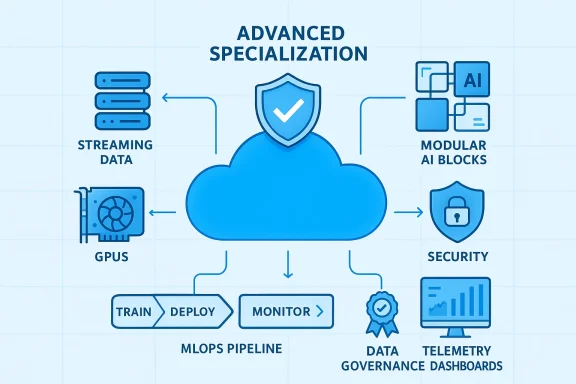
Origin Digital’s announcement that it has earned Microsoft’s Advanced Specialization for AI Platform on Microsoft Azure marks a clear signal: the company has passed Microsoft’s audit gates and is positioning itself as a validated partner for production‑grade AI work on Azure, promising customers a mix of technical rigor, governance practices, and faster time‑to‑value for AI initiatives.
Microsoft’s partner ecosystem has matured beyond simple certification badges into a layered system of Solutions Partner designations and workload‑specific specializations designed to give enterprise buyers verifiable procurement signals. The AI Platform on Microsoft Azure advanced specialization (formerly known as “AI and Machine Learning on Microsoft Azure”) is an audited recognition intended for partners who demonstrate repeatable, production‑grade delivery across Azure AI services, Azure OpenAI, GPU‑backed compute, and responsible AI practices. Microsoft’s documentation details the program’s pillars—Solutions Partner alignment, Performance (Azure Consumed Revenue), Skilling (certified practitioners), and a third‑party audit—and the specialization requires partners to meet explicit thresholds in each area. Origin Digital’s press release and company post say the firm completed a Microsoft‑required audit showing real‑world implementations, architecture best practices, DevOps integration, security and compliance controls, and measurable customer impact—then used that audit to secure the Advanced Specialization. The announcement highlights expected buyer benefits such as validated expertise, priority access to Microsoft co‑innovation programs, accelerated time‑to‑value, and AI solutions built for scalability and governance.
The broader channel movement toward advanced AI specializations underscores a new maturity phase: partners must prove not only technical skill but operational rigor, cost discipline, and responsible AI controls. Vendors like Origin Digital that clear these gates may shorten the path from pilot to production—but buyers retain the responsibility to map audited evidence to their precise risk, compliance, and FinOps needs before greenlighting large‑scale deployments.
Source: Weekly Voice Origin Digital Achieves Microsoft Advanced Specialization for AI Platform on Azure
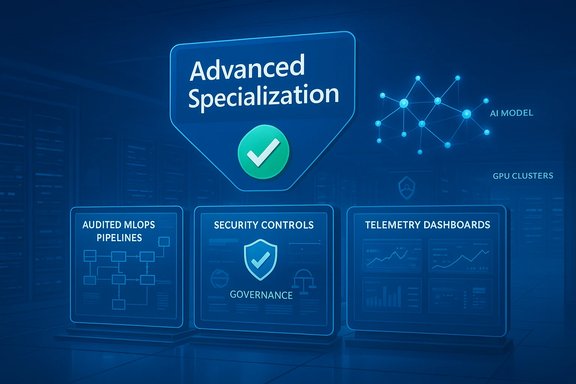 Background / Overview
Microsoft’s partner ecosystem has matured beyond simple certification badges into a layered system of Solutions Partner designations and workload‑specific specializations designed to give enterprise buyers verifiable procurement signals. The AI Platform on Microsoft Azure advanced specialization (formerly known as “AI and Machine Learning on Microsoft Azure”) is an audited recognition intended for partners who demonstrate repeatable, production‑grade delivery across Azure AI services, Azure OpenAI, GPU‑backed compute, and responsible AI practices. Microsoft’s documentation details the program’s pillars—Solutions Partner alignment, Performance (Azure Consumed Revenue), Skilling (certified practitioners), and a third‑party audit—and the specialization requires partners to meet explicit thresholds in each area. Origin Digital’s press release and company post say the firm completed a Microsoft‑required audit showing real‑world implementations, architecture best practices, DevOps integration, security and compliance controls, and measurable customer impact—then used that audit to secure the Advanced Specialization. The announcement highlights expected buyer benefits such as validated expertise, priority access to Microsoft co‑innovation programs, accelerated time‑to‑value, and AI solutions built for scalability and governance. What the Advanced Specialization actually validates
The technical and program gates
Microsoft’s public guidance identifies the following core gates for the AI Platform on Azure specialization:- Solutions Partner designation alignment: the partner must hold either the Data & AI (Azure) or Digital & App Innovation (Azure) Solutions Partner designation.
- Performance: partners must demonstrate recent Azure Consumed Revenue (ACR) from eligible Azure AI strategic pillars (examples include Azure OpenAI, Azure Machine Learning and GPU consumption). Current documentation lists a trailing three‑month ACR threshold and requires revenue from at least three unique customers. The most recent Microsoft pages identify a $15,000 ACR threshold across eligible pillars measured in the last three months, with at least three customers contributing.
- Skilling: a minimum number of certified practitioners is required; Microsoft lists certifications such as Microsoft Certified: Azure Data Scientist Associate and Microsoft Certified: Azure AI Engineer Associate among those mapped to this specialization, with specific counts and distribution requirements defined in Partner Center.
- Audit: a third‑party audit (or equivalent validated customer references in certain cases) that inspects delivery practices across architecture, MLOps/DevOps, security controls, compliance, and measurable outcomes. Microsoft publishes an audit checklist partners must pass.
Why Microsoft requires these elements
The shift to audited specializations reflects two realities: first, enterprise AI projects are operationally complex—requirement scope spans inference costs, data governance, traceability, model lifecycle management, and observability. Second, Microsoft’s commercial channels favor partners that drive measurable Azure consumption and demonstrate adoption across multiple customers, which justifies program investment and co‑sell eligibility. In practice, a specialization should shorten vendor selection cycles for buyers, but it does not replace due diligence.What Origin Digital announced and how it fits the program
Origin Digital states it completed the required audit, demonstrated architecture and DevOps best practices, satisfied security and compliance frameworks, and showed customer impact that met Microsoft’s verification criteria. The company emphasizes that this specialization strengthens its partnership with Microsoft and gives enterprise and mid‑market clients confidence in operationalizing AI on Azure with production‑grade processes. Executive quotes in the release underline the business narrative: validated methods, secured SDLC/DevOps integration, and responsible AI commitments. Independent verification: the announcement is published both as a PR Newswire distribution and on Origin Digital’s own insights page—two separate entries that corroborate the claim of earning the Advanced Specialization and describe the same benefits and executive statements. That dual presence is typical of partner press distributions and lends credibility to the claim, though procurement teams should still request Partner Center artifacts when evaluating vendor credentials.Why this matters to enterprise IT buyers and Windows communities
- Procurement signal: the Advanced Specialization functions as an auditable badge that reduces initial vendor screening friction. For technical procurement, it provides a checklist item you can verify via Partner Center exports, the specialization letter, and audit evidence.
- Operational readiness: partners who pass the audit must show real MLOps/DevOps practices, CI/CD for models, telemetry and observability, and tenant‑level security controls—capabilities that materially reduce the operational risk of moving AI workloads from pilot to production.
- Commercial and delivery leverage: specialization often unlocks prioritized co‑sell paths, funding opportunities, and Microsoft technical resources that can accelerate project timelines and provide access to product engineering or internal enablement. Origin’s release explicitly cites these as customer upsides.
- Ecosystem signaling: as many partners chase Microsoft AI credentials, a specialization differentiates firms that have demonstrable production spend and multiple customer deployments from those with only proof‑of‑concept experience. Recent industry announcements from other firms confirm this trend across the partner channel.
Technical validation: verifying the claims and numbers
To ensure accuracy, the following claims and thresholds were verified against Microsoft’s public partner documentation and the specialization page:- The specialization requires alignment to an eligible Solutions Partner designation (Data & AI or Digital & App Innovation). Verified on Microsoft’s specialization page.
- Performance/Azure Consumed Revenue thresholds and multi‑customer requirement are specified on Microsoft Partner Center pages and the specialization details; current public guidance lists a trailing three‑month ACR requirement sourced from eligible strategic pillars. Microsoft’s published figures and the Partner Center guidance should be treated as authoritative for procurement verification.
- Skilling requirements (certified practitioners such as Azure Data Scientist Associate and Azure AI Engineer Associate) and audit requirements are clearly enumerated in the Partner Center and audit checklist materials.
Strengths demonstrated by Origin Digital’s credential
- Third‑party audited delivery: completing the audit separates a partner that can document and prove production delivery from vendors reliant on unverified marketing claims. That audit, when supported by redacted evidence or named references, is a strong procurement indicator.
- Cross‑discipline capability: the specialization requires evidence across architecture, DevOps/MLOps, security and governance—areas enterprise teams often struggle to assemble internally. Origin’s statement that it demonstrated architecture best practices and integration points suggests a cross‑functional delivery model.
- Focus on responsible AI: Microsoft’s advanced specialization criteria include governance and responsible AI practices. Origin’s messaging emphasizes this, which is a meaningful differentiator for regulated industries or enterprises concerned about explainability, bias mitigation, and audit trails.
- Faster path to co‑innovation: partners with advanced specializations are often prioritized for Microsoft programs, enabling joint funding or engineering collaboration that can shorten pilot lifecycles into production runs. Origin cites these benefits directly.
Risks and limitations buyers should weigh
While the specialization is a useful procurement signal, several risks and practical limits remain:- Badge ≠ guaranteed fit: a specialization proves capability at a program level, not that a partner matches the exact technology stack, compliance posture, or industry context of a specific buyer. Customers should map the partner’s audited case studies to their own problem set and request named, contactable references.
- Vendor concentration and lock‑in: leaning on a partner steeped in Azure AI tooling may accelerate outcomes, but it also deepens dependence on Azure primitives (Azure OpenAI, Azure AI Foundry, Cosmos DB, AKS). Buyers must weigh architectural portability and data sovereignty tradeoffs. Microsoft’s product stack is increasingly comprehensive, which has both benefits (integration) and downsides (migration cost).
- Cost and FinOps exposure: Azure OpenAI, GPU instances, and heavy inference loads can generate significant recurring consumption. The ACR threshold in the specialization is evidence that partners drive billable consumption—buyers should insist on workload cost models, session/inference forecasts, and FinOps guardrails before production go‑live.
- Audit scope and redaction limits: the specialization audit validates processes and selected project evidence, but public press statements do not include the full audit artifacts. Procurement should require Partner Center artifacts and—when necessary—redacted audit summaries or runbook excerpts.
- Program dynamics: Microsoft has adjusted specialization criteria over time (renames, ACR thresholds, alternative Module B paths via Azure Innovate engagements). That fluidity can change what the specialization certifies; date‑stamped Partner Center exports are the reliable artifacts.
Practical checklist for IT and procurement teams evaluating Origin or any Advanced Specialization partner
- Request the partner’s Partner Center export and the specialization certification letter to confirm active status and the “Valid till” date.
- Ask for an audit summary or redacted Module A/B evidence showing the specific controls verified (MLOps, CI/CD, tenant isolation, telemetry, incident playbooks).
- Obtain named references for at least three customers with deployments of comparable scale and scope; validate outcomes (adoption metrics, time‑to‑value, incident history).
- Require a cost forecast and FinOps plan for expected inference, storage, and GPU consumption; include acceptance criteria tied to cost thresholds.
- Map the partner’s technology stack (Azure OpenAI usage, Azure AI Foundry, Cosmos DB, AKS, etc. against your portability, data residency, and compliance needs.
- Confirm security and governance artifacts—runbooks, data flows, Purview classification mapping, identity models (Entra), and telemetry/observability for agents and copilots.
Market context: partner credentialing as competitive signal
Origin Digital’s announcement is one among many in a pattern: over the past 18 months, numerous consultancies and systems integrators have published wins for Azure AI specializations and advanced specializations (for example, Cloud4C, Wavicle, DataArt, TEKsystems Global Services and others have advertised similar achievements), illustrating how partners are racing to prove AI capability and to earn program benefits that amplify their go‑to‑market reach. This is evidence of channel dynamics where program recognition is increasingly a baseline requirement for enterprise AI procurements. That market dynamic has both healthy and cautionary implications: healthy because customers have more qualified vendors to choose from; cautionary because the volume of credentialed partners means procurement must move beyond badges and validate named operational evidence, references, and cost/FinOps discipline.What this means for Origin Digital’s customers and prospects
For organizations considering Origin Digital:- Expect a partner that can present documented processes for building, deploying, and operating Azure‑native AI systems, with third‑party audit evidence behind those claims. That lowers the initial risk of proof‑of‑concepts and can accelerate enterprise adoption.
- Anticipate better access to Microsoft technical resources and possible co‑sell or funding pathways that can materially reduce time and cost for pilots becoming production systems. Origin’s release makes this benefit explicit as part of the specialization value proposition.
- Require concrete evidence in procurement: Partner Center exports, audit summaries, references, runbooks, and cost models. A specialization shortens the checklist, but it does not obviate verification.
Technical focus areas buyers should test in an RFP or pilot
- Model lifecycle and MLOps: how does the partner manage versioning, rollback, retraining, and data drift? Look for pipeline examples (Azure ML pipelines, GitHub Actions, policy enforcement).
- Observability and audit trails: can the partner demonstrate tracing for agent actions, model prompt lineage, and usage logs that satisfy compliance teams? Azure AI Foundry and Copilot telemetry features are relevant here.
- Data grounding and retrieval: what approach is used for retrieval‑augmented generation (RAG)? Are Dataverse/OneLake/Microsoft Fabric patterns used to ensure provenance and data classification?
- Tenant security and least‑privilege: confirm Entra identity mappings, MIP/Purview integration, DLP enforcement, and credential/secret handling for agents and copilots.
- Cost management: require session cost modeling for Azure OpenAI and GPU inference, with threshold alerts and FinOps reporting.
Conclusion
Origin Digital’s achievement of the Microsoft Advanced Specialization for AI Platform on Microsoft Azure is notable—particularly because the specialization is audit‑based and tied to concrete commercial and skilling gates. For customers, it is a useful procurement signal that indicates the partner has demonstrable Azure AI consumption, certified practitioners, and audited delivery practices. That said, the specialization is a starting point for procurement diligence, not an endpoint. Enterprises should request Partner Center artifacts, audit summaries, and named references, and insist on cost forecasting and governance runbooks before awarding production AI programs.The broader channel movement toward advanced AI specializations underscores a new maturity phase: partners must prove not only technical skill but operational rigor, cost discipline, and responsible AI controls. Vendors like Origin Digital that clear these gates may shorten the path from pilot to production—but buyers retain the responsibility to map audited evidence to their precise risk, compliance, and FinOps needs before greenlighting large‑scale deployments.
Source: Weekly Voice Origin Digital Achieves Microsoft Advanced Specialization for AI Platform on Azure