

Bill Gates’ wry on-stage line—“That must be why we’re not shipping Windows 98 yet”—has become one of technology’s most enduring demo gaffes, but the fallout was more than an awkward clip: the Blue Screen of Death (BSOD) that occurred during the COMDEX Windows 98 demo changed how Microsoft staged public shows and even altered the architecture of a production facility on the Redmond campus. What began as a single public failure of plug‑and‑play USB support turned into a company-wide lesson in presentation engineering, rehearsal discipline, and defensive testing that rippled through Microsoft’s broadcast workflows and device‑testing practices for years to come. This feature traces the COMDEX incident, explains exactly what failed, examines the internal changes Microsoft made (including a dedicated staging room in Microsoft Production Studios), and draws practical lessons for product teams and presenters who still rely on live demos today.
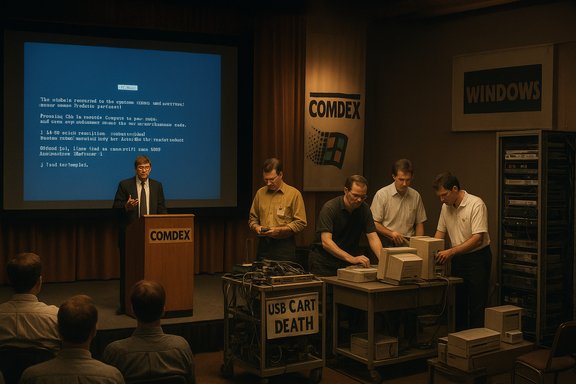
The moment took place during a large trade‑show demo of Windows 98 at COMDEX in April 1998, when Microsoft set out to showcase improved Plug-and-Play USB device support. As the demo team attempted to attach a scanner to demonstrate automatic device recognition and driver installation, the system crashed to a kernel fault—the now-iconic Blue Screen of Death—live in front of thousands. Bill Gates handled the embarrassment with humor, but the event left engineers and presentation staff determined to avoid a repeat. The public record of the incident is well established through contemporaneous reporting, later interviews with those involved, and first‑hand recollections from long‑time Microsoft engineers. Behind the laugh track, however, there was a technical story: a previously unencountered behavior of an off‑the‑shelf scanner interacting with an in‑development USB stack caused the system to fault. Veteran Microsoft engineer Raymond Chen—author of the Old New Thing blog and a decades‑long veteran of Windows engineering—later explained how that demo outcome led the company to alter the design of its new on‑campus media facility to include a staging room where all demo equipment would be fully set up and validated before a live broadcast.
Raymond Chen’s own account of how Microsoft changed the production‑studio design after the Windows 98 incident is explicit about the staging room addition and the rationale behind it. Contemporary reporting and later interviews with participants corroborate the circumstances of the crash and the public reaction. Internal engineering practices—like the USB stress cart and rigorous pre‑show checklists—further illustrate how Microsoft turned a teachable moment into operational change.
Every demo team today would do well to treat that April afternoon at COMDEX not as an old joke but as a blueprint: rehearsal and defensive engineering are the unsung heroes of every successful live presentation.
Source: PC Gamer Microsoft was apparently so embarrassed by Windows 98's infamous on-stage Blue Screen of Death it built a new testing room on campus to ensure it would never happen again
 Background / Overview
The moment took place during a large trade‑show demo of Windows 98 at COMDEX in April 1998, when Microsoft set out to showcase improved Plug-and-Play USB device support. As the demo team attempted to attach a scanner to demonstrate automatic device recognition and driver installation, the system crashed to a kernel fault—the now-iconic Blue Screen of Death—live in front of thousands. Bill Gates handled the embarrassment with humor, but the event left engineers and presentation staff determined to avoid a repeat. The public record of the incident is well established through contemporaneous reporting, later interviews with those involved, and first‑hand recollections from long‑time Microsoft engineers. Behind the laugh track, however, there was a technical story: a previously unencountered behavior of an off‑the‑shelf scanner interacting with an in‑development USB stack caused the system to fault. Veteran Microsoft engineer Raymond Chen—author of the Old New Thing blog and a decades‑long veteran of Windows engineering—later explained how that demo outcome led the company to alter the design of its new on‑campus media facility to include a staging room where all demo equipment would be fully set up and validated before a live broadcast. What happened on stage: the COMDEX 1998 BSOD
The demo, the device, and the crash
Microsoft intended to highlight Windows 98’s improved hardware plug‑and‑play experience by connecting a USB scanner live on stage. The demo assistant plugged the scanner into a demonstration PC; the system attempted to enumerate and install the device and then crashed with a BSOD. The audience reaction—laughter, applause, and nervous energy—cemented the moment as demo lore. Bill Gates’ quip after a brief pause helped defuse the situation on camera, but the internal reaction was far more serious: Microsoft’s dev teams were immediately tasked with determining root cause and preventing recurrence.The technical root cause (short version)
The crash did not occur because Windows’ USB subsystem was inherently broken across the board; instead, the specific scanner used in the live demo behaved in an unexpected way. According to Raymond Chen’s later account, the demo team did not use the development team’s validated scanner unit—they bought an off‑the‑shelf scanner locally. That particular unit attempted to draw more current from the USB port than the (then‑new) USB driver stack and hardware configuration expected, producing an error condition the development code hadn’t yet handled—leading to the kernel fault. In short: a non‑validated peripheral, interacting with an immature driver stack, produced a failure mode that had not been exercised in lab tests.Why this wasn’t merely “bad luck”
A live‑demo failure of this kind is often boiled down in popular retellings to a single unlucky device choice, but several operational weak points converged:- The demo relied on a plug‑and‑play scenario that depends on many moving parts (hardware behavior, driver fallback code, installer sequencing).
- The team executing the demo purchased hardware from retail that had not been exhaustively validated against the pre‑release OS build.
- Presentation workflows lacked a final, integrated staging practice that would have replicated the full on‑stage sequence under controlled conditions.
Inside Microsoft’s response: staging rooms, production studios, and the USB “cart of death”
Microsoft Production Studios: design changes after COMDEX
As Raymond Chen later recounted, Microsoft was in the process of designing its in‑house film and broadcast facility—Microsoft Production Studios—at the time the COMDEX incident occurred. The design was modified to include a dedicated staging room adjacent to the broadcast studio, with the explicit purpose of pre‑assembling and validating any equipment that would be used in live broadcasts and keynotes. That room’s role: set up demo PCs and peripherals, exercise the exact on‑stage sequence, and hand validated hardware to presenters only after the run completed successfully. The policy objective was simple but powerful: never put unvalidated, last‑minute hardware live on stage.The USB Cart of Death and robust device testing
That COMDEX crash also presaged a broader testing mindset the Windows team used to harden USB support. Engineers built what insiders affectionately called a “USB cart of death”—a mobile rig packed with dozens of USB devices, hubs, and daisy‑chains used to stress the USB stack. The cart could be plugged into a test machine to recreate mass‑connect and disconnect scenarios, force edge cases, and trigger surprising interactions. The objective was brutal but effective: expose the OS to chaotic device conditions and fix the bugs that surfaced. Public descriptions and later interviews with Microsoft engineers recount that the cart was sometimes used to “terrorize” test machines to provoke failures and find subtle bugs. The cart and the staged testing approach together significantly improved Windows’ USB robustness over time.A culture shift: presentation engineering meets QA
Microsoft’s reaction to the COMDEX gaffe reflected a broader cultural alignment between product QA and presentation teams:- Presentation producers gained access to engineering test benches and validation checklists for every demo.
- Engineering teams instituted known‑good hardware lists for live events and prohibited last‑minute retail purchases for critical on‑stage demos.
- Presentations adopted repeated dry‑runs with the exact devices, sequences, and network conditions expected in the final show.
Reconstructing the failure: device power, driver behavior, and field variability
USB power rules and early‑era fragility
USB was relatively new in the consumer PC space in the late 1990s. Device vendors shipped a broad variety of peripherals with varying implementations of the USB electrical and protocol specifications. Early USB host controllers, hub implementations, and drivers had to handle:- Devices that attempted to draw more current than the spec allowed.
- Hubs and daisy‑chains that changed port counts dynamically.
- Vendor devices with buggy descriptors or unusual enumeration sequences.
The problem of “unknown unknowns” in real‑world hardware
Even the most comprehensive lab test plan cannot exhaustively cover the billions of possible permutations of device firmware, third‑party peripheral quirks, and user behavior. That’s why the combination of a robust staging environment (to replicate the real sequence), stress rigs (like the USB cart), and validated device lists matters: they intentionally convert unknown unknowns into known, fixable failures before a live audience sees them.What Microsoft learned—and what product teams should copy
The Windows 98 COMDEX incident remains a compact case study in demo risk management. Practical takeaways that are still relevant:- Never trust unvalidated hardware on stage. Always use the exact unit that engineering has validated; retail variants may behave differently.
- Create a staging environment that duplicates the live path. That means identical OS build, drivers, cabling, monitors, and network conditions.
- Stress the platform with adversarial rigs. Intentionally create pathological device and network conditions to surface bugs that typical tests miss.
- Use a “known good” sign‑off procedure. Implement a checklist and sign‑off gate: demos proceed only after the staging team certifies the setup.
- Plan for graceful recovery and fallback content. When a demo involves unknown hardware interactions, have recorded video, screenshots, or a failover plan ready to keep the presentation flowing.
Strengths and limits of the response: critical analysis
Notable strengths
- Practical, low‑cost mitigation: Adding a staging room and a simple validation workflow delivers outsized reductions in demo risk without massive engineering overhead.
- Improved cross‑team discipline: Forcing presentation teams to follow engineering validation checklists closed a major gap between product QA and public communications.
- Defensive testing ethos: The USB cart and mass‑device stress tests reflect a robust engineering mindset—find the worst cases and fix them before customers or press find them.
Potential risks and blind spots
- Over‑reliance on validated hardware can mask broader compatibility issues. If teams only test a narrow set of “known good” devices, they may miss how the platform behaves with the long tail of consumer hardware.
- Staging rooms don’t eliminate production surprises. Environmental differences (lighting rigs, AV processors, third‑party switchers, and unexpected vendor firmware updates) can still trigger problems despite the best staging efforts.
- Human error remains. The protocol works only if teams consistently follow it—pressure, tight timelines, or last‑minute demo changes can still lead to risky shortcuts.
A timeline of related artifacts and corroborating evidence
- COMDEX live demo: Bill Gates’ April 1998 Windows 98 demonstration where a scanner caused a BSOD—publicly documented and widely circulated.
- Contemporary interviews: Chris Capossela later discussed the incident, acknowledging the embarrassment and the subsequent engineering scramble.
- Raymond Chen’s retrospective: The Old New Thing blog explains the staging‑room change to Microsoft Production Studios and gives the technical rationale about the off‑the‑shelf scanner.
- Internal testing practices: Public reporting and interviews by Windows engineers describe the “USB cart of death” stress rig and other aggressive device stress tests used to harden USB.
How the fix influenced later demos and the broader industry
Microsoft’s approach after the incident became a de facto best practice for large vendors: validate hardware, create controlled staging spaces, and employ stress testing to exercise new platform features. Live product demos at major conferences—particularly those that involve hardware and live installs—are now routinely staged, rehearsed, and validated. Many vendors adopted similar facilities and workflows in their own studios and broadcast centers as the cost of avoidance outweighed the occasional PR hit. The COMDEX BSOD is therefore more than an amusing clip; it’s a turning point that nudged the industry toward professionalizing demo engineering.Final thoughts: the enduring value of rehearsal and defensive engineering
The Windows 98 COMDEX BSOD is a small lesson with broad implications: public failure is often symptomatic of procedural gaps, not just flaky software. Microsoft’s pragmatic response—adding a staging room to their Production Studios and investing in adversarial device testing—turned a highly visible embarrassment into improved processes that protected the company (and its product reputation) over the long run. For modern product teams building demos that touch real hardware, the lessons remain unchanged: validate, rehearse, stress, and never assume retail hardware will behave exactly like the one you tested. Those four disciplines separate a memorable demo from an infamous one.Raymond Chen’s own account of how Microsoft changed the production‑studio design after the Windows 98 incident is explicit about the staging room addition and the rationale behind it. Contemporary reporting and later interviews with participants corroborate the circumstances of the crash and the public reaction. Internal engineering practices—like the USB stress cart and rigorous pre‑show checklists—further illustrate how Microsoft turned a teachable moment into operational change.
Every demo team today would do well to treat that April afternoon at COMDEX not as an old joke but as a blueprint: rehearsal and defensive engineering are the unsung heroes of every successful live presentation.
Source: PC Gamer Microsoft was apparently so embarrassed by Windows 98's infamous on-stage Blue Screen of Death it built a new testing room on campus to ensure it would never happen again
